Universal Analog Quantum Simulation
Pith reviewed 2026-05-08 11:19 UTC · model grok-4.3
The pith
UAQS uses optimized continuous-time control fields to make fixed-interaction analog quantum simulators programmable.
A machine-rendered reading of the paper's core claim, the machinery that carries it, and where it could break.
Core claim
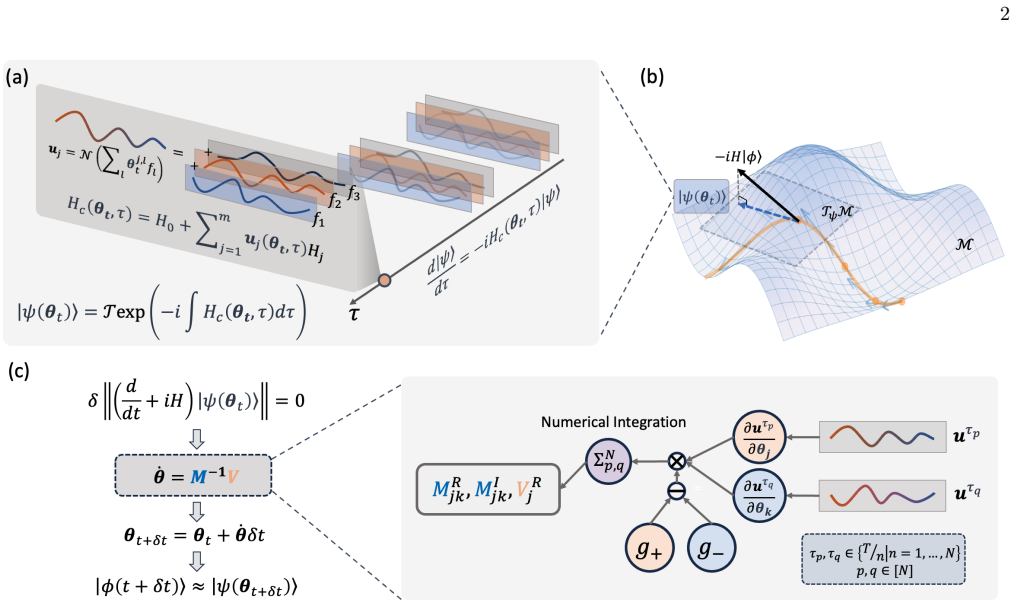
UAQS expands the set of achievable Hamiltonians on a given analog platform by superimposing optimized continuous-time control fields that steer the native evolution toward target dynamics, without requiring gate decompositions or altering the hardware interaction graph.
What carries the argument
UAQS framework, which engineers target quantum dynamics by applying numerically optimized continuous-time control fields on top of the platform's fixed analog interactions.
If this is right
- Non-native Hamiltonians become accessible on existing analog hardware while preserving continuous-time evolution.
- Many-body dynamics beyond the platform's intrinsic interactions can be simulated without full digital gate compilation.
- The same control strategy applies across different analog architectures such as superconducting circuits and Rydberg arrays.
- Programmability is added to analog simulators without sacrificing their native speed for continuous evolution.
Where Pith is reading between the lines
- Control optimization routines developed for UAQS could be integrated into real-time feedback loops on future hardware to adapt to noise.
- The approach might reduce the overhead of simulating certain strongly interacting systems compared with purely digital methods.
- Similar continuous-control ideas could be tested on other analog platforms such as trapped ions or photonic lattices.
Load-bearing premise
Numerically optimized continuous-time control fields can be applied on real hardware to produce the exact target dynamics without prohibitive errors from control inaccuracies, decoherence, or optimization failure.
What would settle it
An experiment on a superconducting circuit or Rydberg array in which the observed many-body evolution under the applied control fields deviates significantly from the numerically predicted target dynamics would falsify the central claim.
Figures




read the original abstract
Analog quantum simulators emulate complex many-body dynamics through native continuous-time evolution under hardware-defined interactions. Yet once a platform is specified, its interaction structure is largely fixed by the underlying hardware, restricting the Hamiltonians that can be realized and limiting programmability. Here we introduce universal analog quantum simulation (UAQS), a hybrid framework that systematically expands the range of accessible quantum evolutions within a given analog platform. UAQS employs optimized continuous-time control fields to engineer target dynamics directly, avoiding decomposition into discrete gate sequences. By preserving native analog evolution while extending the set of achievable Hamiltonians, UAQS transforms fixed-interaction analog devices into programmable simulators. Numerical studies on representative architectures, including superconducting circuits and Rydberg-atom arrays, show that UAQS accurately reproduces non-trivial many-body dynamics beyond the intrinsic interaction structure of the hardware. These results establish UAQS as a practical route toward programmable analog quantum simulation.
Editorial analysis
A structured set of objections, weighed in public.
Referee Report
Summary. The manuscript introduces universal analog quantum simulation (UAQS), a hybrid framework that employs optimized continuous-time control fields to expand the set of achievable Hamiltonians on analog quantum platforms with fixed native interactions (e.g., superconducting circuits and Rydberg arrays). It claims that this preserves the efficiency of native analog evolution while enabling programmable simulation of non-trivial many-body dynamics, as demonstrated by numerical studies showing accurate reproduction of target evolutions beyond the hardware's intrinsic interaction structure.
Significance. If the numerical results hold under realistic conditions, UAQS could meaningfully increase the programmability of existing analog simulators without requiring full digital gate decompositions, potentially offering practical advantages in scalability and fidelity for certain quantum many-body problems. The approach is notable for its focus on continuous-time engineering rather than Trotterization or gate synthesis.
major comments (2)
- [Numerical studies] Numerical studies section: the manuscript asserts that UAQS accurately reproduces non-trivial many-body dynamics on superconducting circuits and Rydberg arrays, yet provides no details on the optimization algorithms employed, the error metrics or fidelity measures used, comparison baselines, or quantitative results (e.g., infidelity values, convergence criteria). This absence leaves the empirical support for the central claim of accurate reproduction unverified and load-bearing for the paper's conclusions.
- [Methods / Numerical Implementation] Control field optimization and hardware assumptions: the numerical optimizations of continuous-time fields appear to assume ideal conditions (perfect control, no decoherence, infinite bandwidth). The central claim that UAQS transforms fixed-interaction devices into programmable simulators relies on these fields realizing target dynamics on real hardware; without robustness analysis against control errors, finite rise times, or environmental coupling, the practical validity of the engineered evolutions remains unestablished.
minor comments (2)
- [Abstract] The abstract would be strengthened by briefly indicating the specific classes of target dynamics (e.g., Ising, Heisenberg) or quantitative fidelity thresholds achieved in the numerics.
- [Introduction] Notation for the control fields and engineered Hamiltonians should be defined more explicitly at first use to aid readability for readers unfamiliar with analog control theory.
Simulated Author's Rebuttal
We thank the referee for the constructive and detailed report. The comments identify key areas where additional information and analysis are needed to support the central claims of the manuscript. We address each point below and commit to substantial revisions.
read point-by-point responses
-
Referee: [Numerical studies] Numerical studies section: the manuscript asserts that UAQS accurately reproduces non-trivial many-body dynamics on superconducting circuits and Rydberg arrays, yet provides no details on the optimization algorithms employed, the error metrics or fidelity measures used, comparison baselines, or quantitative results (e.g., infidelity values, convergence criteria). This absence leaves the empirical support for the central claim of accurate reproduction unverified and load-bearing for the paper's conclusions.
Authors: We agree that the numerical studies section in the submitted manuscript omitted essential implementation details, which weakens the verifiability of the reported results. This was an oversight in balancing brevity with completeness. In the revised manuscript we will expand the section with a dedicated methods subsection specifying the optimization algorithm (gradient-based pulse shaping), the precise fidelity and error metrics employed (state infidelity averaged over an ensemble of initial states together with process fidelity where relevant), quantitative infidelity values and convergence thresholds achieved, and explicit comparison baselines including native Hamiltonian evolution and standard Trotterized decompositions. These additions will allow readers to reproduce and assess the accuracy claims. revision: yes
-
Referee: [Methods / Numerical Implementation] Control field optimization and hardware assumptions: the numerical optimizations of continuous-time fields appear to assume ideal conditions (perfect control, no decoherence, infinite bandwidth). The central claim that UAQS transforms fixed-interaction devices into programmable simulators relies on these fields realizing target dynamics on real hardware; without robustness analysis against control errors, finite rise times, or environmental coupling, the practical validity of the engineered evolutions remains unestablished.
Authors: The referee correctly notes that the presented optimizations were performed under idealized conditions. While such assumptions are standard for establishing the core feasibility of continuous-time control engineering, they limit immediate claims about hardware practicality. We will add a new subsection containing robustness studies that incorporate realistic noise models: amplitude and phase control errors, finite rise times, and decoherence rates drawn from typical parameters of the two platforms. We will report the resulting fidelity degradation and demonstrate that the optimization can be regularized against these imperfections. Full experimental validation lies outside the scope of this theoretical-numerical work, but the added analysis will clarify the conditions under which the engineered fields remain effective. revision: yes
Circularity Check
No circularity: UAQS framework derives from external numerical optimization and hardware models
full rationale
The paper defines UAQS as a hybrid approach using optimized continuous-time fields to extend native analog Hamiltonians, with claims supported by numerical simulations on superconducting circuits and Rydberg arrays. No step reduces by construction to its inputs: the target dynamics are externally specified, the optimization is a standard numerical procedure (not a fitted parameter renamed as prediction), and no load-bearing self-citation or uniqueness theorem is invoked. The derivation chain is self-contained against external benchmarks and does not match any enumerated circularity pattern.
Axiom & Free-Parameter Ledger
free parameters (1)
- control field parameters
axioms (1)
- domain assumption Analog hardware platforms permit application of time-dependent control fields that preserve native interactions sufficiently for engineering purposes.
Reference graph
Works this paper leans on
-
[1]
Estimating transition energy As the transition energies between eigenstates of a quantum many-body system can be determined via dy- namical simulations [40–42], we explore the UAQS to es- timate the transition energy. Specifically, we focus on the following physical quantity, G(ω) = X n,n′ ⟨n|ρ|n′⟩⟨n′| ˆO|n⟩e−τ2(En−En′ −ω)2 (16) Figure 4: Performance of U...
-
[2]
Simulating out-of-time order correlator An out-of-time-order correlator (OTOC) is a diagnos- tic quantity used to quantify information scrambling [43– 45], operator growth, and quantum chaos in many-body quantum systems. Given two local operatorsˆWand ˆV, the OTOC of a pure state|ψ0⟩is defined as, C(t) =⟨ψ 0| ˆW †(t) ˆV † ˆW(t) ˆV|ψ 0⟩(19) whereHis the sy...
-
[3]
Simulating physics with computers
Richard P Feynman. Simulating physics with computers. InFeynman and computation, pages 133–153. cRc Press, 2018
work page 2018
-
[4]
Quantum simulation.Reviews of Modern Physics, 86(1): 153–185, 2014
Iulia M Georgescu, Sahel Ashhab, and Franco Nori. Quantum simulation.Reviews of Modern Physics, 86(1): 153–185, 2014
work page 2014
-
[5]
Quantum compu- tational chemistry.Reviews of Modern Physics, 92(1): 015003, 2020
Sam McArdle, Suguru Endo, Alán Aspuru-Guzik, Si- mon C Benjamin, and Xiao Yuan. Quantum compu- tational chemistry.Reviews of Modern Physics, 92(1): 015003, 2020
work page 2020
-
[6]
Quantum computing for high-energy physics: State of the art and challenges
Alberto Di Meglio, Karl Jansen, Ivano Tavernelli, Con- stantia Alexandrou, Srinivasan Arunachalam, Chris- tian W Bauer, Kerstin Borras, Stefano Carrazza, Ari- anna Crippa, Vincent Croft, et al. Quantum computing for high-energy physics: State of the art and challenges. Prx quantum, 5(3):037001, 2024
work page 2024
-
[7]
Quantum algorithms for quantum dynamics.Nature Computational Science, 3(1): 25–37, 2023
Alexander Miessen, Pauline J Ollitrault, Francesco Tacchino, and Ivano Tavernelli. Quantum algorithms for quantum dynamics.Nature Computational Science, 3(1): 25–37, 2023
work page 2023
-
[8]
Quantum simu- lations with ultracold atoms in optical lattices.Science, 357(6355):995–1001, 2017
Christian Gross and Immanuel Bloch. Quantum simu- lations with ultracold atoms in optical lattices.Science, 357(6355):995–1001, 2017
work page 2017
-
[9]
Understanding analog quantum simulation dynamics in coupled ion-trap qubits
Yang-Le Wu and S Das Sarma. Understanding analog quantum simulation dynamics in coupled ion-trap qubits. Physical Review A, 93(2):022332, 2016
work page 2016
-
[10]
Quantumsimulations with trapped ions.Nature Physics, 8(4):277–284, 2012
RainerBlattandChristianFRoos. Quantumsimulations with trapped ions.Nature Physics, 8(4):277–284, 2012
work page 2012
-
[11]
Many-body physics with individually controlled rydberg atoms.Na- ture Physics, 16(2):132–142, 2020
Antoine Browaeys and Thierry Lahaye. Many-body physics with individually controlled rydberg atoms.Na- ture Physics, 16(2):132–142, 2020
work page 2020
-
[12]
Photonic quan- tum simulators.Nature physics, 8(4):285–291, 2012
Alán Aspuru-Guzik and Philip Walther. Photonic quan- tum simulators.Nature physics, 8(4):285–291, 2012
work page 2012
-
[13]
Practical quantum advantage in quantum simulation.Nature, 607(7920):667–676, 2022
Andrew J Daley, Immanuel Bloch, Christian Kokail, Stu- art Flannigan, Natalie Pearson, Matthias Troyer, and Peter Zoller. Practical quantum advantage in quantum simulation.Nature, 607(7920):667–676, 2022
work page 2022
-
[14]
Christopher Monroe, Wes C Campbell, L-M Duan, Z-X Gong, Alexey V Gorshkov, Paul W Hess, Rajibul Islam, Kihwan Kim, Norbert M Linke, Guido Pagano, et al. Programmable quantum simulations of spin systems with trapped ions.Reviews of Modern Physics, 93(2):025001, 2021
work page 2021
-
[15]
On- chip quantum simulation with superconducting circuits
Andrew A Houck, Hakan E Türeci, and Jens Koch. On- chip quantum simulation with superconducting circuits. Nature Physics, 8(4):292–299, 2012
work page 2012
-
[16]
Quantum simulators: Architectures and opportunities.PRX quantum, 2(1):017003, 2021
Ehud Altman, Kenneth R Brown, Giuseppe Carleo, Lin- coln D Carr, Eugene Demler, Cheng Chin, Brian De- Marco, Sophia E Economou, Mark A Eriksson, Kai- Mei C Fu, et al. Quantum simulators: Architectures and opportunities.PRX quantum, 2(1):017003, 2021
work page 2021
-
[17]
Universal quantum simulators.Science, 273 (5278):1073–1078, 1996
Seth Lloyd. Universal quantum simulators.Science, 273 (5278):1073–1078, 1996
work page 1996
-
[18]
Universal digital quantum simulation with trapped ions.Science, 334(6052):57–61, 2011
Ben P Lanyon, Cornelius Hempel, Daniel Nigg, Markus Müller, Rene Gerritsma, F Zähringer, Philipp Schindler, Julio T Barreiro, Markus Rambach, Gerhard Kirchmair, et al. Universal digital quantum simulation with trapped ions.Science, 334(6052):57–61, 2011
work page 2011
-
[19]
Hirsh Kamakari, Shi-Ning Sun, Mario Motta, and Austin J Minnich. Digital quantum simulation of open quantum systems using quantum imaginary–time evolu- tion.PRX quantum, 3(1):010320, 2022
work page 2022
-
[20]
Laurin E Fischer. Enabling large-scale digital quantum simulations with superconducting qubits.arXiv preprint arXiv:2602.04719, 2026
-
[21]
André Eckardt. Colloquium: Atomic quantum gases in periodically driven optical lattices.Reviews of Modern 10 Physics, 89(1):011004, 2017
work page 2017
-
[22]
D. V. Babukhin, A. A. Zhukov, and W. V. Pogosov. Hybrid digital-analog simulation of many-body dynam- ics with superconducting qubits.Phys. Rev. A, 101: 052337, May 2020. doi:10.1103/PhysRevA.101.052337. URLhttps://link.aps.org/doi/10.1103/PhysRevA. 101.052337
-
[23]
Tasio Gonzalez-Raya, Rodrigo Asensio-Perea, Ana Mar- tin, Lucas C. Céleri, Mikel Sanz, Pavel Lougov- ski, and Eugene F. Dumitrescu. Digital-analog quantum simulations using the cross-resonance ef- fect.PRX Quantum, 2:020328, May 2021. doi: 10.1103/PRXQuantum.2.020328. URLhttps://link. aps.org/doi/10.1103/PRXQuantum.2.020328
-
[24]
Digital-analog quantum simulation of fermionic models.Physical Review Applied, 19(6):064086, 2023
Lucas C Céleri, Daniel Huerga, Francisco Albarrán- Arriagada, Enrique Solano, Mikel Garcia de Andoin, and Mikel Sanz. Digital-analog quantum simulation of fermionic models.Physical Review Applied, 19(6):064086, 2023
work page 2023
-
[25]
Mikel Garcia-de Andoin, Thorge Müller, and Gonzalo Camacho. Hamiltonian simulation with explicit formulas for digital-analog quantum computing.arXiv preprint arXiv:2511.11404, 2025
-
[26]
Shubham Kumar, Narendra N Hegade, Anne-Maria Vi- suri, Balaganchi A Bhargava, Juan FR Hernandez, En- rique Solano, Francisco Albarrán-Arriagada, and G Al- varado Barrios. Digital-analog quantum computing of fermion-boson models in superconducting circuits.npj Quantum Information, 11(1):43, 2025
work page 2025
-
[27]
BenediktFauseweh. Quantummany-bodysimulationson digital quantum computers: State-of-the-art and future challenges.Nature Communications, 15(1):2123, 2024
work page 2024
-
[28]
Ying Li and Simon C Benjamin. Efficient variational quantum simulator incorporating active error minimiza- tion.Physical Review X, 7(2):021050, 2017
work page 2017
-
[29]
Cristina Cirstoiu, Zoe Holmes, Joseph Iosue, Lukasz Cin- cio, Patrick J Coles, and Andrew Sornborger. Variational fast forwarding for quantum simulation beyond the co- herence time.npj Quantum Information, 6(1):82, 2020
work page 2020
-
[30]
Adaptive variational quantum dynamics simula- tions.PRX Quantum, 2(3):030307, 2021
Yong-Xin Yao, Niladri Gomes, Feng Zhang, Cai-Zhuang Wang, Kai-Ming Ho, Thomas Iadecola, and Peter P Orth. Adaptive variational quantum dynamics simula- tions.PRX Quantum, 2(3):030307, 2021
work page 2021
-
[31]
Subspace variational quantum simulator.Phys- ical Review Research, 5(2):023078, 2023
Kentaro Heya, Ken M Nakanishi, Kosuke Mitarai, Zhiguang Yan, Kun Zuo, Yasunari Suzuki, Takanori Sugiyama, Shuhei Tamate, Yutaka Tabuchi, Keisuke Fu- jii, et al. Subspace variational quantum simulator.Phys- ical Review Research, 5(2):023078, 2023
work page 2023
-
[32]
Superconducting qubits: Current state of play.arXiv preprint arXiv:1905.13641, 2019
Morten Kjaergaard, Mollie E Schwartz, Jochen Braumüller, Philip Krantz, Joel I-Jan Wang, Simon Gus- tavsson, and William D Oliver. Superconducting qubits: Current state of play.arXiv preprint arXiv:1905.13641, 2019
-
[33]
Digital quantum rabi and dicke models in superconducting circuits.Scientific reports, 4(1):1–4, 2014
Antonio Mezzacapo, U Las Heras, JS Pedernales, L Di- Carlo, E Solano, and L Lamata. Digital quantum rabi and dicke models in superconducting circuits.Scientific reports, 4(1):1–4, 2014
work page 2014
-
[34]
L García-Álvarez, J Casanova, A Mezzacapo, IL Egusquiza, L Lamata, G Romero, and E Solano. Fermion-fermion scattering in quantum field theory with superconducting circuits.Physical review letters, 114(7): 070502, 2015
work page 2015
-
[35]
Serwan Asaad, Christian Dickel, Nathan K Langford, Stefano Poletto, Alessandro Bruno, Michiel Adriaan Rol, Duije Deurloo, and Leonardo DiCarlo. Independent, extensible control of same-frequency superconducting qubits by selective broadcasting.npj Quantum Infor- mation, 2(1):1–7, 2016
work page 2016
-
[36]
Coherent coupled qubits for quantum annealing
Steven J Weber, Gabriel O Samach, David Hover, Simon Gustavsson, David K Kim, Alexander Melville, Danna Rosenberg, Adam P Sears, Fei Yan, Jonilyn L Yoder, et al. Coherent coupled qubits for quantum annealing. Physical Review Applied, 8(1):014004, 2017
work page 2017
-
[37]
Jiehang Zhang, Guido Pagano, Paul W Hess, Antonis Kyprianidis, Patrick Becker, Harvey Kaplan, Alexey V Gorshkov, Z-X Gong, and Christopher Monroe. Obser- vation of a many-body dynamical phase transition with a 53-qubit quantum simulator.Nature, 551(7682):601, 2017
work page 2017
-
[38]
Scalable multiparticle entanglement of trapped ions.Nature, 438 (7068):643–646, 2005
Hartmut Häffner, Wolfgang Hänsel, CF Roos, Jan Ben- helm, Michael Chwalla, Timo Körber, UD Rapol, Mark Riebe, PO Schmidt, Christoph Becher, et al. Scalable multiparticle entanglement of trapped ions.Nature, 438 (7068):643–646, 2005
work page 2005
-
[39]
Mark Saffman. Quantum computing with atomic qubits and rydberg interactions: progress and challenges.Jour- nal of Physics B: Atomic, Molecular and Optical Physics, 49(20):202001, 2016
work page 2016
-
[40]
Cambridge University Press, 2013
Eduardo Fradkin.Field theories of condensed matter physics. Cambridge University Press, 2013
work page 2013
-
[41]
Domenico d’Alessandro.Introduction to quantum control and dynamics. Chapman and hall/CRC, 2021
work page 2021
-
[42]
Jinzhao Sun, Lucia Vilchez-Estevez, Vlatko Vedral, An- drew T Boothroyd, and MS Kim. Probing spectral fea- tures of quantum many-body systems with quantum sim- ulators.Nature Communications, 16(1):1403, 2025
work page 2025
-
[43]
Yongdan Yang, Ying Li, Xiaosi Xu, and Xiao Yuan. Resource-efficient quantum-classical hybrid algorithm for energygapevaluation.Physical Review A,109(5):052416, 2024
work page 2024
-
[44]
Low-depth amplitude estimation via statistical eigengap estimation
Po-Wei Huang and Bálint Koczor. Low-depth ampli- tude estimation via statistical eigengap estimation.arXiv preprint arXiv:2603.05475, 2026
work page internal anchor Pith review Pith/arXiv arXiv 2026
-
[45]
Out-of-time-order correlation for many-body localiza- tion.Science bulletin, 62(10):707–711, 2017
Ruihua Fan, Pengfei Zhang, Huitao Shen, and Hui Zhai. Out-of-time-order correlation for many-body localiza- tion.Science bulletin, 62(10):707–711, 2017
work page 2017
-
[46]
Unscrambling the physics of out-of-time- order correlators.Nature Physics, 14(10):988–990, 2018
Brian Swingle. Unscrambling the physics of out-of-time- order correlators.Nature Physics, 14(10):988–990, 2018
work page 2018
-
[47]
Martin Gärttner, Justin G Bohnet, Arghavan Safavi- Naini, Michael L Wall, John J Bollinger, and Ana Maria Rey. Measuring out-of-time-order correlations and multi- ple quantum spectra in a trapped-ion quantum magnet. Nature Physics, 13(8):781–786, 2017
work page 2017
-
[48]
Jiaqi Leng, Yuxiang Peng, Yi-Ling Qiao, Ming Lin, and Xiaodi Wu. Differentiable analog quantum computing for optimization and control.Advances in Neural Informa- tion Processing Systems, 35:4707–4721, 2022
work page 2022
-
[49]
Korbinian Kottmann and Nathan Killoran. Evaluating analytic gradients of pulse programs on quantum com- puters.arXiv preprint arXiv:2309.16756, 2023
-
[50]
Methodology for re- placingindirectmeasurementswithdirectmeasurements
Kosuke Mitarai and Keisuke Fujii. Methodology for re- placingindirectmeasurementswithdirectmeasurements. Physical Review Research, 1(1):013006, 2019
work page 2019
-
[51]
General parameter-shift rules for quantum gra- dients.Quantum, 6:677, 2022
DavidWierichs, JoshIzaac, CodyWang, andCedricYen- Yu Lin. General parameter-shift rules for quantum gra- dients.Quantum, 6:677, 2022
work page 2022
-
[52]
Sukin Sim, Peter D Johnson, and Alán Aspuru-Guzik. Expressibility and entangling capability of parameter- 11 ized quantum circuits for hybrid quantum-classical algo- rithms.Advanced Quantum Technologies, 2(12):1900070, 2019
work page 2019
-
[53]
Global entan- glement in multiparticle systems.arXiv preprint quant- ph/0108104, 2001
David A Meyer and Nolan R Wallach. Global entan- glement in multiparticle systems.arXiv preprint quant- ph/0108104, 2001. 12 Appendix A: Proof of theorems In this section, we provide the theoretical foundations and technical details underlying the main results presented in the text. We first review the variational principle that forms the basis of the pro...
-
[54]
a.Real time evolutionFirst, we introduce how to apply the McLachlan’s variational principle to UAQS
V ariational principle Consider the real time dynamics of a many-body system which follows the HamiltonianH, the time evolution is governed by the Schrödinger equation, d|ϕ⟩ dt =−iH|ϕ⟩,(A1) In the variational framework, instead of directly calculate state|ϕ(t)⟩, we approximate it with parametrized trial state |ψ(θt)⟩which is generated by evolving the|ψ0⟩w...
-
[55]
Estimate M and V In this section, we first provide the related lemmas and theorems to derivative the main theorems for estimating theMandV, and then give the corresponding pseudo-codes. Since the parametersθin tunable pulses are real in general, we then only focus on the methods over the real parameters space. Theorem 1(deravative of time evolution operat...
-
[56]
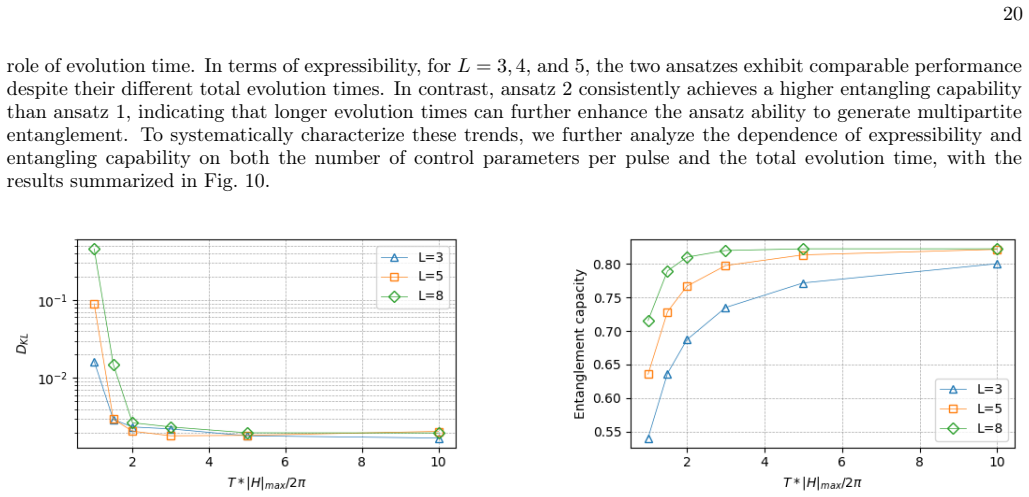
Expressivity In the context of variational quantum algorithm, the expressivity characterizes the capability of an ansatz to represent a broad class of quantum states or transformations. Specifically, it quantifies how extensively the circuit can explore the Hilbert space as its tunable parameters are varied. A highly expressive ansatz can approximate a la...
-
[57]
Entanglement Capability The entanglement capability of a variational quantum ansatz is employed to quantify its ability to generate mul- tipartite quantum correlations, which are essential for the expressive power and potential advantage of variational quantum algorithms. The entanglement capability can be characterized using the Meyer–Wallach global enta...
-
[58]
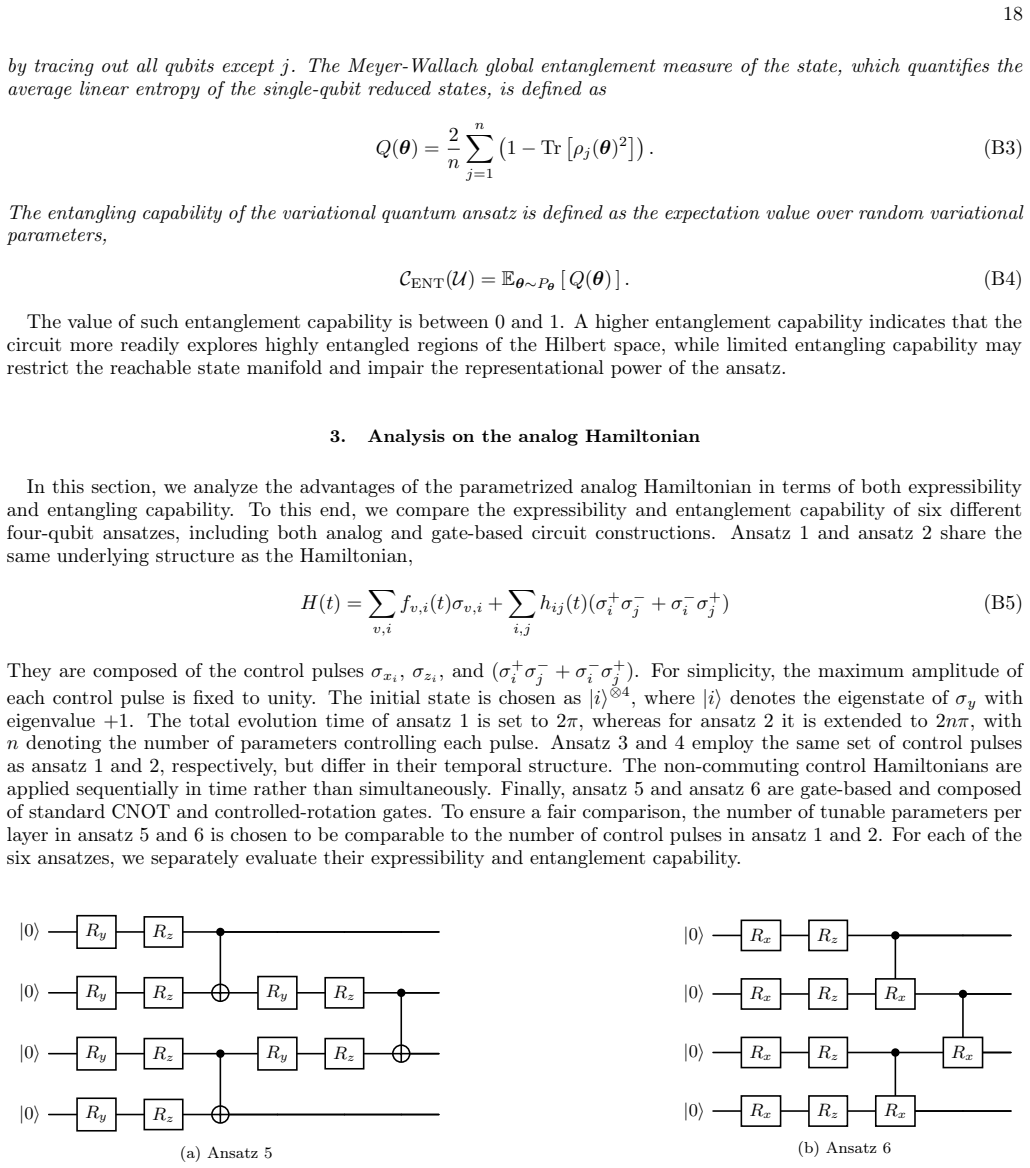
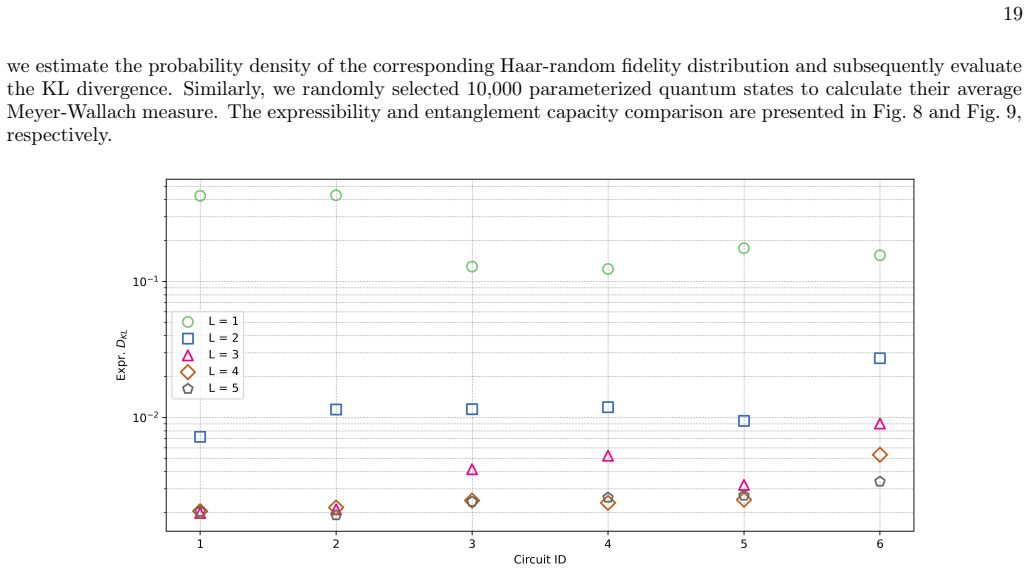
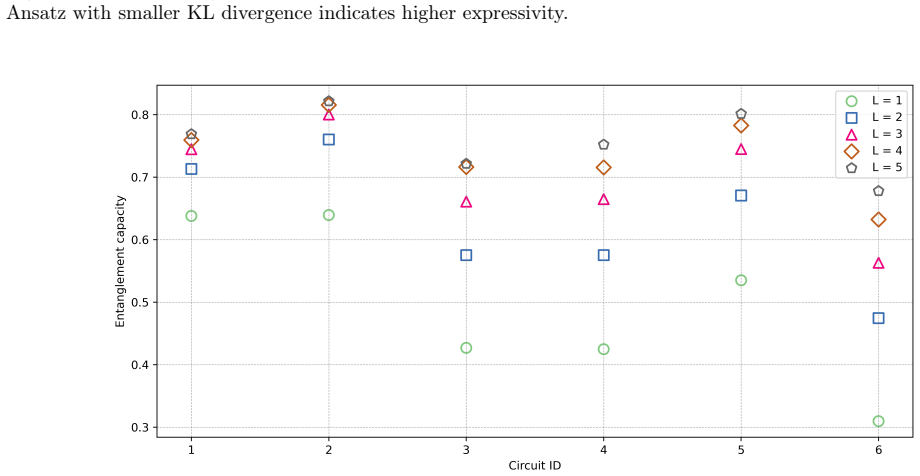
Analysis on the analog Hamiltonian In this section, we analyze the advantages of the parametrized analog Hamiltonian in terms of both expressibility and entangling capability. To this end, we compare the expressibility and entanglement capability of six different four-qubit ansatzes, including both analog and gate-based circuit constructions. Ansatz 1 and...
-
[59]
complexity analysis Here, we first discuss the computational resource estimation of the proposed UAQS. LetmHθ be the number of terms of controllable HamiltonianHc,m H be the terms of problem HamiltonianH,Nbe the sampling number in Monte Carlo integration,m s be associated with quantum process corresponding to the shot number for estimating p(MHj =±1). The...
-
[60]
error analysis To estimate the errors occurred in UAQS, we utilize the trace distance as the metric, i.e.D(|ψ⟩,|ψ ′⟩) =p 1− |⟨ψ ′|ψ⟩|2. The overall errors occurred during the simulation can be bounded by algorithm errorEa and de- vice errorE i, which is illustrated in Fig. 11. Let|ψ(θ, tN)⟩and|ϕ tN ⟩be the trial states and true state at timetN, respective...
-
[61]
Adiabatic state preparation Adiabatic state preparation (ASP) is a widely used approach for preparing the ground state of a complex Hamilto- nian. The central idea is to initialize the quantum system in the ground state of a simple and easily implementable Hamiltonian, denoted asH start, and then gradually transform the system Hamiltonian into the target ...
-
[62]
Ground state preparation for molecularH 2 The other application is ground state preparation via integrating imaginary-time evolution and UAQS. It is well- known that imaginary-time evolution provides a powerful and conceptually simple mechanism for preparing the ground state of a given Hamiltonian. By replacing real timetwith imaginary timeτ=it, the unita...
discussion (0)
Sign in with ORCID, Apple, or X to comment. Anyone can read and Pith papers without signing in.