Recognition: unknown
Orthogonal Least Squares with Integrated Information Theoretic Criteria for Joint Number of Targets and DoA Estimation
Pith reviewed 2026-05-08 06:51 UTC · model grok-4.3
The pith
Integrating information theoretic criteria into orthogonal least squares enables joint estimation of the number of targets and their directions of arrival.
A machine-rendered reading of the paper's core claim, the machinery that carries it, and where it could break.
Core claim
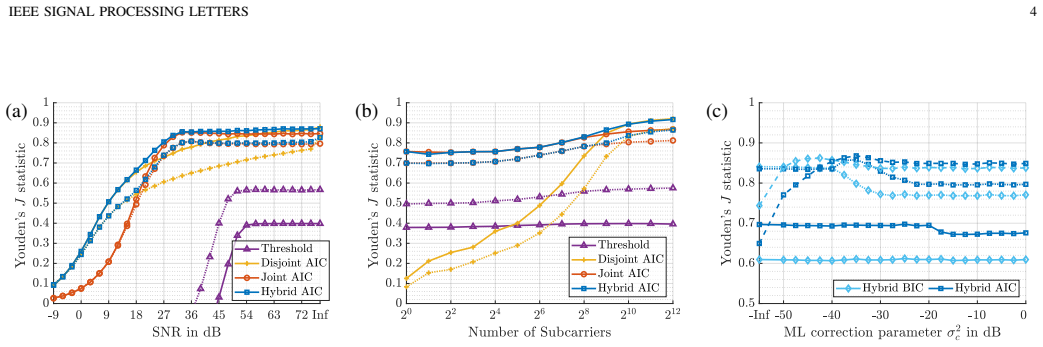
The hybrid rank-and-selection-based ITC-OLS algorithm embeds the information theoretic penalty inside the greedy orthogonal least squares steps to jointly determine the model order and the DoA estimates, and numerical simulations establish that this hybrid consistently outperforms the disjoint and joint variants as well as a baseline method.
What carries the argument
The hybrid rank-and-selection-based ITC-OLS algorithm, which folds the complexity penalty into each greedy step of orthogonal least squares to decide both when to stop adding targets and which directions to select.
If this is right
- The approach lowers complexity by avoiding full multidimensional searches for each candidate model order.
- The same framework works for both Akaike and Bayesian information criteria.
- It delivers better target count accuracy and DoA estimates than the compared methods in simulations.
- The method applies directly to radar and array-based localization tasks requiring simultaneous detection and angle estimation.
Where Pith is reading between the lines
- Similar penalty integration could be tested in other greedy sparse recovery algorithms for unknown source counts.
- Validation on measured array data rather than only simulations would check performance under real propagation conditions.
- The technique may connect to compressive sensing problems where both support size and parameter values must be recovered.
Load-bearing premise
Embedding the information theoretic penalty inside the sequential greedy steps of orthogonal least squares preserves the statistical consistency of model-order selection.
What would settle it
Array data with a known number of targets in which the hybrid ITC-OLS selects the wrong count more often than an exhaustive maximum-likelihood ITC method, especially for closely spaced targets or low signal-to-noise ratios.
Figures
read the original abstract
We address the joint estimation of the number of targets and their direction-of-arrivals (DoAs) using antenna arrays. Target-number estimation can be formulated as a model-order selection problem and solved with the information theoretic criteria (ITC). The ITC minimize an objective function that balances a likelihood term and a complexity penalty. However, direct application of the ITC requires maximum-likelihood DoA estimates for each candidate model order, which is computationally prohibitive because it entails a multidimensional search over all angle combinations. To reduce complexity, many radar processing exploit greedy methods such as orthogonal least squares (OLS). In this paper, we explore three distinct methods to integrate the ITC model-order selection into the OLS estimation procedure for joint target-number and DoA estimation. Specifically, we propose the disjoint rank-based, the joint selection-based, and the hybrid rank-and-selection-based ITC-OLS algorithms. Each algorithm is derived under both the Akaike information criterion (AIC) and the Bayesian information criterion (BIC) frameworks. Numerical simulations show that the proposed hybrid ITC-OLS algorithm consistently outperforms both the other proposed variants and a baseline method from the literature.
Editorial analysis
A structured set of objections, weighed in public.
Referee Report
Summary. The manuscript proposes three strategies for integrating information-theoretic criteria (AIC and BIC) into the orthogonal least squares (OLS) greedy procedure to jointly estimate the number of targets and their directions-of-arrival (DoAs) from array observations. The strategies are a disjoint rank-based ITC-OLS, a joint selection-based ITC-OLS, and a hybrid rank-and-selection-based ITC-OLS. Numerical simulations are presented to show that the hybrid variant consistently outperforms the other two proposed variants as well as a literature baseline.
Significance. If the performance advantage holds under broader conditions, the hybrid integration offers a practical, lower-complexity route to model-order selection in DoA estimation that avoids exhaustive multidimensional ML searches. The explicit comparison of the three integration styles supplies useful guidance on the trade-off between rank information and selection penalties in greedy array processing.
major comments (2)
- [Hybrid ITC-OLS description (likely §3.3)] Hybrid ITC-OLS description (likely §3.3): embedding the ITC penalty inside the sequential OLS atom-selection steps evaluates the criterion only along one greedy residual path rather than over all subsets of a given cardinality. This path dependence can produce model-order errors that a global combinatorial ITC minimization would avoid, especially for closely spaced sources or moderate SNR; no consistency analysis or counter-example study is supplied to quantify the resulting bias.
- [Numerical results section (likely §4)] Numerical results section (likely §4): the reported outperformance of the hybrid variant rests on Monte-Carlo trials whose exact parameters (number of trials, array size and geometry, source correlation, angular separation grid, SNR range, and any statistical significance testing of the differences) are not fully specified. Without these controls it is difficult to judge whether the superiority is robust or scenario-specific.
minor comments (2)
- [Abstract and Introduction] The abstract and introduction could explicitly quantify the complexity saving relative to direct multi-dimensional ML-ITC (e.g., big-O scaling with number of targets and grid size).
- [Algorithm derivations] Notation for the residual norm and the ITC penalty term should be unified across the three algorithm descriptions to avoid reader confusion.
Simulated Author's Rebuttal
We thank the referee for the constructive comments on the hybrid ITC-OLS algorithm and the simulation setup. We address each major comment below, acknowledging valid points where the manuscript can be strengthened through clarification or added discussion.
read point-by-point responses
-
Referee: Hybrid ITC-OLS description (likely §3.3): embedding the ITC penalty inside the sequential OLS atom-selection steps evaluates the criterion only along one greedy residual path rather than over all subsets of a given cardinality. This path dependence can produce model-order errors that a global combinatorial ITC minimization would avoid, especially for closely spaced sources or moderate SNR; no consistency analysis or counter-example study is supplied to quantify the resulting bias.
Authors: We agree that the hybrid ITC-OLS remains a greedy procedure that follows a single residual path and therefore constitutes an approximation rather than an exhaustive combinatorial minimization of the ITC. The hybrid variant was specifically designed to combine residual-rank information with the ITC penalty at each selection step, which our simulations indicate improves model-order accuracy relative to the purely rank-based and purely selection-based variants. A full asymptotic consistency analysis lies outside the scope of the present work, which emphasizes practical low-complexity algorithms. We will revise Section 3.3 to explicitly note the path-dependent nature of the approach and its possible limitations for closely spaced sources or moderate SNR, and we will add a short illustrative simulation example in Section 4 showing a scenario where the hybrid method selects an incorrect order. revision: partial
-
Referee: Numerical results section (likely §4): the reported outperformance of the hybrid variant rests on Monte-Carlo trials whose exact parameters (number of trials, array size and geometry, source correlation, angular separation grid, SNR range, and any statistical significance testing of the differences) are not fully specified. Without these controls it is difficult to judge whether the superiority is robust or scenario-specific.
Authors: The simulation parameters are already stated in the opening paragraph of Section 4, but we accept that they are not presented in a consolidated, easily verifiable form. In the revised manuscript we will insert a new Table I that explicitly tabulates all experimental settings: 5000 Monte-Carlo trials, an 8-element uniform linear array with half-wavelength spacing, uncorrelated sources, angular separations ranging from 5° to 30° in 5° increments, SNR values from -10 dB to 20 dB, and the absence of formal hypothesis testing (performance differences are reported via mean success rates with standard-deviation shading in the figures). These additions will allow readers to reproduce the exact conditions under which the hybrid variant outperforms the baselines. revision: yes
Circularity Check
No circularity: algorithmic proposal evaluated on independent Monte-Carlo trials
full rationale
The paper proposes three algorithmic variants (disjoint rank-based, joint selection-based, hybrid rank-and-selection ITC-OLS) that embed AIC/BIC penalties inside the OLS greedy procedure for joint model-order and DoA estimation. No derivation chain exists that reduces a claimed result to its own inputs by construction: there are no fitted parameters renamed as predictions, no self-definitional equations, and no load-bearing self-citations or uniqueness theorems invoked. The central claim of consistent outperformance rests on numerical simulations across independent Monte-Carlo trials rather than analytic identities or self-referential fits. The work is therefore self-contained against external benchmarks.
Axiom & Free-Parameter Ledger
axioms (1)
- domain assumption Linear array signal model with additive white Gaussian noise.
Reference graph
Works this paper leans on
-
[1]
Principles of modern radar: Basic principles,
M. A. Richards, J. A. Scheer, and W. A. Holm, “Principles of modern radar: Basic principles,” 2013. [Online]. Available: https://api.semanticscholar.org/CorpusID:114114032
2013
-
[2]
M. K. B. Jeffrey Foutz, Andreas Spanias,Narrowband Direction of Arrival Estimation for Antenna Arrays. Springer Cham, 2008
2008
-
[3]
Direction of arrival estimation: A tutorial survey of classical and modern methods,
A. A. Salama, “Direction of arrival estimation: A tutorial survey of classical and modern methods,” 2025. [Online]. Available: https://arxiv.org/abs/2508.11675
-
[4]
Three More Decades in Array Signal Processing Research: An optimization and structure exploitation perspective,
M. Pesavento, M. Trinh-Hoang, and M. Viberg, “Three More Decades in Array Signal Processing Research: An optimization and structure exploitation perspective,”IEEE Signal Processing Magazine, vol. 40, no. 4, pp. 92–106, Jun. 2023
2023
-
[5]
Fundamentals of statistical signal processing: estimation theory,
S. M. Kay, “Fundamentals of statistical signal processing: estimation theory,”Technometrics, vol. 37, p. 465, 1993. [Online]. Available: https://api.semanticscholar.org/CorpusID:120930025
1993
-
[6]
Multiple emitter location and signal parameter estimation,
R. Schmidt, “Multiple emitter location and signal parameter estimation,” IEEE Transactions on Antennas and Propagation, vol. 34, no. 3, pp. 276–280, 1986
1986
-
[7]
Orthogonal least squares methods and their application to non-linear system identification,
S. Chen, S. A. Billings, and W. Luo, “Orthogonal least squares methods and their application to non-linear system identification,”International Journal of Control, vol. 50, no. 5, pp. 1873–1896, Nov. 1989, publisher: Taylor & Francis eprint: https://doi.org/10.1080/00207178908953472
-
[8]
On the Difference Between Orthogonal Matching Pursuit and Orthogonal Least Squares,
T. Blumensath and M. Davies, “On the Difference Between Orthogonal Matching Pursuit and Orthogonal Least Squares,” Mar. 2007
2007
-
[9]
Multi target localization with block orthogonal least squares for mul- tistatic MIMO radars,
M. Willame, G. Monnoyer, H. C. Yildirim, F. Horlin, and J. Louveaux, “Multi target localization with block orthogonal least squares for mul- tistatic MIMO radars,”IEEE Signal Processing Letters, vol. 32, pp. 1990–1994, 2025
1990
-
[10]
Orthogonal matching pursuit for sparse signal recovery with noise,
T. T. Cai and L. Wang, “Orthogonal matching pursuit for sparse signal recovery with noise,”IEEE Transactions on Information Theory, vol. 57, no. 7, pp. 4680–4688, 2011
2011
-
[11]
Theoretical stopping criteria guided greedy algorithm for compressive cooperative spectrum sensing,
W.-J. Liang, T.-H. Chien, and C.-S. Lu, “Theoretical stopping criteria guided greedy algorithm for compressive cooperative spectrum sensing,”Computer Communications, vol. 111, pp. 165–175, 2017. [Online]. Available: https://www.sciencedirect.com/science/article/pii/ S014036641730868X
2017
-
[12]
S. Roy, D. P. Acharya, and A. K. Sahoo, “Fast OMP algorithm and its FPGA implementation for compressed sensing-based sparse signal acquisition systems,”IET Circuits, Devices & Systems, vol. 15, no. 6, pp. 511–521, 2021. [Online]. Available: https: //ietresearch.onlinelibrary.wiley.com/doi/abs/10.1049/cds2.12047
-
[13]
A blind stopping condition for orthogonal matching pursuit with applications to compressive sensing radar,
S. Chen, Z. Cheng, C. Liu, and F. Xi, “A blind stopping condition for orthogonal matching pursuit with applications to compressive sensing radar,”Signal Processing, vol. 165, pp. 331–342, 2019. [Online]. Available: https://www.sciencedirect.com/science/article/pii/ S0165168419302750
2019
-
[14]
Information theory and an extension of the maximum like- lihood principle,
H. Akaike, “Information theory and an extension of the maximum like- lihood principle,” inIn B. N. Petrov & F . Cs ´aki (Eds.), 2nd international symposium on information theory (pp. 267–281). Budapest, Hungary: Akad´emia Kiad ´o, 1973
1973
-
[15]
Estimating the dimension of a model,
G. Schwarz, “Estimating the dimension of a model,”The Annals of Statistics, vol. 6, no. 2, pp. 461–464, 1978. [Online]. Available: http://www.jstor.org/stable/2958889
-
[16]
Detection of signals by information theoretic criteria,
M. Wax and T. Kailath, “Detection of signals by information theoretic criteria,”IEEE Transactions on Acoustics, Speech, and Signal Process- ing, vol. 33, no. 2, pp. 387–392, 1985
1985
-
[17]
Model-order selection: a review of information criterion rules,
P. Stoica and Y . Selen, “Model-order selection: a review of information criterion rules,”IEEE Signal Processing Magazine, vol. 21, no. 4, pp. 36–47, 2004
2004
-
[18]
The bayesian information criterion: background, derivation, and applications,
A. A. Neath and J. E. Cavanaugh, “The bayesian information criterion: background, derivation, and applications,”WIREs Comput. Stat., vol. 4, no. 2, p. 199–203, Feb. 2012. [Online]. Available: https://doi.org/10.1002/wics.199
-
[19]
Model selection techniques: An overview,
J. Ding, V . Tarokh, and Y . Yang, “Model selection techniques: An overview,”IEEE Signal Processing Magazine, vol. 35, no. 6, pp. 16–34, 2018
2018
-
[20]
J. E. Cavanaugh and A. A. Neath, “The akaike information criterion: Background, derivation, properties, application, interpretation, and refinements,”WIREs Comput. Stat., vol. 11, no. 3, Apr. 2019. [Online]. Available: https://doi.org/10.1002/wics.1460
-
[21]
Indoor tracking of multiple individuals with an 802.11ax Wi-Fi-based multi-antenna passive radar,
L. Storrer, H. C. Yildirim, M. Crauwels, E. I. P. Copa, S. Pollin, J. Louveaux, P. De Doncker, and F. Horlin, “Indoor tracking of multiple individuals with an 802.11ax Wi-Fi-based multi-antenna passive radar,” IEEE Sensors Journal, vol. 21, no. 18, pp. 20 462–20 474, 2021
2021
-
[22]
Index for rating diagnostic tests,
W. J. Youden, “Index for rating diagnostic tests,”Cancer, vol. 3, no. 1, pp. 32–35, 1950
1950
-
[23]
The youden index in the generalized receiver operating characteristic curve context,
P. Mart ´ınez-Camblor and J. C. Pardo-Fern ´andez, “The youden index in the generalized receiver operating characteristic curve context,”Interna- tional Journal of Biostatistics, vol. 15, 2019
2019
-
[24]
H. W. Kuhn,The Hungarian Method for the Assignment Problem. Berlin, Heidelberg: Springer Berlin Heidelberg, 2010, pp. 29–47
2010
-
[25]
1–1020, 2025
“IEEE standard for information technology–telecommunications and information exchange between systems local and metropolitan area networks–specific requirements - part 11: Wireless LAN medium access control (MAC) and physical layer (PHY) specifications amendment 2: Enhancements for extremely high throughput (EHT),”IEEE Std 802.11be-2024 (Amendment to IEEE...
2024
discussion (0)
Sign in with ORCID, Apple, or X to comment. Anyone can read and Pith papers without signing in.