Recognition: unknown
Disentangling magnetic and optical contributions in ultrafast dynamics of antiperovskite non-collinear antiferromagnets
Pith reviewed 2026-05-08 08:39 UTC · model grok-4.3
The pith
Magnetic fields redistribute domains in Mn3NiN films via piezomagnetic moments, producing Kerr-like signals absent in Mn3GaN.
A machine-rendered reading of the paper's core claim, the machinery that carries it, and where it could break.
Core claim
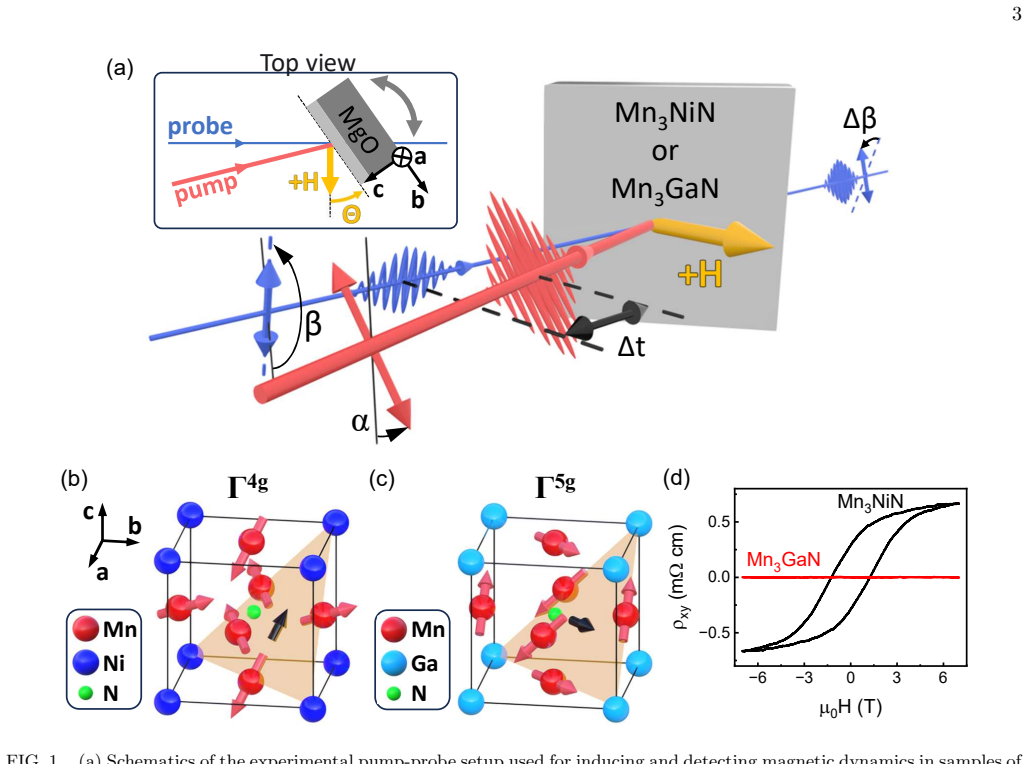
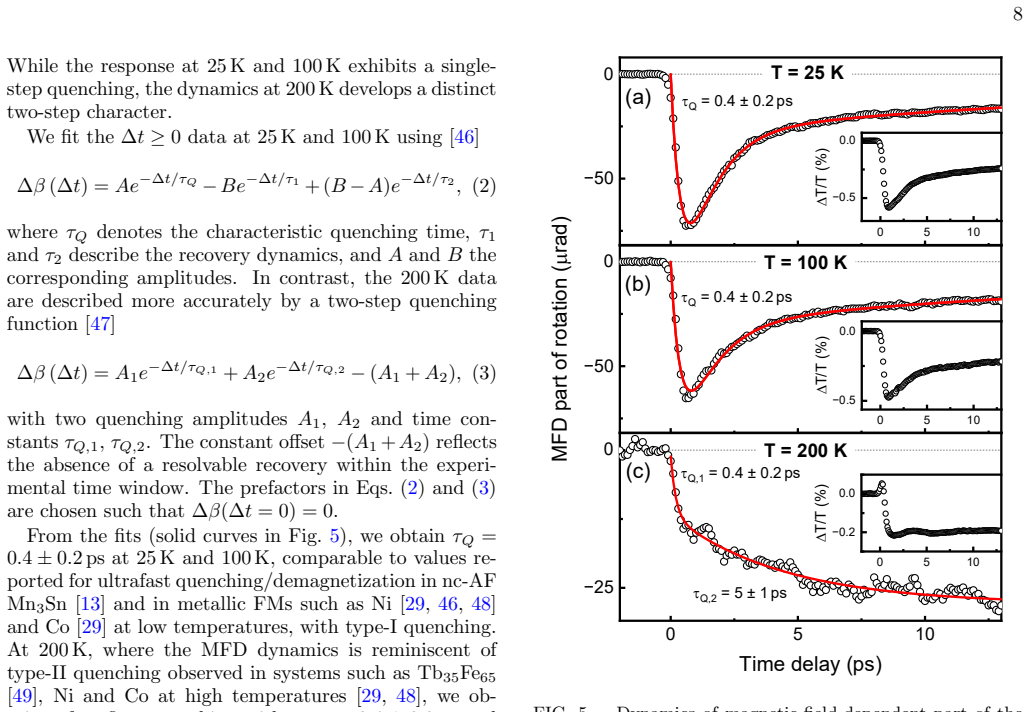
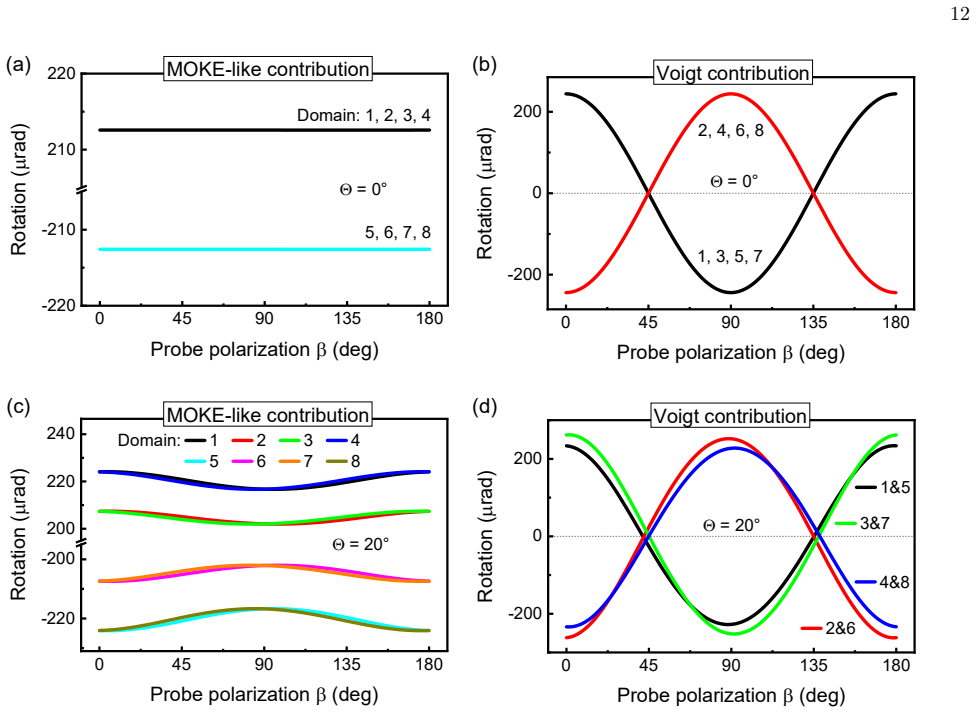
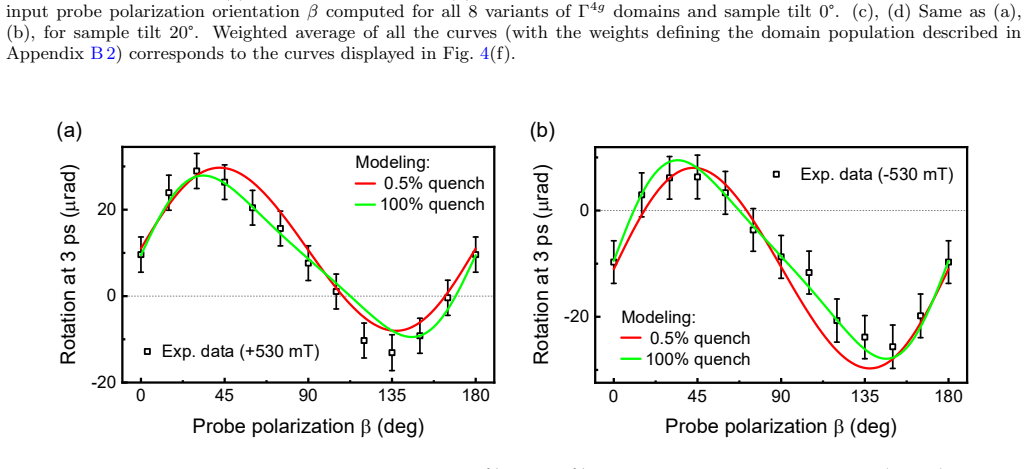
Using probe-polarization-resolved measurements combined with full optical modeling based on Yeh's formalism, magnetic and non-magnetic contributions to the ultrafast signals are quantitatively separated. In Mn3NiN the observed magnetic-field dependence arises from field-controlled redistribution of magnetic domain populations enabled by their piezomagnetic moments and detected by a Kerr-like magneto-optical effect; the same effect is absent in Mn3GaN. Temperature-dependent measurements further reveal a change from single-step to two-step quenching dynamics with rising temperature in Mn3NiN.
What carries the argument
Probe-polarization-resolved pump-probe detection together with Yeh's multilayer optical formalism, which isolates the Kerr-like magneto-optical response arising from field-tunable piezomagnetic domain populations.
If this is right
- The ultrafast magneto-optical response in Mn3NiN can be controlled by modest external fields through piezomagnetic domain reorientation.
- The absence of field dependence in Mn3GaN is consistent with its Γ5g phase lacking net piezomagnetic moments.
- Quenching dynamics in Mn3NiN cross over from single-step to two-step behavior with increasing temperature, resembling metallic ferromagnets.
- Polarization-resolved measurements plus multilayer optical modeling suffice to extract pure magnetic signals even when optical and magnetic effects overlap.
Where Pith is reading between the lines
- The same separation protocol could be used to quantify domain-wall motion or spin-texture dynamics in other non-collinear antiferromagnets that carry piezomagnetic moments.
- Because the Kerr-like signal is tied to domain population rather than net magnetization, the technique may allow optical readout of antiferromagnetic order parameters without requiring a ferromagnetic reference layer.
- If piezomagnetic coupling is the dominant mechanism, modest strain or piezoelectric substrates should produce analogous control over the ultrafast signals.
Load-bearing premise
That Yeh's optical model captures every non-magnetic contribution exactly and that the remaining field dependence comes only from piezomagnetic domain redistribution rather than other magneto-optical or thermal channels.
What would settle it
A direct observation, after applying the same optical model, that the extracted non-magnetic signal still varies with applied field, or that magnetic-domain populations remain unchanged under the fields used in the experiment.
Figures





read the original abstract
Non-collinear antiferromagnets are a class of spin-polarized antiferromagnets in which chiral spin textures give rise to Berry-curvature-driven phenomena, such as the anomalous Hall effect (AHE), without net magnetization. We investigate the properties of thin films of antiperovskite non-collinear antiferromagnetic metals Mn3NiN and Mn3GaN using pump-probe experiments. In both materials, we observe a strong dependence of pump-polarization-independent dynamics, induced by femtosecond laser pulses, on the angle between the sample normal and the direction of probe propagation. In Mn3NiN, where the presence of a sizable AHE indicates the {\Gamma}4g phase, the measured magnetooptical (MO) signals acquire an additional, strong dependence on the external magnetic field when the probe pulses are incident at nonzero angles. In contrast, in Mn3GaN, where the absence of AHE indicates the {\Gamma}5g phase, the measured signals do not depend on the magnetic field. Using probe-polarization-resolved measurements combined with full optical modeling based on Yeh's formalism, we quantitatively separate magnetic and non-magnetic contributions to the measured signals. We show that in Mn3NiN, the observed magnetic field dependence results from field-controlled redistribution of magnetic domain populations, enabled by their piezomagnetic moments and detected by a Kerr-like MO effect, while this effect is absent in Mn3GaN. Temperature-dependent measurements reveal a change from single-step to two-step quenching dynamics with increasing temperature in Mn3NiN. This behavior contrasts with the nearly temperature-independent quenching dynamics reported for the non-collinear antiferromagnetic Heusler compound Mn3Sn, but resembles the crossover from type-I to type-II demagnetization dynamics in metallic ferromagnets.
Editorial analysis
A structured set of objections, weighed in public.
Referee Report
Summary. The manuscript reports femtosecond pump-probe experiments on thin films of the antiperovskite non-collinear antiferromagnets Mn3NiN and Mn3GaN. It describes angle-dependent dynamics that are independent of pump polarization, plus an additional magnetic-field dependence in the magneto-optical signals of Mn3NiN (but not Mn3GaN) when the probe is incident at nonzero angles. Using probe-polarization-resolved data and multilayer Jones-matrix modeling based on Yeh's formalism, the authors claim to quantitatively separate magnetic (Kerr-like) and non-magnetic contributions, attributing the field dependence in Mn3NiN to piezomagnetic domain redistribution while Mn3GaN shows none. Temperature-dependent measurements reveal a crossover from single-step to two-step quenching dynamics in Mn3NiN.
Significance. If the separation holds, the work provides a concrete experimental route to isolate magnetic responses in non-collinear antiferromagnets and demonstrates how piezomagnetism can control ultrafast domain populations. The contrast between the Γ4g and Γ5g phases, together with the temperature-dependent crossover, adds to the limited body of ultrafast data on these materials and may help benchmark models of demagnetization that currently exist mainly for ferromagnets and Mn3Sn. The explicit use of full optical modeling to support quantitative claims is a methodological strength.
major comments (2)
- Optical modeling section: The central claim that probe-polarization-resolved measurements plus Yeh's formalism quantitatively isolate a purely magnetic Kerr-like term rests on the assumption that every non-magnetic contribution (Fresnel terms, strain- or temperature-induced birefringence, higher-order tensors) is either absent or perfectly captured by the fitted layer optical constants. No fit residuals, covariance matrices, or cross-validation against independent non-magnetic observables (e.g., normal-incidence reflectivity transients) are reported, leaving open the possibility of residual magnetic leakage or unmodeled field-dependent optical changes.
- Results on magnetic-field dependence (Mn3NiN vs. Mn3GaN): The interpretation that the observed field dependence arises solely from piezomagnetic domain repopulation requires explicit exclusion of alternative mechanisms such as field-induced modifications to the non-magnetic dielectric tensor at the probe wavelength or thermal transients that couple into the optical path. The manuscript does not present such checks or discuss their absence.
minor comments (3)
- Abstract and introduction: The phrase 'pump-polarization-independent dynamics' should be clarified with a brief statement of how independence was verified (e.g., averaging or explicit checks).
- Figures: All panels showing separated magnetic and non-magnetic components should include the raw data, the model fit, and residuals so readers can assess the quality of the separation.
- References: Consider citing recent work on piezomagnetism in Mn3XN antiperovskites and on ultrafast dynamics in Mn3Sn to place the temperature-dependent crossover in context.
Simulated Author's Rebuttal
We thank the referee for their careful reading of the manuscript and for the constructive comments, which highlight important aspects of the optical modeling and interpretation. We address each major comment below and will revise the manuscript accordingly.
read point-by-point responses
-
Referee: Optical modeling section: The central claim that probe-polarization-resolved measurements plus Yeh's formalism quantitatively isolate a purely magnetic Kerr-like term rests on the assumption that every non-magnetic contribution (Fresnel terms, strain- or temperature-induced birefringence, higher-order tensors) is either absent or perfectly captured by the fitted layer optical constants. No fit residuals, covariance matrices, or cross-validation against independent non-magnetic observables (e.g., normal-incidence reflectivity transients) are reported, leaving open the possibility of residual magnetic leakage or unmodeled field-dependent optical changes.
Authors: We agree that additional documentation of the modeling would strengthen the quantitative claims. In the revised manuscript we will include the fit residuals and covariance matrices from the Yeh-formalism multilayer calculations. The polarization- and angle-dependent data sets already provide internal consistency checks across multiple observables; we will add an explicit comparison of the extracted non-magnetic baseline against normal-incidence reflectivity transients to further validate the separation. While these additions address the main concern of residual leakage, we acknowledge that exhaustive exclusion of every conceivable higher-order tensor contribution would require experiments beyond the present scope. revision: partial
-
Referee: Results on magnetic-field dependence (Mn3NiN vs. Mn3GaN): The interpretation that the observed field dependence arises solely from piezomagnetic domain repopulation requires explicit exclusion of alternative mechanisms such as field-induced modifications to the non-magnetic dielectric tensor at the probe wavelength or thermal transients that couple into the optical path. The manuscript does not present such checks or discuss their absence.
Authors: The material contrast is central to our interpretation: a clear magnetic-field dependence appears only in Mn3NiN (which exhibits both AHE and piezomagnetism in the Γ4g phase) and is absent in Mn3GaN (Γ5g phase). Any field-induced modification of the non-magnetic dielectric tensor would be expected to affect both isostructural compounds similarly, yet the data show otherwise. Thermal transients are minimized by the low pump fluence used and are already separated in the time-dependent analysis. We will add a dedicated paragraph in the revised manuscript that explicitly discusses these alternative mechanisms, supported by the observed material specificity and the results of the optical modeling. revision: yes
Circularity Check
No circularity: experimental separation via standard external formalism
full rationale
The paper reports pump-probe experiments on Mn3NiN and Mn3GaN films, using probe-polarization-resolved data fitted to a multilayer Jones-matrix model based on Yeh's formalism (an established external reference for anisotropic optics) to separate magnetic and non-magnetic signals. The central claims rest on direct observations of field dependence in one material but not the other, attributed to piezomagnetic domain redistribution and a Kerr-like MO effect. No equations, parameters, or predictions are defined in terms of the target quantities; no self-citations are load-bearing for the separation or interpretation; and the modeling is not a derivation but a standard fitting procedure applied to measured transients. The chain is therefore self-contained against external optical theory and comparative data, with no reduction by construction.
Axiom & Free-Parameter Ledger
free parameters (1)
- layer optical constants
axioms (1)
- standard math Yeh's 4x4 matrix formalism accurately describes light propagation and polarization effects in the thin-film stack
Reference graph
Works this paper leans on
-
[1]
The spin-orbit coupling is included and the local magnetic moments are constrained to Γ 4g config- uration (ground state)
Permittivity tensor In order to calculate the parameters of the permit- tivity tensor, we first use non-collinear spin-polarized density functional theory (DFT) to find the electronic structure. The spin-orbit coupling is included and the local magnetic moments are constrained to Γ 4g config- uration (ground state). Subsequently, we employ linear response...
-
[2]
4(a)-(d) and 7], each associ- ated with a particular orientation of piezo-induced mag- netic momentM P [black arrows in Figs
Fitting In strained Mn3NiN, eight distinct domain variants of the Γ4g phase exist [see Figs. 4(a)-(d) and 7], each associ- ated with a particular orientation of piezo-induced mag- netic momentM P [black arrows in Figs. 4(a)–4(d) and 7]. For a givenH, the relative domain populations are governed by the angle betweenMP in a given domain and H(see Table I). ...
-
[3]
Jungwirth, X
T. Jungwirth, X. Marti, P. Wadley, and J. Wunderlich, Antiferromagnetic spintronics, Nature Nanotechnology 11, 231 (2016)
2016
-
[4]
Baltz, A
V. Baltz, A. Manchon, M. Tsoi, T. Moriyama, T. Ono, and Y. Tserkovnyak, Antiferromagnetic spintronics, Re- views of Modern Physics90, 015005 (2018)
2018
-
[5]
Nˇ emec, M
P. Nˇ emec, M. Fiebig, T. Kampfrath, and A. V. Kimel, Antiferromagnetic opto-spintronics, Nature Physics14, 229 (2018)
2018
-
[6]
B. H. Rimmler, B. Pal, and S. S. P. Parkin, Non-collinear antiferromagnetic spintronics, Nature Reviews Materials 10, 109 (2024)
2024
-
[7]
Z. Guo, X. Wang, W. Wang, G. Zhang, X. Zhou, and Z. Cheng, Spin-Polarized Antiferromagnets for Spintron- ics, Advanced Materials37, 2505779 (2025)
2025
-
[8]
Nakatsuji, N
S. Nakatsuji, N. Kiyohara, and T. Higo, Large anomalous Hall effect in a non-collinear antiferromagnet at room temperature, Nature527, 212 (2015)
2015
-
[9]
A. K. Nayak, J. E. Fischer, Y. Sun, B. Yan, J. Karel, A. C. Komarek, C. Shekhar, N. Kumar, W. Schnelle, J. K¨ ubler, C. Felser, and S. S. P. Parkin, Large anoma- lous Hall effect driven by a nonvanishing Berry curvature in the noncolinear antiferromagnet Mn3Ge, Science Ad- vances2, 10.1126/sciadv.1501870 (2016)
-
[10]
Reichlova, T
H. Reichlova, T. Janda, J. Godinho, A. Markou, D. Kriegner, R. Schlitz, J. Zelezny, Z. Soban, M. Be- jarano, H. Schultheiss, P. Nemec, T. Jungwirth, C. Felser, J. Wunderlich, and S. T. B. Goennenwein, Imaging and writing magnetic domains in the non-collinear an- tiferromagnet Mn3Sn, Nature Communications10, 5459 (2019)
2019
-
[11]
T. Higo, H. Man, D. B. Gopman, L. Wu, T. Koret- sune, O. M. J. van ’t Erve, Y. P. Kabanov, D. Rees, Y. Li, M.-T. Suzuki, S. Patankar, M. Ikhlas, C. L. Chien, R. Arita, R. D. Shull, J. Orenstein, and S. Nakatsuji, Large magneto-optical Kerr effect and imaging of mag- netic octupole domains in an antiferromagnetic metal, Nature Photonics12, 73 (2018)
2018
-
[12]
P. Qin, H. Yan, X. Wang, H. Chen, Z. Meng, J. Dong, M. Zhu, J. Cai, Z. Feng, X. Zhou, L. Liu, T. Zhang, Z. Zeng, J. Zhang, C. Jiang, and Z. Liu, Room-temperature magnetoresistance in an all- antiferromagnetic tunnel junction, Nature613, 485 (2023)
2023
-
[13]
X. Chen, T. Higo, K. Tanaka, T. Nomoto, H. Tsai, H. Idzuchi, M. Shiga, S. Sakamoto, R. Ando, H. Kosaki, T. Matsuo, D. Nishio-Hamane, R. Arita, S. Miwa, and S. Nakatsuji, Octupole-driven magnetoresistance in an antiferromagnetic tunnel junction, Nature613, 490 (2023)
2023
-
[14]
S. Miwa, S. Iihama, T. Nomoto, T. Tomita, T. Higo, M. Ikhlas, S. Sakamoto, Y. Otani, S. Mizukami, R. Arita, and S. Nakatsuji, Giant Effective Damping of Octupole Oscillation in an Antiferromagnetic Weyl Semimetal, Small Science1, 2000062 (2021)
2021
-
[15]
H. C. Zhao, H. Xia, S. Hu, Y. Y. Lv, Z. R. Zhao, J. He, E. Liang, G. Ni, L. Y. Chen, X. P. Qiu, S. M. Zhou, and H. B. Zhao, Large ultrafast-modulated Voigt effect in noncollinear antiferromagnet Mn3Sn, Nature Commu- nications12, 5266 (2021)
2021
-
[16]
Y. Song, D. J. X. Lin, S. Hu, Z. Li, J. Zhang, B. C. Lim, H. Y. Y. Ko, S. Chen, P. Ho, Q. Jin, and Z. Zhang, Ultrafast Spin Current Excitation and Controlled Ter- ahertz Radiation from Noncollinear Antiferromagnets, Advanced Optical Materials13, 2500210 (2025)
2025
-
[17]
W.-B. Lee, S. Hwang, H.-W. Ko, B.-G. Park, K.-J. Lee, and G.-M. Choi, Spin-torque-driven gigahertz magne- tization dynamics in the non-collinear antiferromagnet Mn3Sn, Nature Nanotechnology20, 487 (2025)
2025
-
[18]
D. Boldrin, I. Samathrakis, J. Zemen, A. Mihai, B. Zou, F. Johnson, B. D. Esser, D. W. McComb, P. K. Petrov, H. Zhang, and L. F. Cohen, Anomalous Hall effect in non- collinear antiferromagnetic Mn3NiN thin films, Physical Review Materials3, 10.1103/PhysRevMaterials.3.094409 (2019)
-
[19]
Z. Q. Liu, H. Chen, J. M. Wang, J. H. Liu, K. Wang, Z. X. Feng, H. Yan, X. R. Wang, C. B. Jiang, J. M. D. Coey, and A. H. MacDonald, Electrical switching of the topological anomalous Hall effect in a non-collinear anti- ferromagnet above room temperature, Nature Electronics 14 1, 172 (2018)
2018
-
[20]
Johnson, J
F. Johnson, J. Kim´ ak, J. Zemen, Z. ˇSob´ aˇ n, E. Schmoranzerov´ a, J. Godinho, P. Nˇ emec, S. Beckert, H. Reichlov´ a, D. Boldrin, J. Wunderlich, and L. F. Co- hen, Identifying the octupole antiferromagnetic domain orientation in Mn3NiN by scanning anomalous Nernst effect microscopy, Applied Physics Letters120, 232402 (2022)
2022
-
[21]
Beckert, J
S. Beckert, J. Godinho, F. Johnson, J. Kim´ ak, E. Schmoranzerov´ a, J. Zemen, Z. ˇSob´ aˇ n, K. Olejn´ ık, J. ˇZelezn´ y, J. Wunderlich, P. Nˇ emec, D. Kriegner, A. Thomas, S. T. B. Goennenwein, L. F. Cohen, and H. Reichlov´ a, Anomalous Nernst effect in Mn3NiN thin films, Physical Review B108, 024420 (2023)
2023
-
[22]
F. Johnson, J. Z´ azvorka, L. Beran, D. Boldrin, L. F. Cohen, J. Zemen, and M. Veis, Room-temperature weak collinear ferrimagnet with symmetry-driven large intrin- sic magneto-optic signatures, Physical Review B107, 10.1103/PhysRevB.107.014404 (2023)
-
[23]
Lukashev, R
P. Lukashev, R. F. Sabirianov, and K. Belashchenko, Theory of the piezomagnetic effect in Mn-based antiper- ovskites, Physical Review B78, 184414 (2008)
2008
-
[24]
Boldrin, A
D. Boldrin, A. P. Mihai, B. Zou, J. Zemen, R. Thompson, E. Ware, B. V. Neamtu, L. Ghivelder, B. Esser, D. W. McComb, P. Petrov, and L. F. Cohen, Giant Piezomag- netism in Mn3NiN, ACS Applied Materials and Inter- faces10, 18863 (2018)
2018
-
[25]
H. Guo, Z. Feng, H. Yan, J. Liu, J. Zhang, X. Zhou, P. Qin, J. Cai, Z. Zeng, X. Zhang, X. Wang, H. Chen, H. Wu, C. Jiang, and Z. Liu, Giant Piezospintronic Effect in a Noncollinear Antiferromagnetic Metal, Advanced Materials32, 2002300 (2020)
2020
-
[26]
H. Yan, Z. Feng, S. Shang, X. Wang, Z. Hu, J. Wang, Z. Zhu, H. Wang, Z. Chen, H. Hua, W. Lu, J. Wang, P. Qin, H. Guo, X. Zhou, Z. Leng, Z. Liu, C. Jiang, M. Coey, and Z. Liu, A piezoelectric, strain-controlled antiferromagnetic memory insensitive to magnetic fields, Nature Nanotechnology14, 131 (2019)
2019
-
[27]
Zemen, E
J. Zemen, E. Mendive-Tapia, Z. Gercsi, R. Banerjee, J. B. Staunton, and K. G. Sandeman, Frustrated magnetism and caloric effects in Mn-based antiperovskite nitrides: Ab initio theory, Physical Review B95, 184438 (2017)
2017
-
[28]
K. Shi, Y. Sun, J. Yan, S. Deng, L. Wang, H. Wu, P. Hu, H. Lu, M. I. Malik, Q. Huang, and C. Wang, Baromag- netic Effect in Antiperovskite Mn3Ga0.95N0.94 by Neu- tron Powder Diffraction Analysis, Advanced Materials 28, 3761 (2016)
2016
-
[29]
Matsunami, A
D. Matsunami, A. Fujita, K. Takenaka, and M. Kano, Gi- ant barocaloric effect enhanced by the frustration of the antiferromagnetic phase in Mn3GaN, Nature Materials 14, 73 (2015)
2015
-
[30]
J. Kim´ ak, M. Nerodilov´ a, K. Carva, S. Ghosh, J.ˇZelezn´ y, T. Ostatnick´ y, J. Zemen, F. Johnson, D. Boldrin, F. Rendell-Bhatti, B. Zou, A. P. Mihai, X. Sun, F. Yu, E. Schmoranzerov´ a, L. N´ advorn´ ık, L. F. Cohen, and P. Nˇ emec, arXiv:2601.07753
-
[31]
Koopmans, G
B. Koopmans, G. Malinowski, F. Dalla Longa, D. Steiauf, M. F¨ ahnle, T. Roth, M. Cinchetti, and M. Aeschlimann, Explaining the paradoxical diversity of ultrafast laser- induced demagnetization, Nature Materials 2010 9:39, 259 (2010)
2010
-
[32]
Sur´ ynek, V
M. Sur´ ynek, V. Saidl, Z. Kaˇ spar, V. Nov´ ak, R. P. Cam- pion, P. Wadley, and P. Nˇ emec, Investigation of magnetic anisotropy and heat dissipation in thin films of compen- sated antiferromagnet CuMnAs by pump–probe experi- ment, Journal of Applied Physics127, 233904 (2020)
2020
-
[33]
D. Boldrin, F. Johnson, R. Thompson, A. P. Mihai, B. Zou, J. Zemen, J. Griffiths, P. Gubeljak, K. L. Ormandy, P. Manuel, D. D. Khalyavin, B. Ouladdiaf, N. Qureshi, P. Petrov, W. Branford, and L. F. Cohen, The Biaxial Strain Dependence of Magnetic Order in Spin Frustrated Mn3NiN Thin Films, Advanced Func- tional Materials29, 10.1002/adfm.201902502 (2019)
-
[34]
Suzuki, T
M.-T. Suzuki, T. Koretsune, M. Ochi, and R. Arita, Clus- ter multipole theory for anomalous Hall effect in antifer- romagnets, Physical Review B95, 094406 (2017)
2017
-
[35]
Ishino, J
S. Ishino, J. So, H. Goto, T. Hajiri, and H. Asano, Prepa- ration and evaluation of Mn3GaN1-x thin films with con- trolled N compositions, AIP Advances8, 056312 (2018)
2018
-
[36]
Abbas, J
A. Abbas, J. C. M. Hernandez, A. Shrestha, D. Russell, T. Erickson, K. Sun, G. H. Cocoletzi, F. Yang, and A. R. Smith, Experimental and theoretical investigation of the crystalline surface, film, and interface properties of an- tiperovskite Mn3GaN grown by molecular beam epitaxy on MgO(001), Surfaces and Interfaces64, 106201 (2025)
2025
-
[37]
J. Zemen, Z. Gercsi, and K. G. Sandeman, Piezo- magnetism as a counterpart of the magnetovolume effect in magnetically frustrated Mn-based antiper- ovskite nitrides, Physical Review B96, 10.1103/Phys- RevB.96.024451 (2017)
-
[38]
G. Gurung, D. F. Shao, T. R. Paudel, and E. Y. Tsymbal, Anomalous Hall conductivity of noncollinear magnetic antiperovskites, Physical Review Materials3, 10.1103/PhysRevMaterials.3.044409 (2019)
-
[39]
Tesaˇ rov´ a, T
N. Tesaˇ rov´ a, T. Ostatnick´ y, V. Nov´ ak, K. Olejn´ ık, J. ˇSubrt, H. Reichlov´ a, C. T. Ellis, A. Mukherjee, J. Lee, G. M. Sipahi, J. Sinova, J. Hamrle, T. Jung- wirth, P. Nˇ emec, J.ˇCerne, and K. V´ yborn´ y, Systematic study of magnetic linear dichroism and birefringence in (Ga,Mn)As, Physical Review B89, 085203 (2014)
2014
-
[40]
Saidl, P
V. Saidl, P. Nˇ emec, P. Wadley, V. Hills, R. P. Cam- pion, V. Nov´ ak, K. W. Edmonds, F. Maccherozzi, S. S. Dhesi, B. L. Gallagher, F. Troj´ anek, J. Kuneˇ s, J.ˇZelezn´ y, P. Mal´ y, and T. Jungwirth, Optical determination of the N´ eel vector in a CuMnAs thin-film antiferromagnet, Na- ture Photonics11, 91 (2017)
2017
-
[41]
Zheng, J
Z. Zheng, J. Y. Shi, Q. Li, T. Gu, H. Xia, L. Q. Shen, F. Jin, H. C. Yuan, Y. Z. Wu, L. Y. Chen, and H. B. Zhao, Magneto-optical probe of ultrafast spin dynamics in antiferromagnetic CoO thin films, Physical Review B 98, 134409 (2018)
2018
-
[42]
Kirilyuk, A
A. Kirilyuk, A. V. Kimel, and T. Rasing, Ultrafast opti- cal manipulation of magnetic order, Reviews of Modern Physics82, 2731 (2010)
2010
-
[43]
C. K. Sun, F. Vall´ ee, L. H. Acioli, E. P. Ippen, and J. G. Fujimoto, Femtosecond-tunable measurement of electron thermalization in gold, Physical Review B50, 15337 (1994)
1994
-
[44]
Del Fatti, R
N. Del Fatti, R. Bouffanais, F. Vall´ ee, and C. Flytza- nis, Nonequilibrium Electron Interactions in Metal Films, Physical Review Letters81, 922 (1998)
1998
-
[45]
Schmoranzerov´ a, T
E. Schmoranzerov´ a, T. Ostatnick´ y, J. Kim´ ak, D. Krieg- ner, H. Reichlov´ a, R. Schlitz, A. Ba ˇdura, Z. ˇSob´ aˇ n, M. M¨ unzenberg, G. Jakob, E.-J. Guo, M. Kl¨ aui, and P. Nˇ emec, Giant quadratic magneto-optical response of thin thin Y3Fe5O12 films for sensitive magnetometry ex- periments, Physical Review B106, 104434 (2022)
2022
-
[46]
Wohlrath, Z
V. Wohlrath, Z. Sadeghi, J. Kim´ ak, K. Hovoˇ r´ akov´ a, 15 P. Kubaˇ sˇ c´ ık, E. Schmoranzerov´ a, L. N´ advorn´ ık, F. Troj´ anek, P. Nˇ emec, and T. Ostatnick´ y, Quadratic magneto-optical Kerr effect spectroscopy: polarization variation method for investigation of magnetic and magneto-optical anisotropies, Journal of Physics D: Ap- plied Physics58, 1...
2025
-
[47]
Viˇ sˇ novsk´ y, Optics in Magnetic Multilayers and Nanos- tructures (CRC Press, Boca Raton, FL, 2006) Chap
ˇS. Viˇ sˇ novsk´ y, Optics in Magnetic Multilayers and Nanos- tructures (CRC Press, Boca Raton, FL, 2006) Chap. 3
2006
-
[48]
W. You, P. Tengdin, C. Chen, X. Shi, D. Zusin, Y. Zhang, C. Gentry, A. Blonsky, M. Keller, P. M. Oppeneer, H. Kapteyn, Z. Tao, and M. Murnane, Revealing the Na- ture of the Ultrafast Magnetic Phase Transition in Ni by Correlating Extreme Ultraviolet Magneto-Optic and Photoemission Spectroscopies, Physical Review Letters 121, 077204 (2018)
2018
-
[49]
Z. Gong, W. Zhang, J. Liu, Z. Xie, X. Yang, J. Tang, H. Du, N. Li, X. Zhang, W. He, and Z.-h. Cheng, Ultrafast demagnetization dynamics in the epitaxial FeGe(111) film chiral magnet, Physical Review B107, 144429 (2023)
2023
-
[50]
T. Roth, A. J. Schellekens, S. Alebrand, O. Schmitt, D. Steil, B. Koopmans, M. Cinchetti, and M. Aeschli- mann, Temperature Dependence of Laser-Induced De- magnetization in Ni: A Key for Identifying the Underly- ing Mechanism, Physical Review X2, 021006 (2012)
2012
-
[51]
Kim, K.-D
J.-W. Kim, K.-D. Lee, J.-W. Jeong, and S.-C. Shin, Ultrafast spin demagnetization by nonthermal electrons of TbFe alloy film, Applied Physics Letters94, 192506 (2009)
2009
-
[52]
Sultan, U
M. Sultan, U. Atxitia, A. Melnikov, O. Chubykalo- Fesenko, and U. Bovensiepen, Electron- and phonon- mediated ultrafast magnetization dynamics of Gd(0001), Physical Review B85, 184407 (2012)
2012
-
[53]
J.-H. Shim, A. A. Syed, J.-I. Kim, H.-G. Piao, S.-H. Lee, S.-Y. Park, Y. S. Choi, K. M. Lee, H.-J. Kim, J.- R. Jeong, J.-I. Hong, D. E. Kim, and D.-H. Kim, Role of non-thermal electrons in ultrafast spin dynamics of ferro- magnetic multilayer, Scientific Reports10, 6355 (2020)
2020
-
[54]
Pankratova, I
M. Pankratova, I. P. Miranda, D. Thonig, M. Pereiro, E. Sj¨ oqvist, A. Delin, O. Eriksson, and A. Bergman, Heat-conserving three-temperature model for ultrafast demagnetization in nickel, Physical Review B106, 174407 (2022)
2022
-
[55]
Beaurepaire, J.-C
E. Beaurepaire, J.-C. Merle, A. Daunois, and J.-Y. Bigot, Ultrafast Spin Dynamics in Ferromagnetic Nickel, Phys- ical Review Letters76, 4250 (1996)
1996
-
[56]
Atxitia and O
U. Atxitia and O. Chubykalo-Fesenko, Ultrafast magneti- zation dynamics rates within the Landau-Lifshitz-Bloch model, Physical Review B84, 144414 (2011)
2011
-
[57]
Chubykalo-Fesenko and P
O. Chubykalo-Fesenko and P. Nieves, Landau-Lifshitz- Bloch Approach for Magnetization Dynamics Close to Phase Transition, inHandbook of Materials Modeling (Springer International Publishing, Cham, 2020) pp. 867–893
2020
-
[58]
X. Chen, R. Adam, D. E. B¨ urgler, F. Wang, Z. Lu, L. Pan, S. Heidtfeld, C. Greb, M. Liu, Q. Liu, J. Wang, C. M. Schneider, and D. Cao, Ultrafast demagnetization in ferromagnetic materials: Origins and progress, Physics Reports1102, 1 (2025)
2025
-
[59]
Feng, G.-Y
W. Feng, G.-Y. Guo, J. Zhou, Y. Yao, and Q. Niu, Large magneto-optical Kerr effect in noncollinear antiferromag- nets Mn3X (X = Rh, Ir, or Pt), Physical Review B92, 144426 (2015)
2015
-
[60]
J. Zemen, Collinear and noncollinear ferrimagnetic phases in Mn4N investigated by magneto-optical Kerr spectroscopy, Journal of Applied Physics134, 10.1063/5.0170621 (2023)
-
[61]
Kresse and J
G. Kresse and J. Hafner, Ab initio molecular dynamics for liquid metals, Physical Review B47, 558 (1993)
1993
-
[62]
M. Veis, J. Min´ ar, G. Steciuk, L. Palatinus, C. Ri- naldi, M. Cantoni, D. Kriegner, K. K. Tikuiˇ sis, J. Ham- rle, M. Zahradn´ ık, R. Antoˇ s, J. ˇZelezn´ y, L.ˇSmejkal, X. Marti, P. Wadley, R. P. Campion, C. Frontera, K. Uhl´ ıˇ rov´ a, T. Duchoˇ n, P. Kuˇ zel, V. Nov´ ak, T. Jung- wirth, and K. V´ yborn´ y, Band structure of CuMnAs probed by optical a...
2018
-
[63]
S. L. Dudarev, G. A. Botton, S. Y. Savrasov, C. J. Humphreys, and A. P. Sutton, Electron-energy-loss spec- tra and the structural stability of nickel oxide: An LSDA U study, Physical Review B57, 1505 (1998)
1998
-
[64]
F. Johnson, F. Rendell-Bhatti, B. D. Esser, A. Hussey, D. W. McComb, J. Zemen, D. Boldrin, and L. F. Cohen, The Impact of Local Strain Fields in Non- collinear Antiferromagnetic Films, Advanced Materials 36, 10.1002/adma.202401180 (2024)
-
[65]
Del Fatti, C
N. Del Fatti, C. Voisin, M. Achermann, S. Tzortzakis, D. Christofilos, and F. Vall´ ee, Nonequilibrium electron dynamics in noble metals, Physical Review B61, 16956 (2000)
2000
discussion (0)
Sign in with ORCID, Apple, or X to comment. Anyone can read and Pith papers without signing in.