Recognition: unknown
Finite-size general security for differential phase shift keying via variable-length quantum key distribution
Pith reviewed 2026-05-08 11:22 UTC · model grok-4.3
The pith
Variable-length Rényi entropy accumulation and conic optimization remove repetition-rate limits from general security proofs for differential phase shift keying.
A machine-rendered reading of the paper's core claim, the machinery that carries it, and where it could break.
Core claim
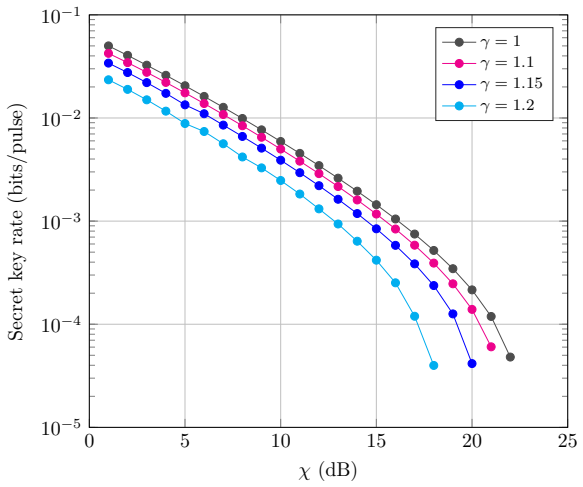
Applying entropy accumulation based on Rényi leftover hashing together with conic optimization methods yields a general security analysis for DPSK that eliminates repetition-rate constraints and costly estimators while still delivering positive secret-key rates with 10^5 signals at channel losses beyond 12 dB.
What carries the argument
Variable-length general security via Rényi leftover hashing combined with conic optimization, which relaxes block-size and repetition-rate requirements for finite-size DPSK proofs.
If this is right
- DPSK systems can operate at higher repetition rates without security penalties from finite-size analysis.
- Positive secret keys become feasible with smaller data blocks than previously required for general security.
- The same variable-length framework can be ported to other DPSK-like phase-encoded protocols.
- Experimental demonstrations no longer need to satisfy the stricter repetition-rate conditions of earlier proofs.
Where Pith is reading between the lines
- Commercial DPSK transmitters already used in classical communications could be repurposed for QKD with only software changes to the security layer.
- The method may extend to other continuous-variable or phase-modulated QKD schemes that currently face similar finite-size bottlenecks.
- Lowering the required block size could enable real-time key generation in low-loss metropolitan networks.
Load-bearing premise
The variable-length general security techniques based on Rényi leftover hashing together with conic optimization methods can be applied to DPSK to remove repetition rate constraints and costly estimators without introducing new unaccounted assumptions or limitations.
What would settle it
A calculation or experiment showing that the secret-key rate becomes zero or negative for 10^5 signals at 12 dB loss under general attacks, or that the Rényi entropy bounds used in the conic program are violated by the actual DPSK statistics.
Figures


read the original abstract
Differential phase shift keying (DPSK) constitutes a pathway towards practical quantum key distribution by using affordable commercial technologies, and robust theoretical foundations. Recent advances in the security of DPSK have proven its security against general adversaries, albeit requiring limitations, including strong repetition rate constraints at the security proof and costly statistical estimators. In this work, we overcome said limitations by leveraging recent techniques in variable-length general security by using entropy accumulation techniques based on R\'enyi leftover hashing, together with conic optimization methods. Our approach achieves secret key rates with $10^5$ signals beyond 12 dB, constituting a robust proof of the experimental implementability of industrial-grade DPSK.
Editorial analysis
A structured set of objections, weighed in public.
Referee Report
Summary. The manuscript develops a finite-size general security proof for differential phase shift keying (DPSK) quantum key distribution. It applies variable-length techniques based on Rényi entropy accumulation and conic optimization to remove prior repetition-rate constraints and costly estimators. The central claim is that positive secret key rates are achieved with only 10^5 signals at channel losses beyond 12 dB, providing evidence for the experimental viability of industrial-grade DPSK.
Significance. If the security reduction holds, the result is significant for practical QKD. DPSK leverages affordable commercial components, and a general finite-size proof at modest block sizes directly supports deployment feasibility. The explicit use of entropy-accumulation theorems together with conic optimization constitutes a methodological advance that reduces fitted parameters and could transfer to related protocols.
major comments (2)
- [§3, Eq. (12)] §3 (Security Analysis) and Eq. (12): the direct invocation of the variable-length Rényi leftover-hashing bound on the DPSK raw-key string does not insert an explicit smoothing or chain-rule term to account for the Markovian dependence induced by differential phase encoding between adjacent pulses. Because the protocol encodes information in relative phases, the i.i.d. or single-shot Rényi bounds cited from the external framework may under-estimate the finite-size penalty; the subsequent conic program therefore optimizes an incomplete dual.
- [Table 1, Fig. 3] Table 1 and Fig. 3 (numerical key rates): the reported positive rates at 10^5 signals and >12 dB loss rest on the assumption that no additional correlation penalty appears. Restoring even a modest Markov-chain correction (e.g., via the chain rule for Rényi entropy) would shift the optimized rates; the manuscript must either derive the missing term or prove it is absorbed by the existing accumulation theorem.
minor comments (2)
- [§2] The notation for the variable-length block size n and the number of signals N is used interchangeably in §2; a single consistent symbol would improve readability.
- [References] Reference list omits the most recent experimental DPSK demonstrations (post-2022); adding two or three citations would better contextualize the claimed industrial relevance.
Simulated Author's Rebuttal
We thank the referee for their careful reading of the manuscript and for highlighting potential subtleties in the application of entropy accumulation to DPSK. The comments focus on the treatment of Markovian dependencies arising from differential phase encoding. We address each point below, explaining why the existing framework already incorporates the necessary accounting.
read point-by-point responses
-
Referee: [§3, Eq. (12)] §3 (Security Analysis) and Eq. (12): the direct invocation of the variable-length Rényi leftover-hashing bound on the DPSK raw-key string does not insert an explicit smoothing or chain-rule term to account for the Markovian dependence induced by differential phase encoding between adjacent pulses. Because the protocol encodes information in relative phases, the i.i.d. or single-shot Rényi bounds cited from the external framework may under-estimate the finite-size penalty; the subsequent conic program therefore optimizes an incomplete dual.
Authors: The variable-length Rényi entropy accumulation theorem applied in §3 and Eq. (12) is formulated precisely for sequential protocols exhibiting Markovian dependence, including the relative-phase encoding of DPSK. The accumulation procedure iterates over the pulse sequence and directly yields a bound that incorporates chain-rule effects and smoothing without requiring an additional explicit term. The cited external framework (entropy accumulation with Rényi leftover hashing) has been proven to hold for such dependent processes; therefore the conic optimization dual remains complete and no modification to Eq. (12) is needed. revision: no
-
Referee: [Table 1, Fig. 3] Table 1 and Fig. 3 (numerical key rates): the reported positive rates at 10^5 signals and >12 dB loss rest on the assumption that no additional correlation penalty appears. Restoring even a modest Markov-chain correction (e.g., via the chain rule for Rényi entropy) would shift the optimized rates; the manuscript must either derive the missing term or prove it is absorbed by the existing accumulation theorem.
Authors: The key rates in Table 1 and Fig. 3 are computed by substituting the output of the variable-length entropy accumulation theorem directly into the conic program. Because the accumulation theorem already absorbs the worst-case Markovian correlations induced by differential encoding, no separate correlation penalty term is required. The numerical results therefore remain valid as stated; the positive rates at 10^5 signals and losses beyond 12 dB follow from the complete bound. revision: no
Circularity Check
No significant circularity; central claim applies external entropy-accumulation and conic-optimization techniques to DPSK
full rationale
The derivation relies on citing and applying recent external variable-length general security methods (Rényi leftover hashing plus conic optimization) to the DPSK protocol. No self-definitional loops, fitted inputs renamed as predictions, or load-bearing self-citation chains are present in the provided abstract or described approach. The key-rate results at 10^5 signals are presented as numerical outcomes of that external framework rather than reductions to the paper's own inputs by construction. This is the expected non-circular outcome for an application paper.
Axiom & Free-Parameter Ledger
axioms (2)
- domain assumption Entropy accumulation techniques based on Rényi leftover hashing apply to the DPSK protocol in the variable-length setting.
- domain assumption Conic optimization methods can efficiently compute the finite-size security bounds for DPSK.
Reference graph
Works this paper leans on
-
[1]
TEFNET24: reference packet optical network topology for edge to core transport , volume =
Jos\'. TEFNET24: reference packet optical network topology for edge to core transport , volume =. J. Opt. Commun. Netw. , keywords =. 2024 , url =
2024
-
[2]
Optimal quantum key distribution networks: capacitance versus security , url =
Cirigliano, Lorenzo and Brosco, Valentina and Castellano, Claudio and Conti, Claudio and Pilozzi, Laura , date =. Optimal quantum key distribution networks: capacitance versus security , url =. npj Quantum Information , doi =. 2024 , month =
2024
-
[3]
Statistical properties of the quantum internet,
Brito, Samuraí and Canabarro, Askery and Chaves, Rafael and Cavalcanti, Daniel , date =. Statistical. doi:10.1103/PhysRevLett.124.210501 , url =
-
[4]
Composable finite-size security of high-dimensional quantum-key-distribution protocols , volume=
Kanitschar, Florian and Huber, Marcus , year=. Composable finite-size security of high-dimensional quantum-key-distribution protocols , volume=. Physical Review Applied , publisher=. doi:10.1103/v51y-vkfr , number=
-
[5]
Sandfuchs, Martin and Haberland, Marcus and Vilasini, V. and Wolf, Ramona , journal =. Security of differential phase shift. doi:10.22331/q-2025-01-27-1611 , url =
-
[6]
Statistical verifications and deep-learning predictions for satellite-to-ground quantum atmospheric channels , author =. Communications Physics , volume =. 2022 , publisher =. doi:10.1038/s42005-022-01002-1 , url =
-
[7]
Finite-Resource Performance of Small-Satellite-Based Quantum-Key-Distribution Missions , author =. PRX Quantum , volume =. 2024 , month =. doi:10.1103/PRXQuantum.5.030101 , url =
-
[8]
Mizutani, Akihiro and Terashita, Masanori and Matsubayashi, Junya and Mori, Shogo and Matsukura, Ibuki and Tagawa, Suzuna and Tamaki, Kiyoshi , title =. 2024 , month =. doi:10.1088/2058-9565/ad71ec , url =
-
[9]
Finite-key security analysis of differential-phase-shift quantum key distribution , author =. Phys. Rev. Res. , volume =. 2023 , month =. doi:10.1103/PhysRevResearch.5.023132 , url =
-
[10]
Chung, Rebecca R. B. and Ng, Nelly H. Y. and Cai, Yu , journal =. Generalized numerical framework for improved finite-sized key rates with. 2025 , publisher =. doi:10.1103/tyts-8v8j , eprint=
-
[11]
Security proof for variable-length quantum key distribution , author =. Phys. Rev. Res. , volume =. 2024 , publisher =. doi:10.1103/PhysRevResearch.6.023002 , archivePrefix =. 2311.01600 , primaryClass =
-
[12]
2023 , eprint=
Information reconciliation for discretely-modulated continuous-variable quantum key distribution , author=. 2023 , eprint=
2023
-
[13]
Proceedings of the Royal Society A: Mathematical, Physical and engineering sciences , volume=
Distillation of secret key and entanglement from quantum states , author=. Proceedings of the Royal Society A: Mathematical, Physical and engineering sciences , volume=. 2005 , publisher=
2005
-
[14]
doi:10.22331/q-2021-09-13-540 , url =
Explicit asymptotic secret key rate of continuous-variable quantum key distribution with an arbitrary modulation , author =. doi:10.22331/q-2021-09-13-540 , url =
-
[15]
Continuous Variable Quantum Cryptography: Beating the 3 dB Loss Limit , author =. Phys. Rev. Lett. , volume =. 2002 , publisher =. doi:10.1103/PhysRevLett.89.167901 , url =
-
[16]
2009 , school=
Theoretical study of continuous-variable quantum key distribution , author=. 2009 , school=
2009
-
[17]
Quantum Information Processing with Finite Resources
Tomamichel, Marco , year=. Quantum Information Processing with Finite Resources , ISBN=. doi:10.1007/978-3-319-21891-5 , journal=
-
[18]
2006 , eprint=
Security of Quantum Key Distribution , author=. 2006 , eprint=
2006
-
[19]
de Finetti Representation Theorem for Infinite-Dimensional Quantum Systems and Applications to Quantum Cryptography , author =. Phys. Rev. Lett. , volume =. 2009 , publisher =. doi:10.1103/PhysRevLett.102.110504 , url =
-
[20]
Asymptotic Security Analysis of Discrete-Modulated Continuous-Variable Quantum Key Distribution , author =. Phys. Rev. X , volume =. 2019 , publisher =. doi:10.1103/PhysRevX.9.041064 , url =
-
[21]
Dimension Reduction in Quantum Key Distribution for Continuous- and Discrete-Variable Protocols , author =. PRX Quantum , volume =. 2021 , publisher =. doi:10.1103/PRXQuantum.2.020325 , url =
-
[22]
Entropy , VOLUME =
Diamanti, Eleni and Leverrier, Anthony , TITLE =. Entropy , VOLUME =. 2015 , NUMBER =
2015
-
[23]
M Peev and others , title =. 2009 , publisher =. doi:10.1088/1367-2630/11/7/075001 , url =
-
[24]
Zubkov, A. M. and Serov, A. A. , title =. Theory of Probability & Its Applications , volume =. 2013 , doi =
2013
-
[25]
The European satellite-based QKD system EAGLE-1 , url=
Hiemstra, Thomas and Hasler, David and Paone, Domenico and Reichert, Fabian and Heine, Frank and Struck, Julian , editor=. The European satellite-based QKD system EAGLE-1 , url=. 2025 , month=mar, pages=. doi:10.1117/12.3042856 , booktitle=
-
[26]
Sasaki and M
M. Sasaki and M. Fujiwara and H. Ishizuka and W. Klaus and K. Wakui and M. Takeoka and S. Miki and T. Yamashita and Z. Wang and A. Tanaka and K. Yoshino and Y. Nambu and S. Takahashi and A. Tajima and A. Tomita and T. Domeki and T. Hasegawa and Y. Sakai and H. Kobayashi and T. Asai and K. Shimizu and T. Tokura and T. Tsurumaru and M. Matsui and T. Honjo a...
2011
-
[27]
and Sekatski, Pavel and Bancal, Jean-Daniel and Schwonnek, Ren
Tan, Ernest Y.-Z. and Sekatski, Pavel and Bancal, Jean-Daniel and Schwonnek, Ren. Improved. doi:10.22331/q-2022-12-22-880 , url =
-
[28]
Applied Physics Reviews , volume =
Zhang, Yichen and Bian, Yiming and Li, Zhengyu and Yu, Song and Guo, Hong , title = ". Applied Physics Reviews , volume =. 2024 , month =. doi:10.1063/5.0179566 , url =
-
[29]
doi:10.22331/q-2024-07-18-1418 , url =
Security of discrete-modulated continuous-variable quantum key distribution , author =. doi:10.22331/q-2024-07-18-1418 , url =
-
[30]
2022 , MONTH = Dec, KEYWORDS =
Neves, Simon , URL =. 2022 , MONTH = Dec, KEYWORDS =
2022
-
[31]
Improved finite-size key rates for discrete-modulated continuous-variable quantum key distribution under coherent attacks , author =. Phys. Rev. A , volume =. 2025 , month =. doi:10.1103/PhysRevA.111.022610 , url =
-
[32]
Information Reconciliation for High-Dimensional Quantum Key Distribution using Nonbinary LDPC codes , year=
Müller, Ronny and Bacco, Davide and Oxenløwe, Leif Katsou and Forchhammer, Søren , booktitle=. Information Reconciliation for High-Dimensional Quantum Key Distribution using Nonbinary LDPC codes , year=
-
[33]
Quantum cryptography without Bell's theorem , author =. Phys. Rev. Lett. , volume =. 1992 , month =. doi:10.1103/PhysRevLett.68.557 , url =
-
[34]
Journal of Mathematical Physics , volume=
The smooth entropy formalism for von Neumann algebras , author=. Journal of Mathematical Physics , volume=. 2016 , publisher=
2016
-
[35]
, journal=
Winter, A. , journal=. Coding theorem and strong converse for quantum channels , year=
-
[36]
2012 , publisher=
Security of continuous-variable quantum key distribution and aspects of device-independent security , author=. 2012 , publisher=
2012
-
[37]
Security Bounds for Continuous Variables Quantum Key Distribution , author =. Phys. Rev. Lett. , volume =. 2005 , publisher =. doi:10.1103/PhysRevLett.94.020505 , url =
-
[38]
and Guosen Yue and Li Ping and Xiaodong Wang , journal=
Leung, W.K.R. and Guosen Yue and Li Ping and Xiaodong Wang , journal=. Concatenated zigzag hadamard codes , year=
-
[39]
Finite-Size Security for Discrete-Modulated Continuous-Variable Quantum Key Distribution Protocols , author =. PRX Quantum , volume =. 2023 , publisher =. doi:10.1103/PRXQuantum.4.040306 , url =
-
[40]
Milicevic, Mario and Feng, Chen and Zhang, Lei M. and Gulak, P. Glenn , title =. npj Quantum Information , volume =. 2018 , issue =. doi:10.1038/s41534-018-0070-6 , url =
-
[41]
Quantum Info
Martinez-Mateo, Jesus and Pacher, Christoph and Peev, Momtchil and Ciurana, Alex and Martin, Vicente , title =. Quantum Info. Comput. , pages =. 2015 , issue_date =
2015
-
[42]
Physical Review A , volume=
Unification of different views of decoherence and discord , author=. Physical Review A , volume=. 2012 , publisher=
2012
-
[43]
Quantum , volume=
Reliable numerical key rates for quantum key distribution , author=. Quantum , volume=. 2018 , publisher=
2018
-
[44]
Naval research logistics quarterly , volume=
An algorithm for quadratic programming , author=. Naval research logistics quarterly , volume=. 1956 , publisher=
1956
-
[45]
Solving natural conic formulations with
Chris Coey and Lea Kapelevich and Juan Pablo Vielma , year=. Solving natural conic formulations with. INFORMS Journal on Computing , publisher=
-
[46]
2023 , journal=
Performance enhancements for a generic conic interior point algorithm , author=. 2023 , journal=
2023
-
[47]
JuMP 1.0: recent improvements to a modeling language for mathematical optimization
Miles Lubin and Oscar Dowson and Joaquim. Mathematical Programming Computation , year =. doi:10.1007/s12532-023-00239-3 , archivePrefix =. 2206.03866 , primaryClass =
-
[48]
Julia: AFreshApproach to Numerical Computing.arXiv:1411.1607 [cs], July 2015
Bezanson, Jeff and Edelman, Alan and Karpinski, Stefan and Shah, Viral B. , title =. SIAM Review , volume =. 2017 , doi =. 1411.1607 , archivePrefix=
-
[49]
and Wolf, J
Slepian, D. and Wolf, J. , journal=. Noiseless coding of correlated information sources , year=
-
[50]
2004 , publisher=
Convex optimization , author=. 2004 , publisher=
2004
-
[51]
MOSEK optimization suite , author=
-
[52]
K. C. Toh and M. J. Todd and R. H. Tütüncü , title =. Optimization Methods and Software , volume =. 1999 , publisher =
1999
-
[53]
Tütüncü, R. H. and Toh, K. C. and Toh, K. C. , title =. Mathematical programming Ser.B , volume =
-
[54]
Computational Complexity of Continuous Variable Quantum Key Distribution , year=
Zhao, Yi-Bo and Gui, You-Zhen and Chen, Jin-Jian and Han, Zheng-Fu and Guo, Guang-Can , journal=. Computational Complexity of Continuous Variable Quantum Key Distribution , year=
-
[55]
Unconditional Security Proof of Long-Distance Continuous-Variable Quantum Key Distribution with Discrete Modulation , author =. Phys. Rev. Lett. , volume =. 2009 , publisher =. doi:10.1103/PhysRevLett.102.180504 , url =
-
[56]
Journal of the American Statistical Association , volume =
Wassily Hoeffding , title =. Journal of the American Statistical Association , volume =. 1963 , publisher =. doi:10.1080/01621459.1963.10500830 , URL =
-
[57]
Trusted Detector Noise Analysis for Discrete Modulation Schemes of Continuous-Variable Quantum Key Distribution , author =. Phys. Rev. Appl. , volume =. 2020 , publisher =. doi:10.1103/PhysRevApplied.14.064030 , url =
-
[58]
Composable Security Proof for Continuous-Variable Quantum Key Distribution with Coherent States , author =. Phys. Rev. Lett. , volume =. 2015 , publisher =. doi:10.1103/PhysRevLett.114.070501 , url =
-
[59]
and Cardinal, J
Van Assche, G. and Cardinal, J. and Cerf, N.J. , journal=. Reconciliation of a quantum-distributed Gaussian key , year=
-
[60]
Proceedings of the CACSD Conference , title =
L. Proceedings of the CACSD Conference , title =
-
[61]
Multiedge-type low-density parity-check codes for continuous-variable quantum key distribution , author =. Phys. Rev. A , volume =. 2021 , publisher =. doi:10.1103/PhysRevA.103.062419 , url =
-
[62]
and Wu, K.Y
Li Ping and Leung, W.K. and Wu, K.Y. , journal=. Low-rate turbo-Hadamard codes , year=
-
[63]
SIAM Journal on Computing , volume =
Arnon-Friedman, Rotem and Renner, Renato and Vidick, Thomas , title =. SIAM Journal on Computing , volume =. 2019 , doi =
2019
-
[64]
Quantum , volume=
Robust interior point method for quantum key distribution rate computation , author=. Quantum , volume=. 2022 , publisher=
2022
-
[65]
Communications in Mathematical Physics , volume=
Entropy Accumulation , author=. Communications in Mathematical Physics , volume=. 2020 , publisher=
2020
-
[66]
IEEE Transactions on information theory , volume=
Entropy accumulation with improved second-order term , author=. IEEE Transactions on information theory , volume=. 2019 , publisher=
2019
-
[67]
arXiv preprint arXiv:2203.06554 , year=
Finite-Key Analysis of Quantum Key Distribution with Characterized Devices Using Entropy Accumulation , author=. arXiv preprint arXiv:2203.06554 , year=
-
[68]
2024 , eprint=
Discrete-modulated continuous-variable quantum key distribution secure against general attacks , author=. 2024 , eprint=
2024
-
[69]
2024 , eprint=
Quantum key distribution rates from non-symmetric conic optimization , author=. 2024 , eprint=
2024
-
[70]
Security of quantum key distribution from generalised entropy accumulation , volume =. Nature Communications , author =. 2023 , pages =. doi:10.1038/s41467-023-40920-8 , number =
-
[71]
2015 , journal=
A homogeneous interior-point algorithm for nonsymmetric convex conic optimization , author=. 2015 , journal=
2015
-
[72]
SIAM Review , volume =
Iain Dunning and Joey Huchette and Miles Lubin , title =. SIAM Review , volume =. 2017 , doi =
2017
-
[73]
Nahar, Shlok and Tupkary, Devashish and Lütkenhaus, Norbert , year=. Imperfect detectors for adversarial tasks with applications to quantum key distribution , volume=. doi:10.22331/q-2026-03-24-2044 , journal=
-
[74]
Weedbrooket al., Gaussian quantum in- formation, Rev
Gaussian. Reviews of Modern Physics , author =. 2012 , note =. doi:10.1103/RevModPhys.84.621 , number =
-
[75]
Bennett and Gilles Brassard
Charles H. Bennett and Gilles Brassard. Quantum. Proceedings of the IEEE International Conference on Computers, Systems and Signal Processing
-
[76]
Ekert, A. K. , journal =. 1991 , publisher=
1991
-
[77]
Physical Review Letters , volume=
Continuous variable quantum cryptography using coherent states , author=. Physical Review Letters , volume=. 2002 , publisher=
2002
-
[78]
Unconditional optimality of
Garc. Unconditional optimality of. Physical Review Letters , volume=. 2006 , publisher=
2006
-
[79]
Asymptotic security of binary modulated continuous-variable quantum key distribution under collective attacks , author =. Phys. Rev. A , volume =. 2009 , publisher =. doi:10.1103/PhysRevA.79.012307 , url =
-
[80]
Quantum key distribution using gaussian-modulated coherent states , volume =. Nature , author =. 2003 , pages =. doi:10.1038/nature01289 , number =
discussion (0)
Sign in with ORCID, Apple, or X to comment. Anyone can read and Pith papers without signing in.