Recognition: unknown
Beyond Rigid Alignment: Graph Federated Learning via Dual Manifold Calibration
Pith reviewed 2026-05-08 13:12 UTC · model grok-4.3
The pith
FedGMC replaces rigid alignment in graph federated learning with dual manifold calibration to keep both global commonalities and local personalization intact.
A machine-rendered reading of the paper's core claim, the machinery that carries it, and where it could break.
Core claim
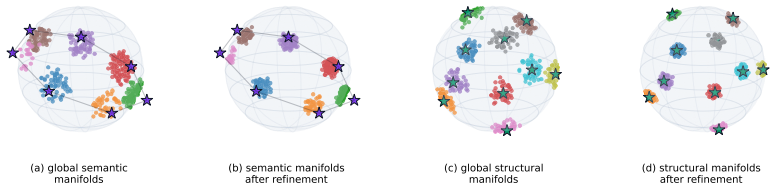
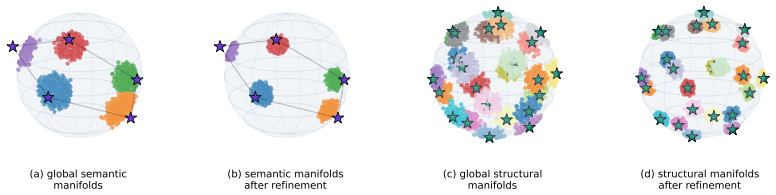
Instead of enforcing rigid alignment of parameters or prototypes, FedGMC constructs a geometrically optimal semantic manifold via equidistant semantic anchors to guide local semantic calibration and a global structural manifold via structural templates to guide local structural calibration; the server then dynamically refines both global manifolds by aggregating the calibrated local manifolds, thereby preserving diverse local graph distributions while maintaining global commonalities.
What carries the argument
dual manifold calibration mechanism that uses equidistant semantic anchors for semantic heterogeneity and global structural templates for structural heterogeneity to steer local manifold adjustments
If this is right
- Clients retain distinct local graph distributions instead of having them compressed into one shared linear space.
- Semantic and structural heterogeneity are handled uniformly through manifold guidance rather than separate ad-hoc fixes.
- Dynamic aggregation of local manifolds continuously updates the global templates and anchors across communication rounds.
- The approach applies equally to homophilic graphs, where neighbors share labels, and heterophilic graphs, where they do not.
Where Pith is reading between the lines
- The separation of semantic and structural manifolds suggests a template that could be tested in non-graph federated settings where data distributions differ along multiple independent axes.
- If equidistant anchors prove stable across rounds, they could be pre-computed once and reused, lowering communication cost in later training stages.
- The method's success on both homophilic and heterophilic graphs indicates it may generalize to other domains that mix dense and sparse connectivity patterns.
Load-bearing premise
Constructing geometrically optimal semantic manifolds via equidistant anchors and global structural templates can guide local calibration while preserving diverse local distributions without the restrictive global linearity assumption.
What would settle it
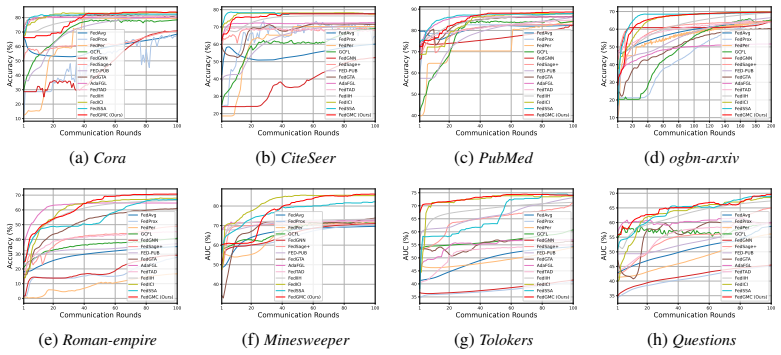
On the eleven homophilic and heterophilic graphs used in the evaluation, FedGMC would fail to show statistically significant gains over rigid-alignment baselines or would show that local client distributions become compressed rather than preserved.
Figures





read the original abstract
Graph Federated Learning (GFL) enables collaborative representation learning across distributed subgraphs while preserving privacy. However, heterogeneity remains a critical challenge, as subgraphs across clients typically differ significantly in both semantics and structures. Existing methods address heterogeneity by enforcing the rigid alignment of model parameters or prototypes between clients and the server. However, these alignments implicitly rely on a restrictive global linearity assumption that summarizes local data distributions using a single and globally consistent representation space. This severely compresses the personalized representation space of clients and fails to preserve diverse local graph distributions. To overcome these limitations, we propose Federated Graph Manifold Calibration (FedGMC), a novel paradigm that tackles semantic heterogeneity and structural heterogeneity from a unified manifold perspective. Instead of enforcing rigid alignment, FedGMC introduces a dual manifold calibration mechanism that preserves global commonalities while maximizing the personalized representation space of local clients. Specifically, for semantic heterogeneity, the server constructs a geometrically optimal semantic manifold via equidistant semantic anchors, so as to guide the calibration of local semantic manifolds. For structural heterogeneity, the server constructs a global structural manifold by building global structural templates, so as to guide the calibration of local structural manifolds. Finally, the server dynamically refines both global semantic manifolds and structural manifolds by aggregating local manifolds. Extensive experiments on eleven homophilic and heterophilic graphs demonstrate that FedGMC effectively balances global commonality and local personalization, thereby significantly outperforming state-of-the-art baseline methods.
Editorial analysis
A structured set of objections, weighed in public.
Referee Report
Summary. The paper proposes Federated Graph Manifold Calibration (FedGMC) as a new paradigm for graph federated learning to address semantic and structural heterogeneity. Instead of rigid alignment of parameters or prototypes (which relies on a global linearity assumption), FedGMC uses a dual manifold calibration mechanism: the server builds a geometrically optimal semantic manifold via equidistant semantic anchors to calibrate local semantic manifolds, and a global structural manifold via structural templates to calibrate local structural manifolds. Local manifolds are then dynamically aggregated to refine the global ones. Experiments on eleven homophilic and heterophilic graphs are reported to show that FedGMC balances global commonality and local personalization better than state-of-the-art baselines.
Significance. If the empirical results and manifold constructions hold under scrutiny, this work offers a coherent relaxation of the restrictive linearity assumption common in prior GFL methods. The manifold-based perspective for handling both semantic and structural heterogeneity could meaningfully advance personalized federated learning on graphs, particularly for heterophilic settings where rigid global representations compress local diversity.
major comments (2)
- [§3.1–3.2] §3.1–3.2: The construction of the 'geometrically optimal semantic manifold via equidistant semantic anchors' is described at a high level but lacks explicit equations showing how equidistance is enforced (e.g., via a specific loss or constraint) and how it avoids introducing hidden parameters that effectively reintroduce a global linearity assumption; this is load-bearing for the central claim that the method is free of the restrictive global linearity of prior work.
- [§4] §4 (Experiments): While outperformance on eleven graphs is asserted, the manuscript provides insufficient detail on the precise baselines, metrics (e.g., node classification accuracy vs. other measures), ablation studies isolating the dual calibration components, and statistical significance testing; without these, the claim that FedGMC 'significantly outperforms' cannot be fully evaluated.
minor comments (2)
- Notation for local vs. global manifolds is introduced without a clear summary table or diagram early in the paper, making it harder to track the dual calibration flow.
- [Abstract, §1] The abstract and introduction repeat the phrase 'balances global commonality and local personalization' without quantifying what 'maximizing the personalized representation space' means in terms of a measurable quantity.
Simulated Author's Rebuttal
We thank the referee for the constructive and insightful comments on our manuscript. We have carefully reviewed each point and provide detailed responses below. Where appropriate, we will revise the manuscript to incorporate additional technical details and experimental clarifications, which we believe will strengthen the presentation without altering the core contributions.
read point-by-point responses
-
Referee: [§3.1–3.2] §3.1–3.2: The construction of the 'geometrically optimal semantic manifold via equidistant semantic anchors' is described at a high level but lacks explicit equations showing how equidistance is enforced (e.g., via a specific loss or constraint) and how it avoids introducing hidden parameters that effectively reintroduce a global linearity assumption; this is load-bearing for the central claim that the method is free of the restrictive global linearity of prior work.
Authors: We appreciate the referee's emphasis on this foundational aspect of our approach. The manuscript intentionally presents the dual manifold calibration at a conceptual level in §3.1–3.2 to highlight the departure from rigid alignment methods. However, we acknowledge that explicit formulations would better substantiate the claims. In the revised version, we will add precise equations in §3.1 detailing the construction of the geometrically optimal semantic manifold, including the specific regularization term or optimization constraint (e.g., a pairwise distance variance minimization objective) used to enforce equidistance among semantic anchors. We will also include a clarifying discussion and supporting argument demonstrating that this manifold calibration avoids reintroducing a global linearity assumption: unlike prior methods that enforce a single shared linear representation space across clients, our anchors serve only as calibration references on a non-linear manifold, permitting each local client to retain its own curved, personalized semantic structure. This distinction will be illustrated with a brief theoretical comparison to linear prototype alignment. revision: yes
-
Referee: [§4] §4 (Experiments): While outperformance on eleven graphs is asserted, the manuscript provides insufficient detail on the precise baselines, metrics (e.g., node classification accuracy vs. other measures), ablation studies isolating the dual calibration components, and statistical significance testing; without these, the claim that FedGMC 'significantly outperforms' cannot be fully evaluated.
Authors: We agree that expanded experimental details are essential for full reproducibility and evaluation of the performance claims. In the revised §4, we will provide: a complete enumeration of all baselines with citations, key hyperparameters, and how they were adapted to the graph federated setting; explicit confirmation that node classification accuracy is the primary metric (with any supplementary metrics such as macro-F1 noted); dedicated ablation studies that isolate the semantic manifold calibration and structural manifold calibration components individually and in combination; and statistical analysis including means and standard deviations over multiple random seeds, along with paired t-test p-values to assess significance of improvements over baselines. These additions will be drawn from the existing experimental protocol on the eleven homophilic and heterophilic graphs and will not require new runs. revision: yes
Circularity Check
No significant circularity; derivation self-contained
full rationale
The paper introduces FedGMC as a new paradigm using dual manifold calibration (equidistant semantic anchors for semantic heterogeneity and global structural templates for structural heterogeneity, with dynamic aggregation). The abstract and high-level description present these as constructive mechanisms operating on manifolds to relax the global linearity assumption of prior rigid-alignment methods. No equations, fitted parameters renamed as predictions, self-definitional reductions, or load-bearing self-citations appear in the provided text. The central claim rests on the proposed construction and experimental validation rather than any step that reduces by construction to its own inputs. This is the normal case of an independent proposal.
Axiom & Free-Parameter Ledger
axioms (2)
- domain assumption Subgraphs across clients differ significantly in both semantics and structures
- domain assumption Rigid alignment implicitly relies on a restrictive global linearity assumption
invented entities (3)
-
Dual manifold calibration mechanism
no independent evidence
-
Geometrically optimal semantic manifold via equidistant semantic anchors
no independent evidence
-
Global structural manifold via global structural templates
no independent evidence
Reference graph
Works this paper leans on
-
[1]
Regan, Hongbo Jiang, and Licheng Jiao
Jing Bai, Wentao Yu, Zhu Xiao, Vincent Havyarimana, Amelia C. Regan, Hongbo Jiang, and Licheng Jiao. Two-stream spatial–temporal graph convolutional networks for driver drowsiness detection.IEEE Transactions on Cybernetics, 52(12):13821–13833, 2022
2022
-
[2]
Hyperspectral image classification with contrastive graph convolutional network.IEEE Transactions on Geoscience and Remote Sensing, 61(1):1–15, 2023
Wentao Yu, Sheng Wan, Guangyu Li, Jian Yang, and Chen Gong. Hyperspectral image classification with contrastive graph convolutional network.IEEE Transactions on Geoscience and Remote Sensing, 61(1):1–15, 2023
2023
-
[3]
Traffic pattern sharing for federated traffic flow prediction with personalization
Hang Zhou, Wentao Yu, Sheng Wan, Yongxin Tong, Tianlong Gu, and Chen Gong. Traffic pattern sharing for federated traffic flow prediction with personalization. InInternational Conference on Data Mining, pages 1–10, 2024
2024
-
[4]
FedTPS: traf- fic pattern sharing for personalized federated traffic flow prediction.Knowledge and Information Systems, 1(1):1–27, 2025
Hang Zhou, Wentao Yu, Sheng Wan, Yongxin Tong, Tianlong Gu, and Chen Gong. FedTPS: traf- fic pattern sharing for personalized federated traffic flow prediction.Knowledge and Information Systems, 1(1):1–27, 2025
2025
-
[5]
Inter-client de- pendency recovery with hidden global components for federated traffic prediction
Hang Zhou, Wentao Yu, Yang Wei, Guangyu Li, Sha Xu, and Chen Gong. Inter-client de- pendency recovery with hidden global components for federated traffic prediction. InAAAI Conference on Artificial Intelligence, pages 28946–28954, 2026
2026
-
[6]
Atom-motif contrastive transformer for molecular property prediction.ACM Transactions on Intelligent Systems and Technology, 1(1):1–28, 2026
Wentao Yu, Shuo Chen, Chen Gong, Bo Han, Gang Niu, and Masashi Sugiyama. Atom-motif contrastive transformer for molecular property prediction.ACM Transactions on Intelligent Systems and Technology, 1(1):1–28, 2026
2026
-
[7]
Personalized subgraph federated learning
Jinheon Baek, Wonyong Jeong, Jiongdao Jin, Jaehong Yoon, and Sung Ju Hwang. Personalized subgraph federated learning. InInternational Conference on Machine Learning, pages 1396– 1415, 2023
2023
-
[8]
Modeling inter-intra heterogeneity for graph federated learning
Wentao Yu, Shuo Chen, Yongxin Tong, Tianlong Gu, and Chen Gong. Modeling inter-intra heterogeneity for graph federated learning. InAAAI Conference on Artificial Intelligence, pages 22236–22244, 2025
2025
-
[9]
Wentao Yu. Homophily heterogeneity matters in graph federated learning: A spectrum sharing and complementing perspective.arXiv:2502.13732, pages 1–15, 2025
-
[10]
Integrating commonality and individuality for graph federated learning: A graph spectrum perspective.Authorea Preprints, pages 1–16, 2025
Wentao Yu, Chen Gong, Bo Han, Lixin Fan, and Qiang Yang. Integrating commonality and individuality for graph federated learning: A graph spectrum perspective.Authorea Preprints, pages 1–16, 2025
2025
-
[11]
Heterogeneity-aware knowledge sharing for graph federated learning
Wentao Yu, Sheng Wan, Shuo Chen, Bo Han, and Chen Gong. Heterogeneity-aware knowledge sharing for graph federated learning. InInternational Conference on Machine Learning, pages 1–8, 2026
2026
-
[12]
Federated graph classification over non-iid graphs
Han Xie, Jing Ma, Li Xiong, and Carl Yang. Federated graph classification over non-iid graphs. InAdvances in Neural Information Processing Systems, pages 18839–18852, 2021. 10
2021
-
[13]
Federated optimization in heterogeneous networks
Tian Li, Anit Kumar Sahu, Manzil Zaheer, Maziar Sanjabi, Ameet Talwalkar, and Virginia Smith. Federated optimization in heterogeneous networks. InMachine Learning and Systems, pages 429–450, 2020
2020
-
[14]
FedProto: Federated prototype learning across heterogeneous clients
Yue Tan, Guodong Long, Lu Liu, Tianyi Zhou, Qinghua Lu, Jing Jiang, and Chengqi Zhang. FedProto: Federated prototype learning across heterogeneous clients. InAAAI Conference on Artificial Intelligence, pages 8432–8440, 2022
2022
-
[15]
Federated graph semantic and structural learning
Wenke Huang, Guancheng Wan, Mang Ye, and Bo Du. Federated graph semantic and structural learning. InInternational Joint Conference on Artificial Intelligence, pages 3830–3838, 2023
2023
-
[16]
FedMC: Federated manifold calibration
Yanbiao Ma, Wei Dai, Gaoyang Jiang, Wanyi Chen, Chenyue Zhou, Yiwei Zhang, Fei Luo, Junhao Wang, and Andi Zhang. FedMC: Federated manifold calibration. InInternational Conference on Learning Representations, pages 1–21, 2026
2026
-
[17]
Beyond homophily in graph neural networks: Current limitations and effective designs
Jiong Zhu, Yujun Yan, Lingxiao Zhao, Mark Heimann, Leman Akoglu, and Danai Koutra. Beyond homophily in graph neural networks: Current limitations and effective designs. In Advances in Neural Information Processing Systems, pages 7793–7804, 2020
2020
-
[18]
Consistency- driven calibration and matching for few-shot class incremental learning
Qinzhe Wang, Zixuan Chen, Keke Huang, Xiu Su, Chunhua Yang, and Chang Xu. Consistency- driven calibration and matching for few-shot class incremental learning. InInternational Conference on Learning Representations, pages 1–25, 2026
2026
-
[19]
FedGNN: Federated graph neural network for privacy-preserving recommendation.arXiv:2102.04925, 2021
Chuhan Wu, Fangzhao Wu, Yang Cao, Yongfeng Huang, and Xing Xie. FedGNN: Federated graph neural network for privacy-preserving recommendation.arXiv:2102.04925, 2021
-
[20]
FedTAD: Topology- aware data-free knowledge distillation for subgraph federated learning
Yinlin Zhu, Xunkai Li, Zhengyu Wu, Di Wu, Miao Hu, and Rong-Hua Li. FedTAD: Topology- aware data-free knowledge distillation for subgraph federated learning. InInternational Joint Conference on Artificial Intelligence, pages 1–9, 2024
2024
-
[21]
Tenenbaum, Vin de Silva, and John C
Joshua B. Tenenbaum, Vin de Silva, and John C. Langford. A global geometric framework for nonlinear dimensionality reduction.Science, 290(5500):2319–2323, 2000
2000
-
[22]
A geometric understanding of deep learning.Engineering, 6(3):361–374, 2020
Na Lei, Dongsheng An, Yang Guo, Kehua Su, Shixia Liu, Zhongxuan Luo, Shing-Tung Yau, and Xianfeng Gu. A geometric understanding of deep learning.Engineering, 6(3):361–374, 2020
2020
-
[23]
Caterini, Gabriel Loaiza-Ganem, Geoff Pleiss, and John P
Anthony L. Caterini, Gabriel Loaiza-Ganem, Geoff Pleiss, and John P. Cunningham. Rectangu- lar flows for manifold learning. InAdvances in Neural Information Processing Systems, pages 30228–30241, 2021
2021
-
[24]
Kiani, Jason Wang, and Melanie Weber
Bobak T. Kiani, Jason Wang, and Melanie Weber. Hardness of learning neural networks under the manifold hypothesis. InAdvances in Neural Information Processing Systems, pages 5661–5696, 2024
2024
-
[25]
Mixon, and John Jasper
Matthew Fickus, Dustin G. Mixon, and John Jasper. Equiangular tight frames from hyperovals. IEEE Transactions on Information Theory, 62(9):5225–5236, 2016
2016
-
[26]
Guiding neural collapse: Opti- mising towards the nearest simplex equiangular tight frame
Evan Markou, Thalaiyasingam Ajanthan, and Stephen Gould. Guiding neural collapse: Opti- mising towards the nearest simplex equiangular tight frame. InAdvances in Neural Information Processing Systems, pages 35544–35573, 2024
2024
-
[27]
Sinkhorn distances: Lightspeed computation of optimal transport
Marco Cuturi. Sinkhorn distances: Lightspeed computation of optimal transport. InAdvances in Neural Information Processing Systems, pages 1–9, 2013
2013
-
[28]
Unified optimal transport framework for universal domain adaptation
Wanxing Chang, Ye Shi, Hoang Tuan, and Jingya Wang. Unified optimal transport framework for universal domain adaptation. InAdvances in Neural Information Processing Systems, pages 29512–29524, 2022
2022
-
[29]
CSOT: Curriculum and structure-aware optimal transport for learning with noisy labels
Wanxing Chang, Ye Shi, and Jingya Wang. CSOT: Curriculum and structure-aware optimal transport for learning with noisy labels. InAdvances in Neural Information Processing Systems, pages 8528–8541, 2023
2023
-
[30]
On a linear Gromov–Wasserstein distance
Florian Beier, Robert Beinert, and Gabriele Steidl. On a linear Gromov–Wasserstein distance. IEEE Transactions on Image Processing, 31(1):7292–7305, 2022. 11
2022
-
[31]
Communication-efficient learning of deep networks from decentralized data
Brendan McMahan, Eider Moore, Daniel Ramage, Seth Hampson, and Blaise Aguera y Arcas. Communication-efficient learning of deep networks from decentralized data. InInternational Conference on Artificial Intelligence and Statistics, pages 1273–1282, 2017
2017
-
[32]
Federated Learning with Personalization Layers
Manoj Ghuhan Arivazhagan, Vinay Aggarwal, Aaditya Kumar Singh, and Sunav Choudhary. Federated learning with personalization layers.arXiv:1912.00818, 2019
work page internal anchor Pith review arXiv 1912
-
[33]
Subgraph federated learning with missing neighbor generation
Ke Zhang, Carl Yang, Xiaoxiao Li, Lichao Sun, and Siu Ming Yiu. Subgraph federated learning with missing neighbor generation. InAdvances in Neural Information Processing Systems, pages 6671–6682, 2021
2021
-
[34]
FedGTA: Topology-aware averaging for federated graph learning
Xunkai Li, Zhengyu Wu, Wentao Zhang, Yinlin Zhu, Rong-Hua Li, and Guoren Wang. FedGTA: Topology-aware averaging for federated graph learning. InInternational Conference on Very Large Databases, pages 41–50, 2023
2023
-
[35]
AdaFGL: A new paradigm for federated node classification with topology heterogeneity
Xunkai Li, Zhengyu Wu, Wentao Zhang, Henan Sun, Rong-Hua Li, and Guoren Wang. AdaFGL: A new paradigm for federated node classification with topology heterogeneity. InInternational Conference on Data Engineering, pages 2517–2530, 2024
2024
-
[36]
Visualizing data using t-SNE.Journal of Machine Learning Research, 9(11):2579–2605, 2008
Laurens Van der Maaten and Geoffrey Hinton. Visualizing data using t-SNE.Journal of Machine Learning Research, 9(11):2579–2605, 2008
2008
-
[37]
A critical look at the evaluation of GNNs under heterophily: Are we re- ally making progress? InInternational Conference on Learning Representations, pages 1–15, 2023
Oleg Platonov, Denis Kuznedelev, Michael Diskin, Artem Babenko, and Liudmila Prokhorenkova. A critical look at the evaluation of GNNs under heterophily: Are we re- ally making progress? InInternational Conference on Learning Representations, pages 1–15, 2023
2023
-
[38]
METIS: Unstructured graph partitioning and sparse matrix ordering system
George Karypis. METIS: Unstructured graph partitioning and sparse matrix ordering system. Technical report, 1997
1997
-
[39]
Felix Sattler, Klaus-Robert Müller, and Wojciech Samek. Clustered federated learning: Model- agnostic distributed multitask optimization under privacy constraints.IEEE Transactions on Neural Networks and Learning Systems, 32(8):3710–3722, 2021
2021
-
[40]
Kipf and Max Welling
Thomas N. Kipf and Max Welling. Semi-supervised classification with graph convolutional networks. InInternational Conference on Learning Representations, pages 1–14, 2017
2017
-
[41]
Inductive representation learning on large graphs
Will Hamilton, Zhitao Ying, and Jure Leskovec. Inductive representation learning on large graphs. InAdvances in Neural Information Processing Systems, pages 1–11, 2017
2017
-
[42]
Graph attention multi-layer perceptron
Wentao Zhang, Ziqi Yin, Zeang Sheng, Yang Li, Wen Ouyang, Xiaosen Li, Yangyu Tao, Zhi Yang, and Bin Cui. Graph attention multi-layer perceptron. InACM SIGKDD Conference on Knowledge Discovery and Data Mining, pages 4560–4570, 2022
2022
-
[43]
Disentangled graph con- volutional networks
Jianxin Ma, Peng Cui, Kun Kuang, Xin Wang, and Wenwu Zhu. Disentangled graph con- volutional networks. InInternational Conference on Machine Learning, pages 4212–4221, 2019
2019
-
[44]
How universal polynomial bases enhance spectral graph neural networks: Heterophily, over-smoothing, and over-squashing
Keke Huang, Yu Guang Wang, Ming Li, and Pietro Lio. How universal polynomial bases enhance spectral graph neural networks: Heterophily, over-smoothing, and over-squashing. In International Conference on Machine Learning, pages 1–20, 2024. 12 NeurIPS Paper Checklist 1.Claims Question: Do the main claims made in the abstract and introduction accurately refl...
2024
-
[45]
Institutional review board (IRB) approvals or equivalent for research with human subjects Question: Does the paper describe potential risks incurred by study participants, whether such risks were disclosed to the subjects, and whether Institutional Review Board (IRB) approvals (or an equivalent approval/review based on the requirements of your country or ...
2082
discussion (0)
Sign in with ORCID, Apple, or X to comment. Anyone can read and Pith papers without signing in.