Recognition: unknown
Revisiting the Constancy of the Speed of Light: Galaxy Cluster Mass Bias Implications
Pith reviewed 2026-05-08 05:34 UTC · model grok-4.3
The pith
Galaxy cluster and supernova data support constant speed of light except under one mass calibration
A machine-rendered reading of the paper's core claim, the machinery that carries it, and where it could break.
Core claim
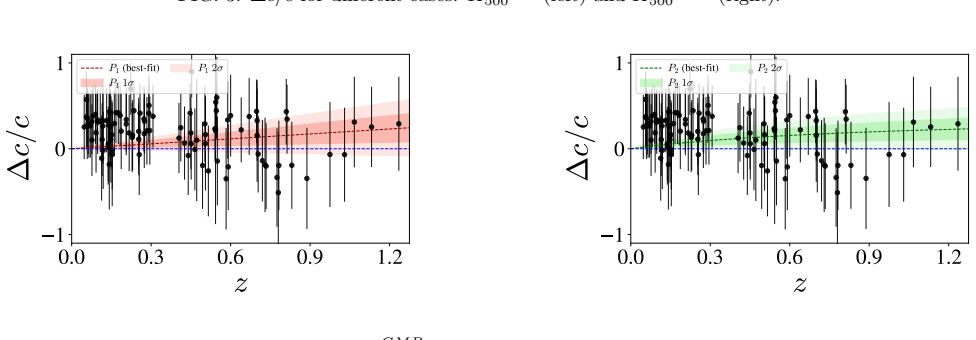
Combining X-ray gas mass fraction measurements from galaxy clusters with SNe Ia luminosity distances from Pantheon+, while adopting the SH0ES H0 prior and the Omega_b/Omega_m ratio from galaxy clustering, yields no deviation from a constant speed of light when CLASH or CCCP mass bias priors are used; the Planck-based calibration produces mild tension, with constant c only marginally consistent at the 2 sigma level.
What carries the argument
The comparison of observed X-ray gas mass fractions in clusters to the expected baryon fraction, set against supernova luminosity distances, under fixed H0 and density ratio priors to constrain possible redshift or distance dependence in c.
If this is right
- The test minimizes reliance on a specific cosmological model through the chosen priors on H0 and the baryon fraction.
- Conclusions about constant c vary with the cluster mass calibration scheme adopted.
- The Planck calibration introduces a 2 sigma tension that may point to residual systematics in mass estimates.
- The method offers a route to probe fundamental constants using cluster observations with reduced model dependence.
Where Pith is reading between the lines
- Future surveys with tighter independent mass constraints could resolve whether the Planck tension reflects calibration issues or a real variation in c.
- The same cluster-plus-supernova comparison could be applied to test other constants or extensions of general relativity.
- Cross-calibration between CLASH, CCCP, and Planck methods would strengthen the reliability of this test for fundamental physics.
Load-bearing premise
The adopted cluster mass bias calibrations from CLASH, CCCP, and Planck correctly capture the true total masses without systematic errors that could mimic or mask variations in the speed of light.
What would settle it
An independent measurement of cluster total masses that aligns with CLASH or CCCP values but produces a clear deviation from constant c in the same gas fraction and distance data would falsify the no-variation conclusion.
Figures


read the original abstract
In recent years, improvements in galaxy cluster observations have enabled a variety of tests of fundamental physics using these systems. In this work, we test the constancy of the speed of light, $c$, by combining X-ray gas mass fraction measurements from galaxy clusters with SNe Ia luminosity distance measurements from Pantheon+. We adopt the SH0ES prior on $H_0$ and the $\Omega_b/\Omega_m$ ratio from galaxy clustering observations, thereby minimizing the dependence of our analysis on any specific cosmological model. We explore different assumptions for the cluster mass calibration (mass bias), including \textsc{CLASH}, \textsc{CCCP}, and Planck-based estimates. We find no deviation from a constant $c$ when adopting \textsc{CLASH} or \textsc{CCCP} priors, while Planck-based calibration yields a mild tension, with the hypothesis of constant $c$ being only marginally consistent at the $2\sigma$ level, indicating a non-negligible sensitivity of the results to the adopted calibration scheme.
Editorial analysis
A structured set of objections, weighed in public.
Referee Report
Summary. The manuscript tests the constancy of the speed of light c by combining X-ray gas mass fraction measurements from galaxy clusters with Pantheon+ Type Ia supernova luminosity distances. External priors on H0 (from SH0ES) and Ωb/Ωm (from galaxy clustering) are adopted to reduce cosmological model dependence. Three cluster mass-bias calibrations (CLASH, CCCP, Planck) are explored; the analysis reports no deviation from constant c under CLASH or CCCP priors but a marginal 2σ tension under the Planck calibration, and concludes that results are sensitive to the adopted mass-bias scheme.
Significance. If the central result were robust to mass-calibration choices, the work would provide an interesting, relatively model-independent probe of fundamental physics using cluster observables. The use of external priors on H0 and Ωb/Ωm is a clear strength that limits dependence on a specific cosmology. However, the reported sensitivity to mass-bias priors (changing the conclusion from consistency to marginal tension) indicates that the test is not yet independent of cluster-mass systematics, limiting its immediate impact on constraints on c.
major comments (2)
- [Abstract and §4] Abstract and §4 (results): The central claim that constant c is 'only marginally consistent at the 2σ level' under Planck calibration (while consistent under CLASH/CCCP) is load-bearing, yet the manuscript presents no joint marginalization or combined error budget over the three mass-bias priors. Because the outcome flips with the choice of prior, the sensitivity statement does not yet establish robustness of the constant-c hypothesis.
- [§3] §3 (methodology): The analysis imports the three mass-bias factors as fixed priors without propagating their mutual inconsistencies or possible redshift-dependent systematics (e.g., hydrostatic bias differences between X-ray and lensing calibrations). This directly controls the reported tension level and must be addressed for the conclusion to be independent of calibration choice.
minor comments (2)
- [Figure 1] Figure 1 (or equivalent): The caption should explicitly state the numerical values of the three mass-bias priors adopted and the resulting best-fit c/c0 values with uncertainties for each case.
- [§2] §2: The notation for the gas-mass fraction f_gas and its relation to the baryon fraction should be clarified with an explicit equation linking it to the assumed constant c.
Simulated Author's Rebuttal
We thank the referee for their careful reading of the manuscript and for the constructive comments. We address the two major comments point by point below, indicating where revisions will be made to improve clarity while preserving the original intent of exploring calibration dependence.
read point-by-point responses
-
Referee: [Abstract and §4] Abstract and §4 (results): The central claim that constant c is 'only marginally consistent at the 2σ level' under Planck calibration (while consistent under CLASH/CCCP) is load-bearing, yet the manuscript presents no joint marginalization or combined error budget over the three mass-bias priors. Because the outcome flips with the choice of prior, the sensitivity statement does not yet establish robustness of the constant-c hypothesis.
Authors: We appreciate the referee highlighting this aspect. The manuscript deliberately reports results for each mass-bias calibration separately precisely to illustrate that the level of consistency with constant c depends on the adopted scheme; a joint marginalization is not performed because the three calibrations represent alternative systematic choices rather than statistically combinable measurements. We will revise the abstract and §4 to more explicitly state that the test of constant c is conditional on the mass calibration and to quantify the variation in outcomes across the three cases as an indicator of systematic sensitivity. This will strengthen the presentation without claiming robustness beyond what the separate analyses support. revision: yes
-
Referee: [§3] §3 (methodology): The analysis imports the three mass-bias factors as fixed priors without propagating their mutual inconsistencies or possible redshift-dependent systematics (e.g., hydrostatic bias differences between X-ray and lensing calibrations). This directly controls the reported tension level and must be addressed for the conclusion to be independent of calibration choice.
Authors: We agree that the mass-bias factors are treated as fixed values drawn from the literature and that a full propagation of their mutual inconsistencies and possible redshift-dependent effects would provide a more comprehensive error budget. The current methodology isolates the impact of each published calibration to demonstrate sensitivity. In the revised manuscript we will expand the discussion in §3 to explicitly note the potential differences (such as between weak-lensing and X-ray hydrostatic estimates) and to state that the reported tension levels are conditional on the chosen calibration. A limited sensitivity test varying the bias factors within published uncertainties will be added if it can be done with existing information; a complete joint propagation of all inter-calibration systematics lies beyond the scope of the present work. revision: partial
Circularity Check
No significant circularity; derivation combines independent datasets and external priors without reducing predictions to inputs by construction.
full rationale
The paper tests constancy of c via X-ray gas mass fraction f_gas combined with Pantheon+ SNe Ia distances, adopting independent SH0ES H0 prior and Omega_b/Omega_m from galaxy clustering surveys. Mass bias calibrations (CLASH, CCCP, Planck) are treated as alternative external assumptions drawn from literature, with explicit exploration of sensitivity rather than any claim that a derived quantity equals the input by definition. No self-definitional steps, fitted inputs renamed as predictions, or load-bearing self-citations appear in the chain; the result is presented as conditional on the chosen calibration scheme. This structure is self-contained against external benchmarks and does not invoke uniqueness theorems or ansatze from the authors' prior work to force the outcome.
Axiom & Free-Parameter Ledger
free parameters (1)
- cluster mass bias factor
axioms (2)
- domain assumption X-ray gas mass fraction measurements trace the true baryonic content in a manner independent of possible c variation once mass bias is calibrated.
- domain assumption The SH0ES H0 prior and galaxy-clustering Ωb/Ωm ratio are independent of the c-constancy hypothesis.
Reference graph
Works this paper leans on
-
[1]
(6) and infer the mass-bias parameter required by the X-COP sample
ObtaingK X−COP by considering acconstant As a complementary consistency test, we assume a con- stant speed of light in Eq. (6) and infer the mass-bias parameter required by the X-COP sample. Under this assumption, we obtainK X-COP = 0.96±0.17 (1σ). Al- though the associated uncertainty is relatively large, this result is consistent with previous mass-cali...
2018
- [2]
- [3]
- [4]
- [5]
- [6]
- [7]
- [8]
- [9]
- [10]
- [11]
- [12]
- [13]
- [14]
-
[15]
G. Hurier and R. E. Angulo, Astron. & Astrophys.610, L4 (2018), 1711.06029
-
[16]
´I. Zubeldia and A. Challinor, Mon. Not. R. Astron. Soc. 489, 401 (2019), 1904.07887
- [17]
-
[18]
The Pantheon+ Analysis: Cosmological Constraints
D. Brout et al. (2022), 2202.04077
work page internal anchor Pith review arXiv 2022
-
[19]
A. Krolewski and W. J. Percival, Phys. Rev. D111, 063526 (2025), 2403.19236
-
[20]
Sereno and S
M. Sereno and S. Ettori, Monthly Notices of the Royal Astronomical Society450, 3633 (2015)
2015
-
[21]
Herbonnet, C
R. Herbonnet, C. Sif´ on, H. Hoekstra, Y. Bah´ e, R. F. van Der Burg, J.-B. Melin, A. von Der Linden, D. Sand, S. Kay, and D. Barnes, Monthly Notices of the Royal Astronomical Society497, 4684 (2020)
2020
-
[22]
Salvati, M
L. Salvati, M. Douspis, and N. Aghanim, Astronomy & Astrophysics614, A13 (2018)
2018
-
[23]
S. W. Allen, D. A. Rapetti, R. W. Schmidt, H. Ebeling, R. G. Morris, and A. C. Fabian, Monthly Notices of the Royal Astronomical Society383, 879 (2007)
2007
- [25]
- [26]
- [27]
-
[28]
C. L. Sarazin, Reviews of Modern Physics58, 1 (1986)
1986
-
[29]
Eckert, V
D. Eckert, V. Ghirardini, S. Ettori, E. Rasia, V. Biffi, E. Pointecouteau, M. Rossetti, S. Molendi, F. Vazza, F. Gastaldello, et al., Astronomy & Astrophysics621, A40 (2019)
2019
- [30]
-
[31]
Corasaniti, M
P.-S. Corasaniti, M. Sereno, and S. Ettori, The Astro- physical Journal911, 82 (2021)
2021
- [32]
-
[33]
N. A. Henden, E. Puchwein, and D. Si- jacki, Monthly Notices of the Royal Astro- nomical Society498, 2114 (2020), ISSN 0035- 8711, https://academic.oup.com/mnras/article- pdf/498/2/2114/33776942/staa2235.pdf, URL https://doi.org/10.1093/mnras/staa2235
-
[34]
M. Angelinelli, S. Ettori, K. Dolag, F. Vazza, and A. Ragagnin, Astron. & Astrophys.663, L6 (2022), 2206.08382
-
[35]
I. Chiu, J. J. Mohr, M. McDonald, S. Bocquet, S. Desai, M. Klein, H. Israel, M. L. N. Ashby, A. Stanford, B. A. Benson, et al., Monthly Notices of the Royal Astronomi- cal Society478, 3072–3099 (2018), ISSN 1365-2966, URL http://dx.doi.org/10.1093/mnras/sty1284
-
[36]
2012, ApJ, 744, 159, doi: 10.1088/0004-637X/744/2/159
A. Leauthaud, J. Tinker, K. Bundy, P. S. Behroozi, R. Massey, J. Rhodes, M. R. George, J.-P. Kneib, A. Ben- son, R. H. Wechsler, et al., The Astrophysical Journal 744, 159 (2011), ISSN 1538-4357, URLhttp://dx.doi. org/10.1088/0004-637X/744/2/159
-
[37]
Eckert, S
D. Eckert, S. Ettori, J. Coupon, F. Gastaldello, M. Pierre, J.-B. Melin, A. Le Brun, I. McCarthy, C. Adami, L. Chiappetti, et al., Astronomy & Astro- physics592, A12 (2016)
2016
-
[38]
Ettori, F
S. Ettori, F. Gastaldello, A. Leccardi, S. Molendi, M. Rossetti, D. Buote, and M. Meneghetti, Astronomy & Astrophysics524, A68 (2010)
2010
-
[39]
Ghirardini, S
V. Ghirardini, S. Ettori, S. Amodeo, R. Capasso, and M. Sereno, Astronomy & Astrophysics604, A100 (2017)
2017
-
[40]
A. G. Riess, W. Yuan, L. M. Macri, D. Scolnic, D. Brout, S. Casertano, D. O. Jones, Y. Murakami, G. S. Anand, L. Breuval, et al., The Astrophysical journal letters934, L7 (2022)
2022
-
[41]
Seikel, C
M. Seikel, C. Clarkson, and M. Smith, Journal of Cos- mology and Astroparticle Physics2012, 036 (2012)
2012
- [42]
- [43]
-
[44]
Foreman-Mackey, D
D. Foreman-Mackey, D. W. Hogg, D. Lang, and J. Good- man, Publications of the Astronomical Society of the Pa- cific125, 306 (2013)
2013
-
[45]
W. Cui, A. Knebe, G. Yepes, F. Pearce, C. Power, R. Dave, A. Arth, S. Borgani, K. Dolag, P. Elahi, et al., Monthly Notices of the Royal Astronomical Society480 (2018)
2018
-
[46]
A. Merloni, P. Predehl, W. Becker, H. B¨ ohringer, T. Boller, H. Brunner, M. Brusa, K. Dennerl, M. Frey- berg, P. Friedrich, et al., arXiv e-prints arXiv:1209.3114 (2012), 1209.3114
discussion (0)
Sign in with ORCID, Apple, or X to comment. Anyone can read and Pith papers without signing in.