A Comparative Study of Mass Extraction Schemes and π^pm-rho^pm Mixing
Pith reviewed 2026-05-08 08:21 UTC · model grok-4.3
The pith
The non-monotonic magnetic-field dependence of the lowest charged pion mode on the lattice arises from genuine mixing with the rho meson, but only when the pole is extracted using direct determinant or near-pole methods.
A machine-rendered reading of the paper's core claim, the machinery that carries it, and where it could break.
Core claim
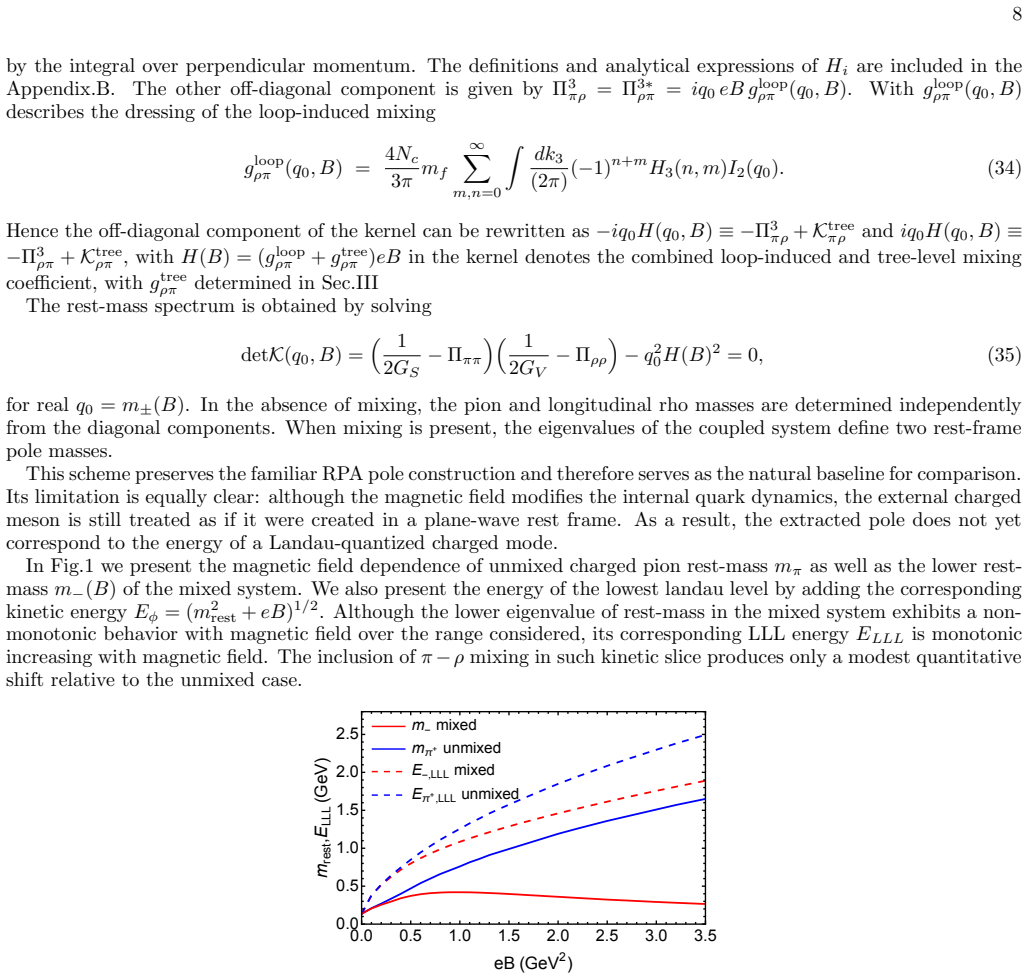
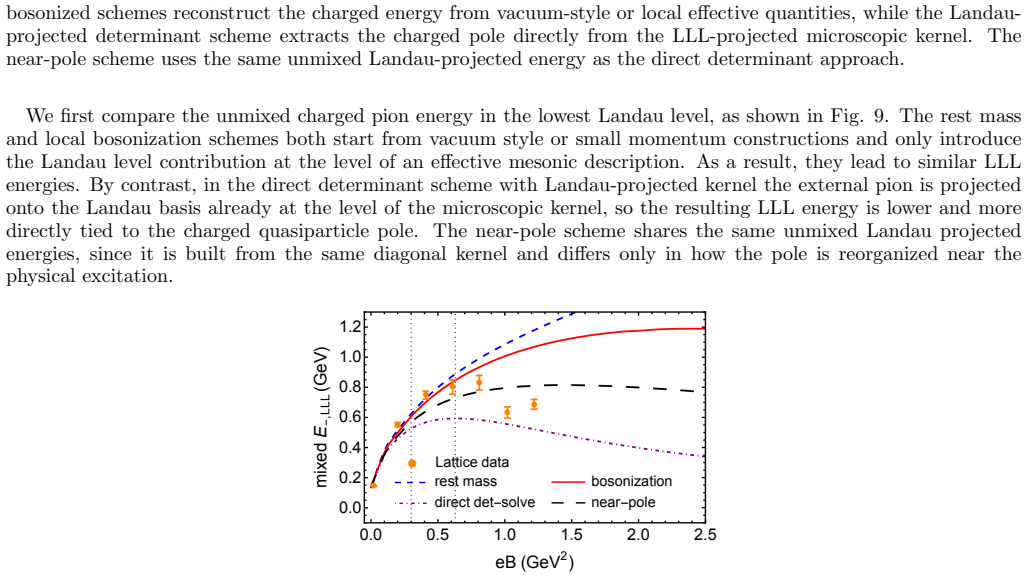
In the SU(2)_f NJL model supplemented by a gauge-invariant tree-level π-ρ mixing operator constrained by the experimental ρ±→π±γ decay width, the charged pion and longitudinally polarized rho meson mix in a magnetic field. Four mass-extraction schemes are compared: rest-mass reconstruction cannot reproduce the lattice-type turnover; local bosonization shows a weak turnover that appears only at large magnetic field; direct determinant solving with Landau projection and near-pole expansion both retain a robust non-monotonic lowest mode. The direct method is most faithful to the Landau-level kinematics of the charged excitation, while the near-pole scheme shows that residue suppression enhances
What carries the argument
Gauge-invariant tree-level π-ρ mixing operator in the SU(2)_f NJL model, strength fixed by the ρ±→π±γ decay width, used to compare four pole-extraction schemes under magnetic field.
Load-bearing premise
The tree-level gauge-invariant π-ρ mixing operator in the SU(2)_f NJL model, with strength fixed solely by the experimental ρ±→π±γ decay width, sufficiently captures the dynamics without needing higher-order corrections or additional parameters when magnetic fields are present.
What would settle it
A lattice computation that extracts the lowest charged pion pole using the rest-mass reconstruction scheme and still finds the non-monotonic turnover would falsify the claim that the behavior is an artifact of the extraction method.
Figures


read the original abstract
We study the origin of the non-monotonic magnetic-field dependence of the lowest charged pion excitation observed in lattice QCD. In a magnetic field, the charged pion mixes with the longitudinally polarized charged rho meson, which shares the same quantum numbers. Within the SU(2)$_f$ Nambu--Jona-Lasinio model supplemented by a gauge invariant tree-level $\pi-\rho$ mixing operator constrained by the experimental $\rho^\pm\rightarrow\pi^\pm\gamma$ decay width, we compare four mass-extraction schemes: rest-mass reconstruction, local bosonization, direct determinant solving with Landau projection, and near-pole expansion. The rest-mass scheme cannot reproduce the lattice-type turnover, while in the local derivative-expansion scheme the turnover presence but is weak which occurs at large magnetic field. By contrast, the direct determinant and near-pole schemes both retain a robust non-monotonic lowest mode. The former is most faithful to the Landau-level kinematics of the charged excitation, while the latter most clearly shows that residue suppression enhances the effective mixing after canonical normalization. Our results indicate that the lattice behavior is a genuine quasiparticle mixing effect, but one whose robustness depends crucially on how the charged-meson pole structure is extracted in a magnetic field.
Editorial analysis
A structured set of objections, weighed in public.
Referee Report
Summary. The paper claims that the non-monotonic magnetic-field dependence of the lowest charged pion excitation seen in lattice QCD arises from quasiparticle mixing with the longitudinally polarized charged rho meson. Within the SU(2)_f NJL model, a gauge-invariant tree-level π-ρ mixing operator is added with strength fixed solely by the experimental ρ±→π±γ decay width. Four mass-extraction schemes are compared: rest-mass reconstruction, local bosonization, direct determinant solving with Landau projection, and near-pole expansion. Only the direct-determinant and near-pole schemes reproduce a robust turnover; the former respects Landau-level kinematics while the latter illustrates residue suppression after canonical normalization. The authors conclude that the lattice behavior is a genuine mixing effect whose visibility depends on the chosen pole-extraction method.
Significance. If the central comparison holds, the work supplies a concrete model explanation for an otherwise puzzling lattice feature and demonstrates that mass-extraction methodology can qualitatively alter the inferred physics of charged mesons in strong fields. The experimentally constrained mixing term is a positive feature, yielding a parameter-free prediction inside the model for the location and strength of the turnover. The study therefore offers guidance for future lattice analyses and highlights the diagnostic power of comparing multiple extraction schemes.
major comments (2)
- [§3 (model definition)] §3 (model definition) and the abstract: the claim that the lattice turnover is a 'genuine quasiparticle mixing effect' rests on the tree-level gauge-invariant π-ρ operator (strength fixed by vacuum ρ→πγ width) remaining adequate once Landau levels are present. Strong eB can generate effective higher-order operators or renormalize the mixing vertex through charged-meson propagators; neither effect is included. If these corrections modify the residue or pole trajectory, the turnover seen in the two faithful schemes could be an artifact of the truncation rather than a robust feature.
- [Results section] Results section (comparison of schemes): the manuscript reports only qualitative outcomes (presence or absence of turnover) without tabulated pole positions, magnetic-field values at which the minimum occurs, or direct numerical overlay against lattice data points. This absence of quantitative metrics and error analysis makes it difficult to judge how faithfully the model reproduces the lattice non-monotonicity beyond the mere existence of a turnover.
minor comments (2)
- [Abstract] Abstract, sentence on local bosonization: 'the turnover presence but is weak which occurs at large magnetic field' is grammatically incomplete and should be rephrased for clarity.
- [Figures and notation] Figure captions and text: ensure uniform notation for the magnetic-field strength (eB versus B) and for the mixing parameter throughout.
Simulated Author's Rebuttal
We thank the referee for the careful reading of our manuscript and the constructive comments, which help clarify the scope and presentation of our results. We address each major comment point by point below and have revised the manuscript to incorporate the suggestions where they strengthen the work without altering its core conclusions.
read point-by-point responses
-
Referee: [§3 (model definition)] §3 (model definition) and the abstract: the claim that the lattice turnover is a 'genuine quasiparticle mixing effect' rests on the tree-level gauge-invariant π-ρ operator (strength fixed by vacuum ρ→πγ width) remaining adequate once Landau levels are present. Strong eB can generate effective higher-order operators or renormalize the mixing vertex through charged-meson propagators; neither effect is included. If these corrections modify the residue or pole trajectory, the turnover seen in the two faithful schemes could be an artifact of the truncation rather than a robust feature.
Authors: We appreciate the referee's point that strong magnetic fields could in principle induce higher-order corrections to the mixing vertex or renormalize it via charged-meson loops. Our approach employs the minimal gauge-invariant tree-level operator whose strength is fixed solely by the vacuum decay width, as this constitutes the leading contribution in the effective theory. Within the NJL model, higher-order effects are suppressed in the large-Nc counting that underlies the model. We have revised Section 3 to include an explicit discussion of this truncation, noting that the turnover remains a robust feature of the quasiparticle mixing under the adopted approximations and that the study provides a concrete model explanation rather than a complete QCD calculation. This addition clarifies the scope without changing the reported results. revision: yes
-
Referee: [Results section] Results section (comparison of schemes): the manuscript reports only qualitative outcomes (presence or absence of turnover) without tabulated pole positions, magnetic-field values at which the minimum occurs, or direct numerical overlay against lattice data points. This absence of quantitative metrics and error analysis makes it difficult to judge how faithfully the model reproduces the lattice non-monotonicity beyond the mere existence of a turnover.
Authors: We agree that quantitative metrics would allow a more precise evaluation of the model's agreement with lattice data. In the revised manuscript we have added a table in the Results section that lists the extracted pole positions of the lowest charged pion mode for several values of eB in both the direct-determinant and near-pole schemes. The table also reports the magnetic-field strength at which the minimum occurs. In addition, we have included a new figure that overlays the model curves with available lattice data points. These additions provide the requested quantitative comparison while preserving the parameter-free nature of the prediction based on the experimental mixing strength. revision: yes
Circularity Check
No significant circularity; mixing strength fixed externally by experiment
full rationale
The paper constrains the tree-level π-ρ mixing operator strength solely by the independent experimental ρ±→π±γ decay width, then compares four mass-extraction schemes inside the standard SU(2)_f NJL model against external lattice QCD data. No equation reduces the non-monotonic turnover or the 'genuine quasiparticle mixing' conclusion to a fitted parameter defined by the target claim itself. The derivation chain remains self-contained against external benchmarks (lattice results and decay width), with no self-definitional steps, fitted-input predictions, or load-bearing self-citations.
Axiom & Free-Parameter Ledger
axioms (2)
- domain assumption The SU(2)_f Nambu-Jona-Lasinio model supplemented by a gauge-invariant tree-level π-ρ mixing operator captures the essential low-energy dynamics of charged pions and rhos in a magnetic field.
- domain assumption The strength of the mixing operator can be fixed by the experimental ρ±→π±γ decay width without additional free parameters.
Reference graph
Works this paper leans on
-
[1]
Rubinstein
Dario Grasso and Hector R. Rubinstein. Magnetic fields in the early universe.Phys. Rept., 348:163–266, 2001. 26
2001
-
[2]
Cosmological Magnetic Fields: Their Generation, Evolution and Observation.Astron
Ruth Durrer and Andrii Neronov. Cosmological Magnetic Fields: Their Generation, Evolution and Observation.Astron. Astrophys. Rev., 21:62, 2013
2013
-
[3]
Efficient magnetic-field amplification due to the Kelvin-Helmholtz instability in binary neutron star mergers.Phys
Kenta Kiuchi, Pablo Cerd´ a-Dur´ an, Koutarou Kyutoku, Yuichiro Sekiguchi, and Masaru Shibata. Efficient magnetic-field amplification due to the Kelvin-Helmholtz instability in binary neutron star mergers.Phys. Rev. D, 92(12):124034, 2015
2015
-
[4]
Skokov, A
V. Skokov, A. Yu. Illarionov, and V. Toneev. Estimate of the magnetic field strength in heavy-ion collisions.Int. J. Mod. Phys. A, 24:5925–5932, 2009
2009
-
[5]
Event-by-event generation of electromagnetic fields in heavy-ion collisions.Phys
Wei-Tian Deng and Xu-Guang Huang. Event-by-event generation of electromagnetic fields in heavy-ion collisions.Phys. Rev. C, 85:044907, 2012
2012
-
[6]
Kharzeev, Larry D
Dmitri E. Kharzeev, Larry D. McLerran, and Harmen J. Warringa. The Effects of topological charge change in heavy ion collisions: ’Event by event P and CP violation’.Nucl. Phys. A, 803:227–253, 2008
2008
-
[7]
Kharzeev and Dam T
Dmitri E. Kharzeev and Dam T. Son. Testing the chiral magnetic and chiral vortical effects in heavy ion collisions.Phys. Rev. Lett., 106:062301, 2011
2011
-
[8]
Magnetohydrodynamics, charged currents and directed flow in heavy ion collisions.Phys
Umut Gursoy, Dmitri Kharzeev, and Krishna Rajagopal. Magnetohydrodynamics, charged currents and directed flow in heavy ion collisions.Phys. Rev. C, 89(5):054905, 2014
2014
-
[9]
V. P. Gusynin, V. A. Miransky, and I. A. Shovkovy. Dimensional reduction and catalysis of dynamical symmetry breaking by a magnetic field.Nucl. Phys. B, 462:249–290, 1996
1996
-
[10]
Kharzeev and Ho-Ung Yee
Dmitri E. Kharzeev and Ho-Ung Yee. Chiral Magnetic Wave.Phys. Rev. D, 83:085007, 2011
2011
-
[11]
G. S. Bali, F. Bruckmann, G. Endrodi, Z. Fodor, S. D. Katz, and A. Schafer. QCD quark condensate in external magnetic fields.Phys. Rev. D, 86:071502, 2012
2012
-
[12]
Phase structure of three flavor QCD in external magnetic fields using HISQ fermions.PoS, LATTICE2018:163, 2019
Akio Tomiya, Heng-Tong Ding, Xiao-Dan Wang, Yu Zhang, Swagato Mukherjee, and Christian Schmidt. Phase structure of three flavor QCD in external magnetic fields using HISQ fermions.PoS, LATTICE2018:163, 2019
2019
-
[13]
G. S. Bali, F. Bruckmann, G. Endr¨ odi, S. D. Katz, and A. Sch¨ afer. The QCD equation of state in background magnetic fields.JHEP, 08:177, 2014
2014
-
[14]
G. S. Bali, F. Bruckmann, M. Constantinou, M. Costa, G. Endrodi, S. D. Katz, H. Panagopoulos, and A. Schafer. Magnetic susceptibility of QCD at zero and at finite temperature from the lattice.Phys. Rev. D, 86:094512, 2012
2012
-
[15]
Miransky and Igor A
Vladimir A. Miransky and Igor A. Shovkovy. Quantum field theory in a magnetic field: From quantum chromodynamics to graphene and Dirac semimetals.Phys. Rept., 576:1–209, 2015
2015
-
[16]
Magnetic Catalysis Versus Magnetic Inhibition.Phys
Kenji Fukushima and Yoshimasa Hidaka. Magnetic Catalysis Versus Magnetic Inhibition.Phys. Rev. Lett., 110(3):031601, 2013
2013
-
[17]
Andersen, William R
Jens O. Andersen, William R. Naylor, and Anders Tranberg. Phase diagram of QCD in a magnetic field: A review.Rev. Mod. Phys., 88:025001, 2016
2016
-
[18]
G. S. Bali, F. Bruckmann, G. Endrodi, Z. Fodor, S. D. Katz, S. Krieg, A. Schafer, and K. K. Szabo. The QCD phase diagram for external magnetic fields.JHEP, 02:044, 2012
2012
-
[19]
E. M. Ilgenfritz, M. Muller-Preussker, B. Petersson, and A. Schreiber. Magnetic catalysis (and inverse catalysis) at finite temperature in two-color lattice QCD.Phys. Rev. D, 89(5):054512, 2014
2014
-
[20]
H. T. Ding, S. T. Li, A. Tomiya, X. D. Wang, and Y. Zhang. Chiral properties of (2+1)-flavor QCD in strong magnetic fields at zero temperature.Phys. Rev. D, 104(1):014505, 2021
2021
-
[21]
Meson masses in external magnetic fields with HISQ fermions.PoS, LATTICE2019:250, 2020
Heng-Tong Ding, Sheng-Tai Li, Swagato Mukherjee, Akio Tomiya, and Xiao-Dan Wang. Meson masses in external magnetic fields with HISQ fermions.PoS, LATTICE2019:250, 2020
2020
-
[22]
Chiral Properties of (2+1)-Flavor QCD in Magnetic Fields at Zero Temperature
Heng-Tong Ding and Dan Zhang. Chiral Properties of (2+1)-Flavor QCD in Magnetic Fields at Zero Temperature. 1 2026
2026
-
[23]
Four fermion interaction model in a constant magnetic field at finite temperature and chemical potential.Prog
Tomohiro Inagaki, Daiji Kimura, and Tsukasa Murata. Four fermion interaction model in a constant magnetic field at finite temperature and chemical potential.Prog. Theor. Phys., 111:371–386, 2004
2004
-
[24]
Inverse Magnetic Catalysis in the three-flavor NJL model with axial-vector interaction.Phys
Lang Yu, Jos Van Doorsselaere, and Mei Huang. Inverse Magnetic Catalysis in the three-flavor NJL model with axial-vector interaction.Phys. Rev. D, 91(7):074011, 2015
2015
-
[25]
Fayazbakhsh and N
Sh. Fayazbakhsh and N. Sadooghi. Anomalous magnetic moment of hot quarks, inverse magnetic catalysis, and reentrance of the chiral symmetry broken phase.Phys. Rev. D, 90(10):105030, 2014
2014
-
[26]
Coppola, D
M. Coppola, D. G´ omez Dumm, and N. N. Scoccola. Charged pion masses under strong magnetic fields in the NJL model. Phys. Lett. B, 782:155–161, 2018
2018
-
[27]
Coppola, D
M. Coppola, D. Gomez Dumm, S. Noguera, and N. N. Scoccola. Neutral and charged pion properties under strong magnetic fields in the NJL model.Phys. Rev. D, 100(5):054014, 2019
2019
-
[28]
Effect of the anomalous magnetic moment of quarks on the phase structure and mesonic properties in the NJL model.Phys
Nilanjan Chaudhuri, Snigdha Ghosh, Sourav Sarkar, and Pradip Roy. Effect of the anomalous magnetic moment of quarks on the phase structure and mesonic properties in the NJL model.Phys. Rev. D, 99(11):116025, 2019
2019
-
[29]
Chiral dynamics in a magnetic field from the functional renormalization group.JHEP, 03:009, 2014
Kazuhiko Kamikado and Takuya Kanazawa. Chiral dynamics in a magnetic field from the functional renormalization group.JHEP, 03:009, 2014
2014
-
[30]
Kiminad A. Mamo. Inverse magnetic catalysis in holographic models of QCD.JHEP, 05:121, 2015
2015
-
[31]
Inverse Magnetic Catalysis in the Soft-Wall Model of AdS/QCD
Danning Li, Mei Huang, Yi Yang, and Pei-Hung Yuan. Inverse Magnetic Catalysis in the Soft-Wall Model of AdS/QCD. JHEP, 02:030, 2017
2017
-
[32]
Charged and neutral vectorρmesons in a magnetic field.Phys
Hao Liu, Lang Yu, and Mei Huang. Charged and neutral vectorρmesons in a magnetic field.Phys. Rev. D, 91(1):014017, 2015
2015
-
[33]
Spectral properties ofρmeson in a magnetic field.Phys
Snigdha Ghosh, Arghya Mukherjee, Mahatsab Mandal, Sourav Sarkar, and Pradip Roy. Spectral properties ofρmeson in a magnetic field.Phys. Rev. D, 94(9):094043, 2016
2016
-
[34]
Vector meson masses from a hidden local symmetry in a constant magnetic field.Phys
Mamiya Kawaguchi and Shinya Matsuzaki. Vector meson masses from a hidden local symmetry in a constant magnetic field.Phys. Rev. D, 93(12):125027, 2016
2016
-
[35]
Avancini, M´ aximo Coppola, Norberto N
Sidney S. Avancini, M´ aximo Coppola, Norberto N. Scoccola, and Joana C. Sodr´ e. Light pseudoscalar meson masses under 27 strong magnetic fields within the SU(3) Nambu–Jona-Lasinio model.Phys. Rev. D, 104(9):094040, 2021
2021
-
[36]
J. P. Carlomagno, D. Gomez Dumm, M. F. Izzo Villafa˜ ne, S. Noguera, and N. N. Scoccola. Charged pseudoscalar and vector meson masses in strong magnetic fields in an extended NJL model.Phys. Rev. D, 106(9):094035, 2022
2022
-
[37]
Scoccola
M´ aximo Coppola, Daniel Gomez Dumm, Santiago Noguera, and Norberto N. Scoccola. Masses of magnetized pseudoscalar and vector mesons in an extended NJL model: The role of axial vector mesons.Phys. Rev. D, 109(5):054014, 2024
2024
-
[38]
Functional renormalization group study of neutral and charged pions in magnetic fields in the quark-meson model.Phys
Rui Wen, Shi Yin, Wei-jie Fu, and Mei Huang. Functional renormalization group study of neutral and charged pions in magnetic fields in the quark-meson model.Phys. Rev. D, 108(7):076020, 2023
2023
-
[39]
Inverse magnetic catalysis effect and current quark mass effect on mass spectra and Mott transitions of pions under external magnetic field.Phys
Luyang Li and Shijun Mao. Inverse magnetic catalysis effect and current quark mass effect on mass spectra and Mott transitions of pions under external magnetic field.Phys. Rev. D, 108(5):054001, 2023
2023
-
[40]
Residue-Enhanced Pion-Rho Mixing as the Origin of Nonmonotonic Charged Pion Mass in Magnetic Fields
Ziyue Wang. Residue-Enhanced Pion-Rho Mixing as the Origin of Nonmonotonic Charged Pion Mass in Magnetic Fields. 2 2026
2026
-
[41]
S. P. Klevansky. The Nambu-Jona-Lasinio model of quantum chromodynamics.Rev. Mod. Phys., 64:649–708, 1992
1992
-
[42]
QCD phenomenology based on a chiral effective Lagrangian.Phys
Tetsuo Hatsuda and Teiji Kunihiro. QCD phenomenology based on a chiral effective Lagrangian.Phys. Rept., 247:221–367, 1994
1994
-
[43]
Avancini, Ricardo L
Sidney S. Avancini, Ricardo L. S. Farias, William R. Tavares, and Varese S. Tim´ oteo. Magnetized pole-mass of neutralρ meson within full RPA evaluation.Nucl. Phys. B, 981:115862, 2022
2022
-
[44]
Meson properties in magnetized quark matter.Phys
Ziyue Wang and Pengfei Zhuang. Meson properties in magnetized quark matter.Phys. Rev. D, 97(3):034026, 2018
2018
-
[45]
Gauge independence of pion masses in a magnetic field within the Nambu–Jona- Lasinio model.Phys
Jianing Li, Gaoqing Cao, and Lianyi He. Gauge independence of pion masses in a magnetic field within the Nambu–Jona- Lasinio model.Phys. Rev. D, 104(7):074026, 2021
2021
-
[46]
Gomez Dumm, S
D. Gomez Dumm, S. Noguera, and N. N. Scoccola. Charged meson masses under strong magnetic fields: Gauge invariance and Schwinger phases.Phys. Rev. D, 108(1):016012, 2023
2023
-
[47]
Zhen-Ni Xu, Zhao-Qian Yao, Si-Xue Qin, Zhu-Fang Cui, and Craig D. Roberts. Bethe–Salpeter kernel and properties of strange-quark mesons.Eur. Phys. J. A, 59(3):39, 2023
2023
-
[48]
Effective field theory of particle mixing.Phys
Shuyang Cao and Daniel Boyanovsky. Effective field theory of particle mixing.Phys. Rev. D, 109(3):036038, 2024
2024
-
[49]
Vogl and W
U. Vogl and W. Weise. The Nambu and Jona Lasinio model: Its implications for hadrons and nuclei.Prog. Part. Nucl. Phys., 27:195–272, 1991
1991
-
[50]
Schwinger
Julian S. Schwinger. On gauge invariance and vacuum polarization.Phys. Rev., 82:664–679, 1951
1951
discussion (0)
Sign in with ORCID, Apple, or X to comment. Anyone can read and Pith papers without signing in.