Recognition: unknown
Anomalous Thomson Effect
Pith reviewed 2026-05-08 06:20 UTC · model grok-4.3
The pith
The anomalous Thomson coefficient is a direct function of the anomalous Nernst coefficient and is enhanced relative to it.
A machine-rendered reading of the paper's core claim, the machinery that carries it, and where it could break.
Core claim
The anomalous Thomson effect is defined by deriving its coefficient directly from the anomalous Nernst coefficient within the massive Dirac model for Fe3Sn2. The anomalous Thomson coefficient exceeds the anomalous Nernst coefficient at all temperatures and their ratio approaches three in the low-temperature limit. Because the relation does not depend on material-specific details beyond the model used for the derivation, experimental anomalous Nernst data for CoS2, Co3Sn2S2, and CeCrGe3 can be converted into predicted anomalous Thomson values, with CeCrGe3 showing an anomalous Thomson coefficient up to fifteen times its anomalous Nernst coefficient in the liquid-nitrogen temperature regime.
What carries the argument
The model-independent functional relation that expresses the anomalous Thomson coefficient in terms of the anomalous Nernst coefficient, obtained from the massive Dirac Hamiltonian capturing intrinsic Berry-curvature transport.
If this is right
- The anomalous Thomson coefficient can be obtained from any existing anomalous Nernst measurement without new equipment or additional data collection.
- CeCrGe3 is predicted to exhibit an anomalous Thomson coefficient fifteen times larger than its anomalous Nernst coefficient near 77 K, offering potential for thermoelectric refrigeration.
- The ratio of the two coefficients approaches three at low temperature in any system described by the same Berry-curvature mechanism.
- Verification of the anomalous Thomson effect can be performed immediately with setups already used for anomalous Nernst experiments.
Where Pith is reading between the lines
- If the predicted enhancement holds, materials already known for large anomalous Nernst signals become candidates for improved solid-state coolers operating near liquid-nitrogen temperature.
- The same conversion could be applied to other topological magnets or semimetals that display measurable anomalous Nernst responses.
- Extensions of the relation to finite magnetic fields or to systems with disorder would test how robust the factor-of-three low-temperature limit remains.
Load-bearing premise
The relation between the anomalous Thomson effect and the anomalous Nernst effect remains valid independently of the specific material model beyond the massive Dirac framework used to derive it.
What would settle it
A direct experimental measurement of the Thomson coefficient in CeCrGe3 at approximately 77 K that fails to match the value obtained by converting its measured anomalous Nernst coefficient through the derived relation.
Figures


read the original abstract
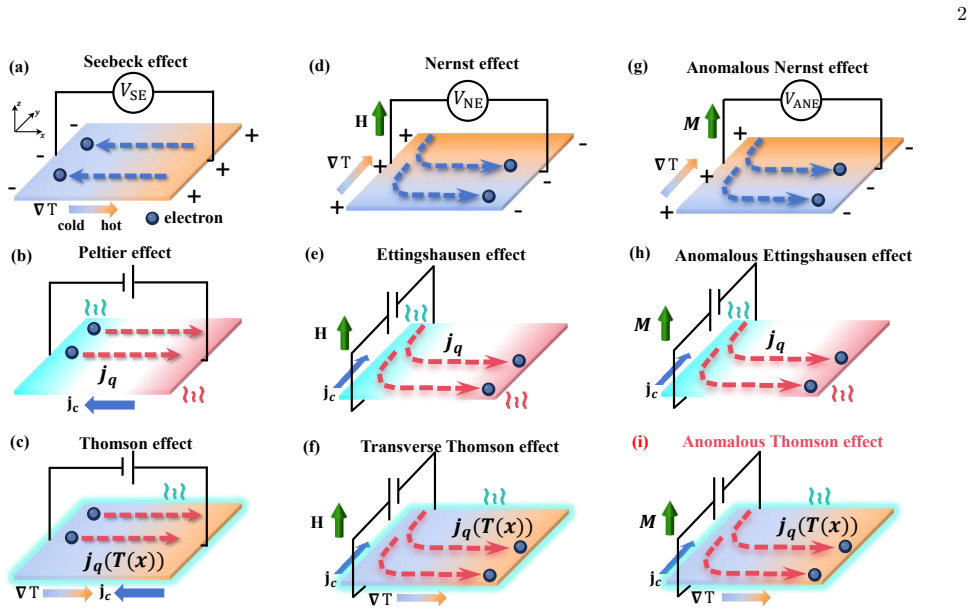
We propose an effect named the anomalous Thomson effect (ATE), analogous to the anomalous Hall effect and the anomalous Nernst effect (ANE). The anomalous Thomson coefficient (ATC) is derived as a function of the anomalous Nernst coefficient (ANC); hence, the ATC inherits the same mechanisms of the ANC. Specifically, we study a massive Dirac model for Fe3Sn2 to capture intrinsic Berry-curvature-driven transport. Our results show that the ATC is generally enhanced relative to the ANC. In the low-temperature limit, the ratio ATC/ANC approaches three. Since the relation between the ATE and the ANE is model-independent, we utilize experimental ANE data to infer experiment-related ATC for CoS2, Co3Sn2S2, and CeCrGe3. We find that the ATC for CeCrGe3 can be as large as fifteen times the ANC in the liquid-nitrogen temperature regime, making this effect highly attractive for solid-state thermoelectric refrigeration in this temperature range. It is important to emphasize that the proposed ATE can be directly verified using existing ANE data, without the need for additional equipment or measurements.
Editorial analysis
A structured set of objections, weighed in public.
Referee Report
Summary. The manuscript proposes the anomalous Thomson effect (ATE) analogous to the anomalous Hall and Nernst effects. Using a massive Dirac model for Fe3Sn2 to capture intrinsic Berry-curvature transport, it derives the anomalous Thomson coefficient (ATC) explicitly as a function of the anomalous Nernst coefficient (ANC), showing general enhancement of ATC relative to ANC with the low-temperature ratio approaching three. The authors assert that the ATC-ANC relation is model-independent, allowing direct inference of ATC values from existing experimental ANC data for CoS2, Co3Sn2S2, and CeCrGe3, with the latter reaching up to 15× ANC near 77 K and thus promising for solid-state thermoelectric refrigeration.
Significance. If the claimed model-independent mapping holds, the work provides a practical route to predict enhanced thermoelectric responses in known ANE materials using only existing data, without new equipment. The explicit connection to experimental ANC measurements for multiple compounds and the focus on liquid-nitrogen temperatures strengthen the applied relevance; the Berry-curvature-based derivation in the Dirac model is a clear strength.
major comments (3)
- [Abstract and derivation section] Abstract and the central derivation: the assertion that 'the relation between the ATE and the ANE is model-independent' is load-bearing for all experimental inferences (including the factor-of-15 claim for CeCrGe3 at 77 K), yet the functional mapping ATC(ANC) is obtained only inside the massive Dirac Hamiltonian for Fe3Sn2. No analytic proof or numerical checks are provided for alternative band structures, different Berry-curvature profiles, or regimes with extrinsic scattering; if the mapping changes with microscopic details, the direct use of experimental ANC(T) data for other materials loses its foundation.
- [Low-temperature analysis] Low-temperature limit result: the statement that ATC/ANC approaches three as T→0 is presented as general, but it must be shown to survive variations in Fermi level position, temperature-dependent scattering rates, or deviations from the massive Dirac dispersion; without such robustness checks the limiting ratio cannot be used to anchor the enhancement claims across materials.
- [Application to experimental data] Inference for CeCrGe3 and other compounds: the paper applies the Fe3Sn2-derived mapping to experimental ANC data from chemically and structurally distinct materials. A discussion of possible differences in dominant mechanisms (intrinsic vs. extrinsic) between the model system and the experimental compounds is required to justify the numerical factors reported.
minor comments (2)
- [Introduction/Notation] Notation for the anomalous Thomson coefficient should be introduced with an explicit equation relating it to the heat current and temperature gradient, to avoid ambiguity with conventional Thomson coefficient definitions.
- [Results] The manuscript would benefit from a brief comparison table of the inferred ATC/ANC ratios across the three materials at selected temperatures, including error estimates from the experimental ANC data.
Simulated Author's Rebuttal
We thank the referee for the positive evaluation of the significance of our work and for the detailed, constructive comments. We address each major comment below, indicating the revisions we will make to the manuscript.
read point-by-point responses
-
Referee: [Abstract and derivation section] Abstract and the central derivation: the assertion that 'the relation between the ATE and the ANE is model-independent' is load-bearing for all experimental inferences (including the factor-of-15 claim for CeCrGe3 at 77 K), yet the functional mapping ATC(ANC) is obtained only inside the massive Dirac Hamiltonian for Fe3Sn2. No analytic proof or numerical checks are provided for alternative band structures, different Berry-curvature profiles, or regimes with extrinsic scattering; if the mapping changes with microscopic details, the direct use of experimental ANC(T) data for other materials loses its foundation.
Authors: We agree that the model-independence claim requires stronger support than currently provided. The relation is obtained from the general thermoelectric response functions expressed in terms of Berry curvature integrals, which in principle hold for any band structure when intrinsic contributions dominate. However, the manuscript does not include explicit checks on other dispersions or scattering regimes. In the revision we will add both an analytic argument based on the structure of the transport integrals (independent of the specific massive Dirac form) and numerical verification using at least one additional model (e.g., a two-band k·p Hamiltonian with different Berry curvature profile). These additions will be placed in the derivation section and will directly support the subsequent experimental inferences. revision: yes
-
Referee: [Low-temperature analysis] Low-temperature limit result: the statement that ATC/ANC approaches three as T→0 is presented as general, but it must be shown to survive variations in Fermi level position, temperature-dependent scattering rates, or deviations from the massive Dirac dispersion; without such robustness checks the limiting ratio cannot be used to anchor the enhancement claims across materials.
Authors: We acknowledge that the low-temperature ratio of three is derived analytically within the specific model assumptions (constant relaxation time, fixed Fermi level). To demonstrate robustness we will extend the low-temperature analysis to include (i) shifts of the Fermi level across the gap and (ii) a simple temperature-dependent scattering rate. The revised manuscript will contain additional analytic expressions and numerical plots confirming that the ratio still approaches three in these cases, thereby justifying its use as a general anchor for the enhancement factor. revision: yes
-
Referee: [Application to experimental data] Inference for CeCrGe3 and other compounds: the paper applies the Fe3Sn2-derived mapping to experimental ANC data from chemically and structurally distinct materials. A discussion of possible differences in dominant mechanisms (intrinsic vs. extrinsic) between the model system and the experimental compounds is required to justify the numerical factors reported.
Authors: This point is well taken. The current manuscript assumes that the intrinsic Berry-curvature mechanism dominates in the cited compounds, consistent with existing literature on their anomalous Hall and Nernst responses. We will insert a concise discussion paragraph that (a) summarizes the evidence for intrinsic dominance in CoS2, Co3Sn2S2, and CeCrGe3 and (b) explicitly notes that extrinsic contributions could modify the ATC/ANC ratio, thereby qualifying the inferred numerical factors. This paragraph will also emphasize that direct ATE measurements are ultimately needed for confirmation. revision: yes
Circularity Check
ATC constructed as explicit function of ANC in Dirac model then applied to experimental data of other materials
specific steps
-
self definitional
[Abstract]
"The anomalous Thomson coefficient (ATC) is derived as a function of the anomalous Nernst coefficient (ANC); hence, the ATC inherits the same mechanisms of the ANC. [...] Since the relation between the ATE and the ANE is model-independent, we utilize experimental ANE data to infer experiment-related ATC for CoS2, Co3Sn2S2, and CeCrGe3. We find that the ATC for CeCrGe3 can be as large as fifteen times the ANC in the liquid-nitrogen temperature regime"
ATC is obtained by direct derivation as a function of ANC within the Fe3Sn2 model; the numerical ATC values and refrigeration claim for CeCrGe3 are then generated by feeding independent experimental ANC data into that same function, so the output ratio is a re-expression of the input derivation rather than an independent result.
full rationale
The paper derives ATC directly as a function of ANC inside the massive Dirac model for Fe3Sn2 and then invokes a model-independence claim to compute ATC values (including the 15x enhancement at 77 K) for CeCrGe3 and others solely from their measured ANC(T) curves. This step links the reported practical result to the model-derived mapping by construction, yet the model calculation itself remains independent and the low-T ratio of 3 is presented as a concrete output. No self-citation chain or ansatz smuggling is present, so the circularity is partial and limited to the inference step rather than the entire derivation.
Axiom & Free-Parameter Ledger
axioms (1)
- domain assumption The relation between the anomalous Thomson effect and the anomalous Nernst effect is model-independent.
Reference graph
Works this paper leans on
-
[1]
was supported in part by the Quantum Sci- ence and Technology-National Science and Technology Major Project under Grant No
G.S. was supported in part by the Quantum Sci- ence and Technology-National Science and Technology Major Project under Grant No. 2024ZD0300500, NSFC Nos. 12534009 and 12447101, the Strategic Priority Research Program of CAS (Grant No. XDB1270000) and the CAS Superconducting Research Project under Grant No. SCZX-0101. ZFZ was supported by the Post- doctora...
-
[2]
Blatt,Thermoelectricity in Metallic Conductors (Springer, New York, NY, 1978)
J. Blatt,Thermoelectricity in Metallic Conductors (Springer, New York, NY, 1978)
1978
-
[3]
L. Anatychuk,200 Years of Thermoelectricity: An His- torical Journey Through the Science and Technology of Thermoelectric Materials (1821-2021)(Springer Interna- tional Publishing, Cham, 2024)
2021
-
[4]
J. Wang, Y. Yin, C. Che, and M. Cui, Research progress of thermoelectric materials -a review, Energies18, 2122 (2025)
2025
-
[5]
J. Dai, H. Deng, J. Huang, and X. Zhang, Recent progress of powering IoT based on thermoelectric technology, Mi- cromachines16, 1017 (2025)
2025
-
[6]
H. Ohta, S. Kim, Y. Mune, T. Mizoguchi, K. Nomura, S. Ohta, T. Nomura, Y. Nakanishi, Y. Ikuhara, M. Hi- rano, H. Hosono, and K. Koumoto, Giant thermoelectric Seebeck coefficient of a two-dimensional electron gas in SrTiO3, Nat. Mater.6, 129 (2007)
2007
-
[7]
Maekawa, T
S. Maekawa, T. Tohyama, S. E. Barnes, S. Ishihara, W. Koshibae, and G. Khaliullin,Physics of Transition Metal Oxides(Springer Berlin Heidelberg, 2004)
2004
-
[8]
Behnia and H
K. Behnia and H. Aubin, Nernst effect in metals and superconductors: a review of concepts and experiments, Rep. Prog. Phys.79, 046502 (2016)
2016
-
[9]
A. v. Ettingshausen and W. Nernst, Ueber das auftreten electromotorischer krafte in metallplatten, welche von einem warmestrome durchflossen werden und sich im magnetischen felde befinden, Ann. Phys.265, 343 (1886)
-
[10]
Behnia, The Nernst effect and the boundaries of the Fermi liquid picture, J
K. Behnia, The Nernst effect and the boundaries of the Fermi liquid picture, J. Phys. Condens. Matter21, 113101 (2009)
2009
-
[11]
F. J. DiSalvo, Thermoelectric cooling and power genera- tion, Science285, 703 (1999)
1999
-
[12]
Y. G. Gurevich and G. N. Logvinov, Physics of thermo- electric cooling, Semicond. Sci. Tech.20, R57 (2005)
2005
-
[13]
L. Cui, R. Miao, K. Wang, D. Thompson, L. A. Zotti, J. C. Cuevas, E. Meyhofer, and P. Reddy, Peltier cooling in molecular junctions, Nat. Nanotechnol.13, 122 (2017)
2017
-
[14]
B. V. Paranjape and J. S. Levinger, Theory of the Et- tingshausen effect in semiconductors, Phys. Rev.120, 437 (1960)
1960
-
[15]
Adachi, F
H. Adachi, F. Ando, T. Hirai, R. Modak, M. A. Grayson, and K.-I. Uchida, Fundamentals and advances in trans- verse thermoelectrics, Appl. Phys. Express18, 090101 (2025)
2025
-
[16]
R. T. Delves, The prospects for Ettingshausen and Peltier cooling at low temperatures, Brit. J. Appl. Phys. 13, 440 (1962)
1962
-
[17]
J. Mao, G. Chen, and Z. Ren, Thermoelectric cooling materials, Nat. Mater.20, 454 (2020)
2020
-
[18]
Razeghi, J
M. Razeghi, J. Spiece, V. Fonck, Y. Zhang, M. Ro- hde, R. Joris, P. S. Dobson, J. M. R. Weaver, L. M. C. Pereira, S. Granville, and P. Gehring, Giant anomalous Ettingshausen effect and hybrid longitudinal-transverse thermoelectric cooling in a nanoscale magnetic Weyl semimetal, ACS Nano19, 39725 (2025)
2025
-
[19]
Thomson, Ix
W. Thomson, Ix. ?on the dynamical theory of heat. part v. thermo-electric currents, Transactions of the Royal So- ciety of Edinburgh21, 123 (1857)
-
[20]
Thomson, 4
W. Thomson, 4. on a mechanical theory of thermo- electric currents, Proc. Roy. Soc. Edinburgh3, 91 (1857)
-
[21]
E. M. Lif?ic and L. P. Pitaevskij,Course of theoretical physics, edited by L. D. Landau, Electrodynamics of con- tinuous media (Pergamon Press, Oxford, 1993)
1993
-
[22]
Young, The Thomson effect in copper, iron, and carbon steels, Proc
J. Young, The Thomson effect in copper, iron, and carbon steels, Proc. Phys. Soc. London37, 145 (1924)
1924
-
[23]
Apertet and C
Y. Apertet and C. Goupil, On the fundamental aspect of the first Kelvin?s relation in thermoelectricity, Int. J. Therm. Sci.104, 225 (2016)
2016
-
[24]
T. Gong, Y. Wu, L. Gao, L. Zhang, J. Li, and T. Ming, Thermo-mechanical analysis on a compact thermoelectric cooler, Energy172, 1211 (2019)
2019
-
[25]
Zevalkink, D
A. Zevalkink, D. M. Smiadak, J. L. Blackburn, A. J. Fer- guson, M. L. Chabinyc, O. Delaire, J. Wang, K. Kovnir, J. Martin, L. T. Schelhas, T. D. Sparks, S. D. Kang, M. T. Dylla, G. J. Snyder, B. R. Ortiz, and E. S. To- berer, A practical field guide to thermoelectrics: Fun- damentals, synthesis, and characterization, Appl. Phys. Rev.5, 021303 (2018)
2018
-
[26]
G. J. Snyder, E. S. Toberer, R. Khanna, and W. Seifert, Improved thermoelectric cooling based on the Thomson effect, Phys. Rev. B86, 045202 (2012)
2012
-
[27]
Giaretto and E
V. Giaretto and E. Campagnoli, The Elusive Thomson effect in thermoelectric devices. Experimental investiga- tion from 363 K to 213 K on various Peltier modules, Metals10, 291 (2020)
2020
-
[28]
Chiba, R
T. Chiba, R. Iguchi, T. Komine, Y. Hasegawa, and K.- I. Uchida, Temperature profile of the Thomson-effect- induced heat release/absorption in junctionless single conductors, Jpn. J. Appl. Phys.62, 037001 (2023)
2023
-
[29]
Zebarjadi and O
M. Zebarjadi and O. Akbari, A model for material met- rics in thermoelectric Thomson coolers, Entropy-switz. 25, 1540 (2023)
2023
-
[30]
Uchida, M
K.-I. Uchida, M. Murata, A. Miura, and R. Iguchi, Obser- vation of the Magneto-Thomson effect, Phys. Rev. Lett. 125, 106601 (2020)
2020
-
[31]
Modak, T
R. Modak, T. Hirai, S. Mitani, and K.-I. Uchida, Obser- vation of the anisotropic magneto-Thomson effect, Phys. Rev. Lett.131, 206701 (2023)
2023
-
[32]
Takahagi, T
A. Takahagi, T. Hirai, A. Alasli, S. J. Park, H. Nagano, and K.-I. Uchida, Observation of the transverse Thomson effect, Nat. Phys.21, 1283 (2025)
2025
-
[33]
Uchida and J
K.-I. Uchida and J. P. Heremans, Thermoelectrics: From longitudinal to transverse, Joule6, 2240 (2022)
2022
-
[34]
Nagaosa, J
N. Nagaosa, J. Sinova, S. Onoda, A. H. MacDonald, and N. P. Ong, Anomalous Hall effect, Rev. Mod. Phys.82, 1539 (2010)
2010
-
[35]
Xiao, M.-C
D. Xiao, M.-C. Chang, and Q. Niu, Berry phase effects on electronic properties, Rev. Mod. Phys.82, 1959 (2010)
1959
-
[36]
D. Xiao, Y. Yao, Z. Fang, and Q. Niu, Berry-phase effect in anomalous thermoelectric transport, Phys. Rev. Lett. 97, 026603 (2006)
2006
-
[37]
Kittel,Introduction to solid state physics(Wiley, 2013)
C. Kittel,Introduction to solid state physics(Wiley, 2013)
2013
-
[38]
N. W. Ashcroft and N. D. Mermin,Solid state physics (2012)
2012
-
[39]
J. M. Ziman,Principles of the Theory of Solids(Cam- bridge University Press, 1972)
1972
-
[40]
Wolfe and G
R. Wolfe and G. E. Smith, Experimental verification of the Kelvin relation of thermoelectricity in a magnetic field, Phys. Rev.129, 1086 (1963)
1963
-
[41]
W. S. Gan,Time reversal acoustics(Springer, Singapore, 2021). 6
2021
-
[42]
L. D. Landau, E. M. Lifshitz, and A. L. King, Electrody- namics of continuous media, Am. J. Phys.29, 647 (1961)
1961
-
[43]
D. Sun, L. Shen, H. Chen, B. Jiang, D. Jie, H. Liu, Y. Yao, and J. Tang, Modeling and analysis of the in- fluence of Thomson effect on micro-thermoelectric cool- ers considering interfacial and size effects, Energy196, 117116 (2020)
2020
-
[44]
The supplementary material gives details of methods and results: SI) derivation of the anomalous thomson effect; SII) model calculation; SIII) the Maximum temperature difference and optimal current optimize
-
[45]
Ikhlas, T
M. Ikhlas, T. Tomita, T. Koretsune, M.-T. Suzuki, D. Nishio-Hamane, R. Arita, Y. Otani, and S. Nakat- suji, Large anomalous Nernst effect at room temperature in a chiral antiferromagnet, Nat. Phys.13, 1085 (2017)
2017
-
[46]
Y. Li, J. Zhou, M. Li, L. Qiao, C. Jiang, Q. Chen, Y. Li, Q. Tao, and Z.-A. Xu, Enhanced anomalous Nernst ef- fect by tuning the chemical potential in the topologi- cal kagome ferromagnet Fe 3Sn2, Phys. Rev. Applied19, 014026 (2023)
2023
-
[47]
L. Ye, M. Kang, J. Liu, F. von Cube, C. R. Wicker, T. Suzuki, C. Jozwiak, A. Bostwick, E. Rotenberg, D. C. Bell, L. Fu, R. Comin, and J. G. Checkelsky, Massive Dirac fermions in a ferromagnetic kagome metal, Nature 555, 638 (2018)
2018
-
[48]
L. Ye, M. K. Chan, R. D. McDonald, D. Graf, M. Kang, J. Liu, T. Suzuki, R. Comin, L. Fu, and J. G. Checkelsky, de Haas-van Alphen effect of correlated Dirac states in kagome metal Fe3Sn2, Nat. Commun.10, 4870 (2019)
2019
-
[49]
Y. Tao, L. Daemen, Y. Cheng, J. C. Neuefeind, and D. Louca, Investigating the magnetoelastic properties in FeSn and Fe 3Sn2 flat band metals, Phys. Rev. B107, 174407 (2023)
2023
-
[50]
K. I. A. Khan, A. Kumar, P. Gupta, R. S. Yadav, J. Ak- erman, and P. K. Muduli, Magnetodynamic properties of ultrathin films of Fe 3Sn2 -a topological kagome ferro- magnet, Sci. Rep.14, 3487 (2024)
2024
-
[51]
Papaj and L
M. Papaj and L. Fu, Enhanced anomalous Nernst effect in disordered Dirac and Weyl materials, Phys. Rev. B 103, 075424 (2021)
2021
- [52]
-
[53]
G. K. Madsen and D. J. Singh, BoltzTrap. A code for cal- culating band-structure dependent quantities, Comput. Phys. Commun.175, 67 (2006)
2006
-
[54]
Katsura, H
Y. Katsura, H. Takagi, and K. Kimura, Roles of carrier doping, band gap, and electron relaxation time in the Boltzmann transport calculations of a semiconductor?s thermoelectric properties, Mater. Trans.59, 1013 (2018)
2018
-
[55]
A. Aziz, P. Mangelis, P. Vaqueiro, A. V. Powell, and R. Grau-Crespo, Electron and phonon transport in shandite-structured Ni 3Sn2S2, Phys. Rev. B94, 165131 (2016)
2016
-
[56]
Faghaninia, J
A. Faghaninia, J. W. Ager, and C. S. Lo, Ab initioelec- tronic transport model with explicit solution to the lin- earized Boltzmann transport equation, Phys. Rev. B91, 235123 (2015)
2015
-
[57]
Kinaci, M
A. Kinaci, M. Kado, D. Rosenmann, C. Ling, G. Zhu, D. Banerjee, and M. K. Y. Chan, Electronic transport in VO 2?experimentally calibrated Boltzmann transport modeling, Appl. Phys. Lett.107, 262108 (2015)
2015
-
[58]
Yu, Z.-G
X.-Q. Yu, Z.-G. Zhu, G. Su, and A.-P. Jauho, Thermally driven pure spin and valley currents via the anomalous Nernst effect in monolayer group -VI dichalcogenides, Phys. Rev. Lett.115, 246601 (2015)
2015
-
[59]
Zhang, Y
X. Zhang, Y. Xu, and G. Jin, Anomalous Nernst effect in epitaxial graphene modulated by external fields, Phys. Rev. B109, 045401 (2024)
2024
-
[60]
Zhang, J
S. Zhang, J. Yang, M. Lyu, J. Liu, B. Wang, H. Wei, C. Felser, W. Zhang, E. Liu, and B. Shen, Scaling the topological transport based on an effective Weyl picture, Appl. Phys. Rev.12, 021409 (2025)
2025
-
[61]
Y. Su, J. Lu, and B. Huang, Free-standing planar thin- film thermoelectric microrefrigerators and the effects of thermal and electrical contact resistances, Int. J. Heat Mass Tran.117, 436 (2018)
2018
-
[62]
Chen, X.-L
W.-Y. Chen, X.-L. Shi, J. Zou, and Z.-G. Chen, Ther- moelectric coolers for on-chip thermal management: Ma- terials, design, and optimization, Materials Science and Engineering: R: Reports151, 100700 (2022)
2022
-
[63]
E. S. Jeong, Optimization of thermoelectric modules for maximum cooling capacity, Cryogenics114, 103241 (2021)
2021
-
[64]
R. Daou, S. Hebert, D. Pelloquin, and A. Maignan, Anomalous Nernst effect and thermal conductivity in Co3Sn2S2 polycrystals, Solid State Sci.149, 107454 (2024)
2024
discussion (0)
Sign in with ORCID, Apple, or X to comment. Anyone can read and Pith papers without signing in.