Recognition: no theorem link
Hybrid Pinching-Fluid Antenna Assisted Wireless Communications: Modeling and Performance Analysis
Pith reviewed 2026-05-12 03:12 UTC · model grok-4.3
The pith
A hybrid system pairs a pinching antenna at the transmitter with a fluid antenna at the receiver to lower outage rates across both line-of-sight and scattering wireless environments.
A machine-rendered reading of the paper's core claim, the machinery that carries it, and where it could break.
Core claim
The hybrid pinching-fluid antenna system places a pinching antenna at the transmitter to adjust the radiation point along a waveguide and thereby strengthen line-of-sight paths, while a fluid antenna at the receiver varies its position to harvest spatial diversity. A tractable channel model is constructed that accounts for the joint influence of these mechanisms. Closed-form outage probability expressions are then derived for both single-user and multi-user downlink scenarios. Numerical results show that the combined architecture produces lower outage than pinching-only or fluid-only baselines over a range of line-of-sight and non-line-of-sight conditions.
What carries the argument
The tractable channel model for the hybrid pinching-fluid antenna system that merges line-of-sight path-loss reduction with spatial diversity, from which outage probability expressions are obtained.
If this is right
- Outage probability decreases in both single-user and multi-user settings relative to pinching-only or fluid-only configurations.
- The performance improvement holds across line-of-sight-dominant, non-line-of-sight-dominant, and mixed propagation environments.
- Analytical outage expressions match simulation outcomes, allowing reliable prediction without exhaustive Monte-Carlo runs.
Where Pith is reading between the lines
- The same hybrid idea could be tested at higher carrier frequencies where path loss is more severe and line-of-sight alignment matters more.
- Hardware cost and control overhead of simultaneously actuating both antenna types remain outside the present analysis and would need separate evaluation.
- Extending the model to include mutual coupling or finite switching speed could reveal practical limits on the reported gains.
Load-bearing premise
The simplified channel model correctly represents the combined line-of-sight enhancement and spatial diversity effects produced by the hybrid antenna pair.
What would settle it
A set of field measurements or high-fidelity ray-tracing results in a mixed line-of-sight and non-line-of-sight scenario in which the hybrid system fails to show lower outage probability than the stronger of the two single-antenna baselines would refute the performance advantage.
Figures

read the original abstract
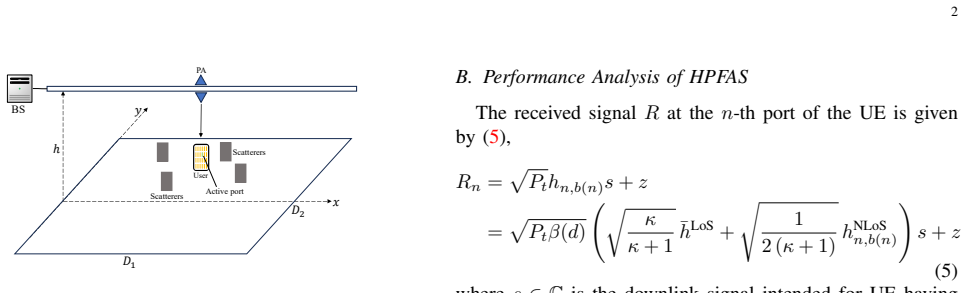
Reconfigurable-antenna systems have received increasing attention for their ability to adapt wireless channels. However, existing architectures exhibit scenario-dependent limitations: fluid antennas provide strong diversity gains in rich-scattering environments but offer limited benefits under line-of-sight (LoS)-dominant conditions, while pinching antennas can effectively reduce path loss by adjusting the radiation point along a waveguide, yet perform poorly in severe non-LoS (NLoS) scenarios. This letter proposes a hybrid pinching-fluid antenna system (HPFAS), where pinching antenna (PA) is employed at the transmitter and a fluid antenna (FA) is used at the receiver to jointly exploit LoS enhancement and spatial diversity. A tractable channel model is developed, and outage probability expressions are derived for both single-user and multi-user scenarios. Simulation results validate the analysis and show that the proposed HPFAS consistently outperforms systems using only pinching antennas or only fluid antennas under various propagation conditions.
Editorial analysis
A structured set of objections, weighed in public.
Referee Report
Summary. The paper proposes a hybrid pinching-fluid antenna system (HPFAS) that combines a pinching antenna at the transmitter to enhance line-of-sight (LoS) conditions by adjusting the radiation point along a waveguide and a fluid antenna at the receiver to provide spatial diversity. A tractable channel model is developed for this hybrid setup, from which closed-form outage probability expressions are derived for both single-user and multi-user scenarios. Simulations are used to validate the analytical results and demonstrate that the HPFAS outperforms pure pinching-antenna and pure fluid-antenna systems across various propagation conditions.
Significance. If the tractable channel model accurately represents the combined LoS enhancement and spatial diversity effects without unaccounted dependencies, the work could offer a valuable approach for improving wireless communication reliability in mixed LoS/NLoS environments. The provision of analytical expressions for outage probability and the simulation-based comparisons provide concrete performance insights that could inform system design in reconfigurable antenna technologies.
major comments (1)
- The tractable channel model section: the central claim of consistent outperformance rests on the model correctly combining PA-induced path-loss reduction with FA-induced diversity. The paper does not explicitly justify or validate the assumption that the effective channel gain (and especially the multi-user interference statistics) can be treated as arising from independent contributions of the two mechanisms; if propagation introduces dependence between radiation-point optimization and receiver-position selection, the derived outage expressions and the reported gains versus pure-PA or pure-FA baselines become unreliable.
minor comments (2)
- Simulation section: the specific numerical values chosen for channel correlation coefficients and path-loss exponents should be tabulated to allow exact reproduction of the Monte-Carlo results.
- Notation throughout: ensure that the hybrid channel gain symbol is defined once and used consistently in all subsequent equations and figures.
Simulated Author's Rebuttal
We thank the referee for the constructive feedback on our manuscript. We address the major comment regarding the tractable channel model below and will incorporate revisions to strengthen the presentation.
read point-by-point responses
-
Referee: The tractable channel model section: the central claim of consistent outperformance rests on the model correctly combining PA-induced path-loss reduction with FA-induced diversity. The paper does not explicitly justify or validate the assumption that the effective channel gain (and especially the multi-user interference statistics) can be treated as arising from independent contributions of the two mechanisms; if propagation introduces dependence between radiation-point optimization and receiver-position selection, the derived outage expressions and the reported gains versus pure-PA or pure-FA baselines become unreliable.
Authors: We appreciate the referee highlighting this modeling assumption. The tractable channel model in the manuscript factors the effective gain as the product of a deterministic path-loss reduction term (optimized via the pinching antenna radiation point along the waveguide) and a random small-scale fading term (selected via the fluid antenna port at the receiver). This separation follows from the physical distinction between large-scale LoS enhancement (affecting the Rician K-factor and average power) and small-scale diversity (governed by port selection in a rich-scattering component), which are treated as independent under the far-field propagation model and fixed antenna dimensions relative to link distance. For the multi-user case, each interfering link applies the same factorization to derive the aggregate interference statistics used in the outage probability expressions. We acknowledge that the manuscript does not provide an extended discussion or dedicated validation of this independence. In the revised version, we will add a dedicated paragraph in the channel model section justifying the assumption based on the distinct physical mechanisms and standard channel modeling practices, along with additional simulation results comparing analytical expressions against Monte Carlo trials that incorporate potential joint effects to confirm the reported performance advantages remain reliable. revision: partial
Circularity Check
Derivation chain is self-contained with independent channel model and performance expressions
full rationale
The paper develops a new tractable channel model for the hybrid pinching-fluid antenna system by combining LoS path-loss reduction from the pinching antenna at the transmitter with spatial diversity from the fluid antenna at the receiver. Outage probability expressions for single-user and multi-user cases are then derived from this model under standard fading assumptions. Simulations are used only for validation against the closed-form expressions, not for fitting parameters that are later renamed as predictions. No self-definitional steps, fitted inputs presented as predictions, or load-bearing self-citations appear in the derivation; the central results follow directly from the proposed model without reducing to its own inputs by construction. This is the expected non-circular outcome for a modeling-and-analysis paper.
Axiom & Free-Parameter Ledger
free parameters (1)
- channel correlation and path-loss parameters
axioms (1)
- domain assumption The developed tractable channel model accurately represents the joint LoS enhancement and spatial diversity behavior of the hybrid system.
Reference graph
Works this paper leans on
-
[1]
On the road to 6G: Visions, requirements, key technologies, and testbeds,
C.-X. Wang, X. You, X. Gao, X. Zhu, Z. Li, C. Zhang, H. Wang, Y . Huang, Y . Chen, H. Haas, J. S. Thompson, E. G. Larsson, M. D. Renzo, W. Tong, P. Zhu, X. Shen, H. V . Poor, and L. Hanzo, “On the road to 6G: Visions, requirements, key technologies, and testbeds,”IEEE Commun. Surv. Tut., vol. 25, no. 2, pp. 905–974, 2023
work page 2023
-
[2]
K.-K. Wong, A. Shojaeifard, K.-F. Tong, and Y . Zhang, “Fluid antenna systems,”IEEE Trans. Wireless Commun., vol. 20, no. 3, pp. 1950–1962, 2021
work page 1950
-
[3]
Fluid antenna systems enabling 6G: Principles, applications, and research directions,
T. Wu, K. Zhi, J. Yao, X. Lai, J. Zheng, H. Niu, M. Elkashlan, K.- K. Wong, C.-B. Chae, Z. Ding, G. K. Karagiannidis, M. Debbah, and C. Yuen, “Fluid antenna systems enabling 6G: Principles, applications, and research directions,”IEEE Wireless Commun., pp. 1–9, 2025
work page 2025
-
[4]
Fluid antenna multiple access,
K.-K. Wong and K.-F. Tong, “Fluid antenna multiple access,”IEEE Trans. Wireless Commun., vol. 21, no. 7, pp. 4801–4815, 2022. 7 5 10 15 20 25 30SNR threshold (dB) 10-4 10-3 10-2 10-1 100 Outage Probability PA-Only (Sim.)PA-Only (Ana.)FA-Only (Sim.)FA-Only (Ana.)FA-Only (Appro.)HPFAS (Sim.)HPFAS (Ana.)HPFAS (Appro.) Fig. 2. Outage probability versus theγ t...
work page 2022
-
[5]
Slow fluid antenna multiple access,
K.-K. Wong, D. Morales-Jimenez, K.-F. Tong, and C.-B. Chae, “Slow fluid antenna multiple access,”IEEE Trans. Commun., vol. 71, no. 5, pp. 2831–2846, 2023
work page 2023
-
[6]
Flexible-antenna systems: A pinching-antenna perspective,
Z. Ding, R. Schober, and H. Vincent Poor, “Flexible-antenna systems: A pinching-antenna perspective,”IEEE Trans. Commun., pp. 1–1, 2025
work page 2025
-
[7]
Rate maximization for downlink pinching-antenna systems,
Y . Xu, Z. Ding, and G. K. Karagiannidis, “Rate maximization for downlink pinching-antenna systems,”IEEE Wireless Commun. Lett., vol. 14, no. 5, pp. 1431–1435, 2025
work page 2025
-
[8]
Array gain for pinching- antenna systems (PASS),
C. Ouyang, Z. Wang, Y . Liu, and Z. Ding, “Array gain for pinching- antenna systems (PASS),”IEEE Commun. Lett., vol. 29, no. 6, pp. 1471– 1475, 2025
work page 2025
-
[9]
A low-complexity placement design of pinching-antenna systems,
X. Xie, F. Fang, Z. Ding, and X. Wang, “A low-complexity placement design of pinching-antenna systems,”IEEE Commun. Lett., vol. 29, no. 8, pp. 1784–1788, 2025
work page 2025
-
[10]
A new spatial block-correlation model for fluid antenna systems,
P. Ram ´ırez-Espinosa, D. Morales-Jimenez, and K.-K. Wong, “A new spatial block-correlation model for fluid antenna systems,”IEEE Trans. Wireless Commun., vol. 23, no. 11, pp. 15 829–15 843, 2024
work page 2024
-
[11]
X. Lin, Y . Zhao, H. Yang, and J. Hu, “Performance analysis of fluid antenna multiple access assisted wireless powered communication network,”IEEE J. Sel. Areas Commun., vol. 44, pp. 1382–1399, 2026
work page 2026
-
[12]
M. K. Simon,Probability distributions involving Gaussian random variables: A handbook for engineers and scientists. Springer, 2002
work page 2002
-
[13]
Laplace transform of product of generalized marcumQ, besselI, and power functions with applications,
N. Y . Ermolova and O. Tirkkonen, “Laplace transform of product of generalized marcumQ, besselI, and power functions with applications,” IEEE Trans. Signal Process., vol. 62, no. 11, pp. 2938–2944, 2014
work page 2014
discussion (0)
Sign in with ORCID, Apple, or X to comment. Anyone can read and Pith papers without signing in.