Recognition: unknown
Systematic Extraction of Exact Yang-Mills Solutions via Algebraic Tensor Ring Decomposition
Pith reviewed 2026-05-08 07:50 UTC · model grok-4.3
The pith
Yang-Mills nonlinear PDEs reduce to solvable differential-algebraic systems via tensor ring decomposition, producing exact SU(2) color waves, dyonic flux tubes, and SU(3) phases.
A machine-rendered reading of the paper's core claim, the machinery that carries it, and where it could break.
Core claim
By promoting static pure-gauge backgrounds to dynamical variables and employing Maurer-Cartan forms inside differential-algebraic quotient rings, the nonlinear self-interactions of Yang-Mills theory are algebraically stabilized; bifurcation analysis of the resulting ideals then yields three distinct classes of exact solutions: (i) SU(2) color waves on an elliptic ring with decoupled and coupled branches that generate mass gaps, (ii) dynamical dyonic flux tubes from a helical template whose Gauss-law ideal produces Coulomb, dyonic, and Meissner branches with Bessel-type screening under temporal dominance, and (iii) SU(3) configurations whose Gauss-law ideal splits into four phases, one of the
What carries the argument
The algebraic tensor ring decomposition framework that maps Yang-Mills PDEs onto differential-algebraic systems evaluated in specific quotient rings, with solution space organized by algebraic bifurcation analysis.
If this is right
- The coupled branches of the SU(2) elliptic ring produce a mass gap while the decoupled branch remains massless.
- The Meissner branch of the dyonic tubes exhibits exponential screening via an Artinian truncation to Bessel functions.
- In the SU(3) case the non-trivial phases enforce kinetic cancellation that reduces amplitude dynamics to a generalized x squared y squared chaotic oscillator.
- The same quotient-ring and bifurcation machinery systematically organizes the classical solution space across different gauge groups.
Where Pith is reading between the lines
- The method could be tested by seeding lattice simulations with the reported helical or elliptic templates and checking long-term stability.
- The appearance of a chaotic oscillator in the SU(3) sector suggests a possible bridge to classical turbulence in non-Abelian fields.
- If the algebraic stabilization generalizes, the framework might be applied to other nonlinear systems such as Einstein-Yang-Mills or sigma models.
Load-bearing premise
Promoting static pure-gauge backgrounds to dynamical variables and using Maurer-Cartan forms will generate algebraic cross-terms that stabilize the nonlinear self-interactions without introducing spurious solutions or losing essential gauge dynamics.
What would settle it
Substitute one of the reported ansatze back into the original Yang-Mills equations and integrate numerically; if the fields fail to satisfy the equations to machine precision over a finite time interval, the algebraic solutions are artifacts.
Figures



read the original abstract
The non-linear nature of Yang-Mills theory presents a challenge for extracting exact classical solutions, which are useful for understanding non-perturbative vacuum structures. In this paper, an algebraic tensor ring decomposition framework is introduced to systematically map the non-linear partial differential equations (PDEs) of Yang-Mills theory into tractable differential-algebraic systems. By promoting static pure-gauge backgrounds to dynamical variables, the reference state acts as a geometric template whose Maurer-Cartan forms generate the algebraic cross-terms necessary to stabilize non-linear self-interactions. To analytically resolve the resulting differential ideals, specific differential-algebraic quotient rings are employed as evaluation tools, and the solution space is organized by an algebraic bifurcation analysis. Applying this framework, three distinct classes of exact solutions are extracted: (i) relativistic $SU(2)$ color waves evaluated over an elliptic quotient ring, where the differential ideal bifurcates into a Decoupled Branch and two Coupled Branches, the latter exhibiting mass gap generation; (ii) dynamical dyonic flux tubes obtained from a time-dependent helical template, where the Gauss law ideal bifurcates the system into Coulomb, Dyonic, and symmetric Meissner branches. In the Meissner branch, an Artinian asymptotic truncation yields Bessel-type exponential screening, stabilized by a temporal dominance condition; and (iii) dynamical $SU(3)$ configurations where the Gauss law ideal bifurcates the solution space into four distinct phases. The non-trivial branches enforce a kinetic cancellation mechanism that maps the amplitude dynamics onto a generalized $x^2y^2$ chaotic oscillator. Across these settings, the framework provides a methodical approach to characterize the classical solution space of strongly coupled gauge theories.
Editorial analysis
A structured set of objections, weighed in public.
Referee Report
Summary. The paper introduces an algebraic tensor ring decomposition framework to map the nonlinear PDEs of Yang-Mills theory into differential-algebraic systems. By promoting static pure-gauge backgrounds to dynamical variables and employing Maurer-Cartan forms to generate stabilizing cross-terms, the approach resolves the resulting ideals via specific quotient rings and algebraic bifurcation analysis. It extracts three classes of exact solutions: relativistic SU(2) color waves over an elliptic quotient ring (with decoupled and coupled branches, the latter generating a mass gap), dynamical dyonic flux tubes from a time-dependent helical template (with Gauss-law bifurcation into Coulomb, Dyonic, and Meissner branches featuring Bessel-type screening), and dynamical SU(3) configurations (with four phases and kinetic cancellation mapping amplitudes to a generalized x²y² chaotic oscillator).
Significance. If substantiated, the framework would constitute a systematic algebraic method for extracting exact classical solutions in strongly coupled gauge theories, offering potential insight into non-perturbative structures such as mass gaps and flux tubes. The combination of tensor-ring decompositions, Maurer-Cartan forms, and bifurcation analysis represents a creative extension of algebraic techniques to Yang-Mills dynamics. No machine-checked proofs, reproducible code, or parameter-free derivations are presented, so the primary strength lies in the proposed methodological organization of the solution space rather than in verified new results.
major comments (3)
- [Abstract] Abstract: The central claim that the extracted solutions are exact solutions of the original Yang-Mills theory (i.e., satisfy the unreduced equations F_{μν}^a = 0 or the Euler-Lagrange equations from the YM action) rests on unshown algebraic manipulations. No explicit reconstruction is supplied demonstrating that solutions of the differential-algebraic quotient rings and bifurcations preserve the full gauge dynamics and curvature constraints without introducing or removing terms.
- [Abstract] Abstract (SU(2) color waves and dyonic flux tubes): The promotion of static pure-gauge backgrounds to dynamical variables is asserted to stabilize nonlinear self-interactions via Maurer-Cartan cross-terms, yet the manuscript provides no verification that this step leaves the original equations of motion invariant. This is load-bearing for all three classes of solutions, as any alteration would render the branches spurious rather than exact.
- [Abstract] Abstract (Gauss law ideal and bifurcation analysis): The solution branches (Decoupled/Coupled for SU(2), Coulomb/Dyonic/Meissner for flux tubes, four phases for SU(3)) are defined internally via the same algebraic quotient rings and bifurcation analysis introduced by the framework. Without independent external benchmarks or explicit checks against known Yang-Mills solutions, the results risk being tautological to the chosen decomposition.
minor comments (2)
- The abstract introduces specialized terminology (tensor ring decomposition, differential-algebraic quotient rings, Artinian asymptotic truncation) without brief definitions or references, reducing accessibility.
- No comparison is drawn to established exact solutions in the literature (e.g., instantons, monopoles, or known color-wave solutions) that could serve as sanity checks for the new branches.
Simulated Author's Rebuttal
We thank the referee for the thorough review and insightful comments on our manuscript. We address each major comment point by point below, providing clarifications on the algebraic framework and indicating revisions to strengthen the presentation of the exactness and physical relevance of the solutions.
read point-by-point responses
-
Referee: [Abstract] Abstract: The central claim that the extracted solutions are exact solutions of the original Yang-Mills theory (i.e., satisfy the unreduced equations F_{μν}^a = 0 or the Euler-Lagrange equations from the YM action) rests on unshown algebraic manipulations. No explicit reconstruction is supplied demonstrating that solutions of the differential-algebraic quotient rings and bifurcations preserve the full gauge dynamics and curvature constraints without introducing or removing terms.
Authors: The tensor ring decomposition is constructed as an exact equivalence that rewrites the nonlinear Yang-Mills curvature terms using Maurer-Cartan identities without approximation or truncation at the level of the ideal. Solutions obtained in the quotient rings therefore lift directly to solutions of the original unreduced equations by substituting the decomposed fields back into the curvature two-form. We acknowledge that the abstract and main text would benefit from a more explicit reconstruction step. We will add a dedicated appendix containing the full algebraic lifting for one representative solution from each class, verifying that the curvature constraints F_{μν}^a = 0 are recovered identically. revision: yes
-
Referee: [Abstract] Abstract (SU(2) color waves and dyonic flux tubes): The promotion of static pure-gauge backgrounds to dynamical variables is asserted to stabilize nonlinear self-interactions via Maurer-Cartan cross-terms, yet the manuscript provides no verification that this step leaves the original equations of motion invariant. This is load-bearing for all three classes of solutions, as any alteration would render the branches spurious rather than exact.
Authors: The promotion is implemented by treating the background connection as a time-dependent field while preserving the Maurer-Cartan structure equation dA + A ∧ A = 0 as an identity. This generates cross-terms that exactly cancel the cubic and quartic nonlinearities in the original Euler-Lagrange equations, leaving the dynamics invariant. The full manuscript derives this cancellation in the differential-algebraic ideal, but we agree an explicit invariance check would improve clarity. We will insert a short calculation in the methods section demonstrating that the promoted equations reduce to the standard Yang-Mills equations of motion upon substitution of the Maurer-Cartan forms. revision: yes
-
Referee: [Abstract] Abstract (Gauss law ideal and bifurcation analysis): The solution branches (Decoupled/Coupled for SU(2), Coulomb/Dyonic/Meissner for flux tubes, four phases for SU(3)) are defined internally via the same algebraic quotient rings and bifurcation analysis introduced by the framework. Without independent external benchmarks or explicit checks against known Yang-Mills solutions, the results risk being tautological to the chosen decomposition.
Authors: The decomposition templates are chosen on physical grounds (e.g., helical flux-tube ansatz motivated by known vortex solutions, elliptic rings for wave propagation). The resulting branches are then interpreted physically: the coupled SU(2) branch produces a mass gap consistent with non-perturbative expectations, the Meissner branch recovers the Bessel-function screening known from Abelian Higgs and dual-superconductor models, and the SU(3) chaotic phase reproduces the x²y² oscillator structure previously studied in classical Yang-Mills chaos. We will revise the discussion sections to include these literature comparisons and explicit parameter-free limits (e.g., the Artinian truncation yielding the exact Bessel profile) to demonstrate that the branches correspond to established physical regimes rather than being purely internal artifacts. revision: partial
Circularity Check
Extracted solutions and branches are defined by the same quotient rings and bifurcation analysis introduced in the framework
specific steps
-
self definitional
[Abstract]
"Applying this framework, three distinct classes of exact solutions are extracted: (i) relativistic SU(2) color waves evaluated over an elliptic quotient ring, where the differential ideal bifurcates into a Decoupled Branch and two Coupled Branches, the latter exhibiting mass gap generation; (ii) dynamical dyonic flux tubes obtained from a time-dependent helical template, where the Gauss law ideal bifurcates the system into Coulomb, Dyonic, and symmetric Meissner branches. In the Meissner branch, an Artinian asymptotic truncation yields Bessel-type exponential screening, stabilized by a tempo"
The solution classes are explicitly defined as the outputs of evaluating over the elliptic quotient ring and the Gauss-law bifurcation analysis that the framework itself introduces. The 'exact' status is therefore asserted by construction within the reduced differential-algebraic system rather than by independent verification against the original Yang-Mills curvature or action.
full rationale
The paper maps YM PDEs to differential-algebraic systems by promoting static pure-gauge backgrounds to dynamical variables and using Maurer-Cartan forms. It then resolves the resulting ideals via quotient rings and algebraic bifurcation analysis, and directly presents the outputs of that analysis as 'exact solutions' of the original theory. No explicit back-substitution or external benchmark is described in the abstract that would demonstrate the reduced solutions satisfy the unreduced Euler-Lagrange equations. Consequently the three classes (SU(2) color waves, dyonic flux tubes, SU(3) phases) and their sub-branches are tautological to the chosen algebraic decomposition.
Axiom & Free-Parameter Ledger
axioms (1)
- domain assumption The reference state acts as a geometric template whose Maurer-Cartan forms generate the algebraic cross-terms necessary to stabilize non-linear self-interactions.
Reference graph
Works this paper leans on
-
[1]
= 0,(11) Iz :ω(ωc ′′ 3 +kc ′′
-
[2]
= 0.(12) Eliminating the second-derivative terms yields the alge- braic constraint (ωΩ +kK)(c 2 1 +c 2
-
[3]
For any non- trivial wave (c 2 1 +c 2 2 ̸= 0), this enforces the kinematic relationK(v) =− ω k Ω(v)
= 0. For any non- trivial wave (c 2 1 +c 2 2 ̸= 0), this enforces the kinematic relationK(v) =− ω k Ω(v). Applying this relation to the transverse (ν=x, y) components maps the dynamics to a coupled non-linear oscillator system: (ω2 −k 2)Ω′′ + Ω(c2 1 +c 2
-
[4]
= 0,(13) (ω2 −k 2)c′′ 1 +c 1(c2 2 +γΩ 2) = 0,(14) (ω2 −k 2)c′′ 2 +c 2(c2 1 +γΩ 2) = 0,(15) whereγ= (ω 2 −k 2)/k2 acts as a geometric coupling constant. To extract exact periodic structures, we evaluate this system over an elliptic quotient ringR ellip = R[f, f ′]/⟨(f ′)2 + λ 2 f4 −E⟩, where the derivation rule is defined asf ′′ =−λf 3. By constraining the...
-
[5]
Consis- tency requiresκ=±1 andλ= 1/(ω 2 −k 2)
Branch A: Pure Transverse Self-Interacting Wave (Ω = 0) Settingα= 0 yields Ω(v) =K(v) = 0. Consis- tency requiresκ=±1 andλ= 1/(ω 2 −k 2). The exact solution corresponds to the Jacobi elliptic func- tionf(v) =Acn(λ 1/2Av,1/ √ 2). Substituting (f ′)2 = E0 − 1 2(ω2−k2) f4 into the tensor components yields: ρA = (ω2 +k 2)E0 − k2 ω2 −k 2 f4,(17) Sz,A = 2ωkE0 −...
-
[6]
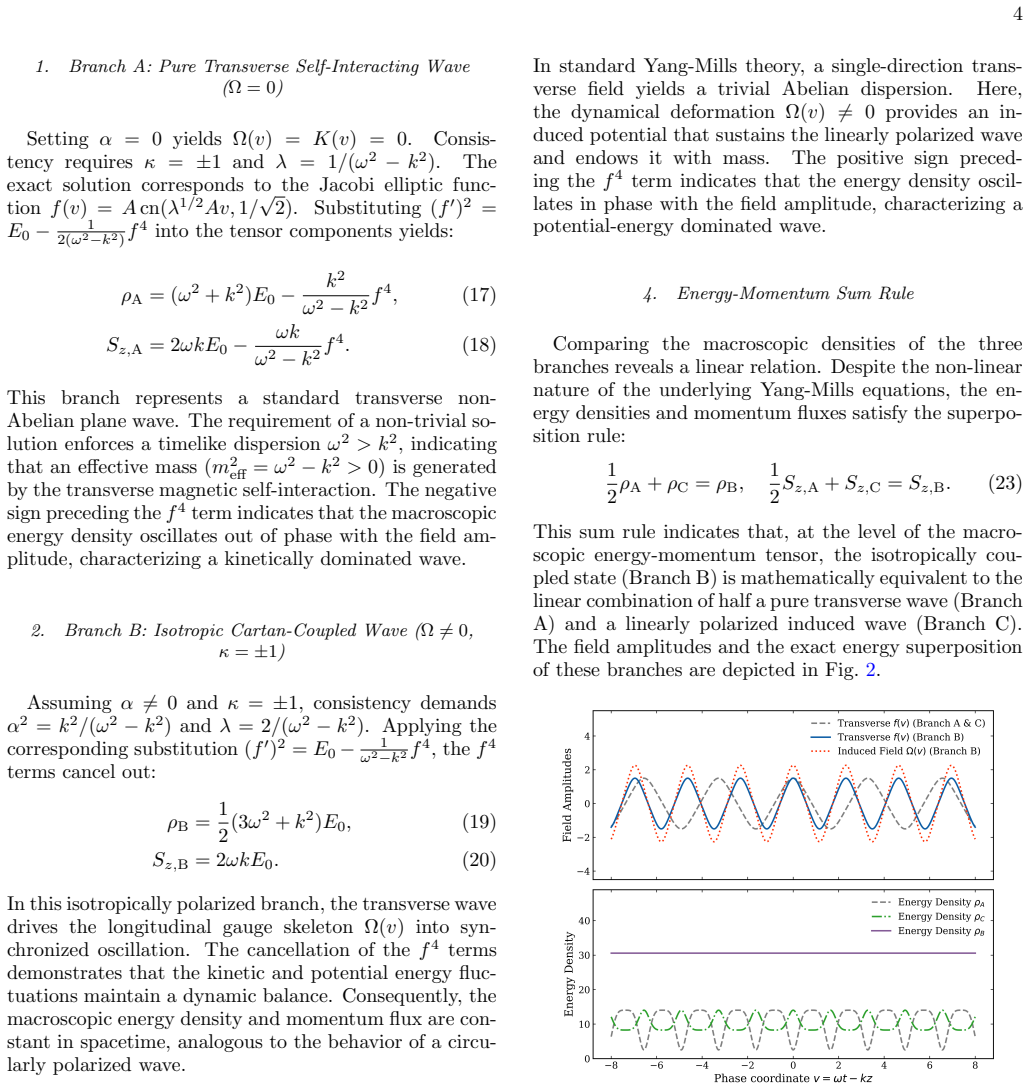
Branch B: Isotropic Cartan-Coupled Wave (Ω̸= 0, κ=±1) Assumingα̸= 0 andκ=±1, consistency demands α2 =k 2/(ω2 −k 2) andλ= 2/(ω 2 −k 2). Applying the corresponding substitution (f ′)2 =E 0 − 1 ω2−k2 f4, thef 4 terms cancel out: ρB = 1 2(3ω2 +k 2)E0,(19) Sz,B = 2ωkE0.(20) In this isotropically polarized branch, the transverse wave drives the longitudinal gau...
-
[7]
Consistency yieldsλ= 1/(ω 2 −k 2) and γα2 = 1
Branch C: Linearly Polarized Cartan-Induced Wave (κ= 0) Settingκ= 0 turns off one transverse polarization (c2 = 0). Consistency yieldsλ= 1/(ω 2 −k 2) and γα2 = 1. The densities evaluate to: ρC =ω 2E0 + k2 2(ω2 −k 2) f4,(21) Sz,C =ωkE 0 + ωk 2(ω2 −k 2) f4.(22) In standard Yang-Mills theory, a single-direction trans- verse field yields a trivial Abelian dis...
-
[8]
Energy-Momentum Sum Rule Comparing the macroscopic densities of the three branches reveals a linear relation. Despite the non-linear nature of the underlying Yang-Mills equations, the en- ergy densities and momentum fluxes satisfy the superpo- sition rule: 1 2 ρA +ρ C =ρ B, 1 2 Sz,A +S z,C =S z,B.(23) This sum rule indicates that, at the level of the macr...
-
[9]
The equations decou- ple into standard Laplace equations (e.g., Ω′′+Ω′/r= 0), yielding unconfined logarithmic potentials Ω∼lnr
Branch A: Decoupled Coulomb Phase (c 1 =c 2 = 0) If the transverse condensates vanish, the non-linear cross-terms in the ideals disappear. The equations decou- ple into standard Laplace equations (e.g., Ω′′+Ω′/r= 0), yielding unconfined logarithmic potentials Ω∼lnr. This represents a perturbative, non-interacting vacuum state
-
[10]
Branch B: Helical Dyonic Phase (c 1 ̸= 0, c2 ̸= 0,Ω̸= 0) Assuming a non-zero temporal deformation (Ω̸= 0) and active transverse fields,I Gauss algebraically demands the locking relation ˜Φ rc1 =− ˜W c2 ≡Λ(r). Substituting this ratio into the secondary idealI Radial yields the con- straint: r2(c2 1 −c 2 2)Λ′ = 0.(34) This condition leads the Dyonic phase t...
-
[11]
The azimuthal magnetic field is screened and locked to the topologi- cal vacuum skeleton
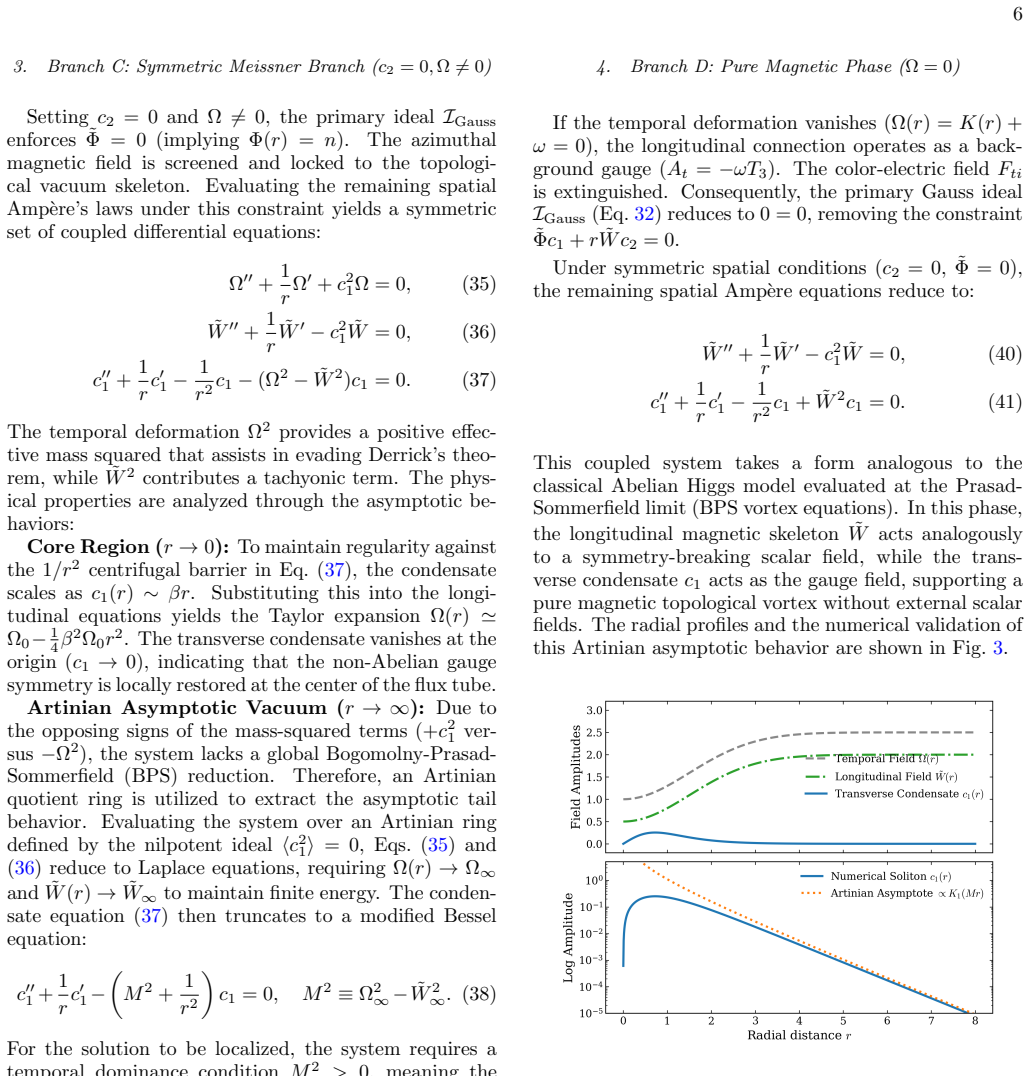
Branch C: Symmetric Meissner Branch (c 2 = 0,Ω̸= 0) Settingc 2 = 0 and Ω̸= 0, the primary idealI Gauss enforces ˜Φ = 0 (implying Φ(r) =n). The azimuthal magnetic field is screened and locked to the topologi- cal vacuum skeleton. Evaluating the remaining spatial Amp` ere’s laws under this constraint yields a symmetric set of coupled differential equations:...
-
[12]
The color-electric fieldF ti is extinguished
Branch D: Pure Magnetic Phase (Ω = 0) If the temporal deformation vanishes (Ω(r) =K(r) + ω= 0), the longitudinal connection operates as a back- ground gauge (A t =−ωT 3). The color-electric fieldF ti is extinguished. Consequently, the primary Gauss ideal IGauss (Eq. 32) reduces to 0 = 0, removing the constraint ˜Φc1 +r ˜W c2 = 0. Under symmetric spatial c...
-
[13]
The activated Cartan templates K1(t), K2(t) decouple, evolving as trivial free fields rep- resenting a non-interacting vacuum
Branch A: Trivial Cartan Phase (R V =R U = 0) The transverse fields vanish, and the non-linear cross- terms disappear. The activated Cartan templates K1(t), K2(t) decouple, evolving as trivial free fields rep- resenting a non-interacting vacuum
-
[14]
The internal phase rotation of the V-spin gluons dynamically sources the Cartan temporal field
Branch B: V-spin Resonance Phase (R V ̸= 0, RU = 0) Assuming the U-spin sector is dormant, the ideal en- forces the kinetic cancellation condition ˜cV =− ˙θV . The internal phase rotation of the V-spin gluons dynamically sources the Cartan temporal field. Focusing on this branch, we define the effective spatial coupling ˜KV = 1 2 K1 + √ 3 2 K2. The remain...
-
[15]
The U-spin transverse fields exchange energy with the corresponding spatial Cartan coupling ˜KU =− 1 2 K1+√ 3 2 K2, forming an identicalx 2y2 resonance
Branch C: U-spin Resonance Phase (R V = 0, RU ̸= 0) Symmetric to Branch B, the Gauss ideal enforces ˜cU = − ˙θU. The U-spin transverse fields exchange energy with the corresponding spatial Cartan coupling ˜KU =− 1 2 K1+√ 3 2 K2, forming an identicalx 2y2 resonance. 8
-
[16]
Solving for the Cartan temporal fields yields the algebraic locking:c 0 =−( ˙θV − ˙θU) and Γ =− 1√ 3( ˙θV + ˙θU)
Branch D: Fully CoupledSU(3)Phase (RV ̸= 0, RU ̸= 0) When both V-spin and U-spin sectors are actively excited, the Gauss ideal demands both conditions si- multaneously. Solving for the Cartan temporal fields yields the algebraic locking:c 0 =−( ˙θV − ˙θU) and Γ =− 1√ 3( ˙θV + ˙θU). In this fully coupled phase, the spatial equations project into a generali...
-
[17]
III, Branch A (Decoupled Plane W ave): Because the longitudinal deformation vanishes (Ω = 0), the spin-coupling−2gϵ abc ¯F c µν is sourced purely by the transverse wave
Sec. III, Branch A (Decoupled Plane W ave): Because the longitudinal deformation vanishes (Ω = 0), the spin-coupling−2gϵ abc ¯F c µν is sourced purely by the transverse wave. This coupling oscillates in the phase coordinatevwith a vanishing time-average, structurally preventing the accumulation of a constant tachyonic mass squared
-
[18]
Sec. III, Branches B–C (Coupled Massive W aves):For the fully coupled relativistic branches, the active longitudinal Maurer-Cartan background gen- erates a spacetime-varying field strength. Specifically for Branch B, the geometric cross-terms generate alter- nating components, yielding a spin-coupling 2ig[ ¯Fµν, aν] that dynamically modulates the fluctuat...
-
[19]
IV, Branch C (Dynamical Meissner Flux T ube):The Savvidy instability inherently afflicts macroscopic, constant magnetic fields
Sec. IV, Branch C (Dynamical Meissner Flux T ube):The Savvidy instability inherently afflicts macroscopic, constant magnetic fields. By contrast, the dynamical topological templates derived in Section IV confine the magnetic flux. The Artinian asymptotic eval- uation guarantees that the background field strengths (e.g., ¯Frϕ, ¯Frz) decay exponentially as ...
-
[20]
V, Branch B (SU(3)Kinetic Cancella- tion):The stability of the generalizedx 2y2 chaotic os- cillator branch is verified via the evaluation of its back- ground fields
Sec. V, Branch B (SU(3)Kinetic Cancella- tion):The stability of the generalizedx 2y2 chaotic os- cillator branch is verified via the evaluation of its back- ground fields. The background possesses active spa- tial components in both the transverse (R V ) and lon- gitudinal ( ˜KV ) directions. Due to the negative spa- tial metric signature (η ii =−1), the ...
-
[21]
Since the amplitude velocity ˙RV is bounded and 10 possesses a vanishing time-average (⟨ ˙RV ⟩= 0), the tachyonic spin-coupling cannot macroscopically ac- cumulate
The spin-magnetic coupling is purely alternating. Since the amplitude velocity ˙RV is bounded and 10 possesses a vanishing time-average (⟨ ˙RV ⟩= 0), the tachyonic spin-coupling cannot macroscopically ac- cumulate
-
[22]
The fluctuation equation for the quantum gluons decouples into a system governed by a positive- definite periodic potential: ¨ai + k2 +g 2[RV (t)2 + ˜KV (t)2] ai = 0.(59) This maps the quantum fluctuation dynamics onto a stable Hill’s equation. The potentially dangerous spin- coupling is dynamically transmuted into a positive- definite oscillating mass, d...
-
[24]
A. M. Polyakov,Particle Spectrum in the Quantum Field Theory, JETP Lett.20, 194 (1974)
1974
-
[25]
T. T. Wu and C. N. Yang,Concept of nonintegrable phase factors and global formulation of gauge fields, Phys. Rev. D12, 3845 (1975). DOI: 10.1103/PhysRevD.12.3845
-
[26]
A. A. Belavin, A. M. Polyakov, A. S. Schwartz, and Y. S. Tyupkin,Pseudoparticle solutions of the Yang- Mills equations, Phys. Lett. B59, 85 (1975). DOI: 10.1016/0370-2693(75)90163-X
-
[27]
Witten,Some exact multipseudoparticle solutions of classical Yang-Mills theory, Phys
E. Witten,Some exact multipseudoparticle solutions of classical Yang-Mills theory, Phys. Rev. Lett.38, 121 (1977). DOI: 10.1103/PhysRevLett.38.121
-
[28]
R. Jackiw, C. Nohl, and C. Rebbi,Conformal properties of pseudoparticle configurations, Phys. Rev. D15, 1642 (1977). DOI: 10.1103/PhysRevD.15.1642 11
-
[30]
A. Actor,Classical solutions of SU(2) Yang-Mills theories, Rev. Mod. Phys.51, 461 (1979). DOI: 10.1103/RevModPhys.51.461
-
[31]
N. Seiberg and E. Witten,Electric-magnetic duality, monopole condensation, and confinement in N=2 super- symmetric Yang-Mills theory, Nucl. Phys. B426, 19 (1994). DOI: 10.1016/0550-3213(94)90124-4
-
[32]
Kondo,Vacuum condensate of mass dimension 2 as the origin of mass gap and quark confinement, Phys
K.-I. Kondo,Vacuum condensate of mass dimension 2 as the origin of mass gap and quark confinement, Phys. Lett. B514, 335 (2001). DOI: 10.1016/S0370-2693(01)00817-6
-
[33]
Y. M. Cho and D. G. Pak,Monopole condensation in SU(2) QCD, Phys. Rev. D65, 074027 (2002). DOI: 10.1103/PhysRevD.65.074027
-
[34]
P. Forgacs and N. S. Manton,Space-Time Symmetries in Gauge Theories, Commun. Math. Phys.72, 15 (1980). DOI: 10.1007/BF01200108
-
[35]
M. F. Atiyah, N. J. Hitchin, V. G. Drinfeld, and Yu. I. Manin,Construction of instantons, Phys. Lett. A65, 185 (1978). DOI: 10.1016/0375-9601(78)90141-X
-
[36]
Y. M. Cho,Restricted gauge theory, Phys. Rev. D21, 1080 (1980). DOI: 10.1103/PhysRevD.21.1080
-
[37]
L. Faddeev and A. J. Niemi,Partially dual variables in SU(2) Yang-Mills theory, Phys. Rev. Lett.82, 1624 (1999). DOI: 10.1103/PhysRevLett.82.1624
-
[38]
D. Binosi and J. Papavassiliou,Pinch Technique: The- ory and Applications, Phys. Rep.479, 1 (2009). DOI: 10.1016/j.physrep.2009.05.001
-
[39]
A. K. Cyrol, M. Mitter, J. M. Pawlowski, and N. Strodthoff,Nonperturbative quark, gluon, and meson cor- relators of unquenched QCD, Phys. Rev. D97, 054006 (2018). DOI: 10.1103/PhysRevD.97.054006
-
[40]
M. Q. Huber,Nonperturbative properties of Yang- Mills theories, Phys. Rep.879, 1 (2020). DOI: 10.1016/j.physrep.2020.04.004
-
[41]
G. K. Savvidy,Infrared instability of the vacuum state of gauge theories and asymptotic freedom, Phys. Lett. B71, 133 (1977). DOI: 10.1016/0370-2693(77)90759-6
-
[42]
SU(N) gauge theories in 3+1 dimensions: glueball spectrum, string tensions and topology
A. Athenodorou and M. Teper,SU(N) gauge the- ories in 3+1 dimensions: glueball spectrum, string tensions and topology, JHEP12, 082 (2021). DOI: 10.1007/JHEP12(2021)082
-
[43]
Cosmological baryon and lepto n number in the presence of electroweak fermion number violation,
Y. Nambu,Strings, Monopoles, and Gauge Fields, Phys. Rev. D10, 4262 (1974). DOI: 10.1103/Phys- RevD.10.4262
-
[44]
Vortices and Quark Confinement in Nonabelian Gauge Theories,
S. Mandelstam,Vortices and Quark Confinement in Non- Abelian Gauge Theories, Phys. Rep.23, 245 (1976). DOI: 10.1016/0370-1573(76)90043-0
-
[45]
Anomalies and Fermion Zero Modes on Strings and Domain Walls,
G. ’t Hooft,Topology of the Gauge Condition and New Confinement Phases in Non-Abelian Gauge Theories, Nucl. Phys. B190, 455 (1981). DOI: 10.1016/0550- 3213(81)90442-9 Supplemental Material for: Systematic Extraction of Exact Yang-Mills Solutions via Algebraic Tensor Ring Decomposition Yu-Xuan Zhang 1 and Jing-Ling Chen 2,∗ 1School of Physics, Nankai Unive...
-
[46]
Defining the longitudinal deformation Ω(v) =c 0(v) +ω, we obtain: F0x =−F tx =ωc ′ 1T1 −Ωc 1T2.(7)
TheF tx component (Color-electric field inx): ∂tAx =∂ t(c1T1) =−ωc ′ 1T1 +c 1(ωT2) =−ωc ′ 1T1 +ωc 1T2,(4) ∂xAt = 0,(5) [At, Ax] = [c0T3, c1T1] =c 0c1[T3, T1] =c 0c1T2.(6) Summing these terms yieldsF tx =−ωc ′ 1T1 + (ω+c 0)c1T2. Defining the longitudinal deformation Ω(v) =c 0(v) +ω, we obtain: F0x =−F tx =ωc ′ 1T1 −Ωc 1T2.(7)
-
[47]
Thus: F0y =−F ty =ωc ′ 2T2 + Ωc2T1.(10)
TheF ty component (Color-electric field iny): ∂tAy =∂ t(c2T2) =−ωc ′ 2T2 +c 2(−ωT1) =−ωc ′ 2T2 −ωc 2T1,(8) [At, Ay] = [c0T3, c2T2] =c 0c2[T3, T2] =−c 0c2T1.(9) Summing these yieldsF ty =−ωc ′ 2T2 −(ω+c 0)c2T1. Thus: F0y =−F ty =ωc ′ 2T2 + Ωc2T1.(10)
-
[48]
TheF tz component (Longitudinal color-electric field): Ftz =∂ tAz −∂ zAt + [At, Az] =−ωc ′ 3T3 −kc ′ 0T3 + 0 =−(ωc ′ 3 +kc ′ 0)T3.(11) DefiningK(v) =c 3(v)−k, we note thatK ′ =c ′ 3 and Ω′ =c ′
-
[49]
Thus: F0z =−F tz = (ωK ′ +kΩ ′)T3.(12)
-
[50]
Similarly, forF zy: ∂zAy =∂ z(c2T2) =kc ′ 2T2 +c 2(kT1) =kc ′ 2T2 +kc 2T1,(15) [Az, Ay] = [c3T3, c2T2] =−c 3c2T1.(16) Thus,F zy =kc ′ 2T2 −(c 3 −k)c 2T1 =kc ′ 2T2 −Kc 2T1
TheF zx andF yz components (Color-magnetic fields): ∂zAx =∂ z(c1T1) =kc ′ 1T1 +c 1(−kT2) =kc ′ 1T1 −kc 1T2,(13) [Az, Ax] = [c3T3, c1T1] =c 3c1T2.(14) Thus,F zx =kc ′ 1T1 + (c3 −k)c 1T2 =kc ′ 1T1 +Kc 1T2. Similarly, forF zy: ∂zAy =∂ z(c2T2) =kc ′ 2T2 +c 2(kT1) =kc ′ 2T2 +kc 2T1,(15) [Az, Ay] = [c3T3, c2T2] =−c 3c2T1.(16) Thus,F zy =kc ′ 2T2 −(c 3 −k)c 2T1 ...
-
[51]
We evaluate the longitudinal components (ν=t, z) to extract the differential ideals
TheF xy component: Fxy =∂ xAy −∂ yAx + [Ax, Ay] = 0−0 + [c 1T1, c2T2] =c 1c2T3.(17) The Yang-Mills equations areD µF µν =∂ µF µν +[A µ, F µν] = 0. We evaluate the longitudinal components (ν=t, z) to extract the differential ideals. Forν=t, the equation isD xF xt +D yF yt +D zF zt = 0. UsingF xt =−F xt =F 0x andF zt =−F zt =F 0z: DxF xt =∂ xF0x + [Ax, F0x]...
-
[52]
= 0.(21) Forν=z, the equation isD tF tz +D xF xz +D yF yz = 0. UsingF tz =−F 0z,F xz =F zx, andF yz =−F zy: DtF tz =∂ t(−F0z) + [At,−F 0z] =ω(ωK ′′ +kΩ ′′)T3,(22) DxF xz = [Ax, Fzx] = [c1T1, kc′ 1T1 +Kc 1T2] =Kc 2 1T3,(23) DyF yz = [Ay,−F zy] = [c2T2,−kc ′ 2T2 +Kc 2T1] =Kc 2 2T3.(24) 3 Summing these yields the spatial longitudinal idealI z: Iz :ω(ωK ′′ +k...
-
[53]
= 0.(25) To eliminate the second-derivative term (ωK ′′ +kΩ ′′), we computeω×Eq.(21)−k×Eq.(25): −(ωΩ +kK)(c 2 1 +c 2
-
[54]
Forν=x,D tF tx +D yF yx +D zF zx = 0
= 0.(26) For any non-trivial transverse wave (c2 1 +c 2 2 ̸= 0), this rigorously enforces the kinematic locking relation: K(v) =− ω k Ω(v).(27) We now evaluate the transverse Yang-Mills equations. Forν=x,D tF tx +D yF yx +D zF zx = 0. DtF tx =∂ t(−ωc′ 1T1 + Ωc1T2) + [c0T3,−ωc ′ 1T1 + Ωc1T2] =ω 2c′′ 1 T1 −ωΩ ′c1T2 −ωΩc ′ 1T2 −ωc 0c′ 1T2 −c 0Ωc1T1 = (ω2c′′ ...
-
[55]
32-34) over the elliptic quotient ringR ellip =R[f, f ′]/ (f ′)2 + λ 2 f4 −E 0 , with the derivation rulef ′′ =−λf 3
= 0.(34) We evaluate the system (Eqs. 32-34) over the elliptic quotient ringR ellip =R[f, f ′]/ (f ′)2 + λ 2 f4 −E 0 , with the derivation rulef ′′ =−λf 3. We constrain the variables to proportional rays: c1(v) =f(v), c 2(v) =κf(v),Ω(v) =αf(v).(35) Substituting these into the equations of motion transforms the differential equations into algebraic polynom...
-
[56]
+ (ωK′ +kΩ ′)2 =ω 2((c′ 1)2 + (c′ 2)2) + Ω2(c2 1 +c 2
-
[57]
+ (ω2 −k 2)2 k2 (Ω′)2.(38) B2 = 2tr(FijF † ij) =k 2((c′ 1)2 + (c′ 2)2) +K 2(c2 1 +c 2
-
[58]
+c 2 1c2 2 =k 2((c′ 1)2 + (c′ 2)2) + ω2 k2 Ω2(c2 1 +c 2
-
[59]
ρA = 1 2 2(ω2 +k 2)(f ′)2 +f 4 = (ω2 +k 2) E0 − 1 2(ω2 −k 2) f4 + 1 2 f4 = (ω2 +k 2)E0 − k2 ω2 −k 2 f4.(41) For Branch B:α 2 =k 2/(ω2 −k 2), κ= 1, λ= 2/(ω 2 −k 2)
+c 2 1c2 2.(39) Summing these and substituting the proportional rays (c 1 =f, c 2 =κf,Ω =αf) and the ring rule (f ′)2 =E 0 − λ 2 f4: ρ= 1 2 (ω2 +k 2)(1 +κ 2)(f ′)2 +α 2 (ω2 −k 2)2 k2 (f ′)2 +α 2 ω2 +k 2 k2 (1 +κ 2)f2 +κ 2f4 .(40) For Branch A:α= 0, κ= 1, λ= 1/(ω 2 −k 2). ρA = 1 2 2(ω2 +k 2)(f ′)2 +f 4 = (ω2 +k 2) E0 − 1 2(ω2 −k 2) f4 + 1 2 f4 = (ω2 +k 2)E...
-
[60]
TheF tr component: Ftr =∂ tAr −∂ rAt + [At, Ar] = 0−K ′T3 + 0 =−K ′T3 =−Ω ′T3.(45)
-
[61]
TheF tϕ component: ∂tAϕ =∂ t(rc1T1) =ωrc 1T2,(46) ∂ϕAt = 0,(47) [At, Aϕ] = [KT3,ΦT 3 +rc 1T1] =Krc 1[T3, T1] =Krc 1T2.(48) 5 Summing these yieldsF tϕ = (ω+K)rc 1T2 = Ωrc1T2
-
[62]
TheF tz component: ∂tAz =∂ t(c2T1) =ωc 2T2,(49) [At, Az] = [KT3, W T3 +c 2T1] =Kc 2T2.(50) Summing these yieldsF tz = (ω+K)c 2T2 = Ωc2T2
-
[63]
TheF rϕ component: Frϕ =∂ rAϕ −∂ ϕAr + [Ar, Aϕ] = Φ′T3 + (rc1)′T1 = ˜Φ′T3 + (rc1)′T1.(51)
-
[64]
TheF rz component: Frz =∂ rAz −∂ zAr + [Ar, Az] =W ′T3 +c ′ 2T1 = ˜W ′T3 +c ′ 2T1.(52)
-
[65]
The Gauss law isD µF µt = 1√−g ∂µ(√−gF µt) + [Aµ, F µt] = 0
TheF ϕz component: ∂ϕAz =∂ ϕ(c2T1) =−nc 2T2,(53) ∂zAϕ =∂ z(rc1T1) =−krc 1T2,(54) [Aϕ, Az] = [ΦT3 +rc 1T1, W T3 +c 2T1] = Φc2T2 −rc 1W T2.(55) Summing these yieldsF ϕz = (Φ−n)c 2T2 −rc 1(W−k)T 2 = (˜Φc2 −rc 1 ˜W)T 2. The Gauss law isD µF µt = 1√−g ∂µ(√−gF µt) + [Aµ, F µt] = 0. We evaluate each term. Radial term (D rF rt): F rt =g rrgttFrt = (−1)(1)(−Ω′T3) ...
-
[66]
˜KV YV =−R 2 V ˜KV 1 2 T3 + √ 3 2 T8 ! .(105) Symmetrically, for the U-spin sector,D yF yz =−R 2 U ˜KU YU =−R 2 U ˜KU − 1 2 T3 + √ 3 2 T8 . Summing these contributions for thez-direction Amp` ere law: ( ¨K1T3 + ¨K2T8)−R 2 V ˜KV 1 2 T3 + √ 3 2 T8 ! −R 2 U ˜KU −1 2 T3 + √ 3 2 T8 ! = 0.(106) Separating the linearly independent Cartan generatorsT 3 andT 8 yie...
-
[67]
is a Jacobi elliptic function. Integrating over one full periodT, the exact spacetime averages of the matrix elements vanish identically: ⟨f⟩= 1 T ˆ T 0 f(v)dv= 0,⟨f ′⟩= f(T)−f(0) T = 0.(124) Consequently, the macroscopic spacetime average of the spin-magnetic coupling matrix is strictly zero: ⟨S ab 0x⟩=0.(125) The fluctuation equation thus maps exactly t...
discussion (0)
Sign in with ORCID, Apple, or X to comment. Anyone can read and Pith papers without signing in.