Recognition: unknown
Genus-protected higher-order topological phases
Pith reviewed 2026-05-08 06:15 UTC · model grok-4.3
The pith
Higher-order topological phases can be protected solely by the bulk gap, fundamental symmetries, and the genus of the system shape without any crystalline symmetries.
A machine-rendered reading of the paper's core claim, the machinery that carries it, and where it could break.
Core claim
Higher-order topological phases can be realized through explicit constructions that rely only on the bulk gap and fundamental symmetries together with the genus of the system shape; the resulting boundary states at higher-codimension boundaries cannot be removed by any purely surface perturbation while those symmetries and the gap remain intact.
What carries the argument
The genus of the system shape, which serves as a global topological feature that, combined with the bulk gap and local symmetries, protects the higher-order boundary modes independently of any crystalline order.
If this is right
- Boundary states at corners and hinges remain stable against any modification confined to the surface.
- Protection does not require the presence of lattice symmetries of any kind.
- The same states appear in systems whose overall shape has holes, provided the bulk gap and local symmetries are preserved.
- Purely surface perturbations cannot eliminate the modes as long as the fundamental symmetries hold.
Where Pith is reading between the lines
- This approach may allow topological protection to be engineered in non-crystalline or amorphous materials by controlling overall shape rather than atomic order.
- Systems with higher genus could host multiple independent sets of protected boundary modes that interact only weakly.
- It points toward device designs in which holes or voids are deliberately introduced to create robust corner or hinge states for quantum information applications.
Load-bearing premise
That explicit construction schemes exist which achieve the protection using only the bulk gap, fundamental symmetries, and genus without crystalline symmetry contributions, and that these can be realized physically while keeping the bulk gap open.
What would settle it
A concrete model or material with non-trivial genus in which surface-only perturbations gap out the higher-order boundary modes while the bulk gap and fundamental local symmetries stay intact.
Figures




read the original abstract
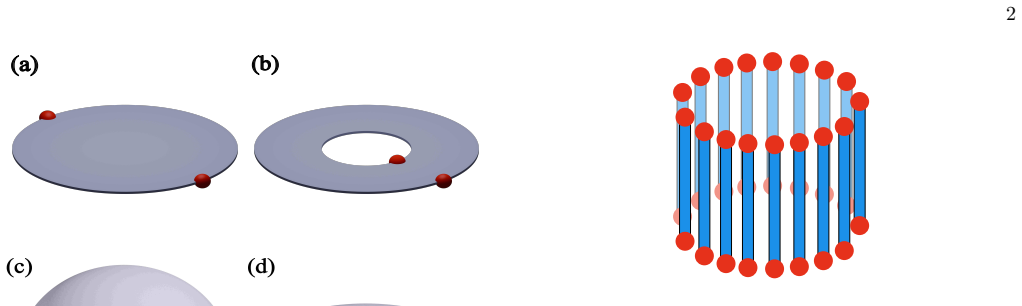
Higher-order topological phases (HOTPs) feature protected gapless modes on boundaries of higher codimension, such as the corners or hinges of a crystal. They are understood as being protected by lattice symmetries: If the latter are broken, it becomes possible to remove the boundary modes without closing the bulk gap. In this work, we present construction schemes for HOTPs protected solely by the bulk gap, by fundamental symmetries, and by the global topology of the system shape (its genus, or number of holes), independent of any crystalline symmetries. As long as the fundamental local symmetries are preserved, the resulting boundary states cannot be removed by any purely-surface perturbation.
Editorial analysis
A structured set of objections, weighed in public.
Referee Report
Summary. The paper claims to construct higher-order topological phases (HOTPs) protected solely by a gapped bulk, fundamental symmetries (e.g., TRS or PHS), and the topological genus of the system domain, without any crystalline symmetries. Explicit lattice models on multiply connected geometries are presented, with analytical arguments and numerical diagonalization demonstrating that corner/hinge modes survive arbitrary surface perturbations that preserve local symmetries and the bulk gap, due to a genus-enforced invariant.
Significance. If the constructions hold, this would represent a notable advance by decoupling HOTP protection from lattice symmetries and introducing the global shape topology (genus) as a robust protector of higher-order boundary states. It enables potential realization in amorphous or irregularly shaped systems while maintaining protection against surface perturbations.
minor comments (3)
- §3.2: The definition of the genus invariant could be stated more explicitly with a formula or topological index to clarify how it enforces the boundary mode count independent of local details.
- Figure 4: The numerical spectra for genus-2 geometries would benefit from an additional panel showing the effect of a symmetry-breaking surface perturbation to directly illustrate the claimed robustness.
- References: Add citations to prior works on shape-dependent topology or non-crystalline HOTPs for better context on novelty.
Simulated Author's Rebuttal
We thank the referee for their positive assessment of our manuscript and for recommending minor revision. The referee's summary correctly captures the central claim that higher-order topological phases can be protected by the bulk gap, fundamental symmetries, and the genus of the system shape without requiring crystalline symmetries.
Circularity Check
No significant circularity; explicit constructions and numerical checks are self-contained
full rationale
The manuscript supplies explicit lattice-model constructions on multiply-connected geometries together with analytical arguments and numerical diagonalization. These demonstrate that higher-order boundary modes survive arbitrary surface perturbations preserving local symmetries and the bulk gap, with the genus acting as an independent topological invariant. No step reduces by definition to a fitted parameter, self-citation chain, or renamed ansatz; the central claim rests on new constructions whose validity is checked directly against the stated assumptions rather than presupposed by them.
Axiom & Free-Parameter Ledger
axioms (2)
- domain assumption The bulk gap remains open and protects the topological character
- domain assumption Fundamental local symmetries (e.g., time-reversal) are preserved
Reference graph
Works this paper leans on
-
[1]
We begin with the class- D Hamiltonian [49]: H(k) =ϵ(k)τ 3 + ∆xτ1 sink x + ∆yτ2 sink y, ϵ(k) =−2t x cosk x −2t y cosk y −µ
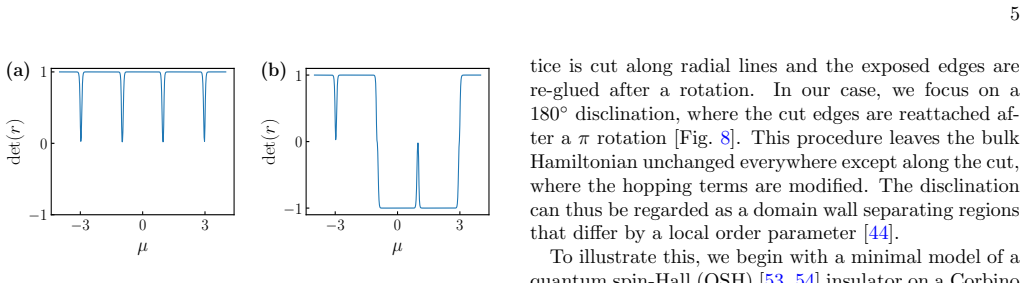
Dislocations A lattice dislocation is constructed by removing a line of sites and reconnecting the lattice across the cut such that the bulk remains uniform. We begin with the class- D Hamiltonian [49]: H(k) =ϵ(k)τ 3 + ∆xτ1 sink x + ∆yτ2 sink y, ϵ(k) =−2t x cosk x −2t y cosk y −µ. (2) (a) □2 □1 0 1 2E/t (b) □2 □1 0 1 2E/t (c) □2 □1 0 1 2E/t (d) □2 □1 0 1 ...
-
[2]
In our case, we focus on a 180◦ disclination, where the cut edges are reattached af- ter aπrotation [Fig
Disclinations Disclinations are topological lattice defects that can be generated through a Volterra construction: the lat- tice is cut along radial lines and the exposed edges are re-glued after a rotation. In our case, we focus on a 180◦ disclination, where the cut edges are reattached af- ter aπrotation [Fig. 8]. This procedure leaves the bulk Hamilton...
-
[3]
We provide examples of this classification in Fig
In contrast, forZsystems, each hole can support an arbitrary number of modes, leading to an infinite number of distinct phases classi- fied byZ g. We provide examples of this classification in Fig. 12(a,b), which shows two distinct PHS-protected phases for a two-dimensional lattice withg= 1 and four distinct PHS-protected phases forg= 2. These phases belo...
-
[4]
(c) Four distinct GPT phases for a three- dimensional torus (g= 1), classified byZ 2
-
[5]
(d) Sixteen distinct GPT phases for a three-dimensional double- torus (g= 2), classified byZ 4
The torus surface is represented as a square with edges of the same color iden- tified, arrows indicate the orientation of gluing, and red lines denote noncontractible loops supporting helical modes. (d) Sixteen distinct GPT phases for a three-dimensional double- torus (g= 2), classified byZ 4
-
[6]
The four independent noncontractible loops produceZ 4 2, corresponding to sixteen distinct GPT phases
The surface is represented as an octagon with edges of the same color identified surface is represented as an octagon with edges identified. The four independent noncontractible loops produceZ 4 2, corresponding to sixteen distinct GPT phases. Finally we note that the 2D case can also be under- stood in terms of homology groups. Here the relevant objects ...
-
[7]
M. Z. Hasan and C. L. Kane, Colloquium: Topological insulators, Rev. Mod. Phys.82, 3045 (2010)
2010
-
[8]
Qi and S.-C
X.-L. Qi and S.-C. Zhang, Topological insulators and su- perconductors, Rev. Mod. Phys.83(2011)
2011
-
[9]
Altland and M
A. Altland and M. R. Zirnbauer, Nonstandard symme- try classes in mesoscopic normal-superconducting hybrid structures, Phys. Rev. B55(1997)
1997
-
[10]
A. P. Schnyder, S. Ryu, A. Furusaki, and A. W. W. Lud- wig, Classification of topological insulators and super- conductors in three spatial dimensions, Phys. Rev. B78 (2008)
2008
-
[11]
Kitaev, V
A. Kitaev, V. Lebedev, and M. Feigel’man, Periodic table for topological insulators and superconductors, inAIP Conference Proceedings(AIP, 2009) p. 22–30
2009
-
[12]
S. Ryu, A. P. Schnyder, A. Furusaki, and A. W. W. Lud- wig, Topological insulators and superconductors: tenfold way and dimensional hierarchy, New J. Phys.12(2010)
2010
-
[13]
W. A. Benalcazar, B. A. Bernevig, and T. L. Hughes, Quantized electric multipole insulators, Science357 (2017)
2017
-
[14]
W. A. Benalcazar, B. A. Bernevig, and T. L. Hughes, Electric multipole moments, topological multipole mo- ment pumping, and chiral hinge states in crystalline in- sulators, Phys. Rev. B96(2017)
2017
-
[15]
Schindler, A
F. Schindler, A. M. Cook, M. G. Vergniory, Z. Wang, S. S. P. Parkin, B. A. Bernevig, and T. Neupert, Higher- order topological insulators, Sci. Adv.4(2018)
2018
-
[16]
Geier, L
M. Geier, L. Trifunovic, M. Hoskam, and P. W. Brouwer, Second-order topological insulators and superconductors with an order-two crystalline symmetry, Phys. Rev. B97 (2018)
2018
-
[17]
Trifunovic and P
L. Trifunovic and P. W. Brouwer, Higher-order bulk- boundary correspondence for topological crystalline phases, Phys. Rev. X9(2019)
2019
-
[18]
Trifunovic and P
L. Trifunovic and P. W. Brouwer, Higher-order topolog- ical band structures, Phys. Status Solidi B258(2020)
2020
-
[19]
Varjas, A
D. Varjas, A. Lau, K. P¨ oyh¨ onen, A. R. Akhmerov, D. I. Pikulin, and I. C. Fulga, Topological phases without crys- talline counterparts, Phys. Rev. Lett.123(2019)
2019
-
[20]
Chen, C.-Z
R. Chen, C.-Z. Chen, J.-H. Gao, B. Zhou, and D.-H. Xu, Higher-order topological insulators in quasicrystals, Phys. Rev. Lett.124(2020). 10
2020
-
[21]
Lin and T
M. Lin and T. L. Hughes, Topological quadrupolar semimetals, Phys. Rev. B98(2018)
2018
-
[22]
Ezawa, Magnetic second-order topological insulators and semimetals, Phys
M. Ezawa, Magnetic second-order topological insulators and semimetals, Phys. Rev. B97(2018)
2018
-
[23]
Simon, M
S. Simon, M. Geier, and P. W. Brouwer, Higher-order topological semimetals and nodal superconductors with an order-two crystalline symmetry, Phys. Rev. B106, 035105 (2022)
2022
-
[24]
Wang, Z.-K
H.-X. Wang, Z.-K. Lin, B. Jiang, G.-Y. Guo, and J.-H. Jiang, Higher-order Weyl semimetals, Phys. Rev. Lett. 125, 146401 (2020)
2020
- [25]
-
[26]
Schindler, Z
F. Schindler, Z. Wang, M. G. Vergniory, A. M. Cook, A. Murani, S. Sengupta, A. Y. Kasumov, R. Deblock, S. Jeon, I. Drozdov, H. Bouchiat, S. Gu´ eron, A. Yazdani, B. A. Bernevig, and T. Neupert, Higher-order topology in bismuth, Nat. Phys.14, 918–924 (2018)
2018
-
[27]
Y. Xu, Z. Song, Z. Wang, H. Weng, and X. Dai, Higher- order topology of the axion insulator EuIn 2As2, Phys. Rev. Lett.122, 256402 (2019)
2019
-
[28]
Zhang, F
R.-X. Zhang, F. Wu, and S. Das Sarma, M¨ obius insulator and higher-order topology in MnBi 2nTe3n+1, Phys. Rev. Lett.124, 136407 (2020)
2020
-
[29]
H. Xue, Y. Yang, F. Gao, Y. Chong, and B. Zhang, Acoustic higher-order topological insulator on a kagome lattice, Nat. Mater.18, 108–112 (2018)
2018
-
[30]
C. W. Peterson, W. A. Benalcazar, T. L. Hughes, and G. Bahl, A quantized microwave quadrupole insulator with topologically protected corner states, Nature555, 346–350 (2018)
2018
-
[31]
Serra-Garcia, V
M. Serra-Garcia, V. Peri, R. S¨ usstrunk, O. R. Bilal, T. Larsen, L. G. Villanueva, and S. D. Huber, Obser- vation of a phononic quadrupole topological insulator, Nature555, 342–345 (2018)
2018
-
[32]
Z. Wang, Q. Wei, H.-Y. Xu, and D.-J. Wu, A higher-order topological insulator with wide bandgaps in Lamb-wave systems, J. Appl. Phys.127, 075105 (2020)
2020
-
[33]
Xie, H.-F
B.-Y. Xie, H.-F. Wang, H.-X. Wang, X.-Y. Zhu, J.-H. Jiang, M.-H. Lu, and Y.-F. Chen, Second-order photonic topological insulator with corner states, Phys. Rev. B98, 205147 (2018)
2018
-
[35]
Wakao, T
H. Wakao, T. Yoshida, H. Araki, T. Mizoguchi, and Y. Hatsugai, Higher-order topological phases in a spring- mass model on a breathing kagome lattice, Phys. Rev. B 101, 094107 (2020)
2020
-
[37]
H. Fan, B. Xia, L. Tong, S. Zheng, and D. Yu, Elastic higher-order topological insulator with topologically pro- tected corner states, Phys. Rev. Lett.122, 204301 (2019)
2019
-
[39]
Zhang, D
W. Zhang, D. Zou, Q. Pei, W. He, J. Bao, H. Sun, and X. Zhang, Experimental observation of higher-order topological Anderson insulators, Phys. Rev. Lett.126, 146802 (2021)
2021
-
[40]
Yang, Z.-X
H. Yang, Z.-X. Li, Y. Liu, Y. Cao, and P. Yan, Observa- tion of symmetry-protected zero modes in topolectrical circuits, Phys. Rev. Research2, 022028 (2020)
2020
-
[41]
Huang and D.-H
L.-T. Huang and D.-H. Lee, Topological insulators on a Mobius strip, Phys. Rev. B84, 193106 (2011)
2011
-
[42]
Beugeling, A
W. Beugeling, A. Quelle, and C. Morais Smith, Nontriv- ial topological states on a M¨ obius band, Phys. Rev. B 89, 235112 (2014)
2014
-
[43]
Y.-L. Tao, M. Yan, M. Peng, Q. Wei, Z. Cui, S. A. Yang, G. Chen, and Y. Xu, Higher-order Klein bottle topologi- cal insulator in three-dimensional acoustic crystals, Phys. Rev. B109, 134107 (2024)
2024
-
[44]
V. Ravindran, B. Yang, and X. Chen, Transition between 2D symmetry protected topological phases on a Klein bottle, arXiv:2510.00587 (2025)
-
[45]
Hatcher,Algebraic Topology(Cambridge University Press, Cambridge, 2002) Freely available online
A. Hatcher,Algebraic Topology(Cambridge University Press, Cambridge, 2002) Freely available online
2002
-
[46]
C. W. Groth, M. Wimmer, A. R. Akhmerov, and X. Waintal, Kwant: a software package for quantum transport, New J. Phys.16, 063065 (2014)
2014
-
[47]
Volterra, Sur l’´ equilibre des corps ´ elastiques multiple- ment connexes, Annales scientifiques de l’ ´Ecole normale sup´ erieure24, 401–517 (1907)
V. Volterra, Sur l’´ equilibre des corps ´ elastiques multiple- ment connexes, Annales scientifiques de l’ ´Ecole normale sup´ erieure24, 401–517 (1907)
1907
-
[48]
Varjas, A
D. Varjas, A. Lau, K. P¨ oyh¨ onen, A. R. Akhmerov, D. I. Pikulin, and I. C. Fulga, Topological phases without crystalline counterparts, Phys. Rev. Lett.123, 196401 (2019)
2019
-
[49]
Thorngren and D
R. Thorngren and D. V. Else, Gauging spatial sym- metries and the classification of topological crystalline phases, Phys. Rev. X8, 011040 (2018)
2018
-
[50]
Kleman and J
M. Kleman and J. Friedel, Disclinations, dislocations, and continuous defects: a reappraisal, Rev. Mod. Phys. 80, 61–115 (2008)
2008
-
[51]
J. C. Y. Teo and C. L. Kane, Topological defects and gapless modes in insulators and superconductors, Phys. Rev. B82, 115120 (2010)
2010
-
[52]
J. C. Y. Teo and T. L. Hughes, Existence of Majorana- Fermion Bound States on Disclinations and the Classifi- cation of Topological Crystalline Superconductors in Two Dimensions, Phys. Rev. Lett.111, 047006 (2013)
2013
-
[53]
Geier, I
M. Geier, I. C. Fulga, and A. Lau, Bulk-boundary-defect correspondence at disclinations in rotation-symmetric topological insulators and superconductors, SciPost Phys.10, 092 (2021)
2021
-
[54]
Y. Liu, S. Leung, F.-F. Li, Z.-K. Lin, X. Tao, Y. Poo, and J.-H. Jiang, Bulk–disclination correspondence in topolog- ical crystalline insulators, Nature589, 381 (2021)
2021
-
[55]
M. Diez, I. C. Fulga, D. I. Pikulin, J. Tworzyd lo, and C. W. J. Beenakker, Bimodal conductance distribution of kitaev edge modes in topological superconductors, New J. Phys.16, 063049 (2014)
2014
-
[56]
A. R. Akhmerov, J. P. Dahlhaus, F. Hassler, M. Wim- mer, and C. W. J. Beenakker, Quantized Conductance at the Majorana Phase Transition in a Disordered Super- conducting Wire, Phys. Rev. Lett.106, 057001 (2011)
2011
-
[57]
I. C. Fulga, F. Hassler, A. R. Akhmerov, and C. W. J. Beenakker, Scattering formula for the topological quan- tum number of a disordered multimode wire, Phys. Rev. B83, 155429 (2011). 11
2011
-
[58]
I. C. Fulga, F. Hassler, and A. R. Akhmerov, Scatter- ing theory of topological insulators and superconductors, Phys. Rev. B85, 165409 (2012)
2012
-
[59]
C. L. Kane and E. J. Mele, Quantum Spin Hall Effect in Graphene, Phys. Rev. Lett.95, 226801 (2005)
2005
-
[60]
B. A. Bernevig, T. L. Hughes, and S.-C. Zhang, Quan- tum Spin Hall Effect and Topological Phase Transition in HgTe Quantum Wells, Science314, 1757–1761 (2006)
2006
-
[61]
Shiozaki and M
K. Shiozaki and M. Sato, Topology of crystalline insu- lators and superconductors, Phys. Rev. B90, 165114 (2014)
2014
-
[62]
Shiozaki, M
K. Shiozaki, M. Sato, and K. Gomi, Topological crys- talline materials: general formulation, module structure, and wallpaper groups, Phys. Rev. B95, 235425 (2017)
2017
-
[63]
C. H. Lee, S. Imhof, C. Berger, F. Bayer, J. Brehm, L. W. Molenkamp, T. Kiessling, and R. Thomale, Topolectrical circuits, Commun. Phys.1, 39 (2018)
2018
-
[64]
Imhof, C
S. Imhof, C. Berger, F. Bayer, J. Brehm, L. W. Molenkamp, T. Kiessling, F. Schindler, C. H. Lee, M. Greiter, and T. Neupert, Topolectrical-circuit real- ization of topological corner modes, Nat. Phys.14, 925 (2018)
2018
-
[65]
J. Bao, D. Zou, W. Zhang, W. He, H. Sun, and X. Zhang, Topoelectrical circuit octupole insulator with topologi- cally protected corner states, Phys. Rev. B100, 201406 (2019)
2019
-
[66]
B. Lv, R. Chen, R. Li, C. Guan, B. Zhou, G. Dong, C. Zhao, Y. Li, Y. Wang, and H. Tao, Realization of quasicrystalline quadrupole topological insulators in elec- trical circuits, Commun. Phys.4, 108 (2021)
2021
-
[67]
J. Dong, V. Juriˇ ci´ c, and B. Roy, Topolectric circuits: Theory and construction, Phys. Rev. Res.3, 023056 (2021)
2021
-
[68]
C. W. Peterson, T. Li, W. Jiang, T. L. Hughes, and G. Bahl, Trapped fractional charges at bulk defects in topological insulators, Nature589, 376 (2021)
2021
-
[69]
S. S. Yamada, T. Li, M. Lin, C. W. Peterson, T. L. Hughes, and G. Bahl, Bound states at partial dislocation defects in multipole higher-order topological insulators, Nat. Commun.13, 2035 (2022)
2035
-
[70]
Chen, W.-M
X.-D. Chen, W.-M. Deng, F.-L. Shi, F.-L. Zhao, M. Chen, and J.-W. Dong, Direct observation of corner states in second-order topological photonic crystal slabs, Phys. Rev. Lett.122, 233902 (2019)
2019
-
[71]
Xie, G.-X
B.-Y. Xie, G.-X. Su, H.-F. Wang, H. Su, X.-P. Shen, P. Zhan, M.-H. Lu, Z.-L. Wang, and Y.-F. Chen, Visu- alization of higher-order topological insulating phases in two-dimensional dielectric photonic crystals, Phys. Rev. Lett.122, 233903 (2019)
2019
-
[72]
M. Li, D. Zhirihin, M. Gorlach, X. Ni, D. Filonov, A. Slobozhanyuk, A. Al` u, and A. B. Khanikaev, Higher- order topological states in photonic kagome crystals with long-range interactions, Nat. Photonics14, 89 (2020)
2020
-
[73]
Z.-K. Lin, Q. Wang, Y. Liu, H. Xue, B. Zhang, Y. Chong, and J.-H. Jiang, Topological phenomena at defects in acoustic, photonic and solid-state lattices, Nat. Rev. Phys.5, 483 (2023)
2023
-
[74]
Lustig, L
E. Lustig, L. J. Maczewsky, J. Beck, T. Biesenthal, M. Heinrich, Z. Yang, Y. Plotnik, A. Szameit, and M. Segev, Photonic topological insulator induced by a dislocation in three dimensions, Nature609, 931 (2022)
2022
-
[75]
L. Ye, C. Qiu, M. Xiao, T. Li, J. Du, M. Ke, and Z. Liu, Topological dislocation modes in three- dimensional acoustic topological insulators, Nat. Com- mun.13, 508 (2022)
2022
-
[76]
Y. Deng, W. A. Benalcazar, Z.-G. Chen, M. Oudich, G. Ma, and Y. Jing, Observation of degenerate zero- energy topological states at disclinations in an acoustic lattice, Phys. Rev. Lett.128, 174301 (2022)
2022
discussion (0)
Sign in with ORCID, Apple, or X to comment. Anyone can read and Pith papers without signing in.