Recognition: unknown
Minimax estimation of Functional Principal Components from noisy discretized functional data: the case of smooth processes
Pith reviewed 2026-05-08 04:14 UTC · model grok-4.3
The pith
Minimax rates for eigenfunction estimation from noisy grid data separate sampling, discretization and spectral effects.
A machine-rendered reading of the paper's core claim, the machinery that carries it, and where it could break.
Core claim
Over the class that jointly controls Hölder smoothness of the covariance kernel and the local relative inverse eigengap at index ℓ, non-asymptotic minimax lower bounds for eigenfunction estimation are of order δ_ℓ n^{-1} + p^{-2α}, where δ_ℓ quantifies spectral difficulty; a wavelet projection estimator attains the minimax dependence on sample size n and grid resolution p up to the spectral factor for any Hölder index α > 0, while kernel smoothness alone permits minimax inconsistency.
What carries the argument
The class of processes that jointly controls the Hölder smoothness of the covariance kernel and a local relative inverse eigengap quantity at the target index ℓ, which disentangles sampling variability, discretization and spectral effects in the derived bounds and guides construction of the wavelet estimator.
If this is right
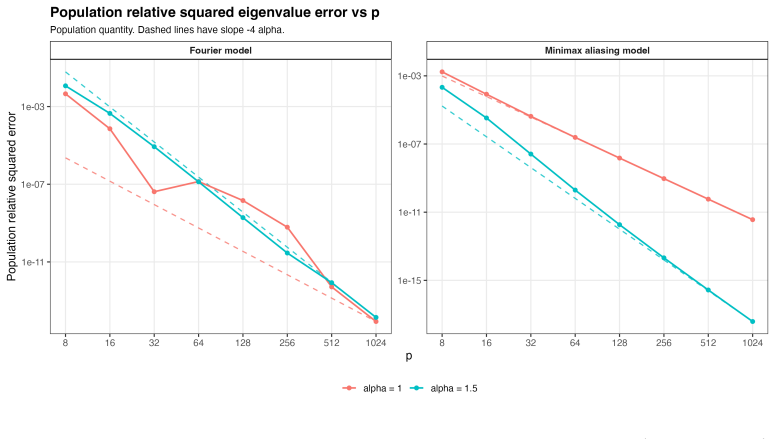
- Non-asymptotic lower bounds for eigenvalue estimation hold under relative squared-error loss.
- The wavelet estimator matches the optimal dependence on n and p for every Hölder index α > 0.
- The framework covers classical Gaussian processes and Karhunen-Loève constructions with explicit links between spectral decay, eigenfunction regularity and kernel smoothness.
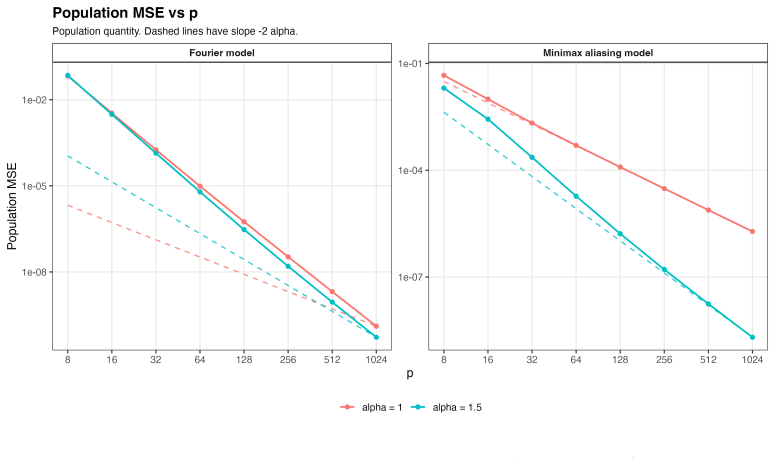
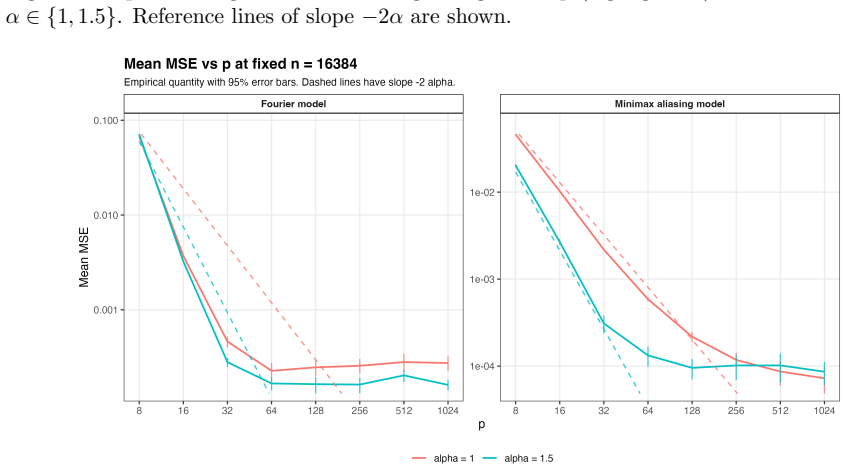
- Controlled simulation settings based on the Karhunen-Loève criterion illustrate the predicted phase transitions and least-favourable discretization effects.
Where Pith is reading between the lines
- When spectral difficulty δ_ℓ is large, increasing grid resolution p yields limited improvement compared with increasing sample size n.
- The Karhunen-Loève criterion supplies a concrete recipe for generating least-favourable examples that can benchmark other functional PCA procedures.
- The separation of effects suggests that experimental designs for functional data should balance grid density against the expected size of eigengaps.
Load-bearing premise
The processes must belong to the class that jointly controls Hölder smoothness of the covariance kernel and the local relative inverse eigengap at the target eigenindex, since regularity of the kernel by itself is insufficient for minimax-consistent eigenfunction estimation.
What would settle it
Generating trajectories from a covariance kernel that is Hölder-α smooth but lies outside the joint-control class, then checking whether any estimator (including the proposed wavelet one) can achieve rates better than order δ_ℓ n^{-1} + p^{-2α} as n and p grow.
Figures

read the original abstract
We study the minimax estimation of covariance eigenfunctions and eigenvalues in functional principal component analysis when $n$ trajectories are observed at $p$ common grid points with additive noise. We consider covariance kernels with arbitrary H\"older smoothness and no prescribed parametric decay of the eigenvalues. In this setting, kernel smoothness and local spectral separation play distinct roles: a minimax inconsistency result over the smoothness-only class shows that kernel regularity alone is not sufficient for minimax-consistent eigenfunction estimation. To capture this interplay, we introduce a class of processes that jointly controls the H\"older smoothness of the covariance kernel and a local relative inverse eigengap quantity at the target index $\ell$. Over this class, we derive non-asymptotic minimax lower bounds for eigenfunction estimation that disentangle sampling variability, discretization and spectral effects, revealing rates of order $\delta_\ell n^{-1}+p^{-2\alpha}$, where $\delta_\ell$ quantifies the spectral difficulty. We also obtain non-asymptotic lower bounds for eigenvalue estimation under a relative squared-error loss. We then construct a computable wavelet projection estimator based on Coiflet scaling functions and a quadrature scheme designed to accommodate arbitrary H\"older smoothness. For eigenfunction estimation, this estimator matches the minimax dependence on the sample size and grid resolution, up to the natural spectral factor, for any H\"older index $\alpha>0$. Finally, we show that the proposed framework covers several classical Gaussian processes and Karhunen--Lo\`eve constructions. In particular, a Karhunen--Lo\`eve based criterion links spectral decay, eigenfunction regularity and covariance-kernel smoothness, and yields controlled simulation settings illustrating the predicted phase transitions and least-favourable discretization effects.
Editorial analysis
A structured set of objections, weighed in public.
Referee Report
Summary. The manuscript develops minimax theory for estimating the eigenfunctions and eigenvalues of a covariance kernel in functional principal component analysis, based on n trajectories observed with additive noise at p common grid points. It demonstrates that Hölder smoothness of the kernel alone does not guarantee minimax-consistent eigenfunction estimation, introduces a new class of processes that jointly controls kernel Hölder smoothness α and a local relative inverse eigengap δ_ℓ at the target index ℓ, derives non-asymptotic lower bounds of order δ_ℓ n^{-1} + p^{-2α} that separate sampling, discretization and spectral contributions, obtains matching lower bounds for eigenvalue estimation under relative squared error, and constructs a computable wavelet projection estimator (Coiflet scaling functions plus quadrature) that attains the upper bound uniformly over the class for every α > 0. The framework is shown to contain standard Gaussian processes and Karhunen-Loève expansions, with an explicit criterion linking spectral decay, eigenfunction regularity and kernel smoothness.
Significance. If the results hold, the work supplies a sharp, non-asymptotic characterization of the interplay between smoothness, discretization error and local spectral separation in FPCA under minimal assumptions (arbitrary Hölder index, no parametric eigenvalue decay). The new joint class resolves an inconsistency that arises from smoothness-only assumptions, the matching rates disentangle the three error sources explicitly, and the explicit wavelet estimator together with verification on classical examples and phase-transition illustrations add both theoretical clarity and practical utility. The non-asymptotic bounds and explicit constructions are clear strengths.
minor comments (2)
- [§2] §2 (class definition): the local relative inverse eigengap δ_ℓ is introduced via a supremum over a neighborhood; an explicit statement of how the neighborhood radius is chosen (or shown to be immaterial) would clarify uniformity over the class.
- [Theorem 4.1] Theorem 4.1 (upper bound): the quadrature error term is controlled by the unknown smoothness α; a brief remark on how the Coiflet order is selected in practice (or shown to be adaptive) would strengthen the computability claim.
Simulated Author's Rebuttal
We thank the referee for the positive and accurate summary of our manuscript, as well as for the recommendation of minor revision. The referee's assessment correctly identifies the key contributions, including the new joint class controlling Hölder smoothness and local spectral separation, the non-asymptotic lower bounds separating sampling, discretization, and spectral effects, and the matching upper bounds achieved by the Coiflet wavelet estimator.
Circularity Check
No significant circularity detected
full rationale
The derivation introduces a new function class jointly controlling Hölder smoothness α and local relative inverse eigengap δ_ℓ, then proves non-asymptotic minimax lower bounds of order δ_ℓ n^{-1} + p^{-2α} directly over that class while separately showing that smoothness alone is insufficient. This is standard minimax construction rather than self-definition or reduction by construction; the rate parameters are part of the class definition but the bounds are derived via explicit information-theoretic arguments separating sampling, discretization and spectral effects. The matching upper bound is obtained from an explicitly constructed wavelet projection estimator (Coiflet scaling functions plus quadrature) whose analysis holds uniformly for any α > 0 without fitting parameters or invoking self-citations as load-bearing steps. The framework is verified to contain classical Gaussian processes and Karhunen-Loève expansions via independent criteria linking spectral decay to regularity, with no renaming of known results or ansatz smuggling. The central claims remain self-contained against external benchmarks.
Axiom & Free-Parameter Ledger
axioms (2)
- domain assumption Covariance kernels have arbitrary Hölder smoothness of order α > 0
- domain assumption A local relative inverse eigengap quantity at the target index ℓ is controlled
invented entities (1)
-
Class of processes jointly controlling Hölder smoothness and local relative inverse eigengap
no independent evidence
Reference graph
Works this paper leans on
-
[1]
Linear Processes in Function Spaces: Theory And Applications
Denis Bosq. Linear Processes in Function Spaces: Theory And Applications . Springer, 2000
2000
-
[2]
Minimax estimation of functional principal components from noisy discretized functional data
Ryad Belhakem, Franck Picard, Vincent Rivoirard, and Angelina Roche. Minimax estimation of functional principal components from noisy discretized functional data. Scand. J. Stat. , 52(1):38--80, 2025
2025
-
[3]
Jared C. Bronski. Small ball constants and tight eigenvalue asymptotics for fractional brownian motions. Journal of Theoretical Probability , 16(1):87--100, 2003
2003
-
[4]
Functional linear model
Herv \'e Cardot, Frederic Ferraty, and Pascal Sarda. Functional linear model. Statistics and Probability Letters , 45:11--22, 02 1999
1999
-
[5]
Adaptive wavelet multivariate regression with errors in variables
Micha\"el Chichignoud, Van Ha Hoang, Thanh Mai Pham Ngoc, and Vincent Rivoirard. Adaptive wavelet multivariate regression with errors in variables. Electron. J. Stat. , 11(1):682--724, 2017
2017
-
[6]
Oracle-efficient confidence envelopes for covariance functions in dense functional data
Guanqun Cao, Lily Wang, Yehua Li, and Lijian Yang. Oracle-efficient confidence envelopes for covariance functions in dense functional data. Statistica Sinica , 26:359--383, 01 2016
2016
-
[7]
Tony Cai and Ming Yuan
T. Tony Cai and Ming Yuan. Optimal estimation of the mean function based on discretely sampled functional data: phase transition. Ann. Statist. , 39(5):2330--2355, 2011
2011
-
[8]
Ten lectures on wavelets
Ingrid Daubechies. Ten lectures on wavelets . Society for Industrial and Applied Mathematics, USA, 1992
1992
-
[9]
Panaretos
Marie-H \'e l \`e ne Descary and Victor M. Panaretos. Functional data analysis by matrix completion. The Annals of Statistics , 47(1):1--38, 2019
2019
-
[10]
Dauxois, A
J. Dauxois, A. Pousse, and Y. Romain. Asymptotic theory for the principal component analysis of a vector random function: Some applications to statistical inference. Journal of Multivariate Analysis , 12(1):136--154, 1982
1982
-
[11]
Nonparametric Functional Data Analysis: Theory and Practice (Springer Series in Statistics)
Fr\' e d\' e ric Ferraty and Philippe Vieu. Nonparametric Functional Data Analysis: Theory and Practice (Springer Series in Statistics) . Springer-Verlag, Berlin, Heidelberg, 2006
2006
-
[12]
F. Gao, J. Hannig, and T. Torcaso. Integrated brownian motions and exact l2-small balls. The Annals of Probability , 31(3):1320--1337, 2003
2003
-
[13]
Lee, Ralf Gommers
Filip Wasilewski Kai Wohlfahrt Aaron O'Leary Gregory R. Lee, Ralf Gommers. Pywavelets: A python package for wavelet analysis. Journal of Open Source Software , 4(36), August 2019
2019
-
[14]
Jan Gertheiss, David R \"u gamer, Bernard X. W. Liew, and Sonja Greven. Functional data analysis: An introduction and recent developments. Biometrical Journal , 66(7), 2024
2024
-
[15]
Theoretical foundations of functional data analysis, with an introduction to linear operators
Tailen Hsing and Randall Eubank. Theoretical foundations of functional data analysis, with an introduction to linear operators . Wiley, 2015
2015
-
[16]
Horowitz
Peter Hall and Joel L. Horowitz. Methodology and convergence rates for functional linear regression. Ann. Statist. , 35(1):70--91, 2007
2007
-
[17]
Relative perturbation bounds with applications to empirical covariance operators
Moritz Jirak and Martin Wahl. Relative perturbation bounds with applications to empirical covariance operators. Adv. Math. , 412:Paper No. 108808, 59, 2023
2023
-
[18]
Exploratory Analysis of Functional Principal Components to Observe the Absorption of Election Sentiments in the Indian Stock Market
Abhinav Keshri and Charu Sharma. Exploratory Analysis of Functional Principal Components to Observe the Absorption of Election Sentiments in the Indian Stock Market . MPRA Paper 122325, University Library of Munich, Germany, July 2020
2020
-
[19]
Functional data classification using covariate-adjusted subspace projection
Pai-Ling Li, Jeng-Min Chiou, and Yu Shyr. Functional data classification using covariate-adjusted subspace projection . Computational Statistics & Data Analysis , 115(C):21--34, 2017
2017
-
[20]
A Wavelet Tour of Signal Processing
St \'e phane Mallat. A Wavelet Tour of Signal Processing . Elsevier, 1999
1999
-
[21]
High-dimensional principal projections
Andr\'e Mas and Frits Ruymgaart. High-dimensional principal projections. Complex Anal. Oper. Theory , 9(1):35--63, 2015
2015
-
[22]
Statistical Inference Based on Divergence Measures
Leandro Pardo. Statistical Inference Based on Divergence Measures . Taylor & Francis, 2006
2006
-
[23]
Functional data analysis
JO Ramsay and BW Silverman. Functional data analysis . Springer, 1997
1997
-
[24]
Non-asymptotic upper bounds for the reconstruction error of pca
Markus Reiss and Martin Wahl. Non-asymptotic upper bounds for the reconstruction error of pca. The Annals of Statistics , 48(2):1098--1123, 2020
2020
-
[25]
Tsybakov
Alexandre B. Tsybakov. Introduction to nonparametric estimation. In Springer series in statistics , 2009
2009
-
[26]
Review of functional data analysis
Jane-Ling Wang, Jeng-Min Chiou, and Hans-Georg Mueller. Review of functional data analysis. Annu. Rev. Statist. , pages 1--41, 2015
2015
-
[27]
Optimal classification for functional data
Shuoyang Wang, Zuofeng Shang, Guanqun Cao, and Jun Liu. Optimal classification for functional data. Statistica Sinica , 34:1545--1564, 2024
2024
-
[28]
Asymptotic properties of penalized splines for functional data
Luo Xiao. Asymptotic properties of penalized splines for functional data. Bernoulli , 26(4):2847--2875, 2020
2020
-
[29]
Theory of functional principal component analysis for discretely observed data
Hang Zhou, Dongyi Wei, and Fang Yao. Theory of functional principal component analysis for discretely observed data. The Annals of Statistics , 53(5):2103--2127, 2025
2025
discussion (0)
Sign in with ORCID, Apple, or X to comment. Anyone can read and Pith papers without signing in.