Recognition: unknown
Finite-Time Optimal Control by Noisy Traps
Pith reviewed 2026-05-08 04:53 UTC · model grok-4.3
The pith
Optimal protocols for a Brownian particle in a fluctuating trap acquire a finite duration when stiffness noise violates detailed balance.
A machine-rendered reading of the paper's core claim, the machinery that carries it, and where it could break.
Core claim
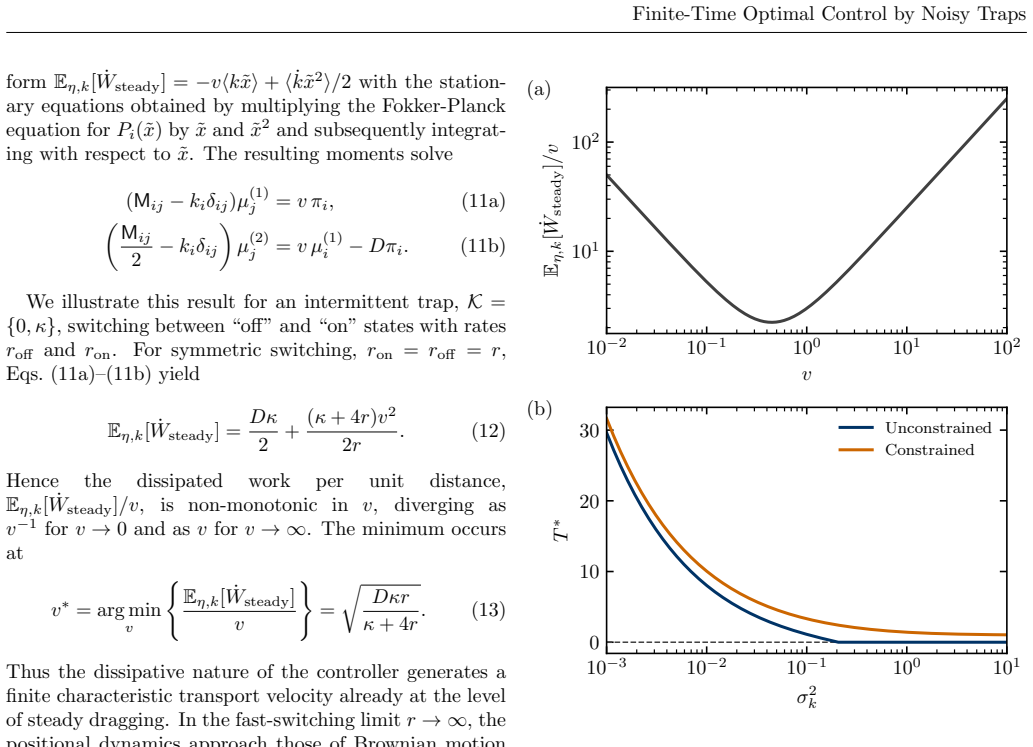
When the stiffness of a harmonic trap fluctuates in a manner that violates detailed balance, the mean work required to steer a confined Brownian particle is minimised by protocols of finite duration. This optimal duration vanishes above a critical fluctuation strength and can be located from the short-time series of the work functional. An endpoint constraint removes the transition, so that finite-duration protocols remain optimal for all fluctuation amplitudes.
What carries the argument
The mean work functional evaluated for protocols of varying duration, whose short-time expansion exhibits a transition from finite to vanishing optimum when trap-stiffness fluctuations break detailed balance.
If this is right
- Optimal protocols switch from infinite to finite duration below a critical noise strength.
- The location of the switch is readable from the leading terms of the short-time work expansion without solving the full optimisation.
- An endpoint constraint keeps the optimum at finite duration for every value of the fluctuation strength.
- Finite-time optimality appears in passive systems once the controller is allowed to operate out of equilibrium.
Where Pith is reading between the lines
- The same mechanism may produce finite-time optima in other colloidal or molecular systems whose control parameters are modulated by a dissipative stochastic process.
- Laboratory tests could be performed with optical traps whose stiffness is modulated by a noisy external feedback loop.
- Controlled addition of noise to the controller might therefore serve as a practical route to shorter protocols in microscopic machines.
Load-bearing premise
The stiffness fluctuations are taken to violate detailed balance and therefore to produce a net continuous work exchange between the particle and the controller.
What would settle it
A plot of average work versus protocol duration should display a minimum that moves continuously toward zero duration as the amplitude of the stiffness fluctuations is raised through the predicted critical value.
Figures


read the original abstract
The optimal control of passive systems in equilibrium typically favours quasistatic (infinite-time) protocols. We show that a breakdown of quasistatic optimality occurs when the controller itself is dissipative. Concretely, we study a Brownian particle confined by a harmonic trap with stochastically fluctuating stiffness, driven by an external protocol. When these fluctuations violate detailed balance, the probe-controller coupling continuously exchanges work with the system, altering the optimisation landscape. In this regime, optimal protocols are characterised by a finite duration which vanishes above a critical fluctuation strength. This transition can be directly observed in a short-time expansion of the mean work functional. When imposing an endpoint constraint, the transition to zero duration disappears and finite duration protocols remain optimal for all values of the controller fluctuations. These results demonstrate that finite-time optimality can emerge in passive systems under nonequilibrium control.
Editorial analysis
A structured set of objections, weighed in public.
Referee Report
Summary. The manuscript studies optimal finite-time control of a Brownian particle in a harmonic trap whose stiffness undergoes stochastic fluctuations that violate detailed balance. It claims that, in contrast to equilibrium cases where quasistatic (infinite-time) protocols are optimal, dissipative controller fluctuations induce optimal protocols of finite duration; this duration vanishes above a critical fluctuation strength, with the transition visible in a short-time expansion of the mean work functional. Imposing an endpoint constraint eliminates the transition, so that finite-duration protocols remain optimal for all fluctuation amplitudes.
Significance. If the central claims are substantiated, the work shows how nonequilibrium driving by a dissipative controller can qualitatively alter the optimization landscape for passive systems, leading to finite-time optimality where quasistatic protocols would otherwise be preferred. The analytical short-time expansion provides a concrete, falsifiable signature of the transition and is a methodological strength.
major comments (1)
- [short-time expansion of the mean work functional (as described in the abstract and central derivation)] The short-time expansion of the mean work functional W(τ) establishes a local change in the derivative at τ=0 above the critical fluctuation strength, but the headline claim that optimal protocols are characterized by a finite duration which vanishes above this threshold requires that zero duration is the global minimum. No explicit comparison of W(τ) at the critical point against values at moderate or large τ, no global variational solution, and no numerical sweep over τ are reported to exclude a competing finite-time branch.
Simulated Author's Rebuttal
We thank the referee for their careful reading of the manuscript and for identifying an important point concerning the distinction between local and global optimality in the mean work functional. We address the comment below and indicate the revisions that will be made to strengthen the presentation.
read point-by-point responses
-
Referee: [short-time expansion of the mean work functional (as described in the abstract and central derivation)] The short-time expansion of the mean work functional W(τ) establishes a local change in the derivative at τ=0 above the critical fluctuation strength, but the headline claim that optimal protocols are characterized by a finite duration which vanishes above this threshold requires that zero duration is the global minimum. No explicit comparison of W(τ) at the critical point against values at moderate or large τ, no global variational solution, and no numerical sweep over τ are reported to exclude a competing finite-time branch.
Authors: We agree that the short-time expansion of W(τ) demonstrates only the local behavior of the derivative at τ=0 and that a change in its sign above the critical fluctuation strength indicates that the work decreases upon approaching τ=0. This is consistent with the optimal duration vanishing at the transition. However, establishing that τ=0 is the global minimum requires ruling out the possibility of a lower value of W at some finite τ>0. The current manuscript relies on the short-time diagnostic together with the physical expectation that W(τ) increases for large τ (recovering the higher quasistatic work in the presence of dissipative controller fluctuations), but does not provide an explicit numerical comparison or variational confirmation. In the revised version we will add a numerical sweep of W(τ) over a wide range of durations for representative values of the fluctuation strength both below and above the critical point. This will explicitly show that the minimum lies at finite τ below criticality and shifts to τ=0 above it, thereby excluding a competing finite-time branch. We will also include a short discussion clarifying the scope of the short-time expansion as a detector of the transition rather than a complete global proof. revision: yes
Circularity Check
No circularity: finite-duration optimality derived directly from work functional expansion
full rationale
The paper computes the mean work functional from the stochastic dynamics of a Brownian particle in a fluctuating harmonic trap that violates detailed balance. The transition to zero-duration optima is identified via the sign change of the short-time expansion of this functional, without any parameter fitting, self-referential definitions, or load-bearing self-citations. The endpoint-constrained case is treated as a separate variational problem. All steps remain self-contained within the model's Langevin equations and nonequilibrium work accounting; no reduction to inputs by construction occurs.
Axiom & Free-Parameter Ledger
axioms (1)
- domain assumption Fluctuations in trap stiffness violate detailed balance and produce continuous work exchange with the system
Reference graph
Works this paper leans on
-
[1]
[1]Schmiedl T.andSeifert U.,Phys. Rev. Lett.,98(2007) 108301. [2]Jarzynski C.,Phys. Rev. Lett.,78(1997)
2007
-
[2]
[3]Bechinger C., Di Leonardo R., L ¨owen H., Reich- hardt C., Volpe G.andVolpe G.,Rev. Mod. Phys., 88(2016) 045006. [4]Garcia-Millan R., Sch ¨uttler J., Cates M. E.and Loos S. A.,Phys. Rev. Lett.,135(2025) 088301. [5]Soriani A., Tjhung E., Fodor ´E.andMarkovich T., arXiv preprint arXiv:2504.19285, (2025) . [6]Sivak D. A.andCrooks G. E.,Phys. Rev. Lett.,10...
-
[3]
K., Proesmans K.andFodor ´E.,Phys
[9]Davis L. K., Proesmans K.andFodor ´E.,Phys. Rev. X,14(2024) 011012. [10]Wang Y., Lei E., Ma Y.-H., Tu Z. C.andLi G.,Phys. Rev. E,112(2025) 054124. [11]Blickle V.andBechinger C.,Nat. Phys.,8(2012)
2024
-
[4]
andRoichman Y.,J
[12]Tal-Friedman O., Pal A., Sekhon A., Reuveni S. andRoichman Y.,J. Phys. Chem. Lett.,11(2020)
2020
-
[5]
K., Ehrich J., Gavrilov M., Still S., Sivak D
[13]Saha T. K., Ehrich J., Gavrilov M., Still S., Sivak D. A.andBechhoefer J.,Phys. Rev. Lett.,131(2023) 057101. [14]Khadka U., Holubec V., Yang H.andCichos F.,Nat. Commun.,9(2018)
2023
-
[6]
[15]Jun Y., Gavrilov M.andBechhoefer J.,Phys. Rev. Lett.,113(2014) 190601. [16]Loos S. A., Monter S., Ginot F.andBechinger C., Phys. Rev. X,14(2024) 021032. [17]Cocconi L., Alston H., Romano J.andBertrand T.,New J. Phys.,26(2024) 103016. [18]Alston H., Cocconi L.andBertrand T.,J. Phys. A, 55(2022) 274004. [19]Bustamante C. J., Chemla Y. R., Liu S.andWang ...
2014
-
[7]
H., Marag `o O
[20]Pesce G., Jones P. H., Marag `o O. M.andVolpe G., Eur. Phys. J. Plus,135(2020)
2020
-
[8]
[22]Liepelt S.andLipowsky R.,Phys. Rev. Lett.,98(2007) 258102. [23]Cocconi L., Garcia-Millan R., Zhen Z., Buturca B.andPruessner G.,Entropy,22(2020)
2007
-
[9]
[24]Bo S.andCelani A.,J. Stat. Phys.,154(2014)
2014
-
[10]
p-6 Finite-Time Optimal Control by Noisy Traps [25]Celani A., Bo S., Eichhorn R.andAurell E.,Phys. Rev. Lett.,109(2012) 260603. [26]Pavliotis G.andStuart A.,Multiscale methods: aver- aging and homogenization(Springer Science & Business Media)
2012
-
[11]
S., L ¨owen H.andRoichman Y.,Phys
[27]Goerlich R., Olsen K. S., L ¨owen H.andRoichman Y.,Phys. Rev. E,113(2026) 014103. [28]Aurell E., Mej ´ıa-Monasterio C.andMuratore- Ginanneschi P.,Phys. Rev. Lett.,106(2011) 250601. [29]Wu X.-L.andLibchaber A.,Phys. Rev. Lett.,84(2000)
2026
-
[12]
P., Cates M
[30]Solon A. P., Cates M. E.andTailleur J.,Eur. Phys. J. Spec. Top.,224(2015)
2015
-
[13]
J., Chetrite R.andSivak D
[31]Large S. J., Chetrite R.andSivak D. A.,Europhys. Lett.,124(2018) 20001. p-7
2018
discussion (0)
Sign in with ORCID, Apple, or X to comment. Anyone can read and Pith papers without signing in.