Recognition: unknown
Muon Track Reconstruction Procedures at the Baikal-GVD Neutrino Telescope
Pith reviewed 2026-05-08 05:00 UTC · model grok-4.3
The pith
Baikal-GVD reconstructs neutrino arrival directions to 0.2 degree precision from muon tracks produced in nearby interactions.
A machine-rendered reading of the paper's core claim, the machinery that carries it, and where it could break.
Core claim
Muons produced in neutrino interactions in the vicinity of the detector leave track-like responses that permit reconstruction of the neutrino arrival direction with a precision up to 0.2 degree. The collaboration has developed a variety of methods for track-like event direction and energy reconstruction together with neutrino candidate event selection; these methods form an analysis pipeline whose application to 2019-2021 data is shown.
What carries the argument
Track-like event analysis methods that process the detector's response to muon tracks, including direction and energy reconstruction algorithms and neutrino candidate selection criteria.
If this is right
- The detector can identify and characterize individual neutrino events with directional accuracy sufficient to associate them with distant astrophysical sources.
- The analysis pipeline produces usable results on actual recorded data rather than only on simulated events.
- Multiple complementary reconstruction techniques can be run in parallel to improve overall event selection efficiency.
Where Pith is reading between the lines
- Combining the reported angular resolution with the telescope's location could help cross-check neutrino alerts from southern-hemisphere instruments.
- If the energy reconstruction component scales reliably, the same tracks could constrain the spectrum of incoming neutrinos without requiring separate calorimetric methods.
- Routine application of these procedures to future data-taking seasons would allow statistical studies of neutrino arrival directions over time.
Load-bearing premise
The developed methods for track-like event direction and energy reconstruction and neutrino candidate event selection remain effective and accurate when applied to real data.
What would settle it
Reconstructed directions from the 2019-2021 dataset fail to achieve 0.2-degree resolution when compared against Monte Carlo simulations of known muon tracks or against any coincident events from other instruments.
Figures



read the original abstract
The Baikal-GVD neutrino telescope is the largest neutrino detector of its kind in the Northern Hemisphere. Muons produced in neutrino interaction in the vicinity of the detector leave track-like response in the detector allowing to reconstruct the neutrino arrival direction with the precision up to 0.2 degree. The Baikal-GVD collaboration has developed a variety of methods for the track-like event analysis. Methods for track-like event direction and energy reconstruction and neutrino cadidate event selection are discussed in this report. Preliminary results of application of analysis pipeline to the data-taking seasons from 2019 to 2021 are shown.
Editorial analysis
A structured set of objections, weighed in public.
Referee Report
Summary. The manuscript describes a variety of methods for track-like event direction and energy reconstruction and neutrino candidate event selection at the Baikal-GVD neutrino telescope. Preliminary results from the application of the analysis pipeline to 2019-2021 data are shown, claiming a reconstruction precision of up to 0.2 degrees for the neutrino arrival direction.
Significance. If the results hold, the paper contributes to neutrino telescope data analysis by detailing multiple reconstruction approaches for a major Northern Hemisphere detector and showing their performance on real data. This is important for advancing the field and for future analyses.
major comments (1)
- [Preliminary results] The 0.2 degree precision claim lacks accompanying quantitative validation, such as resolution distributions, pull plots, or comparison to expected performance from simulations, which is necessary to substantiate the central claim about the effectiveness of the methods on real data.
minor comments (1)
- [Abstract] Typo: 'cadidate' should be 'candidate'.
Simulated Author's Rebuttal
We thank the referee for the careful review and constructive comments on our manuscript describing muon track reconstruction procedures at Baikal-GVD. We address the major comment point by point below and will incorporate revisions to strengthen the presentation of our preliminary results.
read point-by-point responses
-
Referee: [Preliminary results] The 0.2 degree precision claim lacks accompanying quantitative validation, such as resolution distributions, pull plots, or comparison to expected performance from simulations, which is necessary to substantiate the central claim about the effectiveness of the methods on real data.
Authors: We agree that the current manuscript version would benefit from additional quantitative validation to support the stated reconstruction precision of up to 0.2 degrees. In the revised version, we will include angular resolution distributions obtained from Monte Carlo simulations for the track reconstruction methods, pull plots for the direction and energy estimators where relevant, and direct comparisons of the observed performance on the 2019-2021 data with the expected simulation results. These additions will provide the necessary substantiation for the effectiveness of the analysis pipeline on real data. revision: yes
Circularity Check
No significant circularity detected
full rationale
The paper reports developed reconstruction procedures for muon tracks in the Baikal-GVD detector and presents preliminary applications to 2019-2021 real data. No load-bearing derivations, predictions, or equations are described that reduce by construction to fitted inputs, self-definitions, or self-citation chains. The 0.2° angular resolution is presented as the achieved outcome of the methods rather than an input assumption, and the text focuses on procedural descriptions and data results without internal circular reductions. This is a standard methods-and-results report with independent external data validation.
Axiom & Free-Parameter Ledger
Reference graph
Works this paper leans on
-
[1]
INTRODUCTION The main purpose of the large-volume neutrino telescopes such as Baikal-GVD is the study of TeV – PeV cosmic neutrino flux. The Baikal-GVD telescope being constructed in Lake Baikal presently consists of 14 independent sub-detectors - clusters, carrying in total 4212 optical modules enabling the detection volume in high-energy cascade detecti...
2019
-
[2]
THE BAIKAL-GVD NEUTRINO TELESCOPE The Baikal-GVD neutrino telescope in its present configuration consists of 14 independent sub-detectors – clusters (Fig. 1). The detector volume of>0.6 km 3 makes it the largest neutrino telescope in the Northern Hemisphere. The lake depth at the telescope location is about 1366 meters, water light absorption length reach...
-
[3]
The backround is due to luminiscense in layers of sinking remains of living organisms and/or algae
MUON TRACK RECONSTRUCTION The dominant source of PMT pulses (or hits) in the telescope data is the ambient optical background of the Lake Baikal waters. The backround is due to luminiscense in layers of sinking remains of living organisms and/or algae. The PMT signal due to background is at the 1 photoelectron level. The rate is not uniform and depends on...
-
[4]
Reconstructed events are dominated by muon bundles and the total rate of events passing the reconstruction procedure is∼3 Hz per cluster
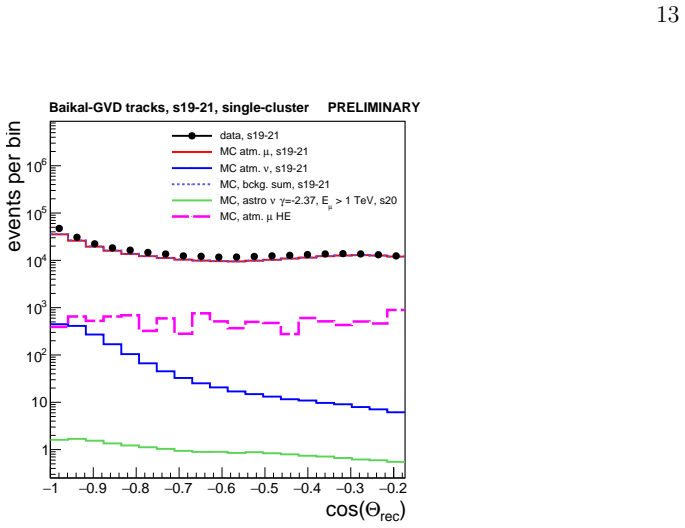
NEUTRINO CANDIDA TE EVENT SELECTION The described track reconstruction procedure was applied to the data and MC of data- taking seasons 2019–2021 in the single cluster-regime. Reconstructed events are dominated by muon bundles and the total rate of events passing the reconstruction procedure is∼3 Hz per cluster. In this analysis the region of interest for...
2019
-
[5]
The total livetime of the sample corresponds to the 14.4 years of data -taking in single-cluster regime
RESUL TS OF THE DA T A PROCESSING An event selection procedure was applied to the data sample of data-taking seasons 2019–2021. The total livetime of the sample corresponds to the 14.4 years of data -taking in single-cluster regime. An event sample of 1189 neutrino candidates was selected with the aforementioned cuts on the BDT classifiers response. An ev...
2019
-
[6]
Reconstruction algorithms allows to reconstruct the muon direction with the precision up to 0.2 ◦ for track of>500 m length
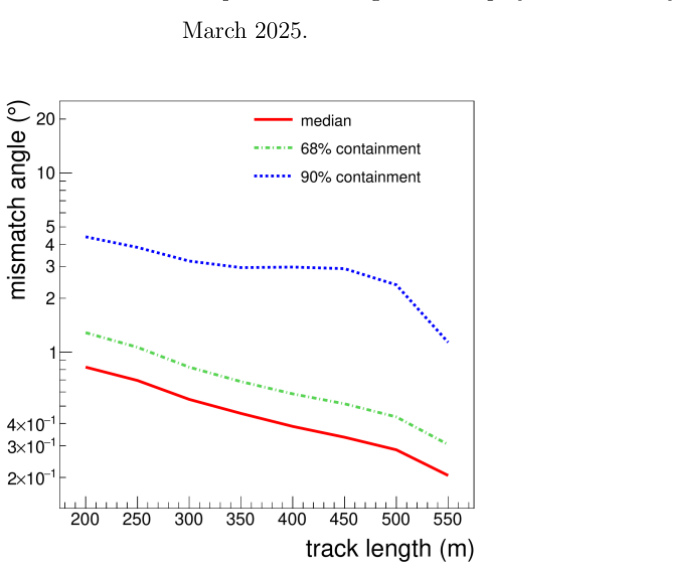
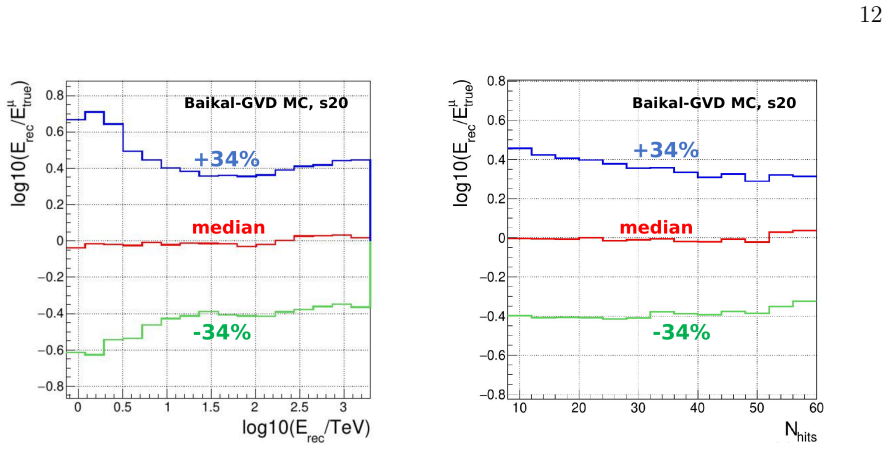
SUMMAR Y Methods and procedures for the track-like events reconstruction at the Baikal-GVD neu- trino telescope were discussed. Reconstruction algorithms allows to reconstruct the muon direction with the precision up to 0.2 ◦ for track of>500 m length. The muon energy is reconstructed with the precision of the factor 2.5. Misreconstructed atmospheric muon...
2019
-
[7]
Baikal-GVD Collab., Eur. Phys. J. C81, 1025 (2021)
2021
-
[8]
Baikal-GVD Collab., Phys. Rev. D107, 042005 (2023)
2023
-
[9]
PCT 2024
Baikal-GVD Collab.,Parallel Computational Technologies. PCT 2024. Communications in Computer and Information Science(Springer, 2024), Vol. 2241, p. 80
2024
-
[10]
Baikal-GVD Collab., EPJ Web Conf.207, 07003 (2019)
2019
-
[11]
Baikal-GVD Collab., PoS (ICRC2021) 1067 (2021)
2021
-
[12]
Baikal-GVD Collab., PoS (ICRC2021) 1083 (2021)
2021
-
[13]
Baikal-GVD Collab., PoS (ICRC2023) 978 (2023)
2023
-
[14]
Baikal-GVD Collab., PoS (ICRC2021) 1063 (2021)
2021
-
[15]
Heck et al., Forschungszentrum Karlsruhe Report FZKA 6019 (1998)
D. Heck et al., Forschungszentrum Karlsruhe Report FZKA 6019 (1998)
1998
-
[16]
Barr et al., Phys
G.D. Barr et al., Phys. Rev. D70, 023006 (2004)
2004
-
[17]
J.928, 50 (2022)
IceCube Collab., Astrophys. J.928, 50 (2022). 9
2022
-
[18]
Vincent et al., JCAP1711, 012 (2017)
A.C. Vincent et al., JCAP1711, 012 (2017)
2017
-
[19]
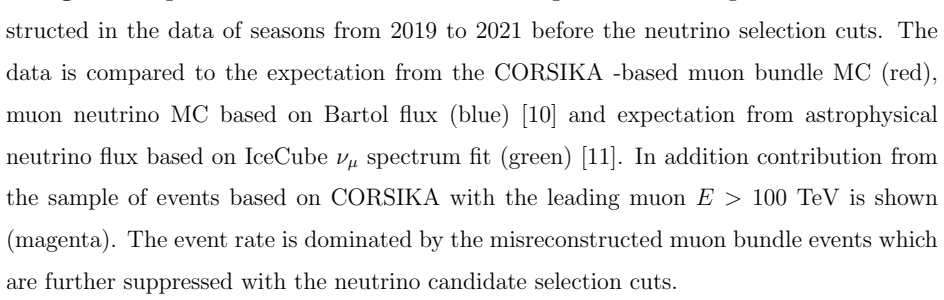
A. Hoecker et al., physics/0703039 (2007). 10 Fig. 1.The Baikal-GVD neutrino telescope in the configuration deployed in February - March 2025. Fig. 2.Precision of muon direction reconstruction as a function of track length. Fig. 3.Muon energy measurement bias and uncertainty as a function of reconstructed energy (a) and number of hits (b). Fig. 4.Angular ...
discussion (0)
Sign in with ORCID, Apple, or X to comment. Anyone can read and Pith papers without signing in.