Recognition: unknown
Engineering a driven-dissipative bath of altermagnetic quantum magnons for controlling classical dynamics of spins hosting spin waves, domain walls, or skyrmions
Pith reviewed 2026-05-08 06:06 UTC · model grok-4.3
The pith
A driven-dissipative bath of altermagnetic magnons adds two nonlocal anisotropic damping terms to the Landau-Lifshitz-Gilbert equation, one of them non-Markovian, for tuning spin-wave, domain-wall, and skyrmion dynamics.
A machine-rendered reading of the paper's core claim, the machinery that carries it, and where it could break.
Core claim
Using Schwinger-Keldysh field theory, we engineer a dissipative and driven bosonic bath of quantum altermagnetic magnons that acts on classical localized spins inside a ferromagnetic insulator layer. The derived extended Landau-Lifshitz-Gilbert equation then contains two damping terms, both spatially nonlocal and anisotropic, while one is also intrinsically non-Markovian. These features can be exploited to tune spintronic and magnonic effects such as spin-wave or domain-wall propagation and skyrmion annihilation in AMI/FI bilayers.
What carries the argument
The Schwinger-Keldysh-derived extended Landau-Lifshitz-Gilbert equation that incorporates the effects of the externally driven altermagnetic magnon bath as two additional damping contributions.
If this is right
- The spatially nonlocal damping permits spatial engineering of spin-wave attenuation or amplification across the ferromagnetic layer.
- The non-Markovian term introduces memory effects that can alter the velocity or stability of moving domain walls.
- External driving of the magnon distribution provides a knob to increase or suppress skyrmion annihilation rates.
- Both damping terms remain anisotropic, allowing directional control of magnonic transport by the crystal axes of the altermagnet.
Where Pith is reading between the lines
- The same bath-engineering method could be applied to other heterostructures in which a quantum magnetic layer is driven out of equilibrium to control classical spins.
- Experimental tests would involve time-resolved measurements of domain-wall motion or skyrmion lifetimes as a function of the drive strength applied to the altermagnetic layer.
- The non-Markovian damping may connect to broader questions of memory effects in magnonic devices and to the design of hybrid quantum-classical spintronic circuits.
Load-bearing premise
The interaction between the slow classical spins and the fast quantum altermagnetic magnons can be captured by an effective driven-dissipative bosonic bath whose nonequilibrium distribution is set by external driving, without back-action or higher-order quantum corrections that would invalidate the classical description.
What would settle it
Measurement of a frequency-dependent, time-nonlocal contribution to the damping of spin waves in an AMI/FI bilayer under controlled external driving of the altermagnet, a signature absent from the conventional local LLG equation.
Figures


read the original abstract
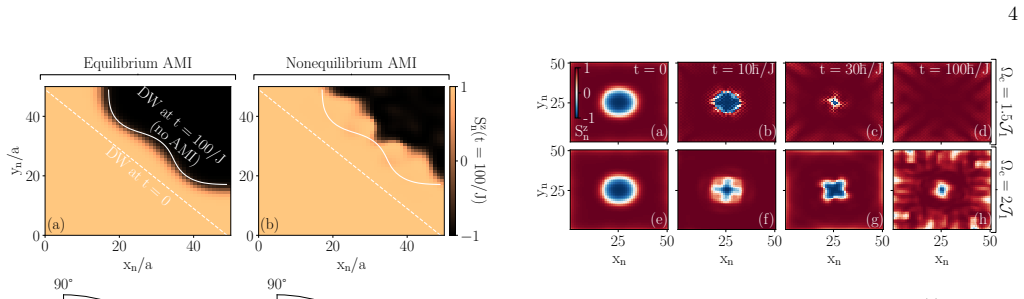
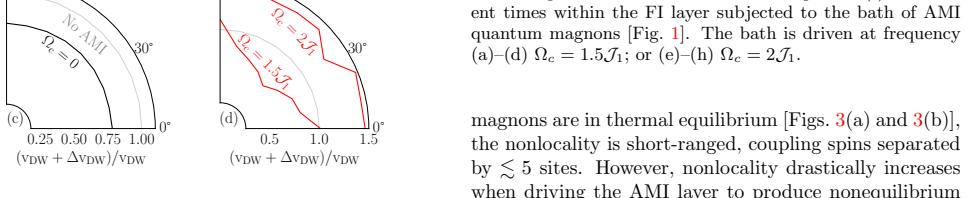
Using Schwinger-Keldysh field theory (SKFT), we engineer a dissipative and driven (i.e., out of equilibrium) bosonic bath acting on classical localized spins within a ferromagnetic insulator (FI) layer whose dynamics is governed by the Landau-Lifshitz-Gilbert equation, as is usually assumed in spintronics and magnonics. The bosonic bath is comprised of quantum magnons within a layer of altermagnetic insulator (AMI) that is attached to a conventional FI layer, often one of the key ingredients within spintronic and magnonic multilayers, so that interaction between slow classical (in the FI layer) and fast quantum (in the AMI layer) localized spins ensues. Such a bath, including its driving to produce a nonequilibrium distribution of altermagnetic magnons, generates a rich structure of the SKFT-derived extended LLG equation for classical spins within the FI layer. Our LLG equation contains two damping terms, both of which are spatially nonlocal and anisotropic, while one of them is also intrinsically non-Markovian, i.e., nonlocal in time. We demonstrate how to exploit these terms for tuning spintronic and magnonic effects within the FI layer of AMI/FI bilayers that involve spin wave or domain wall propagation, as well as skyrmion annihilation.
Editorial analysis
A structured set of objections, weighed in public.
Referee Report
Summary. The manuscript uses Schwinger-Keldysh field theory (SKFT) to derive an extended Landau-Lifshitz-Gilbert (LLG) equation for classical localized spins in a ferromagnetic insulator (FI) layer coupled to a driven-dissipative bosonic bath of quantum altermagnetic magnons in an adjacent altermagnetic insulator (AMI) layer. The resulting LLG contains two damping terms that are both spatially nonlocal and anisotropic, with one intrinsically non-Markovian (nonlocal in time); these are then applied to control spin-wave propagation, domain-wall motion, and skyrmion annihilation in AMI/FI bilayers.
Significance. If the SKFT derivation is free of gaps and the bath approximation holds, the work supplies a first-principles route to engineer nonlocal, anisotropic, and non-Markovian damping via externally driven altermagnetic magnons. This could enable new tuning knobs in magnonics and spintronics that go beyond local Gilbert damping, with concrete demonstrations for skyrmion annihilation and related dynamics.
major comments (2)
- [Derivation section (around the SKFT action and resulting equation of motion for the FI spins)] The central claim rests on the SKFT derivation of the two damping terms in the extended LLG. Explicit verification against limiting cases (equilibrium distribution, Markovian limit, or recovery of standard local Gilbert damping when the AMI drive is turned off) is required to rule out post-hoc choices in the bath spectrum or missing higher-order contributions.
- [Bath approximation and LLG derivation] The driven-dissipative bath treatment assumes the AMI magnons impose a nonequilibrium distribution without appreciable back-action on the classical FI spins. Because the interlayer coupling is bidirectional and altermagnetic magnons carry momentum-dependent spin polarization, reciprocal torques or renormalization of the effective field may appear at the same perturbative order as the derived nonlocal damping; these must be shown to be negligible or explicitly included.
minor comments (2)
- [Extended LLG equation] Notation for the two damping kernels (nonlocal in space and, for one, in time) should be introduced with explicit integral expressions early in the derivation to improve readability.
- [Introduction or applications section] The manuscript would benefit from a brief table comparing the new damping terms to conventional local Gilbert damping and to other nonlocal damping models in the literature.
Simulated Author's Rebuttal
We thank the referee for the careful reading of our manuscript and the constructive comments, which have helped us strengthen the rigor of the derivation. We address each major comment below and have revised the manuscript accordingly.
read point-by-point responses
-
Referee: [Derivation section (around the SKFT action and resulting equation of motion for the FI spins)] The central claim rests on the SKFT derivation of the two damping terms in the extended LLG. Explicit verification against limiting cases (equilibrium distribution, Markovian limit, or recovery of standard local Gilbert damping when the AMI drive is turned off) is required to rule out post-hoc choices in the bath spectrum or missing higher-order contributions.
Authors: We agree that explicit checks of limiting cases are essential to validate the derivation. In the revised manuscript we have added a new subsection (III.C) that performs these verifications explicitly: (i) when the external drive on the AMI layer is switched off, the nonlocal and non-Markovian damping terms vanish and the standard local Gilbert damping is recovered; (ii) the equilibrium fluctuation-dissipation relation is satisfied; and (iii) the Markovian limit is recovered under the appropriate time-scale separation. These additions confirm that the extended terms arise specifically from the driven nonequilibrium bath and are not artifacts of the chosen bath spectrum. revision: yes
-
Referee: [Bath approximation and LLG derivation] The driven-dissipative bath treatment assumes the AMI magnons impose a nonequilibrium distribution without appreciable back-action on the classical FI spins. Because the interlayer coupling is bidirectional and altermagnetic magnons carry momentum-dependent spin polarization, reciprocal torques or renormalization of the effective field may appear at the same perturbative order as the derived nonlocal damping; these must be shown to be negligible or explicitly included.
Authors: Within the SKFT framework the fast quantum AMI magnons are integrated out to obtain an effective dynamics for the slow classical FI spins. Back-action contributions (reciprocal torques and effective-field renormalizations) are higher-order in the weak interlayer coupling and are further suppressed by the separation of time scales between the quantum bath and the classical spins. In the revised manuscript we have expanded the discussion in Section II to explicitly demonstrate the negligibility of these terms under the stated approximations (weak coupling and fast bath relaxation), while clarifying that a fully bidirectional quantum treatment would require a different, non-classical framework. revision: yes
Circularity Check
No significant circularity in SKFT derivation of extended LLG
full rationale
The paper applies standard Schwinger-Keldysh field theory to the AMI/FI bilayer Hamiltonian, treating the AMI magnons as a driven-dissipative bosonic bath whose nonequilibrium distribution is imposed by external driving. The resulting extended LLG equation for the FI classical spins, including its two nonlocal anisotropic damping terms (one non-Markovian), emerges directly from the perturbative expansion of the SKFT action. No load-bearing step reduces the output to the input by construction: there is no fitting of damping coefficients to target dynamics, no self-citation chain supplying a uniqueness theorem, and no ansatz smuggled in via prior work by the same authors. The derivation remains self-contained once the bilayer model and bath approximation are accepted; external benchmarks (standard SKFT for open quantum systems) are independent of the final LLG form.
Axiom & Free-Parameter Ledger
free parameters (2)
- driving strength and spectrum of altermagnetic magnons
- interlayer coupling constants
axioms (2)
- domain assumption Validity of Schwinger-Keldysh contour for hybrid quantum-classical spin systems
- domain assumption Separation of timescales between fast quantum magnons and slow classical spins
Reference graph
Works this paper leans on
-
[1]
Chumak, V
A. Chumak, V. Vasyuchka, A. Serga, and B. Hillebrands, Magnon spintronics, Nat. Phys.11, 453 (2015)
2015
-
[2]
Flebus, D
B. Flebus, D. Grundler, B. Rana, Y. Otani, I. Barsukov, A. Barman, G. Gubbiotti, P. Landeros, J. Akerman, U. Ebels,et al., The 2024 magnonics roadmap, J. Phys.: Condens. Matter36, 363501 (2024)
2024
-
[3]
Pirro, V
P. Pirro, V. I. Vasyuchka, A. A. Serga, and B. Hille- brands, Advances in coherent magnonics, Nat. Rev. Mater.6, 1114 (2021)
2021
-
[4]
L. D. Landau and E. M. Lifshitz, On the theory of the dis- persion of magnetic permeability in ferromagnetic bodies, Phys. Z. Sowjetunion8, 153 (1935)
1935
-
[5]
Gilbert, A phenomenological theory of damping in ferromagnetic materials, IEEE Trans
T. Gilbert, A phenomenological theory of damping in ferromagnetic materials, IEEE Trans. Magn.40, 3443 (2004)
2004
-
[6]
R. F. L. Evans, W. J. Fan, P. Chureemart, T. A. Ostler, M. O. A. Ellis, and R. W. Chantrell, Atomistic spin model simulations of magnetic nanomaterials, J. Phys.: Condens. Matter26, 103202 (2014)
2014
-
[7]
Weindler, H
T. Weindler, H. G. Bauer, R. Islinger, B. Boehm, J.- Y. Chauleau, and C. H. Back, Magnetic damping: Do- main wall dynamics versus local ferromagnetic resonance, Phys. Rev. Lett.113, 237204 (2014)
2014
-
[8]
Ebert, S
H. Ebert, S. Mankovsky, D. K¨ odderitzsch, and P. J. Kelly, Ab Initiocalculation of the Gilbert damping parameter via the linear response formalism, Phys. Rev. Lett.107, 066603 (2011)
2011
-
[9]
Y. Liu, Z. Yuan, R. Wesselink, A. A. Starikov, and P. J. Kelly, Interface enhancement of Gilbert damping from first principles, Phys. Rev. Lett.113, 207202 (2014)
2014
-
[10]
A. A. Starikov, P. J. Kelly, A. Brataas, Y. Tserkovnyak, and G. E. W. Bauer, Unified first-principles study of Gilbert damping, spin-flip diffusion, and resistivity in transition metal alloys, Phys. Rev. Lett.105, 236601 (2010)
2010
-
[11]
Breitbach, M
D. Breitbach, M. Schneider, B. Heinz, F. Kohl, J. Maskill, L. Scheuer, R. O. Serha, T. Br¨ acher, B. L¨ agel, C. Dubs,et al., Stimulated amplification of propagating spin waves, Phys. Rev. Lett.131, 156701 (2023)
2023
-
[12]
Merbouche, B
H. Merbouche, B. Divinskiy, D. Gou´ er´ e, R. Lebrun, A. El Kanj, V. Cros, P. Bortolotti, A. Anane, S. O. Demokritov, and V. E. Demidov, True amplification of spin waves in magnonic nano-waveguides, Nat. Commun. 15, 1560 (2024)
2024
-
[13]
Anders, C
J. Anders, C. R. J. Sait, and S. A. R. Horsley, Quantum Brownian motion for magnets, New J. Phys.24, 033020 (2022)
2022
-
[14]
Garcia-Gaitan and B
F. Garcia-Gaitan and B. K. Nikoli´ c, Fate of entangle- ment in magnetism under Lindbladian or non-Markovian dynamics and conditions for their transition to Landau- Lifshitz-Gilbert classical dynamics, Phys. Rev. B109, L180408 (2024)
2024
-
[15]
Reyes-Osorio, F
F. Reyes-Osorio, F. Garc´ ıa-Gait´ an, D. J. Strachan, P. Plech´ aˇ c, S. R. Clark, and B. K. Nikoli´ c, Schwinger- Keldysh nonperturbative field theory of open quan- tum systems beyond the Markovian regime: application to spin-boson and spin-chain-boson models, Rep. Prog. Phys.89, 018002 (2026)
2026
-
[16]
Bhattacharjee, L
S. Bhattacharjee, L. Nordstr¨ om, and J. Fransson, Atom- istic spin dynamic method with both damping and mo- ment of inertia effects included from first principles, Phys. Rev. Lett.108, 057204 (2012)
2012
-
[17]
Reyes-Osorio and B
F. Reyes-Osorio and B. K. Nikoli´ c, Gilbert damping in metallic ferromagnets from Schwinger-Keldysh field 6 theory: Intrinsically nonlocal, nonuniform, and made anisotropic by Spin-Orbit Coupling, Phys. Rev. B109, 024413 (2024)
2024
-
[18]
Reyes-Osorio and B
F. Reyes-Osorio and B. K. Nikoli´ c, Optically induced magnetic inertia and magnons from non-Markovian ex- tension of the Landau-Lifshitz-Gilbert equation, Phys. Rev. Lett.135, 246701 (2025)
2025
-
[19]
R. C. Verstraten, T. Ludwig, R. A. Duine, and C. M. Smith, The fractional Landau-Lifshitz-Gilbert equation, Phys. Rev. Res.5, 033128 (2023)
2023
-
[20]
M. G. Quarenta, M. Tharmalingam, T. Ludwig, H. Y. Yuan, L. Karwacki, R. C. Verstraten, and R. A. Duine, Bath-induced spin inertia, Phys. Rev. Lett.133, 136701 (2024)
2024
-
[21]
Mondal, L
R. Mondal, L. R´ ozsa, M. Farle, P. M. Oppeneer, U. Nowak, and M. Cherkasskii, Inertial effects in ultra- fast spin dynamics, J. Magn. Magn. Mater.579, 170830 (2023)
2023
-
[22]
Neeraj, N
K. Neeraj, N. Awari, S. Kovalev, D. Polley, N. Z. Hagstr¨ om, S. S. P. K. Arekapudi, A. Semisalova, K. Lenz, B. Green, J.-C. Deinert,et al., Inertial spin dynamics in ferromagnets, Nat. Phys.17, 245 (2020)
2020
-
[23]
Bajpai and B
U. Bajpai and B. K. Nikoli´ c, Time-retarded damping and magnetic inertia in the Landau-Lifshitz-Gilbert equation self-consistently coupled to electronic time-dependent nonequilibrium Green functions, Phys. Rev. B99, 134409 (2019)
2019
-
[24]
Note that we use shorthand notation∂ t ≡∂/∂ t and∂ 2 t ≡ ∂2/∂2 t
-
[25]
Mondal and L
R. Mondal and L. R´ ozsa, Inertial spin waves in ferro- magnets and antiferromagnets, Phys. Rev. B106, 134422 (2022)
2022
-
[26]
d’Aquino, S
M. d’Aquino, S. Perna, M. Pancaldi, R. Hertel, S. Bonetti, and C. Serpico, Micromagnetic study of iner- tial spin waves in ferromagnetic nanodots, Phys. Rev. B 107, 144412 (2023)
2023
-
[27]
Garcia-Gaitan, A
F. Garcia-Gaitan, A. Kefayati, J. Q. Xiao, and B. K. Nikoli´ c, Magnon spectrum of altermagnets beyond linear spin wave theory: Magnon-magnon interactions via time- dependent matrix product states versus atomistic spin dynamics, Phys. Rev. B111, L020407 (2025)
2025
-
[28]
Y. Liu, S. Shao, S. He, Z. Y. Xie, J.-W. Mei, H.-G. Luo, and J. Zhao, Quantum dynamics in a spin- 1 2 square lat- ticeJ 1−J2−δaltermagnet, Phys. Rev. B111, 245117 (2025)
2025
-
[29]
ˇSmejkal, A
L. ˇSmejkal, A. Marmodoro, K.-H. Ahn, R. Gonz´ alez- Hern´ andez, I. Turek, S. Mankovsky, H. Ebert, S. W. D’Souza, O. c. v. ˇSipr, J. Sinova,et al., Chiral magnons in altermagnetic ruo2, Phys. Rev. Lett.131, 256703 (2023)
2023
-
[30]
Verstraete, M
F. Verstraete, M. M. Wolf, and J. I. Cirac, Quantum computation and quantum-state engineering driven by dissipation, Nat. Phys.5, 633 (2009)
2009
-
[31]
P. M. Harrington, E. J. Mueller, and K. W. Murch, Engi- neered dissipation for quantum information science, Nat. Rev. Phys.4, 660 (2022)
2022
-
[32]
Takei, Spin transport in an electrically driven magnon gas near bose-einstein condensation: Hartree- fock-keldysh theory, Phys
S. Takei, Spin transport in an electrically driven magnon gas near bose-einstein condensation: Hartree- fock-keldysh theory, Phys. Rev. B100, 134440 (2019)
2019
-
[33]
Kamenev,Field Theory of Non-Equilibrium Systems (2023)
A. Kamenev,Field Theory of Non-Equilibrium Systems (2023)
2023
-
[34]
Altland and B
A. Altland and B. Simons,Condensed matter field theory (2023)
2023
-
[35]
Gelis,Quantum Field Theory: From Basics to Modern Topics(2019)
F. Gelis,Quantum Field Theory: From Basics to Modern Topics(2019)
2019
-
[36]
SW” stands for excitations of classical localized spins described by the LLG equation [53, 78] and we reserve the term “magnon
Note that we use precise terminology, as required for the bilayer in Fig. 1 where classical localized spins in the FI layer coexist with quantum localized spins within the AMI layer, where “SW” stands for excitations of classical localized spins described by the LLG equation [53, 78] and we reserve the term “magnon” for their quantized counterparts hosted...
-
[37]
X. Wan, S. Mandal, Y. Guo, and K. Haule, High- throughput search for metallic altermagnets by embed- ded dynamical mean field theory, Phys. Rev. Lett.135, 106501 (2025)
2025
-
[38]
A. A. Serga, A. V. Chumak, and B. Hillebrands, YIG magnonics, J. Phys. D: Appl. Phys.43, 264002 (2010)
2010
-
[39]
Bertelli, B
I. Bertelli, B. G. Simon, T. Yu, J. Aarts, G. E. W. Bauer, Y. M. Blanter, and T. van der Sar, Imaging Spin-Wave damping underneath metals using electron spins in dia- mond, Adv. Quantum Technol.4, 2100094 (2021)
2021
-
[40]
ˇSmejkal, J
L. ˇSmejkal, J. Sinova, and T. Jungwirth, Emerging re- search landscape of altermagnetism, Phys. Rev. X12, 040501 (2022)
2022
-
[41]
ˇSmejkal, J
L. ˇSmejkal, J. Sinova, and T. Jungwirth, Beyond Conven- tional ferromagnetism and antiferromagnetism: A phase with nonrelativistic spin and crystal rotation symmetry, Phys. Rev. X12, 031042 (2022)
2022
-
[42]
L. Bai, W. Feng, S. Liu, L. ˇSmejkal, Y. Mokrousov, and Y. Yao, Altermagnetism: Exploring new frontiers in mag- netism and spintronics, Adv. Funct. Mater.34, 2409327 (2024)
2024
-
[43]
Biniskos, M
N. Biniskos, M. dos Santos Dias, S. Agrestini, D. Svit´ ak, K.-J. Zhou, J. Posp´ ıˇ sil, and P.ˇCerm´ ak, Systematic map- ping of altermagnetic magnons by resonant inelastic X- ray circular dichroism, Nat. Commun.16(2025)
2025
-
[44]
Z. Liu, M. Ozeki, S. Asai, S. Itoh, and T. Masuda, Chiral split magnon in altermagnetic MnTe, Phys. Rev. Lett. 133, 156702 (2024)
2024
-
[45]
Hoyer, P
R. Hoyer, P. P. Stavropoulos, A. Razpopov, R. Valent´ ı, L. ˇSmejkal, and A. Mook, Altermagnetic splitting of magnons in hematiteα-Fe 2O3, Phys. Rev. B112(2025)
2025
-
[46]
Beida, E
W. Beida, E. Sasioglu, C. Friedrich, G. Bihlmayer, Y. Mokrousov, and S. Bl¨ ugel, Chiral split magnons in metallic g-wave altermagnets: insights from many-body perturbation theory, npj Quantum Mater.10(2025)
2025
-
[47]
H. Yu, W. Feng, F. Zheng, and Y. Yao, Chiral magnons in an altermagnetic Janus Mn 2SeTe monolayer, Commun. Mater. Today4, 100021 (2024)
2024
-
[48]
R. Wiedmann, D.-B. Hering, V. Sulaiman, M. R. Walther, K. P. Schmidt, and G. S. Uhrig, Quantum ef- fects in the magnon spectrum of 2D altermagnets via con- tinuous similarity transformations, 2511.03528 (2025)
-
[49]
Z. Jin, T. Gong, J. Liu, H. Yang, Z. Zeng, Y. Cao, and P. Yan, Strong Coupling of chiral magnons in altermag- nets, Phys. Rev. Lett.135, 126702 (2025)
2025
-
[50]
Cichutek, P
N. Cichutek, P. Kopietz, and A. R¨ uckriegel, Spontaneous magnon decay in two-dimensional altermagnets, Phys. Rev. Res.7, 033208 (2025)
2025
-
[51]
Cichutek, P
N. Cichutek, P. Kopietz, and A. R¨ uckriegel, Quantum fluctuations in two-dimensional altermagnets, Phys. Rev. B112, 174404 (2025)
2025
-
[52]
R. Eto, M. Gohlke, J. Sinova, M. Mochizuki, A. L. Chernyshev, and A. Mook, Spontaneous magnon decays from nonrelativistic time-reversal symmetry breaking in altermagnets, Phys. Rev. B112, 094442 (2025)
2025
-
[53]
Moreels, I
L. Moreels, I. Lateur, D. De Gusem, J. Mulkers, J. Maes, M. V. Miloˇ sevi´ c, J. Leliaert, and B. Van Waeyenberge, 7 mumax+: extensible GPU-accelerated micromagnetics and beyond, npj Comput. Mater.12, 71 (2026)
2026
-
[54]
F. Hartmann, V. Unikandanunni, M. Bargheer, E. E. Fullerton, S. Bonetti, and J. Anders, Intrinsic non- Markovian magnetisation dynamics, 2512.07378 (2025)
-
[55]
Scali, S
S. Scali, S. Horsley, J. Anders, and F. Cerisola, SpiDy.jl: open-source Julia package for the study of non- Markovian stochastic dynamics, J. Open Source Softw. 9, 6263 (2024)
2024
-
[56]
Scheie, P
A. Scheie, P. Laurell, A. M. Samarakoon, B. Lake, S. E. Nagler, G. E. Granroth, S. Okamoto, G. Alvarez, and D. A. Tennant, Witnessing entanglement in quantum magnets using neutron scattering, Phys. Rev. B103, 224434 (2021)
2021
-
[57]
Yamaguchi, T
H. Yamaguchi, T. Okubo, A. Matsuo, T. Kawakami, Y. Iwasaki, T. Takahashi, Y. Hosokoshi, and K. Kindo, Quantum spin state stabilized by coupling with classical spins, Phys. Rev. B109, L100404 (2024)
2024
-
[58]
L. K¨ orber, P. Coenders, and J. H. Mentink, Spin- correlation dynamics: A semiclassical framework for non- linear quantum magnetism, arXiv:2512.11466 (2025)
-
[59]
Lenzing, D
N. Lenzing, D. Kr¨ uger, and M. Potthoff, Geometrical torque on magnetic moments coupled to a correlated an- tiferromagnet, Phys. Rev. Res.5, L032012 (2023)
2023
-
[60]
Grover, Y
T. Grover, Y. Zhang, and A. Vishwanath, Entanglement entropy as a portal to the physics of quantum spin liquids, New Journal of Physics15, 025002 (2013)
2013
- [61]
-
[62]
F. Garcia-Gaitan and B. K. Nikoli´ c, Fate of entangle- ment in open quantum spin liquid: Time evolution of its genuine multipartite negativity upon sudden coupling to a dissipative bosonic environment, arXiv:2510.02256 (2026)
work page internal anchor Pith review Pith/arXiv arXiv 2026
-
[63]
Gonzalez-Ballestero, T
C. Gonzalez-Ballestero, T. van der Sar, and O. Romero- Isart, Towards a quantum interface between spin waves and paramagnetic spin baths, Phys. Rev. B105, 075410 (2022)
2022
-
[64]
Note that flowing spins of conduction electrons are always fast and must be treated quantum mechanically [23]
-
[65]
Bajpai, A
U. Bajpai, A. Suresh, and B. K. Nikoli´ c, Quantum many- body states and Green’s functions of nonequilibrium electron-magnon systems: Localized spin operators ver- sus their mapping to Holstein-Primakoff bosons, Phys. Rev. B104, 184425 (2021)
2021
-
[66]
Gohlke, A
M. Gohlke, A. Corticelli, R. Moessner, P. A. McClarty, and A. Mook, Spurious symmetry enhancement in lin- ear spin wave theory and interaction-induced topology in magnons, Phys. Rev. Lett.131, 186702 (2023)
2023
-
[67]
M.-W. Xiao, Theory of transformation for the diagonal- ization of quadratic Hamiltonians, 0908.0787 (2009)
-
[68]
Note that we useℏ=k B = 1 for simplicity
-
[69]
Catalan, J
G. Catalan, J. Seidel, R. Ramesh, and J. F. Scott, Do- main wall nanoelectronics, Rev. Mod. Phys.84, 119 (2012)
2012
-
[70]
K.-J. Kim, S. K. Kim, Y. Hirata, S.-H. Oh, T. Tono, D.- H. Kim, T. Okuno, W. S. Ham, S. Kim, G. Go,et al., Fast domain wall motion in the vicinity of the angular momentum compensation temperature of ferrimagnets, Nat. Mater.16, 1187 (2017)
2017
-
[71]
A. Fert, V. Cros, and J. Sampaio, Skyrmions on the track, Nat. Nanotechnol.8, 152 (2013)
2013
-
[72]
Nagaosa and Y
N. Nagaosa and Y. Tokura, Topological properties and dynamics of magnetic skyrmions, Nat. Nanotech.8, 899 (2013)
2013
-
[73]
Koshibae, Y
W. Koshibae, Y. Kaneko, J. Iwasaki, M. Kawasaki, Y. Tokura, and N. Nagaosa, Memory functions of mag- netic skyrmions, Jpn. J. Appl. Phys.54, 053001 (2015)
2015
-
[74]
Psaroudaki, S
C. Psaroudaki, S. Hoffman, J. Klinovaja, and D. Loss, Quantum dynamics of skyrmions in chiral magnets, Phys. Rev. X7, 041045 (2017)
2017
-
[75]
A. Mzyk, A. Sigaeva, and R. Schirhagl, Relaxometry with nitrogen vacancy (NV) centers in diamond, Acc. Chem. Res.55, 3572 (2022)
2022
-
[76]
Rovny, S
J. Rovny, S. Gopalakrishnan, A. C. B. Jayich, P. Maletinsky, E. Demler, and N. P. de Leon, Nanoscale diamond quantum sensors for many-body physics, Nat. Rev. Phys.6, 753 (2024)
2024
-
[77]
Rovny, Z
J. Rovny, Z. Yuan, M. Fitzpatrick, A. I. Abdalla, L. Fu- tamura, C. Fox, M. C. Cambria, S. Kolkowitz, and N. P. de Leon, Nanoscale covariance magnetometry with dia- mond quantum sensors, Science378, 1301 (2022)
2022
-
[78]
Kim, Micromagnetic computer simulations of spin waves in nanometre-scale patterned magnetic elements, J
S.-K. Kim, Micromagnetic computer simulations of spin waves in nanometre-scale patterned magnetic elements, J. Phys. D: Appl. Phys.43, 264004 (2010)
2010
-
[79]
Okuma, Boundary-dependent dynamical instability of bosonic Green’s function: Dissipative Bogoliubov- de Gennes Hamiltonian and its application to Non- Hermitian skin effect, Phys
N. Okuma, Boundary-dependent dynamical instability of bosonic Green’s function: Dissipative Bogoliubov- de Gennes Hamiltonian and its application to Non- Hermitian skin effect, Phys. Rev. B105, 224301 (2022)
2022
-
[80]
Zhang, E
S.-S. Zhang, E. A. Ghioldi, L. O. Manuel, A. E. Trumper, and C. D. Batista, Schwinger boson theory of ordered magnets, Phys. Rev. B105, 224404 (2022). END MA TTER SKFT of the AMI/FI bilayer system The spin Hamiltonian of Eq. (2) in the bosonic mo- mentum representation becomes ˆHAMI =s X k ˆϕ† kMk ˆϕk,(7) where P k is over the first BZ,ϕ k = (ˆak,ˆbk,ˆa† ...
2022
discussion (0)
Sign in with ORCID, Apple, or X to comment. Anyone can read and Pith papers without signing in.