Cooking crystalline candies and the ductile to brittle transition in concentrated suspensions
Pith reviewed 2026-05-08 04:24 UTC · model grok-4.3
The pith
Increasing the solid volume fraction of sugar crystals during cooking drives fudge from a ductile to a brittle solid, matching the same sequence in model calcite suspensions.
A machine-rendered reading of the paper's core claim, the machinery that carries it, and where it could break.
Core claim
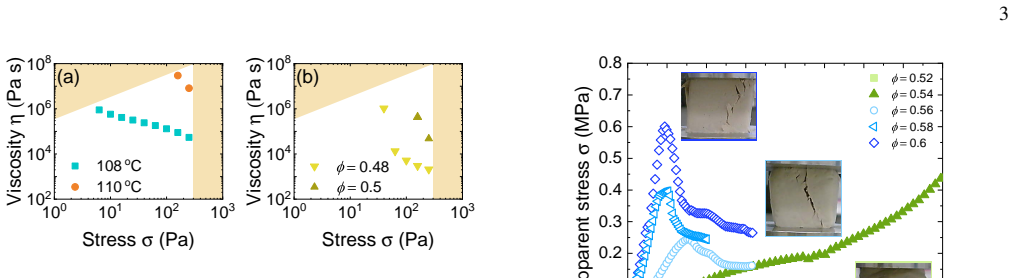
As cooking time or final cooking temperature increases, candies transition from a fluid to a ductile solid, then to a brittle solid that abruptly fractures in compression. This is proposed to be driven by rising solid sugar crystal volume fraction. The same sequence of behaviour is found in a suspension of non-Brownian calcite particles as the solid fraction moves from frictional jamming to random close packing. Particle-based simulations reveal the sensitivity of the observed phenomenon to boundary conditions.
What carries the argument
The solid volume fraction of crystals or particles, which governs the mechanical shift from frictional jamming to dense packing and the associated change from ductile to brittle response.
Load-bearing premise
That the mechanical transition in the candy is caused primarily by the increase in solid crystal volume fraction rather than by concurrent changes in the liquid matrix composition, protein denaturation, or other cooking-induced effects.
What would settle it
Preparing sugar-crystal suspensions at controlled solid fractions but with fixed liquid composition (no cooking) and checking whether the ductile-to-brittle transition occurs at the same volume-fraction values observed in the cooked fudge.
Figures



read the original abstract
The existence and origin of the ductile to brittle transition in non-Brownian suspensions and pastes is underexplored despite the ubiquity of such materials in practical applications. We demonstrate the phenomenon in candies of sugar crystals in a water-protein-fat matrix prepared by boiling a sugar-cream-butter mixture (known as 'fudge' in some countries). As cooking time or final cooking temperature increases, we observe a transition from a fluid to a ductile solid, then to a brittle solid that abruptly fractures in compression. We propose that this is driven by rising solid sugar crystal volume fraction, and indeed find the same sequence of behaviour in a suspension of non-Brownian calcite particles as the solid fraction moves from frictional jamming to random close packing. Particle-based simulations reveal the sensitivity of the observed phenomenon to boundary conditions.
Editorial analysis
A structured set of objections, weighed in public.
Referee Report
Summary. The manuscript reports qualitative observations of a fluid-to-ductile-to-brittle transition in fudge (a suspension of sugar crystals in a water-protein-fat matrix) as cooking time or final temperature is increased. The authors propose that the sequence is driven by rising solid sugar crystal volume fraction and reproduce the same progression in non-Brownian calcite suspensions as solid fraction increases from frictional jamming to random close packing. Particle-based simulations are presented to illustrate sensitivity to boundary conditions.
Significance. If the proposed mechanism holds, the work supplies an accessible experimental platform for investigating ductile-brittle transitions in concentrated suspensions, linking food processing to soft-matter mechanics. The reproduction of the sequence in a well-characterized model suspension together with the boundary-condition simulations constitutes a clear strength and provides a falsifiable route for further tests.
major comments (2)
- [Abstract] Abstract: the central claim that the observed sequence 'is driven by rising solid sugar crystal volume fraction' rests on an untested causal attribution. No direct measurement of crystal volume fraction φ in the cooked fudge samples is reported, nor are control experiments described that hold matrix composition fixed while varying φ.
- [Candy preparation and observation section] Candy preparation and observation section: concurrent changes in liquid supersaturation, viscosity, and protein/fat interactions occur with increased cooking time, yet these are not quantified or isolated from the proposed φ effect; this undermines the attribution of the transition solely to crystal fraction.
minor comments (2)
- [Abstract] The abstract states that simulations 'reveal the sensitivity of the observed phenomenon to boundary conditions' but provides no further detail on simulation method, particle interactions, or specific boundary conditions tested.
- [Figures and Methods] Figure captions and methods should explicitly state how crystal fraction was (or was not) estimated in the fudge and the precise solid fractions used in the calcite experiments.
Simulated Author's Rebuttal
We thank the referee for the positive evaluation of the work's significance and for the detailed, constructive comments. We respond to each major comment below, acknowledging where the manuscript can be improved.
read point-by-point responses
-
Referee: [Abstract] Abstract: the central claim that the observed sequence 'is driven by rising solid sugar crystal volume fraction' rests on an untested causal attribution. No direct measurement of crystal volume fraction φ in the cooked fudge samples is reported, nor are control experiments described that hold matrix composition fixed while varying φ.
Authors: We agree that the manuscript does not report direct measurements of crystal volume fraction φ in the fudge, nor control experiments that isolate φ while holding other matrix properties fixed. The claim is presented as a proposal supported by the reproduction of the same sequence in the calcite model system, where φ is the controlled variable. We will revise the abstract, introduction, and discussion to state this limitation more explicitly, add references to literature on how cooking time affects crystallization in sugar mixtures, and emphasize that the model suspension provides the primary evidence for the role of φ. This is a partial revision, as new measurements on the original samples are not feasible. revision: partial
-
Referee: [Candy preparation and observation section] Candy preparation and observation section: concurrent changes in liquid supersaturation, viscosity, and protein/fat interactions occur with increased cooking time, yet these are not quantified or isolated from the proposed φ effect; this undermines the attribution of the transition solely to crystal fraction.
Authors: The referee is correct that cooking time alters multiple properties simultaneously. The fudge serves as a qualitative demonstration of the transition, while the controlled variation of solid fraction in the non-Brownian calcite suspension isolates the effect of φ. We will add a dedicated paragraph in the discussion section to acknowledge these concurrent changes in the candy system, explain why they are not isolated there, and clarify how the model experiments address the attribution. The text will be revised for greater precision on this point. revision: partial
Circularity Check
No circularity: independent experimental sequences and interpretive hypothesis
full rationale
The paper reports an observed fluid-ductile-brittle sequence in cooked fudge as a function of cooking time/temperature, proposes that rising crystal volume fraction φ is the driver, and tests the proposal by reproducing the same sequence in a separate, controlled calcite suspension system where φ is varied directly from frictional jamming to random close packing. This is an analogy between two distinct experimental systems rather than a derivation in which any prediction or result reduces by construction to its own inputs. No equations, fitted parameters renamed as predictions, self-definitional steps, or load-bearing self-citations appear in the abstract or described chain. The central claim therefore remains self-contained against external benchmarks.
Axiom & Free-Parameter Ledger
axioms (1)
- domain assumption The ductile-to-brittle transition is driven by rising solid sugar crystal volume fraction
Reference graph
Works this paper leans on
-
[1]
Orowan, Fracture and strength of solids, Rep
E. Orowan, Fracture and strength of solids, Rep. Prog. Phys.12, 185 (1949)
work page 1949
-
[2]
K. Felkins, H. P. Leighly, and A. Jankovic, The Royal Mail Ship Titanic: Did a metallurgical failure cause a night to remember?, JOM50, 12 (1998)
work page 1998
-
[3]
Deitz, How Did the Titanic Sink?, Mechanical Engineering 134, 34 (2012)
D. Deitz, How Did the Titanic Sink?, Mechanical Engineering 134, 34 (2012)
work page 2012
-
[4]
S. M. Davarpanah, M. Sharghi, S. Narimani, ´A. T ¨or¨ok, and B. V´as´arhelyi, Brittle-ductile transition stress of different rock types and its relationship with uniaxial compressive strength and Hoek–Brown material constant (𝑚𝑖), Sci. Rep.13, 1186 (2023)
work page 2023
-
[5]
I. M. Ward and J. Sweeney,Mechanical Properties of Solid Polymers, 3rd ed. (John Wiley and Sons, 2013)
work page 2013
- [6]
-
[7]
G. Luo, L. Shi, M. Li, Y. Zhong, X. He, and J. Wang, Ductile- brittle transition in transverse isotropic fibrous networks, Appl. Phys. Lett.112, 051904 (2018)
work page 2018
-
[8]
E. Berthier, J. E. Kollmer, S. E. Henkes, K. Liu, J. M. Schwarz, and K. E. Daniels, Rigidity percolation control of the brittle- ductile transition in disordered networks, Phys. Rev. Materials3, 075602 (2019)
work page 2019
- [9]
-
[10]
H. J. Barlow, J. O. Cochran, and S. M. Fielding, Ductile and brittle yielding in thermal and athermal amorphous materials, Phys. Rev. Lett.125, 168003 (2020)
work page 2020
-
[11]
J. A. Richards, H. Li, R. E. O’Neill, F. H. J. Laidlaw, and J. R. Royer, Fresh cement as a frictional non-Brownian suspension, Powder Technol.441, 119791 (2024)
work page 2024
-
[12]
E. Blanco, D. J. M. Hodgson, M. Hermes, R. Besseling, G. L. Hunter, P. M. Chaikin, M. E. Cates, I. Van Damme, and W. C. K. Poon, Conching chocolate is a prototypical transition from frictionally jammed solid to flowable suspension with maximal solid content, Proc. Natl. Acad. Sci. (U.S.A.)116, 10303 (2019)
work page 2019
-
[13]
McGee,On Food and Cooking: The Science and Lore of the Kitchen(HarperCollins, 1992)
H. McGee,On Food and Cooking: The Science and Lore of the Kitchen(HarperCollins, 1992)
work page 1992
-
[14]
J. A. Richards, R. E. O’Neill, and W. C. K. Poon, Turning a yield-stress calcite suspension into a shear-thickening one by tuning inter-particle friction, Rheol. Acta60, 97 (2021)
work page 2021
- [15]
-
[16]
R. Chetana, R. Ravi, and S. Yella Reddy, Effect of processing variables on quality of milk burfi prepared with and without sugar, J. Food Sci. Technol.47, 114 (2010)
work page 2010
-
[17]
I. Altan, P. Charbonneau, and J. de Valicourt, Sugars: Soft caramel and sucre`a la cr`eme – an undergraduate experiment about sugar crystallization, inHandbook of Molecular Gastronomy: Scientific Foundations, Educational Practices, and Culinary Applications(CRC Press, 2021) 1st ed
work page 2021
-
[18]
S. Weir, K. M. Bromley, A. Lips, and W. C. K. Poon, Celebrat- ing Soft Matter’s 10th anniversary: Simplicity in complexity: towards a soft matter physics of caramel, Soft Matter12, 2757 (2016)
work page 2016
-
[19]
H. M. Hartge, E. Fl ¨oter, and T. A. Vilgis, Rheo-microscopy and flow properties of crystallizing agitated sucrose dispersions, Phys. Fluids36, 013330 (2024)
work page 2024
-
[20]
C. H. Scholz, Brittle fracture of rock, inThe Mechanics of Earthquakes and Faulting(Cambridge University Press, 2019) p. 1–42
work page 2019
-
[21]
X. P. Zhou, Y. J. Lian, L. N. Y. Wong, and F. Berto, Understanding the fracture behavior of brittle and ductile multi-flawed rocks by uniaxial loading by digital image correlation, Eng. Fract. Mech. 199, 438 (2018)
work page 2018
-
[22]
J. Engmann, C. Servais, and A. S. Burbidge, Squeeze flow theory and applications to rheometry: A review, J. Non-Newton. Fluid Mech.132, 1 (2005)
work page 2005
- [23]
-
[24]
B. M. Guy, J. A. Richards, D. J. M. Hodgson, E. Blanco, and W. C. K. Poon, Constraint-based approach to granular dispersion rheology, Phys. Rev. Lett.121, 128001 (2018)
work page 2018
-
[25]
J. A. Richards, B. M. Guy, E. Blanco, M. Hermes, G. Poy, and W. C. K. Poon, The role of friction in the yielding of adhesive non-Brownian suspensions, J. Rheol.64, 405 (2020)
work page 2020
-
[26]
L. El Hosry, V. Elias, V. Chamoun, M. Halawi, P. Cayot, A. Nehme, and E. Bou-Maroun, Maillard reaction: Mecha- 6 nism, influencing parameters, advantages, disadvantages, and food industrial applications: A review, Foods14, 1881 (2025)
work page 2025
-
[27]
Physical properties of glycerine and its solutions, Tech. Rep. (Glycerine Producers’ Association, 1963)
work page 1963
-
[28]
A. Gauthier, G. Ovarlez, and A. Colin, Shear thickening in presence of adhesive contact forces: The singularity of cornstarch, J. Colloid Interface Sci.650, 1105 (2023)
work page 2023
-
[29]
D. J. M. Hodgson, M. Hermes, E. Blanco, and W. C. K. Poon, Granulation and suspension rheology: A unified treatment, J. Rheol.66, 853 (2022)
work page 2022
- [30]
- [31]
-
[32]
E. Az ´ema, F. Radjai, and F. Dubois, Packings of irregular polyhedral particles: Strength, structure, and effects of angularity, Phys. Rev. E87, 062203 (2013)
work page 2013
-
[33]
Ness, Simulating dense, rate-independent suspension rheology using LAMMPS, Comput
C. Ness, Simulating dense, rate-independent suspension rheology using LAMMPS, Comput. Part. Mech10, 2031 (2023)
work page 2031
-
[34]
O. Cheal and C. Ness, Rheology of dense granular suspensions under extensional flow, J. Rheol.62, 501 (2018)
work page 2018
-
[35]
D. M. Mueth, H. M. Jaeger, and S. R. Nagel, Force distribution in a granular medium, Phys. Rev. E57, 3164 (1998)
work page 1998
-
[36]
M. E. Cates, J. P. Wittmer, J.-P. Bouchaud, and P. Claudin, Jamming, force chains, and fragile matter, Phys. Rev. Lett.81, 1841 (1998)
work page 1998
-
[37]
T. S. Majmudar and R. P. Behringer, Contact force measurements and stress-induced anisotropy in granular materials, Nature435, 1079 (2005)
work page 2005
-
[38]
R. P. Behringer and B. Chakraborty, The physics of jamming for granular materials: a review, Rep. Prog. Phys.82, 012601 (2019)
work page 2019
-
[39]
A. W. Hatheway and G. A. Kiersch, Engineering properties of rock, inHandbook of physical properties of rocks, Volume II, edited by R. S. Carmichael (CRC Press, Boca Raton, FL, 1982) data for Limesone (Barberton, OH)
work page 1982
-
[40]
D. Rathbone, M. Marigo, D. Dini, and B. van Wachem, An accurate force–displacement law for the modelling of elastic– plastic contacts in discrete element simulations, Powder Technol. 282, 2 (2015)
work page 2015
-
[41]
C. Thornton, Coefficient of restitution for collinear collisions of elastic-perfectly plastic spheres, J. Appl. Mech.64, 383 (1997)
work page 1997
-
[42]
C. Ness and S. M. Fielding, Nonmonotonic constitutive curves and shear banding in dry and wet granular flows, Phys. Rev. Lett. 134, 038201 (2025)
work page 2025
-
[43]
M. I. Smith, R. Besseling, M. E. Cates, and V. Bertola, Dilatancy in the flow and fracture of stretched colloidal suspensions, Nat. Commun.1, 114 (2010)
work page 2010
-
[44]
M. I. Smith, Fracture of jammed colloidal suspensions, Sci. Rep. 5, 14175 (2015)
work page 2015
- [45]
-
[46]
T. Ono, K. Hori, K. ichi Tamine, and Y. Maeda, Evaluation of tongue motor biomechanics during swallowing: From oral feeding models to quantitative sensing methods, Jpn. Dent. Sci. Rev.45, 65 (2009)
work page 2009
-
[47]
G. V. Civille, Food texture: Pleasure and pain, J. Agric. Food Chem.59, 1487 (2011)
work page 2011
-
[48]
A. Deblais, E. d. Hollander, C. Boucon, A. E. Blok, B. Veltkamp, P. Voudouris, P. Versluis, H.-J. Kim, M. Mellema, M. Stieger, et al., Predicting thickness perception of liquid food products from their non-Newtonian rheology, Nat. Commun.12, 6328 (2021)
work page 2021
- [49]
-
[50]
A. Emmerich, Density data for sucrose solutions: contribution to the application of the new values adopted by ICUMSA, Zuckerindustrie119, 120 (1994)
work page 1994
-
[51]
W. Kaialy, G. Martin, M. Ticehurst, P. Royall, M. Mohammad, J. Murphy, and A. Nokhodchi, Characterisation and deposi- tion studies of recrystallised lactose from binary mixtures of ethanol/butanol for improved drug delivery from dry powder inhalers, The AAPS Journal13, 30 (2011). End Matter Fudge compositionThe final fudge is assumed to be a protein netwo...
work page 2011
discussion (0)
Sign in with ORCID, Apple, or X to comment. Anyone can read and Pith papers without signing in.