Recognition: unknown
Pair-Breaking and Dimensionality in Spin-Orbit Coupled Superconductors
Pith reviewed 2026-05-08 04:07 UTC · model grok-4.3
The pith
Thin LaBi2 films reveal spin exchange scattering as a key depairing channel through field-enhanced superconductivity in the thin limit.
A machine-rendered reading of the paper's core claim, the machinery that carries it, and where it could break.
Core claim
The response of ultra-thin LaBi2 to parallel magnetic fields shows that multiple depairing mechanisms must be considered together. Resolving field-enhanced superconductivity in the thin limit allows an estimate of spin exchange scattering in addition to paramagnetic and orbital effects. This offers insight into how the critical temperature as well as the Pauli limit are defined, and recasts how scattering times in two-dimensional superconductors can be interpreted.
What carries the argument
The multi-mechanism Kharitonov-Feigel'man framework, which models the combined suppression of superconductivity by paramagnetic, orbital, and spin exchange scattering channels in thin films under parallel fields.
If this is right
- The Pauli limit in these thin films incorporates a measurable contribution from spin exchange scattering.
- Critical temperature definitions in two-dimensional superconductors must include thickness-dependent scattering channels.
- Scattering times extracted from transport or magnetic data require reinterpretation once multiple depairing mechanisms are resolved.
- Dimensionality tunes the relative weight of spin exchange scattering against orbital and paramagnetic effects.
Where Pith is reading between the lines
- The same separation of mechanisms could be tested in other spin-orbit-coupled thin-film superconductors to check consistency of the framework.
- Device-scale predictions for superconducting films in applied fields would improve if spin exchange scattering is routinely included.
- Systematic variation of film thickness beyond the current range could further constrain the thickness dependence assumed in the model.
Load-bearing premise
The multi-mechanism Kharitonov-Feigel'man framework accurately captures all relevant depairing channels in LaBi2 without additional material-specific corrections or unaccounted thickness-dependent effects.
What would settle it
A direct measurement of scattering rates in thin LaBi2 films that fails to match the values estimated from the field-enhanced superconductivity when spin exchange scattering is included in the framework.
Figures


read the original abstract
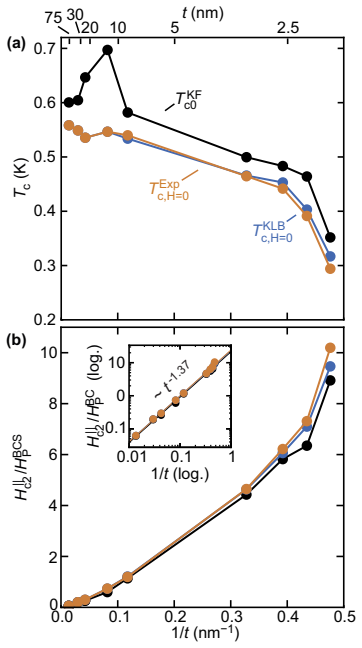
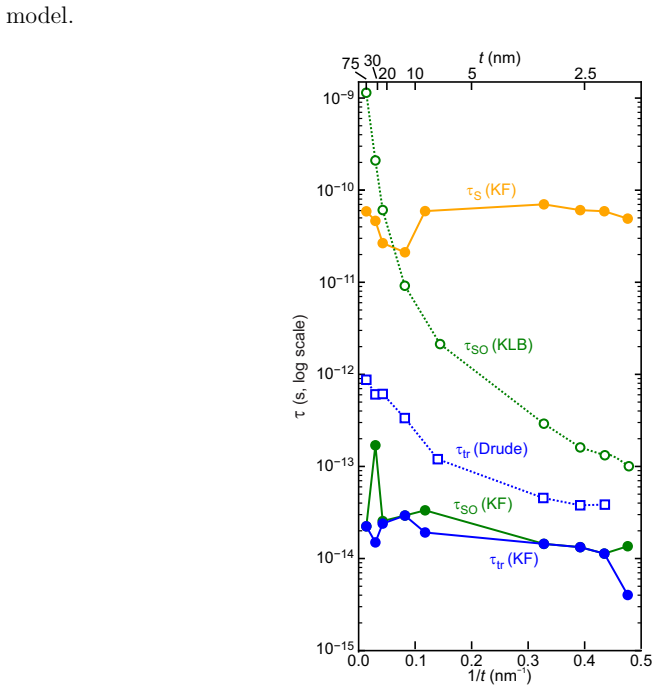
The response of ultra-thin superconducting materials under parallel magnetic fields is often leveraged to obtain insight into the nature of the condensate, including features attributable to unconventional forms of pairing. Despite there being multiple competing mechanisms responsible for suppressing superconductivity, it is common for these analyses to overlook certain depairing channels. Here we report an analysis of thickness dependent superconductivity in thin films of \ce{LaBi2} using the multi-mechanism Kharitonov-Feigel'man framework . By resolving field-enhanced superconductivity in the thin-limit, we obtain an estimate the role of spin exchange scattering, in addition to paramagnetic and orbital effects. Our analyses offer insight into how fundamental quantities such as the critical temperature as well as Pauli limit are defined, recasting the landscape for how scattering times in two-dimensional superconductors can be interpreted.
Editorial analysis
A structured set of objections, weighed in public.
Referee Report
Summary. The manuscript analyzes thickness-dependent superconductivity in LaBi2 thin films under parallel magnetic fields. It applies the multi-mechanism Kharitonov-Feigel'man framework to separate spin-exchange scattering from paramagnetic and orbital depairing channels by examining field-enhanced superconductivity in the thin-film limit. The central claim is that this resolves an estimate for the spin-exchange scattering time and recasts how critical temperature and Pauli limits are defined in two-dimensional spin-orbit-coupled superconductors.
Significance. If the Kharitonov-Feigel'man framework applies without material-specific corrections or unaccounted thickness-dependent effects, the work offers a concrete route to isolate spin-exchange scattering in thin-limit data. This would strengthen interpretation of scattering times and pair-breaking mechanisms in 2D superconductors, particularly where multiple depairing channels compete. The approach is internally consistent with standard thin-film theory and addresses a frequent oversight in the literature.
minor comments (2)
- Abstract: the sentence 'we obtain an estimate the role of spin exchange scattering' is missing the preposition 'of' and should be rephrased for grammatical clarity.
- Abstract: the phrase 'recasting the landscape for how scattering times in two-dimensional superconductors can be interpreted' is vague; a more precise statement of the concrete interpretive change would improve readability.
Simulated Author's Rebuttal
We thank the referee for the positive assessment of our manuscript and the recommendation for minor revision. The summary accurately captures our use of the Kharitonov-Feigel'man framework to analyze thickness-dependent superconductivity in LaBi2 thin films under parallel fields, including the separation of spin-exchange scattering from other depairing mechanisms.
Circularity Check
No significant circularity detected
full rationale
The paper applies the external Kharitonov-Feigel'man multi-mechanism framework to separate spin-exchange, paramagnetic, and orbital depairing channels in LaBi2 thin films by analyzing thickness-dependent field-enhanced superconductivity. No equations or steps reduce by construction to fitted inputs, self-definitions, or load-bearing self-citations; the framework is invoked as an independent standard model whose parameters are not shown to be redefined from the target estimates. The derivation remains self-contained against external benchmarks of thin-film pair-breaking theory.
Axiom & Free-Parameter Ledger
free parameters (2)
- spin exchange scattering time
- thickness-dependent critical temperature scaling
axioms (1)
- domain assumption Kharitonov-Feigel'man multi-mechanism depairing model applies without additional corrections to LaBi2
Reference graph
Works this paper leans on
-
[1]
X. Xi, Z. Wang, W. Zhao, J.-H. Park, K. T. Law, H. Berger, L. Forr´ o, J. Shan, and K. F. Mak, Nature Physics12, 139 (2016), ISSN 1745-2481, URLhttps://www.nature.com/articles/ nphys3538
2016
-
[2]
A. Devarakonda, H. Inoue, S. Fang, C. Ozsoy-Keskinbora, T. Suzuki, M. Kriener, L. Fu, E. Kaxiras, D. C. Bell, and J. G. Checkelsky, Science370, 231 (2020), URLhttps://www. science.org/doi/10.1126/science.aaz6643
-
[3]
J. M. Lu, O. Zheliuk, I. Leermakers, N. F. Q. Yuan, U. Zeitler, K. T. Law, and J. T. Ye, Science 350, 1353 (2015), URLhttps://www.science.org/doi/10.1126/science.aab2277
-
[4]
D. A. Rhodes, A. Jindal, N. F. Q. Yuan, Y. Jung, A. Antony, H. Wang, B. Kim, Y.-c. Chiu, T. Taniguchi, K. Watanabe, et al., Nano Letters21, 2505 (2021), ISSN 1530-6984, URL https://doi.org/10.1021/acs.nanolett.0c04935
-
[6]
S. C. de la Barrera, M. R. Sinko, D. P. Gopalan, N. Sivadas, K. L. Seyler, K. Watanabe, T. Taniguchi, A. W. Tsen, X. Xu, D. Xiao, et al., Nature Communications9, 1427 (2018), ISSN 2041-1723, URLhttps://www.nature.com/articles/s41467-018-03888-4
2018
-
[7]
Z. Xie, Z. Chen, M. Yang, L. Liao, J. Deng, B. Song, X. Chen, Z. Liu, J. Yan, X. Huang, et al., Advanced Functional Materials35, 2501453 (2025), ISSN 1616-3028, URLhttps: //onlinelibrary.wiley.com/doi/abs/10.1002/adfm.202501453
-
[8]
Fatemi, S
V. Fatemi, S. Wu, Y. Cao, L. Bretheau, Q. D. Gibson, K. Watanabe, T. Taniguchi, R. J. Cava, and P. Jarillo-Herrero, Science362, 926 (2018), URLhttps://www.science.org/doi/10. 1126/science.aar4642
2018
-
[9]
J. Lu, O. Zheliuk, Q. Chen, I. Leermakers, N. E. Hussey, U. Zeitler, and J. Ye, Proceedings of the National Academy of Sciences115, 3551 (2018), URLhttps://www.pnas.org/doi/ full/10.1073/pnas.1716781115
-
[10]
M. Kim, Y. Kozuka, C. Bell, Y. Hikita, and H. Y. Hwang, Phys. Rev. B86, 085121 (2012), URLhttps://link.aps.org/doi/10.1103/PhysRevB.86.085121. 12
-
[11]
S. J. Poage, X. Gao, M. Baksi, S. Salmani-Rezaie, D. A. Muller, D. P. Kumah, C. N. Lau, J. Lorenzana, M. N. Gastiasoro, and K. Ahadi, Physical Review B111, 214506 (2025), URL https://link.aps.org/doi/10.1103/PhysRevB.111.214506
-
[12]
Y. Liu, Z. Wang, X. Zhang, C. Liu, Y. Liu, Z. Zhou, J. Wang, Q. Wang, Y. Liu, C. Xi, et al., Physical Review X8, 021002 (2018), URLhttps://link.aps.org/doi/10.1103/PhysRevX. 8.021002
-
[13]
X. Chen, C. Tang, L. Yao, Z. Cao, Y. Zhu, D. Zhang, and X. Kou, Physical Review B111, 184503 (2025), URLhttps://link.aps.org/doi/10.1103/PhysRevB.111.184503
-
[14]
Z. Zhang, W. Jiang, T. Shao, Y. Qiao, X. Chen, Q. Zhao, M. Chen, R. Dou, C. Xiong, and J. Nie, New Journal of Physics25, 023023 (2023), ISSN 1367-2630, URLhttps://doi.org/ 10.1088/1367-2630/acbae4
-
[15]
H. Nam, H. Chen, T. Liu, J. Kim, C. Zhang, J. Yong, T. R. Lemberger, P. A. Kratz, J. R. Kirtley, K. Moler, et al., Proceedings of the National Academy of Sciences113, 10513 (2016), https://www.pnas.org/doi/pdf/10.1073/pnas.1611967113, URLhttps://www.pnas. org/doi/abs/10.1073/pnas.1611967113
-
[16]
J. Falson, Y. Xu, M. Liao, Y. Zang, K. Zhu, C. Wang, Z. Zhang, H. Liu, W. Duan, K. He, et al., Science367, 1454 (2020), URLhttps://www.science.org/doi/10.1126/science.aax3873
-
[17]
R. A. Klemm, A. Luther, and M. R. Beasley, Physical Review B12, 877 (1975), URLhttps: //link.aps.org/doi/10.1103/PhysRevB.12.877
-
[18]
Tinkham, inIntroduction to superconductivity, 2nd edition(McGraw Hill, Inc., New York City, 1996), chap
M. Tinkham, inIntroduction to superconductivity, 2nd edition(McGraw Hill, Inc., New York City, 1996), chap. 4
1996
-
[19]
V. Jaccarino and M. Peter, Physical Review Letters9, 290 (1962), URLhttps://link.aps. org/doi/10.1103/PhysRevLett.9.290
- [20]
-
[21]
M. Y. Kharitonov and M. V. Feigelman, Journal of Experimental and Theoretical Physics Letters82, 421 (2005), ISSN 1090-6487, URLhttps://doi.org/10.1134/1.2142869
-
[22]
M. Niwata, R. Masutomi, and T. Okamoto, Phys. Rev. Lett.119, 257001 (2017), URLhttps: //link.aps.org/doi/10.1103/PhysRevLett.119.257001
- [23]
-
[24]
T. Sekihara, R. Masutomi, and T. Okamoto, Phys. Rev. Lett.111, 057005 (2013), URL https://link.aps.org/doi/10.1103/PhysRevLett.111.057005
-
[25]
B. T. Zhou, N. F. Q. Yuan, H.-L. Jiang, and K. T. Law, Physical Review B93, 180501 (2016), URLhttps://link.aps.org/doi/10.1103/PhysRevB.93.180501
-
[26]
D. Zhang and J. Falson, Nanotechnology32, 502003 (2021), ISSN 0957-4484, 1361-6528, URL https://iopscience.iop.org/article/10.1088/1361-6528/ac238d
-
[27]
R. Dorrian, S. Song, J. Kim, M. Ohno, S.-H. Jhi, N. Kioussis, and J. Falson,Relativistic Effects in LaBi$ 2$Thin Films(2026), arXiv:2602.09975 [cond-mat], URLhttp://arxiv. org/abs/2602.09975
-
[28]
See Supplementary Material [URL] for detailed discussion of the KF and KLB models, ex- tended XRD data, two-carrier Drude analysis, extended data on field-enhanced SC, full KF and KLB fitting curves, and fitting parameters
-
[29]
A. Llanos, G. Campisi, V. Show, J. Kim, R. Dorrian, S. Salmani-Rezaie, N. Kioussis, and J. Falson, Nano Lett.24, 8518 (2024), ISSN 1530-6984, 1530-6992, URLhttps://pubs.acs. org/doi/10.1021/acs.nanolett.4c01068
-
[30]
R. Dorrian, J. Kim, M. Ohno, A. Llanos, V. Show, N. Kioussis, and J. Falson, Nano Letters (2025), ISSN 1530-6984, URLhttps://pubs.acs.org/doi/abs/10.1021/acs.nanolett. 5c02665
-
[31]
J. Kim, R. Dorrian, A. Llanos, J. Falson, and N. Kioussis, Physical Review Materials10, 033401 (2026), publisher: American Physical Society, URLhttps://link.aps.org/doi/10. 1103/t4m3-jjdn
2026
-
[32]
A. I. Gubin, K. S. Il’in, S. A. Vitusevich, M. Siegel, and N. Klein, Physical Review B72, 064503 (2005), URLhttps://link.aps.org/doi/10.1103/PhysRevB.72.064503
-
[33]
A. Semenov, B. G¨ unther, U. B¨ ottger, H.-W. H¨ ubers, H. Bartolf, A. Engel, A. Schilling, K. Ilin, M. Siegel, R. Schneider, et al., Physical Review B80, 054510 (2009), URLhttps: //link.aps.org/doi/10.1103/PhysRevB.80.054510
-
[34]
X. J. Chen, H. Q. Lin, and C. D. Gong, Physical Review B61, 9782 (2000), URLhttps: //link.aps.org/doi/10.1103/PhysRevB.61.9782
-
[35]
Asaba, Y
T. Asaba, Y. Wang, G. Li, Z. Xiang, C. Tinsman, L. Chen, S. Zhou, S. Zhao, D. Laleyan, 14 Y. Li, et al., Scientific reports8, 6520 (2018)
2018
- [36]
-
[37]
V. G. Kogan and R. Prozorov, Physical Review B107, L020501 (2023), URLhttps://link. aps.org/doi/10.1103/PhysRevB.107.L020501
-
[38]
Z. Devizorova and A. I. Buzdin, Physical Review B110, L180504 (2024), URLhttps:// link.aps.org/doi/10.1103/PhysRevB.110.L180504
-
[39]
D. Maryenko, M. Kawamura, I. V. Maznichenko, S. Ostanin, D. Zhang, M. Kriener, V. K. Dugaev, E. Y. Sherman, A. Ernst, and M. Kawasaki,Re-entrant superconductivity at an ox- ide heterointerface(2025), arXiv:2510.01682 [cond-mat], URLhttp://arxiv.org/abs/2510. 01682
-
[40]
O. P. Squire, S. A. Hodgson, J. Chen, V. Fedoseev, C. K. De Podesta, T. I. Weinberger, P. L. Alireza, and F. M. Grosche, Physical Review Letters131, 026001 (2023), ISSN 0031-9007, 1079-7114, URLhttps://link.aps.org/doi/10.1103/PhysRevLett.131.026001
-
[41]
Y. Hu, K. Liang, J. Li, Z. Li, F. Meng, H. Lei, J. Wang, H. Wen, R. Zhang, J. Cai, et al., Nature Communications16, 7305 (2025), ISSN 2041-1723, URLhttps://www.nature.com/ articles/s41467-025-62624-x
2025
-
[42]
H. W. Meul, C. Rossel, M. Decroux, O. Fischer, G. Remenyi, and A. Briggs, Physical Review Letters53, 497 (1984), URLhttps://link.aps.org/doi/10.1103/PhysRevLett.53.497
-
[43]
D. Vu, H. Lee, D. Nicoletti, W. Wei, Z. Jin, D. V. Chichinadze, M. Buzzi, W. Li, X. Yang, R. Wu, et al., Nature Communications (2026), ISSN 2041-1723, URLhttps://www.nature. com/articles/s41467-026-70254-0
2026
-
[44]
Klemenz, S
S. Klemenz, S. Lei, and L. M. Schoop, Annual Review of Materials Research49, 185 (2019), ISSN 1531-7331, 1545-4118, URLhttps://www.annualreviews.org/doi/10.1146/ annurev-matsci-070218-010114
2019
-
[45]
J. Hu, Z. Tang, J. Liu, Y. Zhu, J. Wei, and Z. Mao, Physical Review B96, 045127 (2017), URLhttps://link.aps.org/doi/10.1103/PhysRevB.96.045127. 15 Pair-Breaking and Dimensionality in Spin-Orbit Coupled Superconductors Supplementary Material The Kharitonov-Feigelman Model:We adapt the fitting procedure and KF model im- plementation from Ref. [23] with a fe...
discussion (0)
Sign in with ORCID, Apple, or X to comment. Anyone can read and Pith papers without signing in.