Recognition: unknown
Non-Local Particle Flows Become Local When Considering Dissipative Stress
Pith reviewed 2026-05-08 04:11 UTC · model grok-4.3
The pith
A shear-rate-weighted dissipative stress restores the local μ(J) rheology throughout the bulk of inhomogeneous dense suspension flows
A machine-rendered reading of the paper's core claim, the machinery that carries it, and where it could break.
Core claim
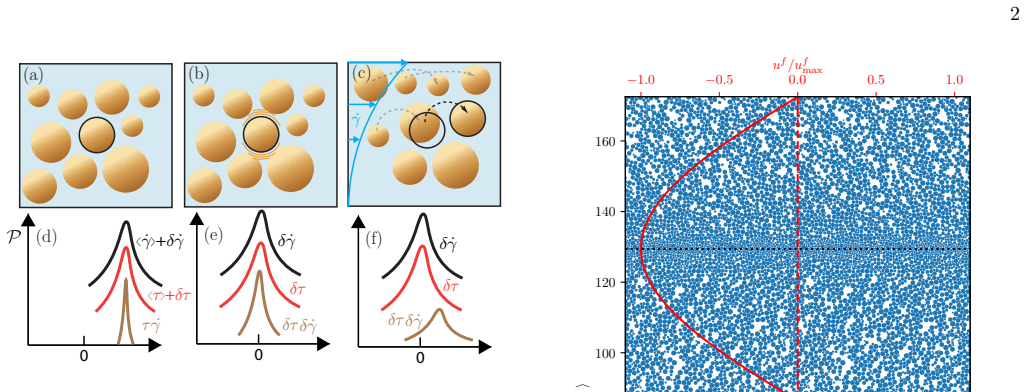
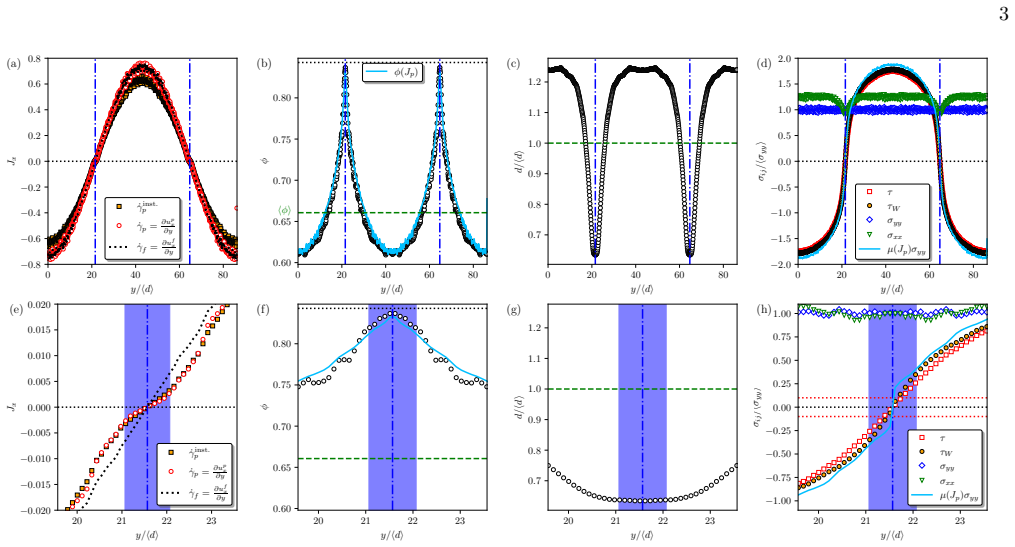
In particle-resolved simulations of frictionless dense suspensions under two-dimensional Kolmogorov flow, the shear-rate-weighted dissipative stress τ_W = ⟨τ γ̇⟩ / ⟨γ̇⟩ restores the homogeneous μ(J) law throughout the bulk while the inferred friction remains strictly above yield; a simple geometric mixing-length model with conventional stresses then explains the remaining sub-yield motion inside a sub-diameter layer at flow reversals.
What carries the argument
The shear-rate-weighted dissipative stress τ_W = ⟨τ γ̇⟩ / ⟨γ̇⟩, which isolates the irreversible-work component of stress and allows the local μ(J) relation to hold in the bulk.
If this is right
- The bulk of the flow obeys the homogeneous local μ(J) law with friction strictly above yield when the dissipative stress is used.
- Only a narrow sub-diameter layer at flow reversals requires an additional geometric mixing-length argument.
- Much of the observed non-locality is an artifact of conventional stress averaging rather than an intrinsic material property.
- Non-local rheological models are not required for this class of frictionless inhomogeneous flows once stress is redefined.
Where Pith is reading between the lines
- The same weighting could be applied to experimental data or three-dimensional simulations to check whether locality is recovered in more realistic geometries.
- If the approach holds, continuum models of industrial or geological flows could drop non-local terms in favor of this redefined local stress.
- Analogous weighting might resolve apparent non-locality in other driven soft-matter systems where irreversible work is the relevant quantity.
Load-bearing premise
The shear-rate-weighted average correctly isolates only the irreversible dissipative component of stress and the 2D frictionless simulations generalize to other inhomogeneous granular and suspension flows.
What would settle it
A direct test in which the μ(J) curve measured in homogeneous simple shear (using the same weighted stress) fails to collapse onto the curve extracted from the inhomogeneous Kolmogorov flow would falsify the claim that the weighted stress restores locality.
Figures



read the original abstract
Dense granular and suspension flows under inhomogeneous shear exhibit persistent particle motion in regions where the local yield criterion is subcritical, an apparent breakdown of locality that has motivated the development of a generation of nonlocal rheological models. Using particle-resolved simulations of frictionless dense suspensions in two-dimensional Kolmogorov flow, we show that two independent considerations together account for this signature. First, replacing the conventional shear stress by a shear-rate-weighted dissipative stress $\tau_W=\langle \tau \dot \gamma \rangle/\langle \dot \gamma \rangle$, which isolates the component of stress that performs irreversible work, restores the homogeneous $\mu(J)$ law throughout the bulk of the flow, with the inferred friction remaining strictly above yield. Second, a simple geometric mixing-length construction, applied with conventional stresses and requiring no fluctuation input, accounts for the residual sub-yielding within a sub-diameter layer at flow reversals. Each approach is based on a different philosophy and mechanism, and together they suggest that much of the apparent non-locality in this geometry and frictionless case is an artefact of how stress is measured and averaged rather than an intrinsic breakdown of local rheology.
Editorial analysis
A structured set of objections, weighed in public.
Referee Report
Summary. The paper claims that apparent non-local particle flows in inhomogeneous shear of dense granular and suspension systems are largely an artifact of conventional stress averaging. Using particle-resolved simulations of frictionless dense suspensions in 2D Kolmogorov flow, it shows that a shear-rate-weighted dissipative stress τ_W = ⟨τ γ̇⟩/⟨γ̇⟩ restores the homogeneous μ(J) law throughout the bulk (with inferred friction strictly above yield), while a parameter-free geometric mixing-length construction using conventional stresses accounts for residual sub-yielding within a sub-diameter layer at flow reversals.
Significance. If the result holds, the work indicates that much of the non-locality observed in such flows arises from how irreversible work is isolated in stress measurement rather than requiring intrinsic non-local constitutive models. It is strengthened by its reliance on particle-resolved simulations and a parameter-free geometric construction, offering a concrete, falsifiable alternative for this geometry and the frictionless case.
major comments (2)
- [Definition of dissipative stress τ_W] Definition of dissipative stress τ_W (abstract and the section introducing the weighted average): The steady-state momentum balance in Kolmogorov flow requires ∇·⟨τ⟩ to balance the body force, so the time-averaged stress ⟨τ(y)⟩ is fixed by the driving. The paper does not show that τ_W equals ⟨τ⟩ when fluctuations are uncorrelated or how a local μ(J) relation written with τ_W remains consistent with the integrated force balance; this is load-bearing for the claim that conventional local rheology is restored rather than redefined.
- [Results on μ(J) restoration] Restoration of μ(J) law in the bulk (results section reporting the collapse): The claim that friction remains strictly above yield relies on τ_W; the manuscript should quantify the difference between τ_W and ⟨τ⟩ in low-⟨γ̇⟩ regions and demonstrate that the collapse survives when the weighting is replaced by a simple time average over the same windows, to rule out that the apparent restoration is an artifact of the weighting procedure.
minor comments (2)
- [Abstract] The abstract states that the two approaches are 'based on a different philosophy and mechanism' but does not briefly indicate how the geometric mixing length is constructed (e.g., the precise length scale choice); adding one sentence would improve readability.
- [Figures] Figure captions comparing stress profiles should explicitly label curves as ⟨τ⟩ versus τ_W to prevent reader confusion between the two measures.
Simulated Author's Rebuttal
We thank the referee for their thorough review and valuable suggestions. We address the major comments point by point below, and will revise the manuscript accordingly where appropriate.
read point-by-point responses
-
Referee: [Definition of dissipative stress τ_W] Definition of dissipative stress τ_W (abstract and the section introducing the weighted average): The steady-state momentum balance in Kolmogorov flow requires ∇·⟨τ⟩ to balance the body force, so the time-averaged stress ⟨τ(y)⟩ is fixed by the driving. The paper does not show that τ_W equals ⟨τ⟩ when fluctuations are uncorrelated or how a local μ(J) relation written with τ_W remains consistent with the integrated force balance; this is load-bearing for the claim that conventional local rheology is restored rather than redefined.
Authors: We appreciate the referee pointing out this crucial aspect of consistency. Upon reflection, we acknowledge that the manuscript does not explicitly demonstrate the reduction of τ_W to ⟨τ⟩ in the uncorrelated limit. In the revised manuscript, we will include a brief analytical section showing that τ_W = ⟨τ⟩ when stress and shear-rate fluctuations are uncorrelated, following directly from the definition. For the consistency with the force balance: the local μ(J) relation is proposed for the dissipative stress τ_W, while the momentum balance holds for the total average stress ⟨τ⟩. The difference ⟨τ⟩ - τ_W represents non-dissipative contributions (e.g., reversible elastic or fluctuating parts) that average to satisfy the global balance without affecting the local dissipative rheology. We will add a discussion clarifying this distinction and, if possible, a numerical check in the simulations. This supports rather than redefines the local rheology by focusing on the relevant stress component for dissipation. revision: yes
-
Referee: [Results on μ(J) restoration] Restoration of μ(J) law in the bulk (results section reporting the collapse): The claim that friction remains strictly above yield relies on τ_W; the manuscript should quantify the difference between τ_W and ⟨τ⟩ in low-⟨γ̇⟩ regions and demonstrate that the collapse survives when the weighting is replaced by a simple time average over the same windows, to rule out that the apparent restoration is an artifact of the weighting procedure.
Authors: We agree this is an important check to rule out procedural artifacts. In the revised manuscript, we will add a new figure or panel quantifying the relative difference (τ_W - ⟨τ⟩)/⟨τ⟩ in regions with low ⟨γ̇⟩, showing that deviations are confined to areas with strong fluctuations near flow reversals. Furthermore, we will recompute the μ(J) relation using a simple time average of τ over the identical temporal windows employed for the weighted average, and demonstrate that the data collapse onto the homogeneous curve remains robust in the bulk, with only minor deviations in the lowest shear-rate bins. This confirms that the restoration is not an artifact of the specific weighting but arises from properly accounting for the dissipative nature of the stress. revision: yes
Circularity Check
No significant circularity; central claims rest on simulation data and independent geometric construction
full rationale
The paper's core result—that a shear-rate-weighted dissipative stress τ_W restores the homogeneous μ(J) relation in the bulk while a parameter-free mixing-length model handles the reversal layer—is obtained from direct particle-resolved simulations of 2D Kolmogorov flow. The definition τ_W = ⟨τ γ̇⟩/⟨γ̇⟩ is introduced as a proposed measure isolating irreversible work, then tested against the same simulation trajectories rather than derived from or forced by the target μ(J) curve. The geometric construction likewise requires no fluctuation statistics and is applied with conventional stresses. No self-citations are load-bearing, no parameters are fitted to the inhomogeneous data and then relabeled as predictions, and no uniqueness theorem or ansatz is smuggled in. The derivation chain therefore remains self-contained against external benchmarks (the homogeneous rheology and the simulation force balance).
Axiom & Free-Parameter Ledger
axioms (1)
- domain assumption The homogeneous μ(J) rheology law holds for dense frictionless suspensions when the appropriate stress measure is used.
invented entities (1)
-
Dissipative stress τ_W
no independent evidence
Reference graph
Works this paper leans on
-
[1]
GDR MiDi, On dense granular flows, Eur. Phys. J. E14, 341 (2004)
2004
-
[2]
da Cruz, S
F. da Cruz, S. Emam, M. Prochnow, J.-N. Roux, and F. Chevoir, Rheophysics of dense granular materials: Dis- crete simulation of plane shear flows, Phys. Rev. E72, 021309 (2005). 5
2005
-
[3]
P. Jop, Y. Forterre, and O. Pouliquen, A constitutive law for dense granular flows, Nature441, 727 (2006)
2006
-
[4]
Boyer, E
F. Boyer, E. Guazzelli, and O. Pouliquen, Unifying sus- pension and granular rheology, Phys. Rev. Lett.107, 188301 (2011)
2011
-
[5]
Trulsson, B
M. Trulsson, B. Andreotti, and P. Claudin, Transition from the viscous to inertial regime in dense suspensions, Phys. Rev. Lett.109, 118305 (2012)
2012
-
[6]
Forterre and O
Y. Forterre and O. Pouliquen, Flows of dense granular media, Annu. Rev. Fluid Mech.40, 1 (2008)
2008
-
[7]
Guazzelli and O
E. Guazzelli and O. Pouliquen, Rheology of dense gran- ular suspensions, J. Fluid Mech.852, P1 (2018)
2018
-
[8]
Koval, J.-N
G. Koval, J.-N. Roux, A. Corfdir, and F. m. c. Chevoir, Annular shear of cohesionless granular materials: From the inertial to quasistatic regime, Phys. Rev. E79, 021306 (2009)
2009
-
[9]
Kamrin and G
K. Kamrin and G. Koval, Nonlocal constitutive relation for steady granular flow, Phys. Rev. Lett.108, 178301 (2012)
2012
-
[10]
Bouzid, M
M. Bouzid, M. Trulsson, P. Claudin, E. Cl´ ement, and B. Andreotti, Nonlocal rheology of granular flows across yield conditions, Phys. Rev. Lett.111, 238301 (2013)
2013
-
[11]
Bouzid, M
M. Bouzid, M. Trulsson, P. Claudin, E. Cl´ ement, and B. Andreotti, Microrheology to probe non-local effects in dense granular flows, Europhysics Letters109, 24002 (2015)
2015
-
[12]
J. J. J. Gillissen and C. Ness, Modeling the microstruc- ture and stress in dense suspensions under inhomoge- neous flow, Phys. Rev. Lett.125, 184503 (2020)
2020
-
[13]
B. P. Bhowmik and C. Ness, Scaling description of fric- tionless dense suspensions under inhomogeneous flow, Phys. Rev. Lett.132, 118203 (2024)
2024
-
[14]
Bocquet, A
L. Bocquet, A. Colin, and A. Ajdari, Kinetic theory of plastic flow in soft glassy materials, Phys. Rev. Lett.103, 036001 (2009)
2009
-
[15]
Pouliquen and Y
O. Pouliquen and Y. Forterre, A non-local rheology for dense granular flows, Philos. Trans. R. Soc. A367, 5091 (2009)
2009
-
[16]
D. L. Henann and K. Kamrin, A predictive, size- dependent continuum model for dense granular flows, Proc. Natl. Acad. Sci. U.S.A.110, 6730 (2013)
2013
-
[17]
DeGiuli and M
E. DeGiuli and M. Wyart, Friction law and hysteresis in granular materials, Proc. Natl. Acad. Sci. U.S.A.114, 9284 (2017)
2017
-
[18]
Trulsson, E
M. Trulsson, E. DeGiuli, and M. Wyart, Effect of friction on dense suspension flows of hard particles, Phys. Rev. E95, 012605 (2017)
2017
-
[19]
P¨ ahtz, O
T. P¨ ahtz, O. Dur´ an, D. N. de Klerk, I. Govender, and M. Trulsson, Local rheology relation with variable yield stress ratio across dry, wet, dense, and dilute granular flows, Phys. Rev. Lett.123, 048001 (2019)
2019
-
[20]
Kim and K
S. Kim and K. Kamrin, Power-law scaling in granular rheology across flow geometries, Phys. Rev. Lett.125, 088002 (2020)
2020
-
[21]
Gaume, G
J. Gaume, G. Chambon, and M. Naaim, Microscopic origin of nonlocal rheology in dense granular materials, Phys. Rev. Lett.125, 188001 (2020)
2020
-
[22]
B. P. Bhowmik and C. Ness, Unifying homogeneous and inhomogeneous rheology of dense suspensions, J. Rheol. 69, 423 (2025)
2025
-
[23]
Bouzid, A
M. Bouzid, A. Izzet, M. Trulsson, E. Cl´ ement, P. Claudin, and B. Andreotti, Non-local rheology in dense granular flows, The European Physical Journal E38, 125 (2015)
2015
-
[24]
Zhang and K
Q. Zhang and K. Kamrin, Microscopic description of the granular fluidity field in nonlocal flow modeling, Phys. Rev. Lett.118, 058001 (2017)
2017
-
[25]
Berzi, On granular flows: From kinetic theory to in- ertial rheology and nonlocal constitutive models, Phys
D. Berzi, On granular flows: From kinetic theory to in- ertial rheology and nonlocal constitutive models, Phys. Rev. Fluids9, 034304 (2024)
2024
-
[26]
J. M. N. T. Gray, Particle segregation in dense granular flows, Annu. Rev. Fluid Mech.50, 407 (2018)
2018
-
[27]
Substitutingσ xx orP= (σ xx +σ yy)/2 into theτorτ W leaves the qualitative results unchanged
-
[28]
Deviations between the measured stress and the local prediction at high|J|are merely a consequence of the limited accuracy of our fits of the SS data in the high-J region, where the simple fit slightly overestimatese.g., the effective friction coefficient
-
[29]
Nott, Prabhu R., A non-local plasticity theory for slow granular flows, EPJ Web Conf.140, 11015 (2017)
2017
-
[30]
P. V. Dsouza and P. R. Nott, A non-local constitutive model for slow granular flow that incorporates dilatancy, Journal of Fluid Mechanics888, R3 (2020)
2020
- [31]
-
[32]
Trulsson, Rheology and shear jamming of frictional ellipses, Journal of Fluid Mechanics849, 718–740 (2018)
M. Trulsson, Rheology and shear jamming of frictional ellipses, Journal of Fluid Mechanics849, 718–740 (2018)
2018
-
[33]
Fazelpour, Z
F. Fazelpour, Z. Tang, and K. E. Daniels, The effect of grain shape and material on the nonlocal rheology of dense granular flows, Soft Matter18, 1435 (2022)
2022
-
[34]
Favier de Coulomb, M
A. Favier de Coulomb, M. Bouzid, P. Claudin, E. Cl´ ement, and B. Andreotti, Rheology of granular flows across the transition from soft to rigid particles, Phys. Rev. Fluids2, 102301 (2017)
2017
-
[35]
Mandal, M
S. Mandal, M. Nicolas, and O. Pouliquen, Rheology of cohesive granular media: Shear banding, hysteresis, and nonlocal effects, Phys. Rev. X11, 021017 (2021). End Matter DEM simulations details We use the discrete element method to simulate particles in Kolmogorov fluid flows, whereu f,x(y)∼ sin(2πy/L) and zero inu f,y. We keep the length in the x-directio...
2021
discussion (0)
Sign in with ORCID, Apple, or X to comment. Anyone can read and Pith papers without signing in.