Recognition: unknown
On Fano effect in IR spectra of hydrogenated nanodiamonds
Pith reviewed 2026-05-08 08:38 UTC · model grok-4.3
The pith
C-H stretch vibrations cannot explain the Fano resonance in hydrogenated nanodiamonds; a bending mode of monohydride on (111) faces may couple to the optical phonon instead.
A machine-rendered reading of the paper's core claim, the machinery that carries it, and where it could break.
Core claim
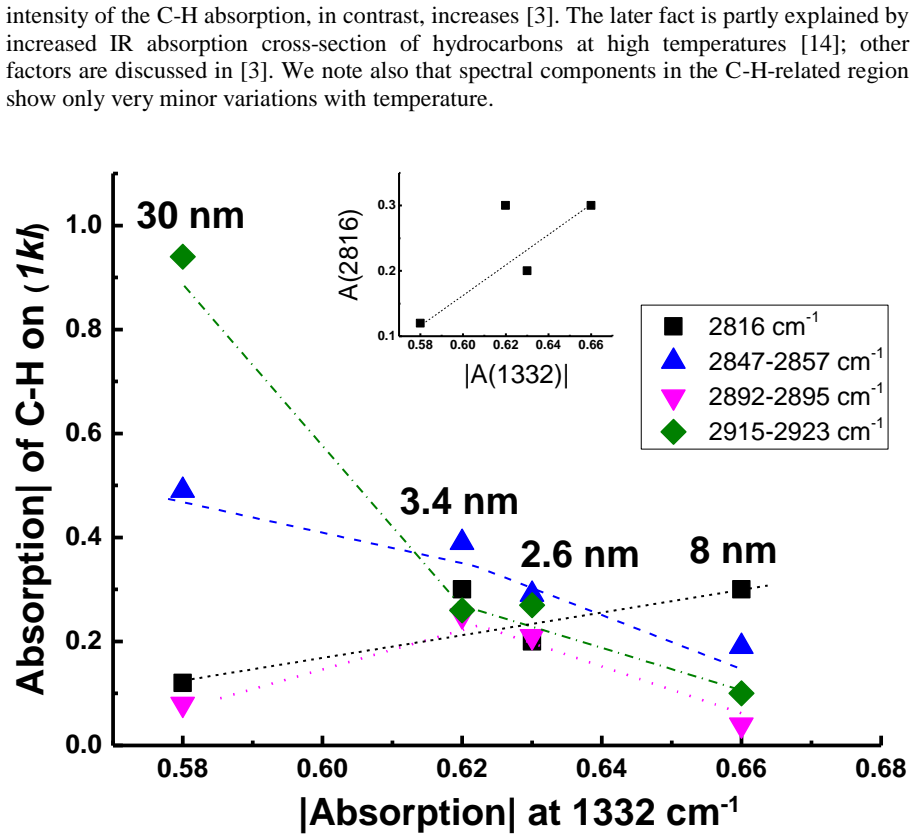
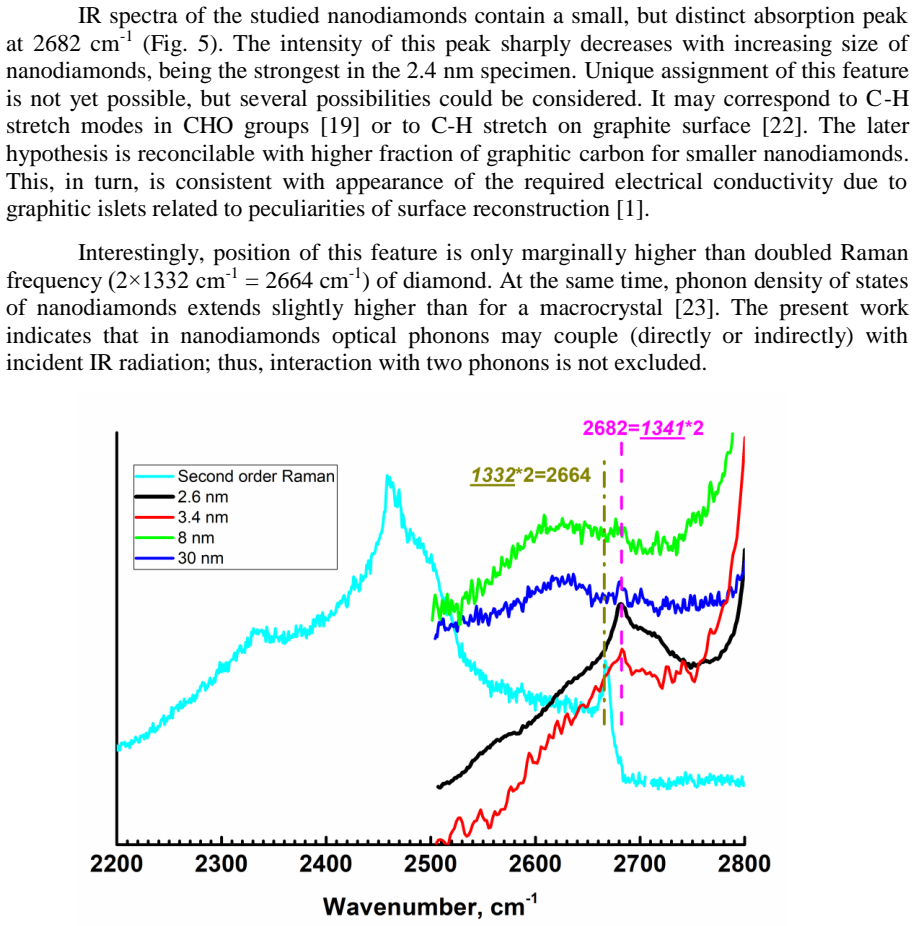
Detailed analysis of IR spectra of nanodiamonds of different sizes (2.6-30 nm) possessing the transmission window shows that the C-H stretch vibrations of adsorbed functional groups cannot be responsible for the Fano resonance. At the same time, it is suggested that a bending mode of monohydride termination on nanodiamond (111) face may couple with diamond optical phonon, explaining the Fano resonance in some cases. The relative importance of the monohydride contribution and of the graphitic islets to the appearance of the transmission window and conductivity is likely dependent on dominating morphology and size distribution of nanodiamond grains.
What carries the argument
Coupling of the bending vibration mode of monohydride termination on the (111) nanodiamond face with the diamond optical phonon, enabling photon interaction with continuum states to produce the observed Fano resonance and transmission window.
If this is right
- Surface C-H stretch vibrations of adsorbed groups do not drive the resonance or associated conductivity.
- Monohydride terminations specifically on (111) faces can account for the Fano resonance when those faces predominate.
- Graphitic islets on the surface compete with the monohydride mechanism depending on particle shape.
- The strength and presence of the transmission window vary systematically with nanodiamond size and morphology.
Where Pith is reading between the lines
- Engineering nanodiamond surfaces to favor monohydride coverage on (111) facets could allow deliberate tuning of their infrared transmission and conductivity.
- Analogous bending-mode couplings to optical phonons may occur in other faceted nanoparticles and warrant targeted checks.
- Facet-selective spectroscopy on individual grains would provide a direct test of the proposed monohydride contribution.
Load-bearing premise
The transmission window is a genuine Fano resonance from photon coupling to continuum states, and size and morphology differences in the samples can isolate the contribution of particular surface terminations without major interference from other reconstructions or impurities.
What would settle it
IR spectra recorded on nanodiamond samples with controlled (111)-facet dominance and verified monohydride termination, compared against samples lacking such terminations, would show whether the transmission window appears or disappears as predicted.
Figures



read the original abstract
Hydrogenated nanodiamonds may show a "transmission window" in infra-red spectra in the vicinity of diamond Raman frequency. This phenomenon is a manifestation of resonance coupling of incident photons with continuum states (Fano resonance). Hpwever, precise mechanism of appearence of the resonance and of related conductivity - surface hydrogenation or specific type of surface reconstruction - remains debatable. We present detailed analysis of infra-red spectra of nanodiamonds of different sizes (2.6-30 nm) possessing the "transmission window" and show that the C-H stretch vibrations of adsorbed functional groups cannot be responsible the the Fano resonance. At the same time, it is suggested that a bending mode of monohydride termination on nanodiamond (111) face may couple with diamond optical phonon, explaining the Fano resonance in some cases. The relative importance of the monohydride contribution and of the graphitic islets to the appearence of the "transmission window" and conductivity is likely dependent on dominating morphology and size distribution of nanodiamond grains.
Editorial analysis
A structured set of objections, weighed in public.
Referee Report
Summary. The manuscript analyzes infrared spectra of hydrogenated nanodiamonds (sizes 2.6–30 nm) exhibiting a transmission window near the diamond optical phonon frequency (~1332 cm⁻¹), interpreted as a Fano resonance arising from photon coupling to continuum states. The authors rule out C-H stretch vibrations of adsorbed functional groups as the origin based on size-dependent spectral comparisons and propose that a bending mode of monohydride termination on the (111) face may couple to the phonon continuum to produce the feature in some cases, with relative importance of this mode versus graphitic islets depending on morphology and size distribution.
Significance. If substantiated, the work would help resolve debates on the microscopic origin of Fano resonances and associated conductivity in hydrogenated nanodiamonds by linking specific surface terminations to the observed spectral feature. This could inform surface engineering for nanodiamond applications in electronics and sensing, while highlighting how particle size and facet distribution modulate vibrational coupling.
major comments (1)
- The load-bearing claim that size and implied morphology variations (2.6–30 nm) cleanly isolate the contribution of the (111) monohydride bending mode—while holding constant or independently quantifying other surface states such as graphitic islets, reconstructions, or impurities—is not supported by quantitative surface analysis or controls. Without such data, the observed correlation between window presence and particle size cannot be uniquely attributed to the proposed bending mode (see skeptic concern on confounding factors).
minor comments (2)
- Abstract: Multiple typos and grammatical issues ('Hpwever' → 'However'; 'responsible the the Fano' → 'responsible for the Fano'; 'appearence' → 'appearance', twice) detract from clarity.
- Abstract: The statement that 'detailed analysis' rules out C-H stretches would benefit from explicit reference to the specific spectral features or quantitative metrics (e.g., intensity ratios or peak positions) used in the comparison across sizes.
Simulated Author's Rebuttal
We thank the referee for the constructive and detailed review of our manuscript. We address the major comment point by point below, providing the strongest honest defense of our analysis while acknowledging its limitations.
read point-by-point responses
-
Referee: The load-bearing claim that size and implied morphology variations (2.6–30 nm) cleanly isolate the contribution of the (111) monohydride bending mode—while holding constant or independently quantifying other surface states such as graphitic islets, reconstructions, or impurities—is not supported by quantitative surface analysis or controls. Without such data, the observed correlation between window presence and particle size cannot be uniquely attributed to the proposed bending mode (see skeptic concern on confounding factors).
Authors: We do not claim that particle size variations alone provide a clean, quantitative isolation of the (111) monohydride bending mode while holding all other surface states constant. Our central result is the exclusion of C-H stretch vibrations from adsorbed functional groups as the origin of the transmission window, based on direct spectral comparisons across the 2.6–30 nm range that show no matching intensity or position trends. The suggestion that monohydride bending on (111) faces can couple to the optical phonon continuum is offered as a plausible mechanism consistent with known vibrational frequencies and the observed Fano lineshape in smaller particles, which literature indicates possess higher (111) facet fractions. We agree that independent quantification of graphitic islets, reconstructions, or impurities (e.g., via XPS or detailed Raman deconvolution) is absent and would strengthen attribution. In the revised manuscript we will add an explicit limitations paragraph discussing potential confounding factors, the correlative nature of the size-dependent evidence, and the morphology-dependent balance between monohydride and graphitic contributions, without overstating uniqueness. revision: partial
Circularity Check
No significant circularity; experimental spectral comparisons stand independently
full rationale
The paper's central claims rest on direct experimental comparison of IR spectra across nanodiamond samples of sizes 2.6–30 nm that exhibit or lack the transmission window. It rules out C-H stretch modes of adsorbed groups by observing that the window persists or varies independently of those modes, then proposes a possible coupling of (111) monohydride bending vibration to the optical phonon continuum. No equations, fitted parameters, or self-citations are invoked to derive the attribution; the reasoning is observational and does not reduce any prediction to its own inputs by construction. The derivation chain is therefore self-contained against external spectral data.
Axiom & Free-Parameter Ledger
axioms (1)
- domain assumption The observed transmission window is a manifestation of Fano resonance arising from resonance coupling of incident photons with continuum states.
Reference graph
Works this paper leans on
-
[1]
Ekimov, A.A
E. Ekimov, A.A. Shiryaev, Y. Grigoriev, A. Averin, E. Shagieva, S. Stehlik and M. Kondrin. Size -Dependent Thermal Stability and Optical Properties of Ultra -Small Nanodiamonds Synthesized under High Pressure, Nanomaterials (2022), 12(3), 351, https://www.mdpi.com/2079-4991/12/3/351/pdf
2022
-
[2]
O.S. Kudryavtsev, R.H. Bagramov, A.M. Satanin, A.A. Shiryaev, O.I. Lebedev, A.M. Romshin, D.G. Pasternak, A.V. Nikolaev, V.P. Filonenko, and I.I. Vlasov. Fano -type Effect in Hydrogen -Terminated Pure Nanodiamond, Nano Letters (2022), 22, 2589−2594 , https://doi.org/10.1021/acs.nanolett.1c04887
-
[3]
A. A. Shiryaev, E. A. Ekimov, V. Yu. Prokof’ev, and M. V. Kondrin. Temperature Dependence of the Fano Resonance in Nanodiamonds Syn thesized at High Static Pressures, JETP Letters (2022), 115(11), 651–656
2022
-
[4]
Ekimov, S
E. Ekimov, S. Lyapin, Y. Grigoriev, I. Zibrov, K. Kondrina. Size-controllable synthesis of ultrasmall diamonds from halogenated adamantanes at high static pressure. Carbon (2019), 150, 436–438
2019
-
[5]
J. W. Ager III, W. Walukiewicz, M. McCluskey, M. A. Plano, M. I. Landstrass. Fano interference of the Raman phonon in heavily boron -doped diamond films grown by chemical vapor deposition. Applied Physics Letters (1995), 66, 616; doi: 10.1063/1.114031
-
[6]
Ekimov, A.A
E.A. Ekimov, A.A. Shiryaev, T.B. Shatalova, K.I. Maslakov, S.G. Lyapin, K.M. Kondrina, Y.V. Grigoriev, S. Stehlik, M.V. Kondrin. Thermal stability and oxidation resistance of single -digit boron -doped nanodiamonds, Materials Research Bull etin (2025), 192, 113604
2025
-
[7]
H. Y. Fan. Effects of Free Carriers on the Optical Properties. Semiconductors and semimetals (1967), 3, 405-419
1967
-
[8]
Osswald, V
S. Osswald, V. N. Mochalin, M. Havel, G. Yushin, Y. Gogotsi. Phonon confinement effects in the Raman spectrum of nanodiamond. Physical review B (2009), 80, 075419
2009
-
[9]
M. Wojdyr. Fityk: a general -purpose peak fitting program. J. Appl. Cryst. (2010) 43, 1126-1128
2010
-
[10]
Chang, J
H.-C. Chang, J. -C. Lin; J. -Y. Wu, K. -H. Chen. Infrared Spectroscopy and Vibrational Relaxation of CH, and CD, Stretches on Synthetic Diamond Nanocrystal Surfaces, J. Phys. Chem. (1995), 99, 11081-11088
1995
-
[11]
C. -L. Cheng, J. -C. Lin, and H. -C. Chang . The absolute absorption strength and vibrational coupling of CH stretching on diamond C(111), The Journa l of Chemical Physics (1997), 106, 7411; doi: 10.1063/1.473701
-
[12]
J.-C. Lin, K. -H. Chen, H. -C. Chang, C. -S. Tsai, C. -E. Lin, and J. -K. Wang . The vibrational dephasing and relaxation of CH and CD stretches on diamond surfaces: An anomaly, J. Chem. Phys. (1996), 105, 3975
1996
-
[13]
S.-Y. Sheu, I. -P. Lee, Y. T. Lee, and H. -C. Chang . Laboratory investigation of hydrogenated diamond surfaces: implications for the formation and size of interstellar nanodiamonds, The Astrophysical Journal (2002), 581, L55–L58
2002
-
[14]
A. E. Klingbeil, J. B. Jeffries, R. K. Hanson . Temperature-dependent mid-IR absorption spectra of gaseous hydrocarbons. Journal of Quantitative Spectroscopy & Radiative Transfer (2007), 107 407–420,
2007
-
[15]
Maier, M
F. Maier, M. Riedel, B. Mantel, J. Ristein, L. Ley. Origin of surface conductivity in diamond. Phys. Rev. Lett. (2000), 85, 3472−3475
2000
-
[16]
Bolker, C
A. Bolker, C. Saguy, R. Kalish. Transfer doping of single isolated nanodiamonds, studied by scanning probe microscopy techniques. Nanotechnology (2014), 25, 385702
2014
-
[17]
J. L. Birman . Theory of Crystal Space Groups and Infra -Red and R aman Lattice Processes of Insulating Crystals. In : Theory of Crystal Space Groups and Lattice Dynamics, 1–521. Berlin, Heidelberg: Springer. (1974) https://doi.org/10.1007/978-3-642-69707-4_1
-
[18]
Brand, G
J.C.D. Brand, G. Eglington. Applications of spectroscopy to organic che mistry. Oldbourne press, London (1965)
1965
-
[19]
Brown, A.J
D.W. Brown, A.J. Floyd, M. Sainsbury. Organic spectroscopy. Wiley. (1988)
1988
-
[20]
J.-S. Tu, E. Perevedentseva, P. -H. Chung, and C. -L. Cheng. Size-dependent surface CO stretching frequency investigations on nanodiamond particles, J. Chem. Phys. (2006), 125, 174713; doi: 10.1063/1.2370880
-
[21]
R. P. Chin, J. Y. Huang, and Y. R. Shen, T. J. Chuang, H. Seki . Interaction of atomic hydrogen with the diamond C(111)surface studied by infrared -visible sum -frequency- generation spectroscopy. Physical Review B (1995), 52(8), 5985-5995
1995
-
[22]
A. Allouche, Y. Ferro, T. Angot, C. Thomas, J. -M. Layet . Hydrogen adsorption on graphite (0001) surface: A combined s pectroscopy–density-functional-theory study. J. Chem. Phys. (2005), 123, 124701; doi: 10.1063/1.2043008
-
[23]
A.A. Shiryaev, V.B. Polyakov, S. Rols, A. Rivera, O.A. Shenderova. Inelastic neutron scattering: A novel approach towards determination of equilib rium isotopic fractionation factors. Size effects on heat capacity and beta -factor of diamond , Physical Chemistry Chemical Physics (2020), 22, 13261 – 13270, DOI: 10.1039/D0CP02032J
discussion (0)
Sign in with ORCID, Apple, or X to comment. Anyone can read and Pith papers without signing in.