Recognition: unknown
The strange and flavor-singlet axial form factors of the nucleon from lattice QCD
Pith reviewed 2026-05-08 03:20 UTC · model grok-4.3
The pith
Lattice QCD yields the singlet and strange axial form factors of the nucleon with controlled uncertainties.
A machine-rendered reading of the paper's core claim, the machinery that carries it, and where it could break.
Core claim
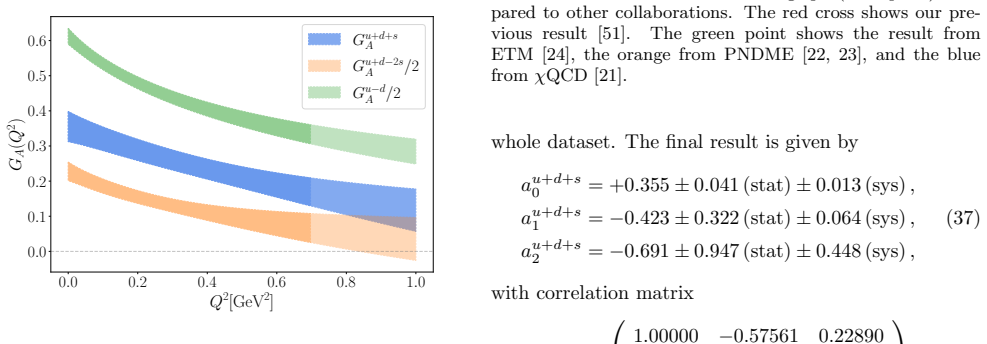
We present a lattice QCD determination of the singlet axial form factor G_A^{u+d+s}(Q^2) and the strange contribution G_A^s(Q^2) using N_f=2+1 CLS gauge ensembles with O(a)-improved Wilson fermions, including a full error budget for the extrapolation to the chiral, continuum and infinite-volume limits. Particular focus is placed on the treatment of the disconnected contributions, which constitute the crucial element for the extraction of the strange component.
What carries the argument
Lattice QCD simulations on CLS ensembles of O(a)-improved Wilson fermions, with explicit computation of disconnected quark-loop diagrams to isolate the strange axial form factor.
If this is right
- The results supply the missing flavor-singlet piece needed for a complete lattice decomposition of the nucleon spin.
- Combined with the isovector and octet axial form factors they give the full set of axial matrix elements across quark flavors.
- The numbers provide direct input for modeling axial currents in neutrino-nucleon scattering and related processes.
- The controlled error budget allows quantitative tests of whether strange quarks contribute appreciably to the proton spin.
Where Pith is reading between the lines
- If the strange form factor remains small at low Q^2, models that attribute a sizable fraction of the spin puzzle to strange quarks would need revision.
- The same disconnected-diagram techniques can be reused for other singlet operators such as the gluonic spin contribution.
- Future finer lattices or different fermion actions could test whether the present extrapolation assumptions hold.
Load-bearing premise
The disconnected strange-quark contributions are evaluated with enough precision that residual systematics after extrapolation remain smaller than the quoted errors.
What would settle it
A statistically significant mismatch between the extrapolated G_A^s(0) and the value obtained from polarized deep-inelastic scattering data would indicate that the lattice treatment of disconnected diagrams or the extrapolations are incomplete.
Figures

read the original abstract
The singlet axial form factor of the nucleon provides essential input for a complete understanding of the nucleon axial structure. Together with the isovector and isoscalar octet channels, in the forward limit it forms the basis for a full flavor decomposition of the proton spin. In this work we present a lattice QCD determination of the singlet axial form factor $G^{u+d+s}_A(Q^2)$ and related strange contribution $G^{s}_A(Q^2)$ using a set of $N_f = 2 + 1$ CLS gauge ensembles with $O(a)$-improved Wilson fermions, with a full error budget for the extrapolation to the chiral, continuum and infinite-volume limits. Particular focus is placed on the treatment of the disconnected contributions, which constitute the crucial element for the extraction of the strange component. Together with determinations of the isovector and isoscalar octet axial form factors, this work provides a comprehensive lattice QCD determination of the nucleon axial structure across different flavor channels.
Editorial analysis
A structured set of objections, weighed in public.
Referee Report
Summary. The manuscript presents a lattice QCD determination of the flavor-singlet axial form factor G_A^{u+d+s}(Q^2) and the strange-quark contribution G_A^s(Q^2) on N_f=2+1 CLS ensembles with O(a)-improved Wilson fermions. It emphasizes the treatment of disconnected diagrams and asserts a complete error budget for simultaneous chiral, continuum, and infinite-volume extrapolations, providing these results together with isovector and isoscalar-octet channels to complete a flavor decomposition of the nucleon axial structure.
Significance. If the error budget holds, the work supplies valuable non-perturbative input for the nucleon spin decomposition and strange-quark contributions to axial charges, serving as a benchmark for phenomenology and other lattice calculations. The use of multiple CLS ensembles and explicit focus on disconnected contributions are positive features.
major comments (2)
- Abstract: the assertion of a 'full error budget' for the chiral/continuum/volume extrapolation is load-bearing for the central claim, yet no quantitative breakdown is supplied for the size of residual uncertainties from the stochastic estimation of disconnected loops or from the choice of extrapolation ansatz. This directly affects the reliability of G_A^s(Q^2) and the singlet combination.
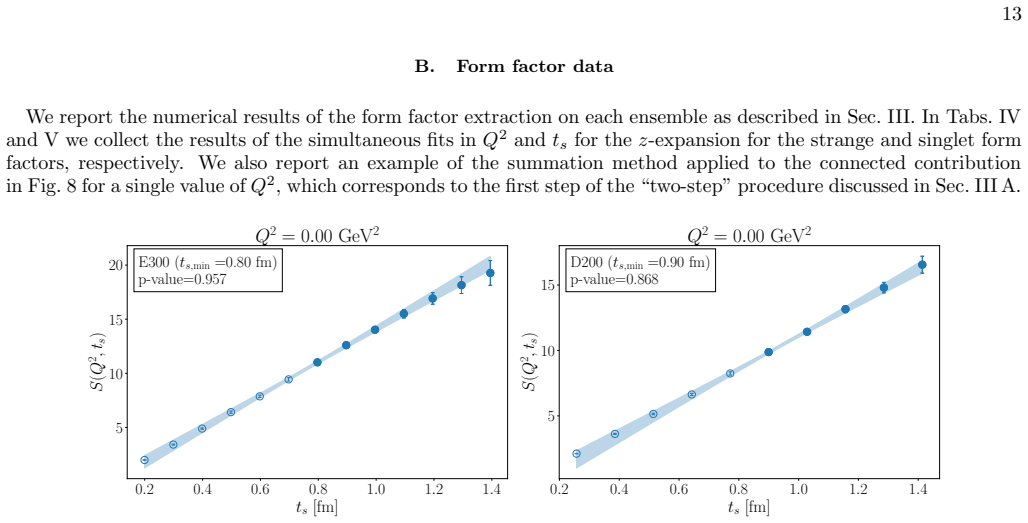
- Disconnected-diagram analysis: the manuscript must demonstrate explicitly (e.g., via variance reduction factors, plateau stability, or comparison of different stochastic estimators) that the disconnected signals remain statistics-limited rather than method-limited on every ensemble used; otherwise the quoted total errors on the strange form factor cannot be taken at face value.
minor comments (2)
- Notation for the various flavor combinations (isovector, octet, singlet) should be introduced once in a dedicated table or equation block and used consistently thereafter.
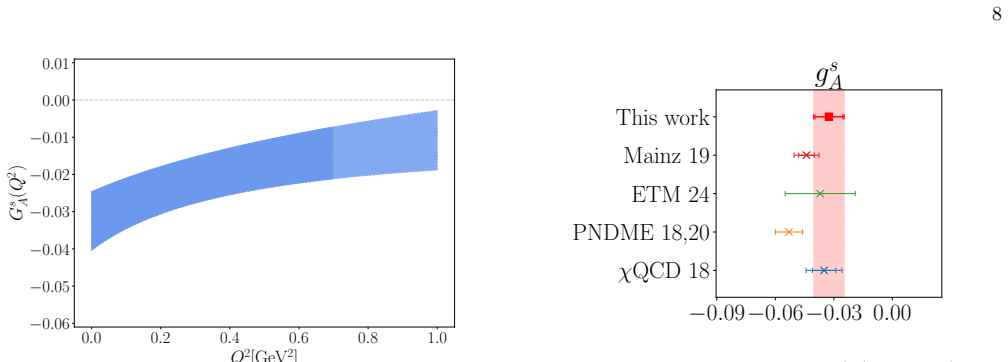
- The figures displaying the Q^2 dependence and the extrapolation fits would benefit from explicit indication of the physical-point result and its total uncertainty band.
Simulated Author's Rebuttal
We thank the referee for their positive evaluation of our work and for the constructive major comments. We address each point below and will incorporate the suggested improvements into the revised manuscript.
read point-by-point responses
-
Referee: Abstract: the assertion of a 'full error budget' for the chiral/continuum/volume extrapolation is load-bearing for the central claim, yet no quantitative breakdown is supplied for the size of residual uncertainties from the stochastic estimation of disconnected loops or from the choice of extrapolation ansatz. This directly affects the reliability of G_A^s(Q^2) and the singlet combination.
Authors: We agree that an explicit quantitative breakdown of the individual uncertainty components would strengthen the presentation of the full error budget. While the manuscript already includes a systematic study of extrapolation ansatz variations and estimates of stochastic noise in the disconnected contributions (detailed in the extrapolation and error analysis sections), we will add a dedicated table and accompanying text in the revised version that decomposes the total errors into statistical, stochastic-estimator, and ansatz-related contributions for both G_A^{u+d+s}(Q^2) and G_A^s(Q^2). We will also revise the abstract to reference this breakdown more precisely. revision: yes
-
Referee: Disconnected-diagram analysis: the manuscript must demonstrate explicitly (e.g., via variance reduction factors, plateau stability, or comparison of different stochastic estimators) that the disconnected signals remain statistics-limited rather than method-limited on every ensemble used; otherwise the quoted total errors on the strange form factor cannot be taken at face value.
Authors: We accept this request for more explicit validation. In the revised manuscript we will augment the disconnected-diagram section with additional figures and tables showing (i) variance reduction factors obtained from the stochastic estimator techniques employed, (ii) plateau stability under variations in fit range and starting time slice, and (iii) direct comparisons of results using different numbers of stochastic sources on representative ensembles. These additions will confirm that the quoted errors remain statistics-dominated on all ensembles used for the strange form factor. revision: yes
Circularity Check
No circularity: direct numerical lattice QCD computation
full rationale
The paper performs a standard lattice QCD calculation of axial form factors on external CLS gauge ensembles using O(a)-improved Wilson fermions. The central results for G^{u+d+s}_A(Q^2) and G^s_A(Q^2) are obtained via stochastic estimation of disconnected diagrams followed by simultaneous chiral/continuum/infinite-volume extrapolation with an explicit error budget. No load-bearing step reduces by construction to a fitted parameter renamed as a prediction, no self-definitional equations appear, and no uniqueness theorem or ansatz is smuggled via self-citation. The derivation chain consists of independent numerical measurements and standard extrapolations that remain falsifiable against external benchmarks.
Axiom & Free-Parameter Ledger
free parameters (2)
- lattice spacing a
- pion mass m_pi
axioms (2)
- standard math Locality and unitarity of the lattice action
- domain assumption Validity of chiral, continuum, and infinite-volume extrapolations
Reference graph
Works this paper leans on
- [1]
- [2]
-
[3]
C. A. Aidala, S. D. Bass, D. Hasch, and G. K. Mallot, Rev. Mod. Phys.85, 655 (2013), arXiv:1209.2803 [hep- ph]
work page Pith review arXiv 2013
-
[4]
Acciarriet al.(DUNE Collaboration), arXiv:1512.06148
R. Acciarriet al.(DUNE), arXiv:1512.06148 [physics.ins- det] (2015)
-
[5]
K. Abeet al.(Hyper-Kamiokande), Hyper-Kamiokande Design Report (2018), arXiv:1805.04163 [physics.ins- det]
-
[6]
D. Beckeret al., Eur. Phys. J. A54, 208 (2018), arXiv:1802.04759 [nucl-ex]
-
[7]
Papavassiliou, AIP Conf
V. Papavassiliou, AIP Conf. Proc.1222, 186 (2010)
2010
- [8]
-
[9]
K. S. Kim, K.-S. Choi, M.-K. Cheoun, W. Y. So, and H. Moon, Phys. Rev. C100, 034604 (2019)
2019
- [10]
- [11]
-
[12]
C. Alexandrouet al., Phys. Rev. D103, 034509 (2021), arXiv:2011.13342 [hep-lat]
-
[13]
R. Gupta, Y.-C. Jang, H.-W. Lin, B. Yoon, and T. Bhattacharya, Phys. Rev. D96, 114503 (2017), arXiv:1705.06834 [hep-lat]
-
[14]
D. Djukanovic, G. von Hippel, J. Koponen, H. B. Meyer, K. Ottnad, T. Schulz, and H. Wittig, Phys. Rev. D106, 074503 (2022), arXiv:2207.03440 [hep-lat]
- [15]
-
[16]
O. Tomalak, R. Gupta, and T. Bhattacharya, Phys. Rev. D108, 074514 (2023), arXiv:2307.14920 [hep-lat]
- [17]
- [18]
-
[19]
Up, down, and strange nucleon axial form factors from lattice QCD,
J. Green, N. Hasan, S. Meinel, M. Engelhardt, S. Krieg, 10 J. Laeuchli, J. Negele, K. Orginos, A. Pochinsky, and S. Syritsyn, Phys. Rev. D95, 114502 (2017), arXiv:1703.06703 [hep-lat]
-
[20]
C. Alexandrou, S. Bacchio, M. Constantinou, K. Had- jiyiannakou, K. Jansen, and G. Koutsou, Phys. Rev. D 104, 074503 (2021), arXiv:2106.13468 [hep-lat]
-
[21]
J. Liang, Y.-B. Yang, T. Draper, M. Gong, and K.-F. Liu, Phys. Rev. D98, 074505 (2018), arXiv:1806.08366 [hep-ph]
- [22]
- [23]
-
[24]
C. Alexandrou, S. Bacchio, J. Finkenrath, C. Iona, G. Koutsou, Y. Li, and G. Spanoudes, Phys. Rev. D111, 054505 (2025), arXiv:2412.01535 [hep-lat]
- [25]
- [26]
-
[27]
M. Brunoet al., JHEP02, 043, arXiv:1411.3982 [hep- lat]
-
[28]
Sheikholeslami and R
B. Sheikholeslami and R. Wohlert, Nucl. Phys. B259, 572 (1985)
1985
-
[29]
Luscher and P
M. Luscher and P. Weisz, Commun. Math. Phys.98, 433 (1985), [Erratum: Commun.Math.Phys. 98, 433 (1985)]
1985
-
[30]
D. Mohler and S. Schaefer, Phys. Rev. D102, 074506 (2020), arXiv:2003.13359 [hep-lat]
-
[31]
S. Kuberski, Comput. Phys. Commun.300, 109173 (2024), arXiv:2306.02385 [hep-lat]
-
[32]
Strassbergeret al., PoSLA TTICE2021, 135 (2022), arXiv:2112.06696 [hep-lat]
B. Strassbergeret al., PoSLA TTICE2021, 135 (2022), arXiv:2112.06696 [hep-lat]
- [33]
-
[34]
Gusken, U
S. Gusken, U. Low, K. H. Mutter, R. Sommer, A. Patel, and K. Schilling, Phys. Lett. B227, 266 (1989)
1989
-
[35]
Albaneseet al.(APE), Phys
M. Albaneseet al.(APE), Phys. Lett. B192, 163 (1987)
1987
-
[36]
A. Agadjanov, D. Djukanovic, G. von Hippel, H. B. Meyer, K. Ottnad, and H. Wittig, Phys. Rev. Lett.131, 261902 (2023), arXiv:2303.08741 [hep-lat]
- [37]
- [38]
- [39]
-
[40]
M. Dalla Brida, T. Korzec, S. Sint, and P. Vilaseca, Eur. Phys. J. C79, 23 (2019), arXiv:1808.09236 [hep-lat]
- [41]
-
[42]
T. Bhattacharya, R. Gupta, W. Lee, S. R. Sharpe, and J. M. S. Wu, Phys. Rev. D73, 034504 (2006), arXiv:hep- lat/0511014
-
[43]
Maiani, G
L. Maiani, G. Martinelli, M. L. Paciello, and B. Taglienti, Nucl. Phys. B293, 420 (1987)
1987
-
[44]
S. Capitani, M. Della Morte, G. von Hippel, B. Jager, A. Juttner, B. Knippschild, H. B. Meyer, and H. Wittig, Phys. Rev. D86, 074502 (2012), arXiv:1205.0180 [hep- lat]
-
[45]
D. Djukanovic, G. von Hippel, H. B. Meyer, K. Ottnad, M. Salg, and H. Wittig, Phys. Rev. D109, 094510 (2024), arXiv:2309.06590 [hep-lat]
- [46]
- [47]
- [48]
-
[49]
Akaike, IEEE Transactions on Automatic Control19, 716 (1974)
H. Akaike, IEEE Transactions on Automatic Control19, 716 (1974)
1974
-
[50]
Aokiet al.(Flavour Lattice Averaging Group (FLAG)), FLAG review 2024, Phys
Y. Aokiet al.(Flavour Lattice Averaging Group (FLAG)), Phys. Rev. D113, 014508 (2026), arXiv:2411.04268 [hep-lat]
-
[51]
D. Djukanovic, H. Meyer, K. Ottnad, G. von Hippel, J. Wilhelm, and H. Wittig, PoSLA TTICE2019, 158 (2019), arXiv:1911.01177 [hep-lat]
-
[52]
Ashmanet al.(European Muon), Phys
J. Ashmanet al.(European Muon), Phys. Lett. B206, 364 (1988)
1988
-
[53]
Ashmanet al.(European Muon), Nucl
J. Ashmanet al.(European Muon), Nucl. Phys. B328, 1 (1989)
1989
- [54]
-
[55]
M. Luscher and S. Schaefer, Comput. Phys. Commun. 184, 519 (2013), arXiv:1206.2809 [hep-lat]
-
[56]
D. Djukanovic, Comput. Phys. Commun.247, 106950 (2020), arXiv:1603.01576 [hep-lat]
- [57]
-
[58]
Wilhelm,The strangeness form factors of the nucleon from lattice QCD, Ph.D
J. Wilhelm,The strangeness form factors of the nucleon from lattice QCD, Ph.D. thesis, Johannes Gutenberg Uni- versity Mainz (2020)
2020
-
[59]
G. Martinelli, C. Pittori, C. T. Sachrajda, M. Testa, and A. Vladikas, Nucl. Phys. B445, 81 (1995), arXiv:hep- lat/9411010
-
[60]
M. Gockeler, R. Horsley, H. Oelrich, H. Perlt, D. Petters, P. E. L. Rakow, A. Schafer, G. Schierholz, and A. Schiller, Nucl. Phys. B544, 699 (1999), arXiv:hep-lat/9807044
-
[61]
S. J. Brodsky, G. P. Lepage, and P. B. Mackenzie, Phys. Rev. D28, 228 (1983)
1983
- [62]
- [63]
-
[64]
S. A. Larin and J. A. M. Vermaseren, Phys. Lett. B303, 334 (1993), arXiv:hep-ph/9302208
work page Pith review arXiv 1993
-
[65]
two-step
M. Dalla Brida, R. H¨ ollwieser, F. Knechtli, T. Korzec, A. Ramos, S. Sint, and R. Sommer, Nature652, 328 (2026). 11 APPENDIX A. Renormalization Our calculation of the renormalization factors is de- scribed in detail in Ref. [57]; here we summarize the per- tinent formulae and concentrate on the results for the singlet case, for which we follow the prelim...
2026
discussion (0)
Sign in with ORCID, Apple, or X to comment. Anyone can read and Pith papers without signing in.