Recognition: unknown
Probing unknown nonperturbative effects in b to s ellell with inclusive and exclusive observables
Pith reviewed 2026-05-08 08:19 UTC · model grok-4.3
The pith
Ratios of exclusive to inclusive b to s lepton-pair decays distinguish new physics from constant hadronic effects.
A machine-rendered reading of the paper's core claim, the machinery that carries it, and where it could break.
Core claim
Non-perturbative contributions associated with c c-bar loops affect inclusive B to X_s ell ell and exclusive B to K(*) ell ell modes differently. In inclusive decays factorizable pieces are fixed by e+ e- to hadrons data and non-factorizable pieces are described by resolved-photon or local power corrections, whereas in exclusive decays hypothetical charming-penguin effects beyond current estimates can manifest as a constant universal contribution. Ratios built from exclusive over inclusive branching fractions therefore respond differently to new physics versus such a constant shift, and can be extracted at LHCb without reference to J/psi K(*) modes. A preliminary comparison with existing LHC
What carries the argument
Ratios of exclusive B to K(*) ell ell to inclusive B to X_s ell ell branching fractions in selected q2 bins, which respond differently to a constant hadronic shift than to new-physics Wilson-coefficient shifts.
If this is right
- LHCb can extract the ratios directly from its own data without B-factory normalization.
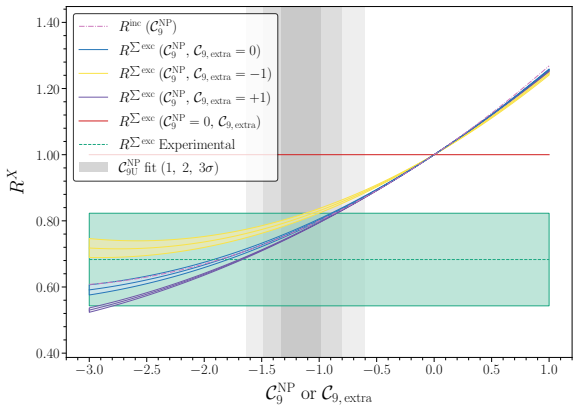
- Current data show a mild preference for the new-physics pattern over a constant hadronic shift.
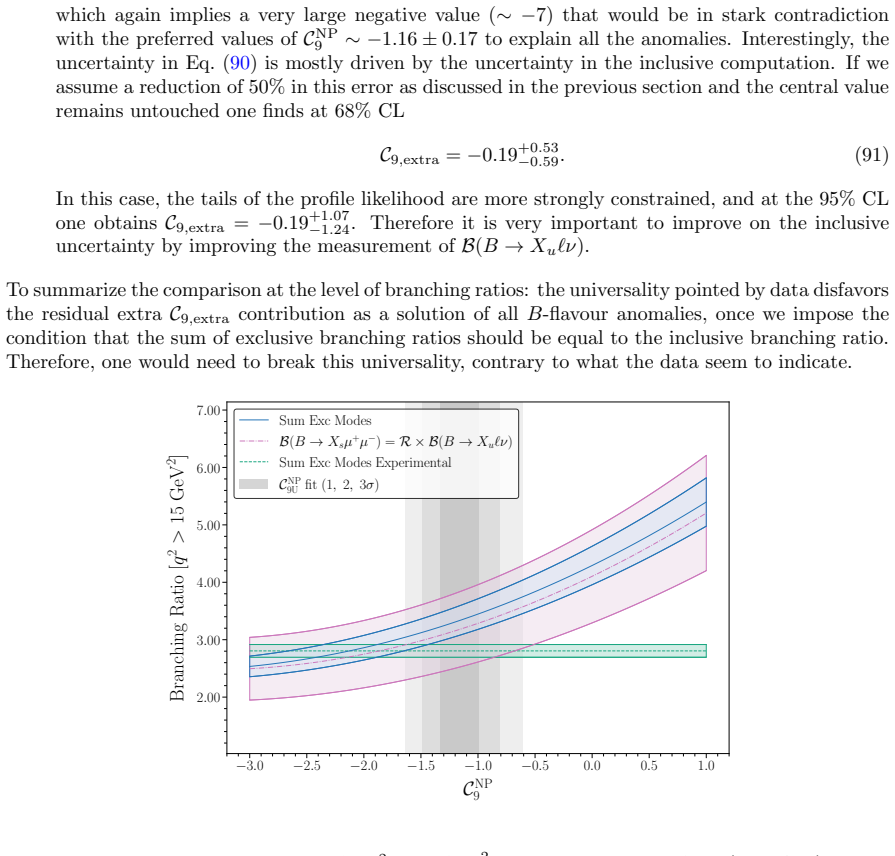
- A sum of exclusive modes versus inclusive measurements at high q2 also disfavors a constant hadronic explanation.
- Projected precision from LHCb and Belle II will sharpen the discrimination.
Where Pith is reading between the lines
- Confirmation would resolve whether the b to s muon anomalies are genuine new physics or an artifact of unaccounted hadronics.
- The method could be extended to other lepton-flavor modes or to angular observables to further constrain the origin of any deviation.
- It highlights the value of combining inclusive and exclusive measurements in future flavor-physics programs.
Load-bearing premise
Any unknown hadronic effects beyond those already included in uncertainty estimates would appear as a constant, universal contribution rather than a kinematics-dependent one.
What would settle it
A measurement of the proposed ratios at the few-percent level that matches the pattern expected for a constant hadronic addition instead of the pattern expected for new-physics shifts in C9 and C10.
Figures


read the original abstract
In this paper we revisit, from a different perspective, a long-standing question: ``Is the systematic deficit observed in all branching ratios mediated by a $b\to s \mu\mu$ transition due to New Physics, or to a hypothetical constant unknown universal hadronic contribution that mimics New Physics?'' The key observation that allows us to distinguish between these two possibilities is that non-perturbative contributions associated with $c\bar c$ loops affect inclusive $B\to X_s \ell\ell$ and exclusive $B\to K^{(*)}\ell\ell$ modes differently. In inclusive decays, factorizable contributions are exactly determined from data on $e^+e^-\to \mathrm{hadrons}$, while non-factorizable corrections are described by resolved-photon contributions at low $q^2$ and by local power corrections at high $q^2$. In exclusive decays, by contrast, hypothetical charming-penguin effects, beyond those already included in current uncertainty estimates, could appear, in a worst-case scenario, as a constant, universal contribution that it seems, in principle, indistinguishable from genuine New Physics. We identify two observables, constructed from ratios of exclusive to inclusive modes, that can discriminate between a New Physics contribution and a constant hadronic contribution. Moreover, these ratios can be measured directly by LHCb, as they do not require any normalisation to $J/\psi K^{(*)}$ branching fractions from B factories. A preliminary evaluation of these observables with present data shows some preference for the New Physics interpretation. In a complementary test, a comparison between inclusive measurements and the corresponding sum of exclusive modes at high $q^2$ similarly disfavours an explanation based on a constant hadronic contribution. Finally, we provide projections for the new observables based on expected LHCb and Belle II measurements in the near future.
Editorial analysis
A structured set of objections, weighed in public.
Referee Report
Summary. The manuscript proposes two observables constructed as ratios of exclusive B→K(*)ℓℓ branching fractions to the inclusive B→Xsℓℓ rate. These ratios are designed to discriminate between New Physics (which rescales Wilson coefficients uniformly across inclusive and exclusive modes) and a hypothetical constant universal hadronic contribution from charming-penguin effects (which would affect only exclusive modes). Inclusive rates are fixed using e⁺e⁻→hadrons data plus resolved-photon and power corrections; exclusive modes may receive an extra constant term. The ratios are normalization-free for direct LHCb measurement, a preliminary data evaluation shows mild preference for the NP hypothesis, a complementary high-q² inclusive-vs-sum-of-exclusives test is presented, and future projections are given.
Significance. If the central distinction holds, the work provides a practical, data-driven method to test the origin of b→sℓℓ deficits without B-factory normalizations, exploiting the different non-perturbative treatments in inclusive versus exclusive decays. Credit is due for the normalization-free construction and the use of established QCD constraints on inclusive modes. This could help resolve whether current anomalies are due to NP or unknown hadronics, with clear implications for future LHCb and Belle II analyses.
major comments (2)
- [§4] §4 (preliminary evaluation): the reported mild preference for the New Physics interpretation relies on a comparison of the proposed ratios to existing data, but the manuscript does not provide a quantitative measure (e.g., Δχ² or p-value) of this preference nor a full breakdown of correlated systematics between inclusive and exclusive inputs; this weakens the strength of the data-driven claim even though the method itself is independent of it.
- [§3.1] §3.1 (definition of the ratios): the assumption that the hypothetical constant hadronic term is strictly q²-independent and universal across K and K* modes is presented as a worst-case scenario, but the paper does not explore how even mild q² dependence or mode-specific variations in charming-penguin contributions would degrade the discriminating power of the ratios; this is load-bearing for the claim that the observables cleanly separate the two hypotheses.
minor comments (3)
- [Introduction] The notation for the two proposed ratios (e.g., R_K and R_{K*}) should be introduced with explicit equations in the introduction or §3 to improve readability before the data comparison.
- Figure 2 (or equivalent projection plot): the error bands on future LHCb/Belle II points should be labeled with the assumed integrated luminosities to allow readers to assess the projected sensitivity.
- [§2] A reference to the specific e⁺e⁻→hadrons data sets used for the inclusive normalization (e.g., the precise references for the charm-loop contributions) is missing in §2.
Simulated Author's Rebuttal
We thank the referee for the careful reading, the positive assessment of the proposed observables, and the recommendation for minor revision. We address each major comment below, indicating revisions where appropriate.
read point-by-point responses
-
Referee: [§4] §4 (preliminary evaluation): the reported mild preference for the New Physics interpretation relies on a comparison of the proposed ratios to existing data, but the manuscript does not provide a quantitative measure (e.g., Δχ² or p-value) of this preference nor a full breakdown of correlated systematics between inclusive and exclusive inputs; this weakens the strength of the data-driven claim even though the method itself is independent of it.
Authors: We agree that the evaluation in §4 is preliminary and that a full quantitative statistical analysis (including Δχ² and a complete covariance matrix) would strengthen the data-driven claim. Such an analysis is limited by the current size of experimental and theoretical uncertainties on both inclusive and exclusive inputs. In the revised manuscript we have added an explicit discussion of the dominant correlated systematics—primarily the inclusive rate normalization from e⁺e⁻ data and shared non-perturbative inputs—and we now state more clearly that the observed preference remains qualitative. We view this as a partial revision that addresses the referee’s concern without overclaiming statistical significance. revision: partial
-
Referee: [§3.1] §3.1 (definition of the ratios): the assumption that the hypothetical constant hadronic term is strictly q²-independent and universal across K and K* modes is presented as a worst-case scenario, but the paper does not explore how even mild q² dependence or mode-specific variations in charming-penguin contributions would degrade the discriminating power of the ratios; this is load-bearing for the claim that the observables cleanly separate the two hypotheses.
Authors: The constant, universal term is presented precisely because it constitutes the worst-case scenario that most closely mimics a uniform New Physics rescaling. Any mild q² dependence in the hadronic contribution would cause the ratios to acquire a non-flat q² dependence, in contrast to the strictly flat prediction from New Physics. Likewise, non-universality between the K and K* modes would produce differing numerical values for the two ratios. Both effects would therefore make the hadronic hypothesis easier to distinguish from New Physics rather than harder. We have added a short clarifying paragraph in §3.1 making this analytic point explicit; no additional numerical scan is required because the argument follows directly from the construction of the observables. revision: no
Circularity Check
No significant circularity; derivation is self-contained
full rationale
The paper constructs two ratios of exclusive to inclusive b→sℓℓ rates as observables. Inclusive rates are fixed by external e⁺e⁻→hadrons data plus resolved-photon and power corrections; the hypothetical constant charming-penguin term is introduced only as a worst-case addition to exclusive modes. Discrimination follows directly from this differential sensitivity without any fitted parameter being renamed as a prediction, without load-bearing self-citations, and without any ansatz or uniqueness theorem imported from prior work by the same authors. The central claim therefore does not reduce to its inputs by construction.
Axiom & Free-Parameter Ledger
axioms (2)
- domain assumption Factorizable contributions in inclusive B to X_s ll decays are exactly determined from data on e+e- to hadrons, with non-factorizable corrections described by resolved-photon contributions at low q^2 and local power corrections at high q^2.
- ad hoc to paper Hypothetical charming-penguin effects in exclusive decays could appear as a constant universal contribution indistinguishable from new physics.
Reference graph
Works this paper leans on
-
[1]
A. Khodjamirian, T. Mannel, A.A. Pivovarov and Y.M. Wang,Charm-loop effect in B→K (∗)ℓ+ℓ− andB→K ∗γ,JHEP09(2010) 089 [1006.4945]
-
[2]
N. Gubernari, A. Kokulu and D. van Dyk,B→PandB→VForm Factors fromB-Meson Light-Cone Sum Rules beyond Leading Twist,JHEP01(2019) 150 [1811.00983]
-
[3]
A. Bharucha, D.M. Straub and R. Zwicky,B→V ℓ +ℓ− in the Standard Model from light-cone sum rules,JHEP08(2016) 098 [1503.05534]
- [4]
-
[5]
M. Ciuchini, M. Fedele, E. Franco, A. Paul, L. Silvestrini and M. Valli,Constraints on lepton universality violation from rare B decays,Phys. Rev. D107(2023) 055036 [2212.10516]
-
[6]
M. Alguer´ o, A. Biswas, B. Capdevila, S. Descotes-Genon, J. Matias and M. Novoa-Brunet,To (b)e or not to (b)e: no electrons at LHCb,Eur. Phys. J. C83(2023) 648 [2304.07330]
- [7]
-
[8]
N. Gubernari, M. Reboud, D. van Dyk and J. Virto,Improved theory predictions and global analysis of exclusiveb→sµ +µ− processes,JHEP09(2022) 133 [2206.03797]
-
[9]
N. Gubernari, M. Reboud, D. van Dyk and J. Virto,Dispersive analysis ofB→K (∗) and Bs →ϕform factors,JHEP12(2023) 153 [2305.06301]
- [10]
-
[11]
S. Descotes-Genon, T. Hurth, J. Matias and J. Virto,Optimizing the basis ofB→K ∗ll observables in the full kinematic range,JHEP05(2013) 137 [1303.5794]. [15]HPQCDcollaboration,Standard Model predictions forB→Kℓ +ℓ−,B→Kℓ − 1 ℓ+ 2 and B→Kν¯νusing form factors from Nf=2+1+1 lattice QCD,Phys. Rev. D107(2023) 014511 [2207.13371]. 21
-
[12]
G. Isidori, Z. Polonsky and A. Tinari,Explicit estimate of charm rescattering in B0→K0ℓ¯ℓ, Phys. Rev. D111(2025) 093007 [2405.17551]
-
[13]
G. Isidori, Z. Polonsky and A. Tinari,Charm rescattering inB 0 →K 0¯ℓℓ: an improved analysis, Eur. Phys. J. C85(2025) 1221 [2507.17824]
-
[14]
H.M. Asatrian, C. Greub and J. Virto,Exact NLO matching and analyticity inb→sℓℓ,JHEP 04(2020) 012 [1912.09099]
-
[15]
M. Beylich, G. Buchalla and T. Feldmann,Theory ofB→K (∗)ℓ+ℓ− decays at highq 2: OPE and quark-hadron duality,Eur. Phys. J. C71(2011) 1635 [1101.5118]
-
[16]
M. Bordone, G. Isidori, S. M¨ achler and A. Tinari,Short- vs. long-distance physics in B→K (∗)ℓ+ℓ−: a data-driven analysis,Eur. Phys. J. C84(2024) 547 [2401.18007]
-
[17]
M. Hoferichter, B. Kubis and S. Mutke,Reconciling hadronic and partonic analyticity inb→sℓℓ transitions,2604.01284
-
[18]
Weak decays beyond leading logarithms,
G. Buchalla, A.J. Buras and M.E. Lautenbacher,Weak Decays beyond Leading Logarithms,Rev. Mod. Phys.68(1996) 1125 [hep-ph/9512380]
-
[19]
Grinstein, R.P
B. Grinstein, R.P. Springer and M.B. Wise,Effective Hamiltonian for Weak Radiative B Meson Decay,Phys. Lett. B202(1988) 138
1988
-
[20]
B. Capdevila, A. Crivellin, S. Descotes-Genon, J. Matias and J. Virto,Patterns of New Physics inb→sℓ +ℓ− transitions in the light of recent data,JHEP01(2018) 093 [1704.05340]
-
[21]
A. Hardmeier, E. Lunghi, D. Pirjol and D. Wyler,Subleading collinear operators and their matrix elements,Nucl. Phys. B682(2004) 150 [hep-ph/0307171]
-
[22]
T. Becher, R.J. Hill and M. Neubert,Soft collinear messengers: A New mode in soft collinear effective theory,Phys. Rev. D69(2004) 054017 [hep-ph/0308122]
-
[23]
S. Descotes-Genon, L. Hofer, J. Matias and J. Virto,Global analysis ofb→sℓℓanomalies, JHEP06(2016) 092 [1510.04239]
-
[24]
M. Alguer´ o, B. Capdevila, A. Crivellin, S. Descotes-Genon, P. Masjuan, J. Matias et al., Emerging patterns of New Physics with and without Lepton Flavour Universal contributions, Eur. Phys. J. C79(2019) 714 [1903.09578]
- [25]
- [26]
-
[27]
N. Gubernari, D. van Dyk and J. Virto,Non-local matrix elements inB (s) → {K (∗), ϕ}ℓ+ℓ−, JHEP02(2021) 088 [2011.09813]
-
[28]
B. Grinstein and D. Pirjol,Exclusive rareB→K ∗ℓ+ℓ− decays at low recoil: Controlling the long-distance effects,Phys. Rev. D70(2004) 114005 [hep-ph/0404250]
-
[29]
F. Kruger and L.M. Sehgal,Lepton polarization in the decaysb→X dµ+µ− andB→X sτ +τ −, Phys. Lett. B380(1996) 199 [hep-ph/9603237]
- [30]
- [31]
- [32]
-
[33]
G. Buchalla, G. Isidori and S.J. Rey,Corrections of orderΛ 2 QCD /m2 c to inclusive rare B decays, Nucl. Phys. B511(1998) 594 [hep-ph/9705253]
- [34]
- [35]
-
[36]
M. Benzke and T. Hurth,Resolved1/m b contributions to ¯B→X s,dℓ+ℓ− and ¯B→X sγ,Phys. Rev. D102(2020) 114024 [2006.00624]
-
[37]
Z. Ligeti and F.J. Tackmann,Precise predictions forB→X sl+l− in the largeq 2 region,Phys. Lett. B653(2007) 404 [0707.1694]
-
[38]
T. Huber, T. Hurth, J. Jenkins, E. Lunghi, Q. Qin and K.K. Vos,Inclusive B→X sℓ+ℓ− at the LHC: theory predictions and new-physics reach,JHEP11(2024) 130 [2404.03517]. [43]Bellecollaboration,Measurement of Differential Branching Fractions of Inclusive B→X u ℓ+ νℓ Decays,Phys. Rev. Lett.127(2021) 261801 [2107.13855]. [44]Particle Data Groupcollaboration,Rev...
-
[39]
F. Bernlochner, M. Jung, M. Khan, G. Landsberg and Z. Ligeti,Novel approaches to determine B±and B0 meson production fractions,Phys. Rev. D110(2024) 014007 [2306.04686]
-
[40]
M. Jung and S. Schacht, ¯B→D (∗)ℓ¯νBranching Ratios and Evidence for Isospin Breaking in Υ(4S)Decays,2604.08391. [48]Bellecollaboration,Measurement of the B+/B0 production ratio in e+e- collisions at the Υ(4S)resonance usingB→J/ψ(ℓℓ)Kdecays at Belle,Phys. Rev. D107(2023) L031102 [2207.01194]
work page internal anchor Pith review Pith/arXiv arXiv 2023
-
[41]
R. Fleischer and T. Mannel,General analysis of new physics inB→J/ψK,Phys. Lett. B506 (2001) 311 [hep-ph/0101276]. [50]LHCbcollaboration,Differential branching fractions and isospin asymmetries of B→K (∗)µ+µ− decays,JHEP06(2014) 133 [1403.8044]. [51]LHCbcollaboration,Measurements of the S-wave fraction inB 0 →K +π−µ+µ− decays and the B0 →K ∗(892)0µ+µ− diff...
-
[42]
A. Broggio, B. Capdevila, A. Ferroglia and P. Gambino,Structure functions for the inclusive semileptonicb-quark decay at NNLO: a semi-analytic calculation,2601.15447
- [43]
- [44]
- [45]
discussion (0)
Sign in with ORCID, Apple, or X to comment. Anyone can read and Pith papers without signing in.