Recognition: unknown
Molecular dynamics simulation study of mechanical properties of 3C-SiC with extended defects
Pith reviewed 2026-05-08 08:32 UTC · model grok-4.3
The pith
Molecular dynamics simulations show extended defects reduce the stiffness of 3C-SiC by up to 6%.
A machine-rendered reading of the paper's core claim, the machinery that carries it, and where it could break.
Core claim
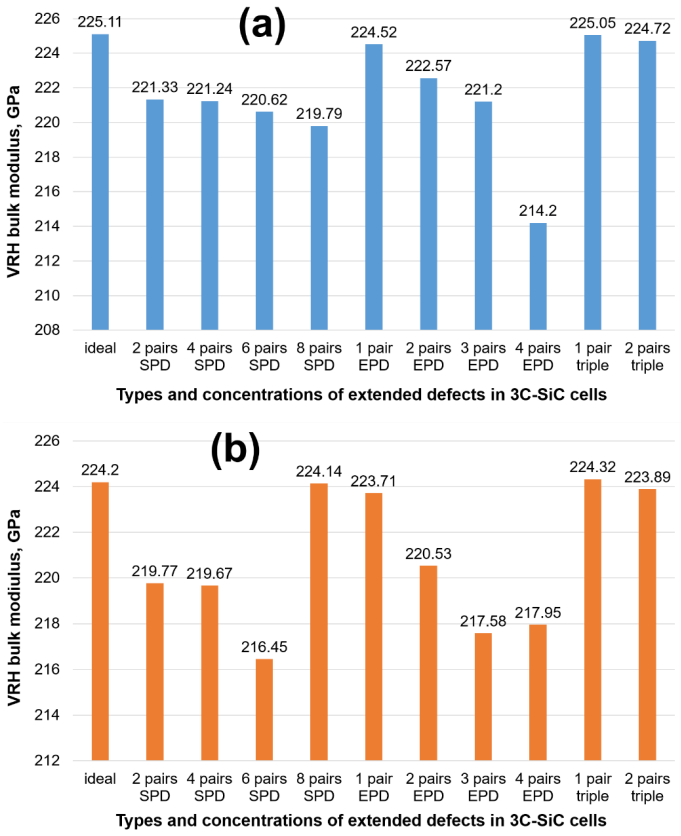
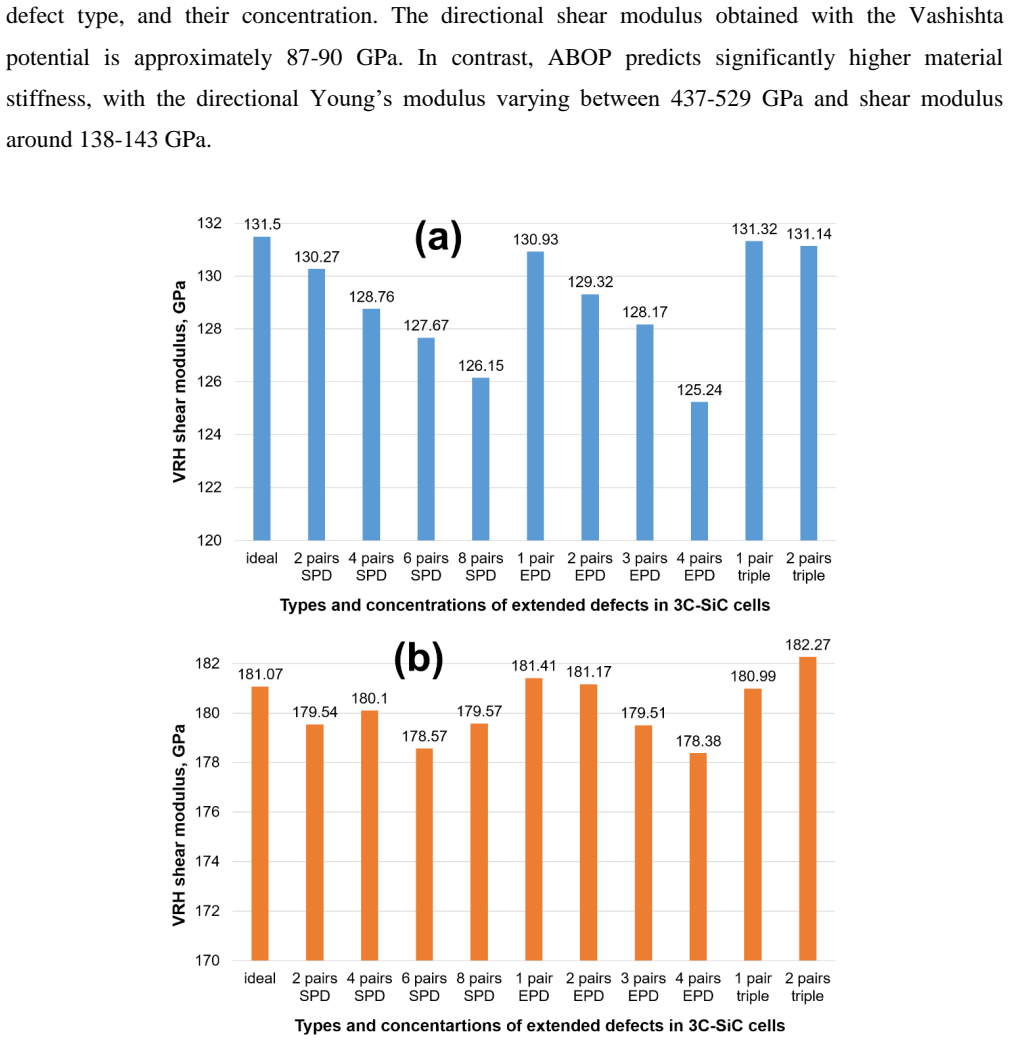
Large-scale molecular dynamics simulations performed with the Vashishta potential and the analytic bond-order potential quantify the effect of increasing densities of Shockley partial dislocations terminating stacking faults and of double and triple dislocation complexes on the elastic stiffness constants C11, C12, and C44 of 3C-SiC. From the altered constants the study computes direction-specific and orientation-averaged bulk, shear, and Young's moduli, establishing a general reduction in material stiffness whose magnitude depends on defect type and reaches up to approximately 6 percent with the Vashishta potential and 4 percent with the ABOP, with triple complexes producing the smallest of
What carries the argument
Molecular dynamics simulations of supercells containing Shockley partial dislocations, stacking faults, and dislocation complexes that compute changes in the elastic stiffness constants C11, C12, and C44 as defect density varies.
Load-bearing premise
The Vashishta and ABOP interatomic potentials accurately reproduce the elastic response of 3C-SiC when these extended defects are present, and the simulated defect concentrations and geometries represent those found in real crystals.
What would settle it
Experimental measurements of the elastic moduli of 3C-SiC samples whose densities of Shockley partial dislocations and dislocation complexes have been independently quantified, showing either no reduction or reductions outside the 4-6 percent range predicted by the simulations.
Figures



read the original abstract
In this study, large-scale molecular dynamics simulations with the Vashishta potential and the analytic bond-order potential (ABOP) were performed to investigate the effect of extended defects on the elastic properties of cubic silicon carbide (3C-SiC). Specifically, we focused on systems containing Shockley partial dislocations terminating stacking faults, along with double and triple dislocation complexes. The changes in the independent elastic stiffness constants C11, C12 and C44 upon varying the mentioned extended defects concentrations were quantified. Using the values of these constants, the effective bulk, shear, and Young's moduli were calculated for different defect types and concentrations. The moduli were calculated along particular crystallographic directions aligned with the mentioned defect configurations as well as evaluated using Voigt-Reuss-Hill averaging to provide overall orientation-independent characterization of the defect-altered lattice. The obtained results reveal a general trend of diminishing the material's stiffness with increasing densities of Shockley partial dislocations and dislocation complexes. Depending on the defect configuration, the average elastic moduli decrease by up to approximately 6 % with the Vashishta potential and up to about 4 % using the analytic bond-order potential. At this, triple dislocation complexes induce smaller perturbations. These findings demonstrate that extended defect networks can measurably modify the elastic response of 3C-SiC and should be considered in further scientific research and practical applications of this material.
Editorial analysis
A structured set of objections, weighed in public.
Referee Report
Summary. The manuscript reports large-scale molecular dynamics simulations of 3C-SiC using the Vashishta potential and the analytic bond-order potential (ABOP). It quantifies the effect of Shockley partial dislocations terminating stacking faults, as well as double and triple dislocation complexes, on the independent elastic constants C11, C12, and C44. Derived bulk, shear, and Young's moduli are computed both along defect-aligned directions and via Voigt-Reuss-Hill averaging. The central result is a systematic softening trend, with average moduli reductions reaching up to ~6% (Vashishta) or ~4% (ABOP) as defect density increases; triple complexes produce smaller perturbations.
Significance. If the potentials accurately capture the long-range strain fields and local bonding changes around extended defects, the work demonstrates that realistic defect networks can produce measurable (few-percent) changes in the elastic response of 3C-SiC. This is relevant for device modeling in high-power electronics where defect densities vary. The use of two independent potentials supplies a limited internal consistency check, though the absence of higher-fidelity benchmarks or experimental anchors limits broader impact.
major comments (3)
- [Methods / Potential selection] The transferability of both the Vashishta and ABOP potentials to configurations containing extended defects is not demonstrated. These potentials are typically parameterized against perfect-crystal elastic constants, phonon spectra, or point defects; their ability to reproduce the elastic softening induced by Shockley partials, stacking faults, and dislocation complexes therefore remains an untested extrapolation. Without side-by-side DFT calculations on identical defective supercells, the reported percentage reductions cannot be confidently attributed to physical behavior rather than functional-form artifacts.
- [Methods / Simulation details] Essential simulation-protocol details are missing: supercell dimensions, number of atoms, equilibration protocols (temperature, pressure, time), the precise strain-deformation procedure used to extract C11, C12, and C44 in the presence of defects, and any statistical error estimation or convergence tests. These omissions prevent independent assessment of whether the quoted 4–6 % changes exceed numerical uncertainty.
- [Results / Discussion] No direct comparison is made to experimental elastic moduli of 3C-SiC samples whose defect densities have been independently characterized (e.g., by TEM). Such a benchmark would be required to establish that the simulated defect concentrations and geometries are representative of real crystals.
minor comments (2)
- [Results] Clarify whether the reported moduli reductions are obtained from single realizations or averaged over multiple independent defect placements; if the latter, state the number of samples and the observed scatter.
- [Abstract / Results] The abstract states “up to approximately 6 %” and “up to about 4 %”; the main text should tabulate the exact defect densities at which these maxima occur and the corresponding Voigt-Reuss-Hill values for each potential.
Simulated Author's Rebuttal
We thank the referee for the constructive and detailed review of our manuscript. We address each major comment point by point below, providing the strongest honest defense of the work while acknowledging where revisions are warranted. The revised manuscript incorporates clarifications and additional discussion as described.
read point-by-point responses
-
Referee: [Methods / Potential selection] The transferability of both the Vashishta and ABOP potentials to configurations containing extended defects is not demonstrated. These potentials are typically parameterized against perfect-crystal elastic constants, phonon spectra, or point defects; their ability to reproduce the elastic softening induced by Shockley partials, stacking faults, and dislocation complexes therefore remains an untested extrapolation. Without side-by-side DFT calculations on identical defective supercells, the reported percentage reductions cannot be confidently attributed to physical behavior rather than functional-form artifacts.
Authors: We agree that direct DFT benchmarks on the exact defective supercells would provide the strongest possible validation. The Vashishta and ABOP potentials were chosen because they have been extensively validated in the literature for SiC elastic constants, phonon spectra, and various defect structures (including stacking faults and dislocations), and they enable the large-scale simulations required here. Large DFT calculations on systems with ~10^5–10^6 atoms containing extended defects remain computationally prohibitive. In the revised manuscript we have expanded the Methods section with additional references to prior validation studies of these potentials on defective SiC and have added an explicit limitations paragraph stating that the reported softening trends should be viewed as potential-dependent predictions pending higher-fidelity confirmation. revision: partial
-
Referee: [Methods / Simulation details] Essential simulation-protocol details are missing: supercell dimensions, number of atoms, equilibration protocols (temperature, pressure, time), the precise strain-deformation procedure used to extract C11, C12, and C44 in the presence of defects, and any statistical error estimation or convergence tests. These omissions prevent independent assessment of whether the quoted 4–6 % changes exceed numerical uncertainty.
Authors: The referee correctly identifies that these technical details were omitted. We have added a dedicated Methods subsection in the revised manuscript that reports: supercell sizes of approximately 25 nm × 25 nm × 25 nm containing 1.2–1.5 million atoms; equilibration in the NPT ensemble at 300 K and zero pressure for 100 ps using a 1 fs timestep; the strain procedure of applying six independent 0.05 % affine deformations along the principal axes and computing the resulting stress tensor via the virial formula; and statistical uncertainties obtained from five independent runs with standard deviations shown as error bars on all reported moduli. Convergence with respect to system size and strain magnitude was verified and is now documented. revision: yes
-
Referee: [Results / Discussion] No direct comparison is made to experimental elastic moduli of 3C-SiC samples whose defect densities have been independently characterized (e.g., by TEM). Such a benchmark would be required to establish that the simulated defect concentrations and geometries are representative of real crystals.
Authors: We acknowledge that a direct experimental benchmark would be desirable. Our study is a controlled computational investigation that isolates the effect of specific extended-defect configurations at well-defined densities; experimental samples typically contain mixed defect populations whose densities are difficult to quantify precisely. In the revised manuscript we have added a paragraph in the Discussion that cites available experimental literature on elastic softening in defective 3C-SiC and notes that the magnitude of our predicted reductions (4–6 %) is consistent with the range of stiffness reductions reported for high-defect-density epitaxial films. We also state that quantitative one-to-one comparison lies beyond the scope of the present work. revision: partial
Circularity Check
No circularity: direct MD simulation outputs of elastic constants
full rationale
The paper runs large-scale molecular dynamics with Vashishta and ABOP potentials on explicitly constructed supercells containing Shockley partials, stacking faults, and dislocation complexes. Elastic stiffness constants C11, C12, C44 are computed directly from the simulated stress-strain response; bulk, shear, and Young's moduli (including Voigt-Reuss-Hill averages) are then obtained via standard linear-elastic formulas. No parameters are fitted to the target defect-induced softening percentages, no equations reduce the reported 4-6 % drops to the input potentials or defect geometries by construction, and no self-citations or uniqueness theorems are invoked as load-bearing steps. The workflow is a forward numerical experiment whose results are independent of the final claims.
Axiom & Free-Parameter Ledger
axioms (1)
- domain assumption Vashishta potential and analytic bond-order potential accurately describe atomic interactions and elastic behavior in defective 3C-SiC.
Reference graph
Works this paper leans on
-
[1]
Kimoto, J
T. Kimoto, J. A. Cooper, Fundamentals of Silicon Carbide Technology: Growth, Characterization, Devices, and Applications, John Wiley & Sons, Hoboken, NJ, USA, 2014
2014
-
[2]
F. La Via, A. Severino, R. Anzalone, C. Bongiorno, G. Litrico, M. Mauceri, M. Schoeler, P. Schuh, P. Wellmann, From thin film to bulk 3C -SiC growth: Understanding the mechanism of defects reduction, Mater. Sci. Semicond. Proc. 78, 57 -68 (2018). http://doi.org/10.1016/j.mssp.2017.12.012
-
[3]
F. La Via, D. Alquier, F. Giannazzo, T. Kimoto, P. Neudeck, H. Ou, A. Roncaglia, S. E. Saddow, S. Tudisco, Emerging SiC applications beyond power electronic devices. Micromachines 14, 1200 (2023). http://doi.org/10.3390/mi14061200
-
[4]
C. Atkinson, A. K. Head, The influence of elastic anisotropy on the propagation of fractur e, Int. J. Fracture 2, 489-505 (1966). http://doi.org/10.1007/BF00193688
-
[5]
V. Scuderi, C. Calabretta, R. Anzalone, M. Mauceri, F. La Via, Characterization of 4H - and 6H- like stacking faults in 3C -SiC epitaxial layers , Materials 13, 1837 (2020). http://doi.org/10.3390/ma13081837
-
[6]
M. Zimbone, A. Sarikov, C. Bongiorno, A. Marzegalli, V. Scuderi, C. Calabretta, L. Miglio, F. La Via, Extended defects in 3C -SiC: Stacking faults, threading partial dislocations, and inverted domain boundaries, Acta Mater. 213, 116915 (2021). http://doi.org/10.1016/j.actamat.2021.116915
-
[7]
D. Méndez, A. Aouni, F. M. Morales, F. J. Pacheco, D. Araújo, E. Bustarret, G. Ferro, Y. Monteil, Defect morphology and strain of CVD grown 3C -SiC layers: Effect of the carbonization process , Phys. Stat. Solidi A 202, 561-565 (2005). http://doi.org/10.1002/pssa.200460421
-
[8]
U. Kaiser, I. Khodos, On the determination of partial dislocation Burgers vectors in fcc lattices and its application to cubic SiC films , Phil. Mag. A 82, 541 -551 (2002). http://doi.org/10.1080/01418610208239615
-
[9]
C. Wen, Y. M. Wang, W. Wan, F. H. Li, J. W. Liang, J. Zou, Nature of interfacial defects and their roles in strain relaxation at highly lattice mismatched 3C-SiC/Si(001) interface, J. Appl. Phys. 106, 073522 (2009). http://doi.org/10.1063/1.3234380
-
[10]
A. Sarikov, A. Marzegalli, L. Barbisan, M. Zimbone, C. Bongiorno, M. Mauceri, D. Crippa, F. La Via, L. Miglio, Mechanism of stacking fault annihilation in 3C-SiC epitaxially grown on Si(001) by molecular dynamics simulations , CrystEngComm 23, 1566 -1571 (2021). http://doi.org/10.1039/D0CE01613F
-
[11]
F. La Via, M. Zimbone, C. Bongiorno, A. La Magna, G. Fisicaro, I. Deretzis, V. Scuderi, C. Calabretta, F. Giannazzo, M. Zielinski, R. Anzalone, M. Mauceri, D. Crippa, E. Scalise, A. Marzegalli, A. Sarikov, L. Miglio, V. Jokubavicius, M. Syväjärvi, R. Yakimova, P. Schuh, M. Schöler, M. Kollmuss, P. Wellmann, New approaches and understandings in the growth ...
-
[12]
M. Lancin, C. Ragaru, C. Godon, Atomic structure and core composition of partial dislocations and dislocation fronts in β -SiC, Phil. Mag. B 81, 1633 -1647 (2001). https://doi.org/10.1080/13642810108223108
-
[13]
A. Sarikov, A. Marzegalli, L. Barbisan, F. Montalenti, L. Miglio, Structure and stability of partial dislocation complexes in 3C-SiC, Materials 12, 3027 (2019). http://doi.org/10.3390/ma12183027
-
[14]
E. Scalise, L. Barbisan, A. Sarikov, F. Montalenti, L. Miglio, A. Marzegalli, The origin and nature of killer defects in 3C -SiC, J. Mater. Chem. C 8, 7323 -7330 (2020). http://doi.org/10.1039/d0tc00909a
-
[15]
S. Shmahlii, A. Sarikov, Influence of extended defects on melting behavior of 3C-SiC by molecular dynamics simulations , Semicond. Phys., Quant . Electr. & Optoelectr. 27, 389 -396 (2024). http://doi.org/10.15407/spqeo27.04.389
-
[16]
F. Gao, W. J. Weber, Mechanical properties and elastic constants due to damage accumulation and amorphization in SiC , Phys. Rev. B 69, 224108 ( 2004). https://doi.org/10.1103/PhysRevB.69.224108
-
[17]
A novel single-crystal & single-pass source for polarisation- and colour-entangled photon pairs,
M. Jiang, J. W. Zheng, H. Y. Xiao, X. T. Zu, A comparative study of the mechanical and thermal properties of defective ZrC , TiC and SiC , Sci. Rep. 7, 9344 (2017). http://doi.org/10.1038/s41598- 017-09562-x
-
[18]
Hirth, J
J. Hirth, J. Lothe, Theory of Dislocations, second ed., Krieger Publishing, Malabar, FL, USA, 1982
1982
-
[19]
A. P. Thompson, H. M. Aktulga, R. Berger, D. S. Bolintineanu, W. M. Brown, P. S. Crozier, P. J. in ’t Veld, A. Kohlmeyer, S. G. Moore, T. D. Nguyen, R. Shan, M. J. Stevens, J. Tranchida, C. Trott, S. J. Plimpton, LAMMPS: A flexible simulation tool for particle -based materials modeling. Computer Physics Communications 271, 108171 (2022). http://doi.org/10...
-
[20]
A. Sarikov, A. Marzegalli, L. Barbisan, E. Scalise, F. Montalenti, L. Miglio, Molecular dynamics simulations of extended defects in 3C -SiC, Model. Simul. Mater. Sci. Eng. 28, 015002 (2019). http://doi.org/10.1088/1361-651x/ab50c7
-
[21]
Visualization and Analysis of Atomistic Simulation Data with
A. Stukowski, Visualization and analysis of atomistic simulation data with OVITO , Model. Simul. Mater. Sci. Eng. 18, 015012 (2009). http://doi.org/10.1088/0965-0393/18/1/015012
-
[22]
J. F. Nye, Physical Properties of Crystals, Clarendon Press, Oxford, UK, 1985
1985
-
[23]
A. F. Bower, Applied Mechanics of Solids, CRC Press, Boca Raton, FL, USA, 2009
2009
-
[24]
F. Mouhat, F.-X. Coudert, Necessary and sufficient elastic stability conditio ns, Phys. Rev. B 90, 224104 (2014). https://doi.org/10.1103/PhysRevB.90.224104
-
[25]
D. F. Slaughter, The Linearized Theory of Elasticity, Birkhäuser, Boston, MA, USA, 2002
2002
-
[26]
T. C. T. Ting, Anisotropic Elasticity: Theory and Applications; Oxford University P ress, New York, USA, 1996
1996
-
[27]
Hill, The elastic behaviour of a crystalline aggregate, Proc
R. Hill, The elastic behaviour of a crystalline aggregate, Proc. Phys. Soc. A 65, 349-354 (1952)
1952
-
[28]
D. H. Chung, W. R. Buessem, The Voigt–Reuss–Hill approximation, J. Appl. Phys. 39, 2777-2782 (1968). http://doi.org/10.1063/1.1656672
-
[29]
S. I. Ranganathan, M. Ostoja-Starzewski, Universal elastic anisotropy index, Phys. Rev. Lett. 101, 055504 (2008). https://:doi.org/10.1103/PhysRevLett.101.055504
-
[30]
Pizzagalli, Accurate values of SiC elastic constants , Phil
L. Pizzagalli, Accurate values of SiC elastic constants , Phil. Mag. Lett. 101, 242 -252 (2021). http://doi.org/10.1080/09500839.2021.1909167
-
[31]
P. Djemia, Y. Roussigné, G. Dirras, K. Jackson, Elastic properties of β-SiC films, J. Appl. Phys. 95, 2324-2330 (2004). http://doi.org/10.1063/1.1645972
-
[32]
B. Jeong, S. Lahkar, Q. An, K. M. Reddy, Mechanical properties of nanocrystalline ceramics , Nanomaterials 12, 3228 (2022). http://doi.org/10.3390/nano12183228
-
[33]
S. Goel, A. Stukowski, X. Luo, A. Agrawal, R. L. Reuben, Anisotropy of single -crystal 3C-SiC, Model. Simul. Mater. Sci. Eng. 21, 065004 (2013). http://doi.org/10.1088/0965-0393/21/6/065004
-
[34]
N. M. Sultan, T. M. B. Albarody, H. K. M. Al-Jothery, M. A. Abdullah, H. G. Mohammed, K. O. Obodo, Thermal expansion of 3C -SiC, Materials 15, 6229 (2022). http://doi.org/10.3390/ma15186229
-
[35]
H. Wang, R. N. Singh, J. S. Goela, Effects of postdeposition treatments , J. Amer. Ceram. Soc. 78, 2437-2442 (1995). http://doi.org/10.1111/j.1151-2916.1995.tb08682.x
-
[36]
B. O. Yavuz, R. E. Tressler, High temperature mechanical behavior of β-SiC, Ceram. Int. 18, 19-26 (1992). http://doi.org/10.1016/0272-8842(92)90057-K
-
[37]
Y. Katoh, L. L. Snead, Mechanical properties after neutron irradiation , J. ASTM Int . 2, 12377 (2005). http://doi.org/10.1520/JAI12377
-
[38]
M. C. Osborne, J. C. Hay, L. L. Snead, D. Steiner, Property changes of irradiated SiC , J. Amer. Ceram. Soc. 82, 2490-2496 (1999). http://doi.org/10.1111/j.1151-2916.1999.tb02107.x
-
[39]
J. D. Reddy, A. A. Volinsky, C. L. Frewin, C. Locke, S. E. Saddow, Mechanical properties of 3C - SiC films for MEMS, MRS Proc. 1049, 306 (2007). http://doi.org/10.1557/PROC-1049-AA03-06
-
[40]
C. Locke, G. Kravchenko, P. Waters, M. Mehregany, L. G. Matus, S. E. Saddow, 3C-SiC films on Si for MEMS , Mater. Sci. Forum 615-617, 633 -636 (2009). http://doi.org/10.4028/www.scientific.net/MSF.615-617.633
work page doi:10.4028/www.scientific.net/msf.615-617.633 2009
-
[41]
L. Tong, M. Mehregany, L. G. Matus, Mechanical properties of 3C -SiC. Appl . Phys. Lett. 60, 2992-2994 (1992). http://doi.org/10.1063/1.106786
-
[42]
K. M. Jackson, R. L. Edwards, G. F. Dirras, W. N. Sharpe, Mechanical properties of thin film Si C, MRS Proc. 687, 63 (2001). http://doi.org/10.1557/PROC-687-B6.3
-
[43]
C. Shin, H.-H. Jin, W.-J. Kim, J.-Y. Park, Mechanical properties of SiC micropillars , J. Amer. Ceram. Soc. 95, 2944-2950 (2012). http://doi.org/10.1111/j.1551-2916.2012.05346.x
-
[44]
Y. V. Milman, S. I. Chugunova, I. V. Goncharova, T. Chudoba, W. Lojkowski, W. Gooch, Temperature dependence of hardness in silicon –carbide ce ramics, Int. J. Refractory Metals and Hard Materials 17, 361-368 (1999). http://doi.org/10.1016/S0263-4368(99)00022-0
discussion (0)
Sign in with ORCID, Apple, or X to comment. Anyone can read and Pith papers without signing in.