Recognition: unknown
Practical Log-Depth Quantum State Preparation and Circuit Verification via Tree Tensor Network Compilation
Pith reviewed 2026-05-08 10:56 UTC · model grok-4.3
The pith
Matrix product states decompose into quantum circuits whose depth scales only logarithmically with system size.
A machine-rendered reading of the paper's core claim, the machinery that carries it, and where it could break.
Core claim
Matrix product states can be decomposed into log-depth quantum circuits via a simple tree tensor network renormalisation procedure. The method exposes an explicit parameter which can be used to trade a small amount of fidelity for large savings in circuit depth. The decomposition extends to matrix product operators, allowing construction of log-depth and ancilla-free circuits to calculate overlaps of the form |<φ|U|ψ>|^2, which can be interpreted as verifier circuits for circuit-level device calibration.
What carries the argument
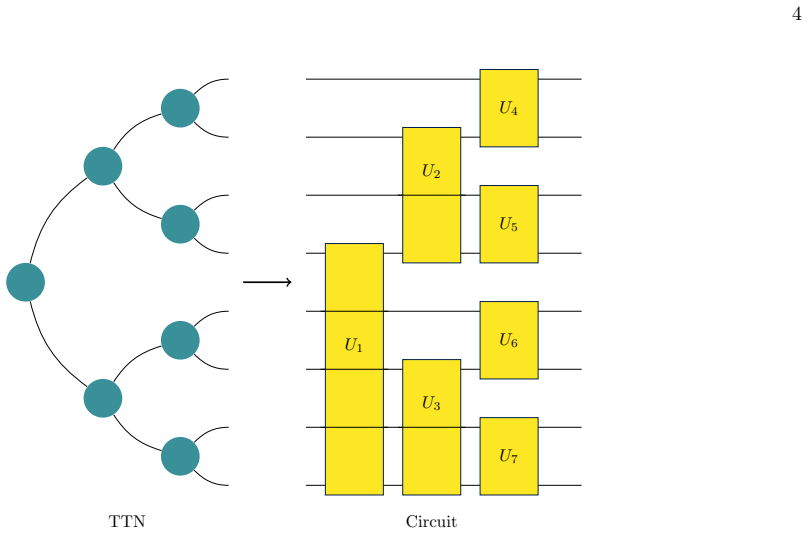
The tree tensor network renormalisation procedure, which contracts the matrix product state hierarchically into a binary tree of unitary gates to produce the circuit layers.
If this is right
- Matrix product states become usable as initial states for quantum phase estimation and selected configuration interaction on near-term hardware.
- Squared overlaps between states can be evaluated with shallow circuits that require no extra qubits.
- The overlap circuits provide a direct means to verify gate performance at the full circuit level rather than gate-by-gate.
- Users gain a concrete knob to balance circuit depth against preparation accuracy according to hardware limits.
Where Pith is reading between the lines
- The hierarchical construction may combine with other tensor-network compression techniques to handle states beyond one dimension.
- Verifier circuits could be inserted into larger algorithms to monitor fidelity drift during long computations.
- The depth-fidelity trade-off suggests a systematic way to benchmark how much classical pre-processing is worth for a given quantum device.
Load-bearing premise
The renormalization procedure must always produce circuits whose depth is strictly logarithmic in system size while preserving enough fidelity for target algorithms without incurring extra gate counts or ancilla requirements.
What would settle it
Implement the procedure for a small number of qubits, prepare the resulting circuit on hardware, and check whether the observed state fidelity matches the value predicted by the trade-off parameter while the measured depth remains logarithmic in qubit count.
Figures







read the original abstract
Matrix product states provide efficient classical descriptions of quantum systems that may be useful as reference states for quantum algorithms such as quantum phase estimation and quantum-selected configuration interaction. Shallow circuit constructions for loading matrix product states onto quantum computers is necessary for this to be practical on near-term hardware. We present a decomposition of matrix product states to log-depth quantum circuits via a simple tree tensor network renormalisation procedure. Our method exposes an explicit parameter which can be used to trade a small amount of fidelity for large savings in circuit depth. We extend this decomposition to the case of matrix product operators allowing us to construct log-depth and ancilla-free circuits to calculate overlaps of the form $\left |\langle\phi|U|\psi\rangle\right |^2$. In particular, we demonstrate an interpretation of these circuits as \emph{verifier circuits} with application to circuit-level device calibration.
Editorial analysis
A structured set of objections, weighed in public.
Referee Report
Summary. The paper claims a tree tensor network renormalization procedure that decomposes matrix product states into log-depth quantum circuits, with an explicit fidelity trade-off parameter allowing reduced depth at modest fidelity cost. It extends the approach to matrix product operators to yield log-depth, ancilla-free circuits computing squared overlaps |⟨φ|U|ψ⟩|², interpreted as verifier circuits for quantum device calibration.
Significance. If the central claims hold with rigorous depth bounds, the work would offer a practical route to loading MPS reference states onto near-term quantum hardware for algorithms such as quantum phase estimation and selected configuration interaction. The tunable fidelity parameter and the verifier-circuit application for overlap computation are useful features that could aid circuit calibration and reduce resource overhead compared to standard MPS preparation methods.
major comments (2)
- [Tree tensor network renormalisation procedure (main text description)] The central log-depth claim for the TTN renormalization of an MPS with bond dimension D requires an explicit proof or bound showing that the compiled circuit depth remains O(log N) after decomposing the isometries produced at each renormalization step into elementary gates; standard QR/SVD-based decompositions typically introduce per-isometry depth linear in D or log D, which the tree parallelism may not fully eliminate. This directly affects whether the method achieves strict logarithmic depth without hidden linear costs or ancilla overhead.
- [Extension to matrix product operators] For the MPO extension, the manuscript must specify the assumptions on MPO bond dimension and demonstrate that the resulting overlap circuits remain ancilla-free while preserving the log-depth scaling; without this, the verifier-circuit application rests on an unverified assumption that the compilation incurs no additional depth or qubit costs.
minor comments (2)
- The abstract and introduction would benefit from a brief pseudocode outline of the renormalization steps and the role of the fidelity parameter to make the procedure reproducible from the text alone.
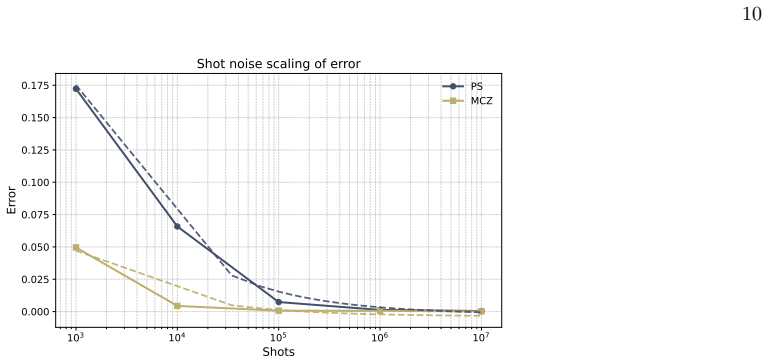
- Numerical examples or small-system benchmarks illustrating the achieved depth versus fidelity trade-off for concrete MPS (e.g., for varying D and N) would strengthen the practical claims.
Simulated Author's Rebuttal
We thank the referee for their careful reading and constructive comments on our manuscript. We address each major comment point by point below, providing clarifications and indicating the revisions made to strengthen the rigor of the depth bounds and MPO assumptions.
read point-by-point responses
-
Referee: [Tree tensor network renormalisation procedure (main text description)] The central log-depth claim for the TTN renormalization of an MPS with bond dimension D requires an explicit proof or bound showing that the compiled circuit depth remains O(log N) after decomposing the isometries produced at each renormalization step into elementary gates; standard QR/SVD-based decompositions typically introduce per-isometry depth linear in D or log D, which the tree parallelism may not fully eliminate. This directly affects whether the method achieves strict logarithmic depth without hidden linear costs or ancilla overhead.
Authors: We agree that an explicit bound accounting for isometry decomposition is necessary for rigor. In the revised manuscript we have added a new subsection deriving the depth scaling: each isometry (of size at most D x D^2) is decomposed into elementary gates with depth O(log D) using standard unitary synthesis methods that exploit the tree parallelism. Because the renormalization proceeds level-by-level in a binary tree of height log_2 N and independent branches execute in parallel, the overall circuit depth is bounded by O(log N log D). For the constant or slowly growing D typical in the targeted applications this remains O(log N), consistent with the original claim; we have updated the abstract, introduction, and main text to state the D dependence explicitly. No ancilla overhead is introduced beyond the qubits already present in the MPS representation. revision: yes
-
Referee: [Extension to matrix product operators] For the MPO extension, the manuscript must specify the assumptions on MPO bond dimension and demonstrate that the resulting overlap circuits remain ancilla-free while preserving the log-depth scaling; without this, the verifier-circuit application rests on an unverified assumption that the compilation incurs no additional depth or qubit costs.
Authors: We thank the referee for this observation. The revised manuscript now explicitly states that we assume the MPO bond dimension D_MPO is bounded by a constant (or at most polylog N) independent of system size, which holds for the local or low-entanglement operators relevant to overlap verification. Under this assumption the MPO is compiled via the same tree renormalization procedure as the MPS, yielding an ancilla-free circuit: the MPO tensors are contracted directly onto the state qubits without auxiliary registers. We have added a short proof that the resulting depth remains O(log N log D_MPO) and included an explicit diagram and contraction ordering confirming ancilla-freeness. These clarifications support the verifier-circuit application for device calibration. revision: yes
Circularity Check
No significant circularity in the derivation chain.
full rationale
The paper presents a constructive tree tensor network renormalization procedure that maps MPS (and MPO) representations to quantum circuits, with an explicit tunable parameter for fidelity-depth trade-off. This is a direct algorithmic construction building on standard tensor-network renormalization techniques rather than a fitted prediction, self-defined quantity, or load-bearing self-citation. No step reduces the log-depth claim to an input by construction; the method is described as exposing the parameter and extending to verifier circuits, with the central claim remaining independently verifiable against the procedure itself. The derivation is self-contained.
Axiom & Free-Parameter Ledger
free parameters (1)
- fidelity trade-off parameter
axioms (1)
- domain assumption Matrix product states provide efficient classical descriptions of quantum systems that may be useful as reference states for quantum algorithms.
Reference graph
Works this paper leans on
-
[1]
A. Y. Kitaev, Quantum measurements and the abelian stabilizer problem, arXiv preprint quant-ph/9511026 (1995)
work page internal anchor Pith review arXiv 1995
- [2]
-
[3]
Robledo-Moreno, M
J. Robledo-Moreno, M. Motta, H. Haas, A. Javadi-Abhari, P. Jurcevic, W. Kirby, S. Martiel, K. Sharma, S. Sharma, T. Shirakawa,et al., Chemistry beyond the scale of exact diagonalization on a quantum-centric supercomputer, Science Advances11, eadu9991 (2025)
2025
-
[4]
Fomichev, K
S. Fomichev, K. Hejazi, M. S. Zini, M. Kiser, J. Fraxanet, P. A. M. Casares, A. Delgado, J. Huh, A.-C. Voigt, J. E. Mueller, et al., Initial state preparation for quantum chemistry on quantum computers, PRX Quantum5, 040339 (2024)
2024
-
[5]
On the robustness of Quantum Phase Estimation to compute ground properties of many-electron systems
W. Sennane and J. Messud, On the robustness of quantum phase estimation to compute ground properties of many-electron systems, arXiv preprint arXiv:2601.05788 (2026)
work page internal anchor Pith review Pith/arXiv arXiv 2026
-
[6]
Y. O. Nakagawa, M. Kamoshita, W. Mizukami, S. Sudo, and Y.-y. Ohnishi, Adapt-qsci: Adaptive construction of an input state for quantum-selected configuration interaction, Journal of Chemical Theory and Computation20, 10817 (2024)
2024
-
[7]
Or´ us, A practical introduction to tensor networks: Matrix product states and projected entangled pair states, Annals of physics349, 117 (2014)
R. Or´ us, A practical introduction to tensor networks: Matrix product states and projected entangled pair states, Annals of physics349, 117 (2014)
2014
-
[8]
S. R. White, Density-matrix algorithms for quantum renormalization groups, Physical review b48, 10345 (1993)
1993
-
[9]
Schollw¨ ock, The density-matrix renormalization group in the age of matrix product states, Annals of physics326, 96 (2011)
U. Schollw¨ ock, The density-matrix renormalization group in the age of matrix product states, Annals of physics326, 96 (2011)
2011
-
[10]
M. S. Rudolph, J. Miller, D. Motlagh, J. Chen, A. Acharya, and A. Perdomo-Ortiz, Synergistic pretraining of parametrized quantum circuits via tensor networks, Nature Communications14, 8367 (2023)
2023
-
[11]
Jaderberg, G
B. Jaderberg, G. Pennington, K. V. Marshall, L. W. Anderson, A. Agarwal, L. P. Lindoy, I. Rungger, S. Mensa, and J. Crain, Variational preparation of normal matrix product states on quantum computers, Physical Review Research8, 013081 (2026)
2026
-
[12]
Preskill, Quantum computing in the nisq era and beyond, Quantum2, 79 (2018)
J. Preskill, Quantum computing in the nisq era and beyond, Quantum2, 79 (2018)
2018
-
[13]
Bharti, A
K. Bharti, A. Cervera-Lierta, T. H. Kyaw, T. Haug, S. Alperin-Lea, A. Anand, M. Degroote, H. Heimonen, J. S. Kottmann, T. Menke,et al., Noisy intermediate-scale quantum algorithms, Reviews of Modern Physics94, 015004 (2022)
2022
-
[14]
Sch¨ on, E
C. Sch¨ on, E. Solano, F. Verstraete, J. I. Cirac, and M. M. Wolf, Sequential generation of entangled multiqubit states, Physical review letters95, 110503 (2005). 12
2005
-
[15]
Ran, Encoding of matrix product states into quantum circuits of one-and two-qubit gates, Physical Review A101, 032310 (2020)
S.-J. Ran, Encoding of matrix product states into quantum circuits of one-and two-qubit gates, Physical Review A101, 032310 (2020)
2020
-
[16]
M. S. Rudolph, J. Chen, J. Miller, A. Acharya, and A. Perdomo-Ortiz, Decomposition of matrix product states into shallow quantum circuits, Quantum Science and Technology9, 015012 (2024)
2024
-
[17]
D. Malz, G. Styliaris, Z.-Y. Wei, and J. I. Cirac, Preparation of matrix product states with log-depth quantum circuits, Physical Review Letters132, 040404 (2024)
2024
- [18]
-
[19]
A. Mingare, A. Moroz, M. D. Kovacs, and A. G. Green, Quantum error mitigation via linear-depth verifier circuits, arXiv preprint arXiv:2411.03245 (2024)
-
[20]
K. C. Smith, A. Khan, B. K. Clark, S. M. Girvin, and T.-C. Wei, Constant-depth preparation of matrix product states with adaptive quantum circuits, PRX Quantum5, 030344 (2024)
2024
-
[21]
Robertson, A
N. Robertson, A. Akhriev, J. Vala, and S. Zhuk, Approximate quantum compiling for quantum simulation: A tensor network based approach, ACM Transactions on Quantum Computing6, 1 (2025)
2025
discussion (0)
Sign in with ORCID, Apple, or X to comment. Anyone can read and Pith papers without signing in.