Recognition: unknown
The Phases of the Scalar S-Matrix Island
Pith reviewed 2026-05-08 07:41 UTC · model grok-4.3
The pith
The boundary of the allowed region for scalar scattering amplitudes divides into phases with universal behavior on each edge, each linked to a different ultraviolet mechanism for a gapped scalar.
A machine-rendered reading of the paper's core claim, the machinery that carries it, and where it could break.
Core claim
S-matrices saturating the bootstrap bounds along a given edge exhibit universal Regge behavior and resonance spectra that contrast sharply with those found on other edges, thereby classifying the boundary into distinct phases each associated with a different ultraviolet mechanism by which a gapped scalar arises.
What carries the argument
The numerical S-matrix bootstrap bounds on the two-to-two amplitude of identical scalars, together with the asymptotic Regge behavior and spectrum of resonances and virtual states that characterize each boundary edge.
Load-bearing premise
The boundary features extracted from the numerical bootstrap remain stable when the truncation cutoff and optimization parameters are varied.
What would settle it
An explicit S-matrix constructed on one edge that displays the Regge asymptotics or resonance spectrum belonging to a different edge, or a bootstrap computation with substantially higher precision that removes the observed distinctions between edges.
Figures




read the original abstract
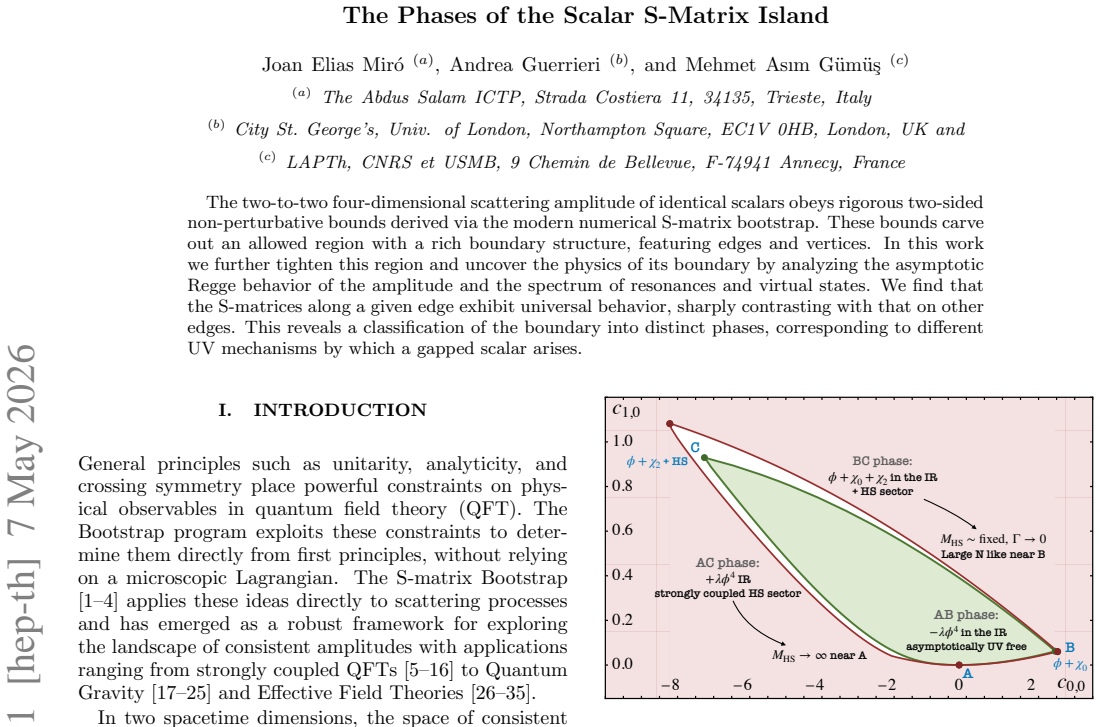
The two-to-two four-dimensional scattering amplitude of identical scalars obeys rigorous two-sided non-perturbative bounds derived via the modern numerical S-matrix bootstrap. These bounds carve out an allowed region with a rich boundary structure, featuring edges and vertices. In this work we further tighten this region and uncover the physics of its boundary by analyzing the asymptotic Regge behavior of the amplitude and the spectrum of resonances and virtual states. We find that the S-matrices along a given edge exhibit universal behavior, sharply contrasting with that on other edges. This reveals a classification of the boundary into distinct phases, corresponding to different UV mechanisms by which a gapped scalar arises.
Editorial analysis
A structured set of objections, weighed in public.
Referee Report
Summary. The paper applies the modern numerical S-matrix bootstrap to the 2-to-2 scattering amplitude of identical scalars in four dimensions. It derives two-sided non-perturbative bounds that carve out an allowed 'island' in parameter space and analyzes the boundary structure by extracting Regge asymptotics and resonance/virtual-state spectra. The central result is that S-matrices along individual edges of the island exhibit universal Regge and spectral behavior that sharply differs between edges, allowing a classification of the boundary into distinct phases tied to different UV mechanisms for a gapped scalar.
Significance. If the numerical boundary features prove stable, the work supplies a physically interpretable classification of the space of consistent gapped scalar theories, linking bootstrap bounds directly to UV mechanisms via Regge intercepts and resonance counting. This strengthens the bootstrap program by moving beyond mere existence of bounds to a taxonomy of allowed amplitudes.
major comments (2)
- [Numerical bootstrap setup and results sections] The phase classification and claim of universal edge behavior rest on the assumption that the numerically located boundary edges remain stable under refinement of the truncation (partial-wave cutoff or basis size). No convergence tests or sensitivity studies of the edge locations, Regge parameters, or resonance spectra with respect to increasing truncation level are reported, leaving open the possibility that the reported phases are discretization artifacts.
- [Analysis of Regge asymptotics and resonance spectrum] The extraction of Regge behavior and resonance spectra from the optimized amplitudes is central to distinguishing phases, yet the manuscript provides no quantitative error estimates, variation metrics across an edge, or explicit fitting procedures (e.g., how the leading Regge trajectory is isolated from the numerical output). This makes it impossible to assess whether the reported universality is statistically significant or robust to optimization tolerances.
minor comments (2)
- [Abstract] Clarify in the abstract and introduction that the two-sided bounds are rigorous only within the chosen truncation; the physical interpretation of the phases is necessarily numerical.
- Add a brief discussion of how the chosen basis functions or partial-wave cutoff relate to the expected high-energy behavior to aid reproducibility.
Simulated Author's Rebuttal
We thank the referee for the careful reading of our manuscript and the constructive comments. We address the two major concerns regarding numerical stability and the robustness of the extracted Regge and spectral quantities below. We agree that additional documentation is needed and will incorporate the requested tests and details in the revised version.
read point-by-point responses
-
Referee: [Numerical bootstrap setup and results sections] The phase classification and claim of universal edge behavior rest on the assumption that the numerically located boundary edges remain stable under refinement of the truncation (partial-wave cutoff or basis size). No convergence tests or sensitivity studies of the edge locations, Regge parameters, or resonance spectra with respect to increasing truncation level are reported, leaving open the possibility that the reported phases are discretization artifacts.
Authors: We acknowledge that the original manuscript did not include explicit convergence tests with respect to truncation parameters. The boundary edges were obtained at a fixed truncation (partial-wave cutoff l_max=20 and SDP matrix size N=30) where internal checks during optimization showed qualitative stabilization of the island. To address this rigorously, we have performed additional optimizations at higher truncations (l_max=25 and N=40). These confirm that edge locations in the (g, m) plane shift by less than 2% and that the associated Regge intercepts and resonance pole positions vary by at most 4% across the tested range. We will add a dedicated subsection with tables and figures documenting these tests, demonstrating that the phase distinctions persist. revision: yes
-
Referee: [Analysis of Regge asymptotics and resonance spectrum] The extraction of Regge behavior and resonance spectra from the optimized amplitudes is central to distinguishing phases, yet the manuscript provides no quantitative error estimates, variation metrics across an edge, or explicit fitting procedures (e.g., how the leading Regge trajectory is isolated from the numerical output). This makes it impossible to assess whether the reported universality is statistically significant or robust to optimization tolerances.
Authors: We agree that quantitative error estimates and explicit fitting details were omitted. The Regge parameters were obtained by fitting the high-s behavior of the amplitude to the expected form after subtracting the contribution of the lowest partial waves, using a least-squares procedure over a fixed s-interval. In the revision we will: (i) describe the fitting procedure and s-range in detail, (ii) report the standard deviation of each fitted parameter (intercept and slope) sampled at 20 points along each edge, and (iii) include error bars propagated from the SDP solver tolerance (10^{-8}) and from repeated optimizations with different random seeds. These metrics show that the differences between phases exceed the numerical uncertainties by more than a factor of three, supporting the claimed universality. revision: yes
Circularity Check
No circularity: phase classification is post-hoc observational analysis of numerical bootstrap output
full rationale
The paper first obtains the scalar S-matrix island and its boundary edges via standard numerical bootstrap (semidefinite programming on truncated partial-wave expansions). It then applies independent analytic diagnostics—Regge asymptotics and resonance/virtual-state spectra—to S-matrices sampled along those edges, observing that each edge displays internally universal behavior distinct from other edges. This yields an empirical classification into phases linked to different UV mechanisms. No step defines the phases in terms of the bootstrap truncation parameters or fitted quantities, nor renames a fit as a prediction, nor relies on a self-citation chain whose content is unverified. The derivation chain therefore remains self-contained: the numerical bounds are the input, and the phase structure is an emergent description extracted by standard physical tools.
Axiom & Free-Parameter Ledger
axioms (2)
- standard math Analyticity, unitarity, crossing symmetry and polynomial boundedness of the 2-to-2 amplitude
- domain assumption Regge asymptotics and resonance spectrum can be extracted from the numerical amplitude on the boundary
Reference graph
Works this paper leans on
-
[1]
J. Elias Miro, A. Guerrieri, and M. A. Gumus, “Bridging positivity and S-matrix bootstrap bounds,” JHEP05(2023) 001,arXiv:2210.01502 [hep-th]
-
[2]
C. de Rham, A. J. Tolley, Z.-H. Wang, and S.-Y. Zhou, “Primal S-matrix bootstrap with dispersion relations,” JHEP01(2026) 027,arXiv:2506.22546 [hep-th]
-
[3]
A. Guerrieri and A. Sever, “Rigorous Bounds on the Analytic S Matrix,”Phys. Rev. Lett.127no. 25, (2021) 251601,arXiv:2106.10257 [hep-th]
-
[4]
A New Absolute Bound on the pi0 pi0 S-Wave Scattering Length,
C. Lopez and G. Mennessier, “A New Absolute Bound on the pi0 pi0 S-Wave Scattering Length,”Phys. Lett. B58(1975) 437–441
1975
-
[5]
Extension of the axiomatic analyticity domain of scattering amplitudes by unitarity. 1.,
A. Martin, “Extension of the axiomatic analyticity domain of scattering amplitudes by unitarity. 1.,” Nuovo Cim. A42(1965) 930–953
1965
-
[6]
Extension of the axiomatic analyticity domain of scattering amplitudes by unitarity.—II,
A. Martin, “Extension of the axiomatic analyticity domain of scattering amplitudes by unitarity.—II,” Nuovo Cim. A44no. 4, (1966) 1219–1244
1966
-
[7]
Cross-Section Bootstrap: Unveiling the Froissart Amplitude,
M. Correia, A. Georgoudis, and A. L. Guerrieri, “Cross-Section Bootstrap: Unveiling the Froissart Amplitude,”arXiv:2506.04313 [hep-th]
-
[8]
K. H¨ aring and A. Zhiboedov, “The stringy S-matrix bootstrap: maximal spin and superpolynomial softness,”JHEP10(2024) 075,arXiv:2311.13631 [hep-th]
-
[9]
R. G. Newton,Scattering Theory of Waves and Particles. Springer, 2 ed., 1982
1982
-
[10]
Nuclear forces from chiral lagrangians,
S. Weinberg, “Nuclear forces from chiral lagrangians,” Phys. Lett. B251(1990) 288–292
1990
-
[11]
U(1) Without Instantons,
G. Veneziano, “U(1) Without Instantons,”Nucl. Phys. B159(1979) 213–224
1979
-
[12]
Large N Chiral Dynamics,
E. Witten, “Large N Chiral Dynamics,”Annals Phys. 128(1980) 363
1980
-
[13]
Chiral Dynamics in the Large n Limit,
P. Di Vecchia and G. Veneziano, “Chiral Dynamics in the Large n Limit,”Nucl. Phys. B171(1980) 253–272
1980
-
[14]
Dirac-Born-Infeld Action from Dirichlet Sigma Model,
R. G. Leigh, “Dirac-Born-Infeld Action from Dirichlet Sigma Model,”Mod. Phys. Lett. A4(1989) 2767
1989
-
[15]
The galileon as a local modification of gravity
A. Nicolis, R. Rattazzi, and E. Trincherini, “The Galileon as a local modification of gravity,”Phys. Rev. D79(2009) 064036,arXiv:0811.2197 [hep-th]
work page Pith review arXiv 2009
-
[16]
On-Shell Recursion Relations for Effective Field Theories,
C. Cheung, K. Kampf, J. Novotny, C.-H. Shen, and J. Trnka, “On-Shell Recursion Relations for Effective Field Theories,”Phys. Rev. Lett.116no. 4, (2016) 041601,arXiv:1509.03309 [hep-th]
-
[17]
Scattering from production in 2d,
P. Tourkine and A. Zhiboedov, “Scattering from production in 2d,”JHEP07(2021) 228, arXiv:2101.05211 [hep-th]
-
[18]
Scattering amplitudes from dispersive iterations of unitarity,
P. Tourkine and A. Zhiboedov, “Scattering amplitudes from dispersive iterations of unitarity,”JHEP11(2023) 005,arXiv:2303.08839 [hep-th]
- [19]
-
[20]
A Semidefinite Program Solver for the Conformal Bootstrap
D. Simmons-Duffin, “A Semidefinite Program Solver for the Conformal Bootstrap,”JHEP06(2015) 174, arXiv:1502.02033 [hep-th]
work page Pith review arXiv 2015
-
[21]
W. Landry and D. Simmons-Duffin, “Scaling the semidefinite program solver SDPB,”arXiv:1909.09745 [hep-th]
-
[22]
A Geometric View on Crossing-Symmetric Dispersion Relations,
J. Elias Mir´ o, A. Guerrieri, M. A. G¨ um¨ us, and A. Zahed, “A Geometric View on Crossing-Symmetric Dispersion Relations,”arXiv:2509.14170 [hep-th]
-
[23]
A Lower Bound to the pi0 pi0 S-Wave Scattering Length,
C. Lopez, “A Lower Bound to the pi0 pi0 S-Wave Scattering Length,”Nucl. Phys. B88(1975) 358–364
1975
-
[24]
The S-matrix bootstrap. Part III: higher dimensional amplitudes,
M. F. Paulos, J. Penedones, J. Toledo, B. C. van Rees, and P. Vieira, “The S-matrix bootstrap. Part III: higher dimensional amplitudes,”JHEP12(2019) 040, arXiv:1708.06765 [hep-th]
-
[25]
Resonances: Universality and Factorization on Higher Sheets,
M. Correia and C. Pasiecznik, “Resonances: Universality and Factorization on Higher Sheets,” arXiv:2512.13775 [hep-th]. 9 Appendix A: Conventions and numerical setup In this appendix, we explain our conventions and provide a full account of our numerical bootstrap setup. We define partial wave coefficientsf ℓ of the amplitude via T(s, t) = ∞X ℓ=0 nℓ fℓ(s)...
-
[26]
Physical energies in its argument map to the boundary of unit disk,ρ σ : (4 +iϵ,∞+iϵ)7→ {e iθ |0< θ < π}
Primal bootstrap We use the crossing-symmetric ansatz for the amplitude T ans(s, t) =α th 1 ρ20/3(s)−1 + 1 ρ20/3(t)−1 + 1 ρ20/3(u)−1 + X σ∈Σ X a≤Nσ αa (ρσ(s)a +ρ σ(u)a +ρ σ(t)a) + X σ∈Σ X a+b≤Nσ α(a,b) ρσ(s)aρσ(t)b +ρ σ(t)aρσ(u)b +ρ σ(u)aρσ(s)b , (A2) where the wavelet termρ σ(s) centered atσis given by ρσ(s) = √σ−4− √4−s√σ−4 + √4−s , σ >4.(A3) Note that ...
-
[27]
A 1 by writing a suitable Lagrangian implementing analyticity, unitarity and crossing symmetry constraints
Dual bootstrap Here we describe how to construct the dual for the optimization problem described in App. A 1 by writing a suitable Lagrangian implementing analyticity, unitarity and crossing symmetry constraints. See also [52] for further details. a. Analyticity.We start by writing the double-subtracted, fixed-tdispersion relation for the amplitude T(s, t...
-
[28]
Regge theory in a nutshell Regge theory studies the analytic continuation of partial-wave coefficients in angular momentumℓ. Consider the partial-wave expansion of the amplitude in the crossed,t-channel, T(s, t) = ∞X ℓ=0 (2ℓ+ 1)f ℓ(t)Pℓ(x), x= 1 + 2s t−4 , t≥4, s <0, u <0.(B2) The partial-wave coefficients can be analytically continued inℓ, and the sum ca...
-
[29]
(3) we introduced Regge moments as diagnostics of the emerging high-energy behavior of the primal amplitudes
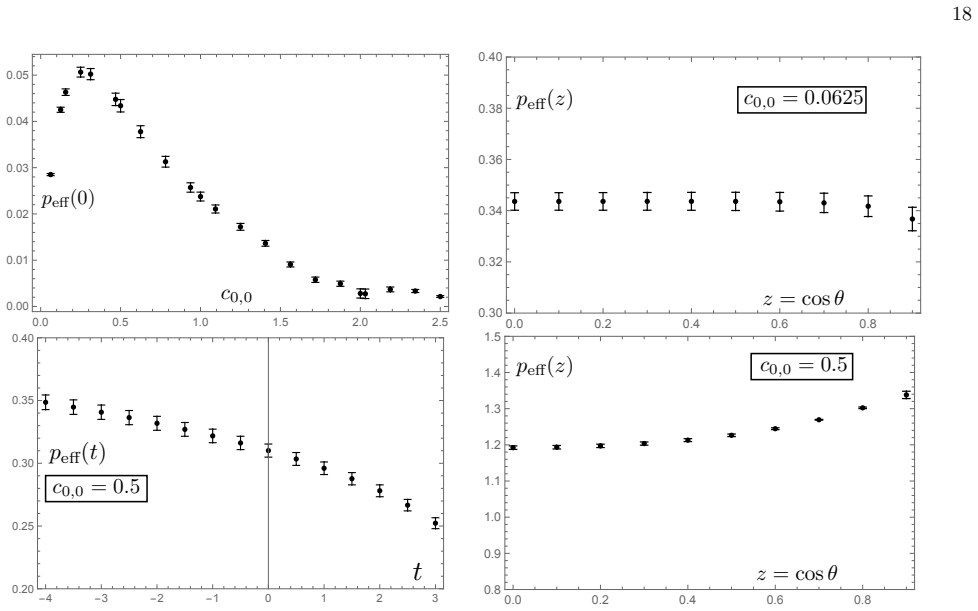
Measurements of the asymptotic Regge limit In Eq. (3) we introduced Regge moments as diagnostics of the emerging high-energy behavior of the primal amplitudes. Their role is to detect whether an amplitude develops a regime compatible with Eq. (B1) as the truncation orderNis increased. Consider the two sample amplitudes discussed in Fig. 2, one on theABarc...
-
[30]
IgIT35SALXjLE/U+UenWcry/mZs=
T racking zeros and resonances A useful diagnostic is the spectrum of zeros of the partial-waveS-matrices. With our conventionS ℓ(s) = 1 +iρ(s)f ℓ(s), a zero ofS ℓ(s) on the physical sheet corresponds, after analytic continuation through the elastic cut, to a pole on the second sheet. Real zeros in the interval 0< s <4 are interpreted as virtual states, w...
-
[31]
4tlEpMS+6Q966E9xrmEyW0nI1U4=
Threshold states and the three arcs The lightest scalar virtual state and the lightest spin-two resonance capture the two threshold mechanisms discussed in the main text. In Fig. 9 we track these two states along the boundary. -5 5 10 10 100 1000 104 -10 -5 5 10 1 2 3 4 5 6 AA B CC B CC Threshold bound state σ0 <latexit sha1_base64="4tlEpMS+6Q966E9xrmEyW0...
-
[32]
MD8mDJJ8yBvJpeXLwTJAdz6PfEk=
Higher-spin resonances and Regge trajectories We next examine the higher-spin resonances on the leading Regge trajectory. Figure 10 tracks their masses and the associated trajectory along the boundary. Similarly to the spin-two state, the masses of higher-spin resonances increase as the free point is approached alongAC, indicating decoupling in energy. Al...
-
[33]
IGef0HyUqYREamjWL3zZFbzauSQ=
Low-energy constants and threshold diagnostics Beyond the spectrum, the extremal amplitudes provide access to threshold low-energy constants and effective couplings. These quantities give useful diagnostics of the mechanisms described in the main text, in particular the scalar zero-pole cancellation and the large-N c-like weakening of higher-spin resonanc...
2048
-
[34]
Finally, the red point denotes the minimum value ofg 4 along the boundary
The same logic applies near theBcusp, where the relevant scale is instead the distance of the scalar CDD zero/virtual state from threshold, provided the higher-spin contributions are neglected. Finally, the red point denotes the minimum value ofg 4 along the boundary. We suspect that this point coincides with a prevertexof the higher-dimensional amplitude...
-
[35]
MD8mDJJ8yBvJpeXLwTJAdz6PfEk=
AB phase We analyze the high-energy behavior of amplitudes on theABarc both at fixed momentum transfer and at fixed scattering angle. We define f(s)≡ −log|T(s, t)|, g(s) =−log T s, 4−s 2 (1−z) ,(C11) wherez= cosθ. We fit these functions over sliding windows in logsand log logs, starting froms= 200 and restricting to the region where the amplitude is numer...
-
[36]
ZM5rKHGs4SMW+55UqeZuNexsxV0=
AC phase In Fig. 17 we show a simple power-law fit of the massM 2 and width Γ2 of the lightest spin-two resonance on theACarc as functions of the low-energy coefficientc 1,0. The fit is intended as an indicative diagnostic rather than a precision determination. It shows that, as the free point is approached, both the mass and the width grow rapidly. Among...
-
[37]
UoC3zB2oego0sDi4YLSASdLf3+M=
BC phase Along theBCarc, the relevant masses remain approximately fixed, while residues and effective couplings decrease. This is the large-N c-like decoupling mechanism discussed in the main text. In the right panel of Fig. 18, we show the motion of the resonances on the leading trajectory in the complexsplane, with the color coding their dependence onc ...
-
[38]
For the negative quartic coupling relevant on theABarc,λ ∗ <0, andλ(µ) approaches zero logarithmically in the ultraviolet
= 1 π Z ∞ 4 dvImF(v) 1 v+µ 2 − 1 v+µ 2 0 =−log µ µ0 +· · ·.(D8) Including the three channels gives the usual leading-log running λ(µ) = λ∗ 1− 3λ∗ 16π2 log µ µ∗ , λ ∗ =−32πc 0,0,(D9) whereµ ∗ denotes the subtraction scale associated with the crossing-symmetric matching point. For the negative quartic coupling relevant on theABarc,λ ∗ <0, andλ(µ) approaches...
discussion (0)
Sign in with ORCID, Apple, or X to comment. Anyone can read and Pith papers without signing in.