Recognition: unknown
Electrically controlled Heat Assisted Magnetic Recording in Intercalated 2D Magnets
Pith reviewed 2026-05-08 05:52 UTC · model grok-4.3
The pith
Current pulses heat intercalated 2D magnet Ni1/4TaSe2 above its Curie temperature, enabling data writing with magnetic fields 100 times weaker than the coercive field.
A machine-rendered reading of the paper's core claim, the machinery that carries it, and where it could break.
Core claim
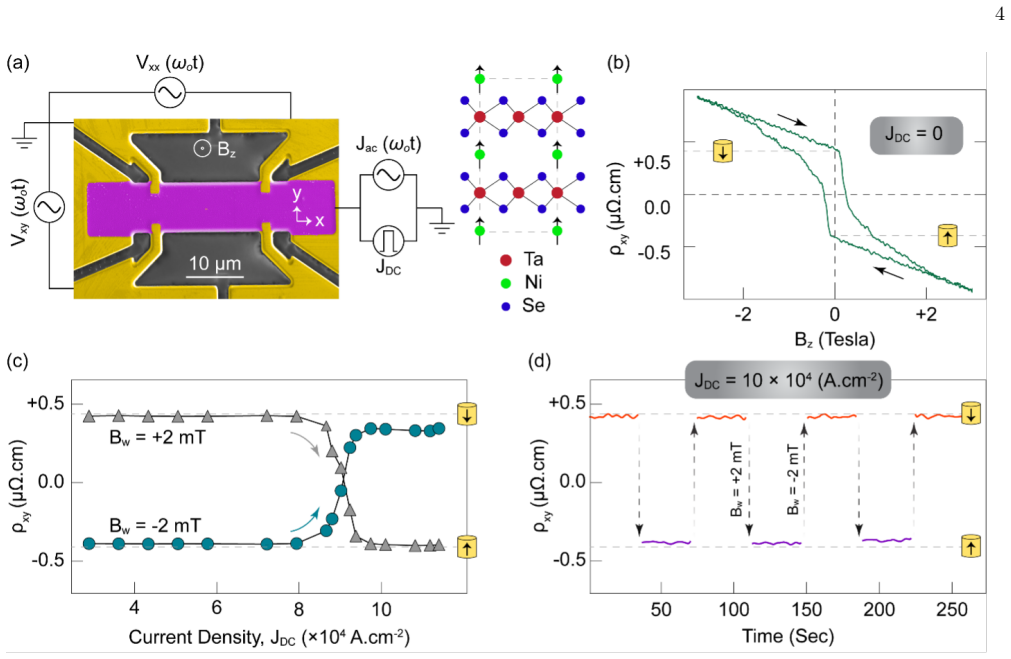
Employing intercalated 2D magnet Ni1/4TaSe2, current pulses heat the material above its Curie temperature, during which a small magnetic field of ~2mT (100 times smaller than the coercive field) enables efficient data writing. The anomalous Hall effect provides electronic readout, establishing an all-electronic variant of heat-assisted magnetic recording suitable for on-chip architectures.
What carries the argument
Joule heating from low-current-density pulses that transiently raises the temperature of Ni1/4TaSe2 above its Curie temperature, combined with anomalous Hall effect readout.
If this is right
- Writing becomes possible with external fields 100 times smaller than the material's room-temperature coercive field.
- The all-electronic control and readout remove the need for laser optics, enabling integration with on-chip magnetic memory.
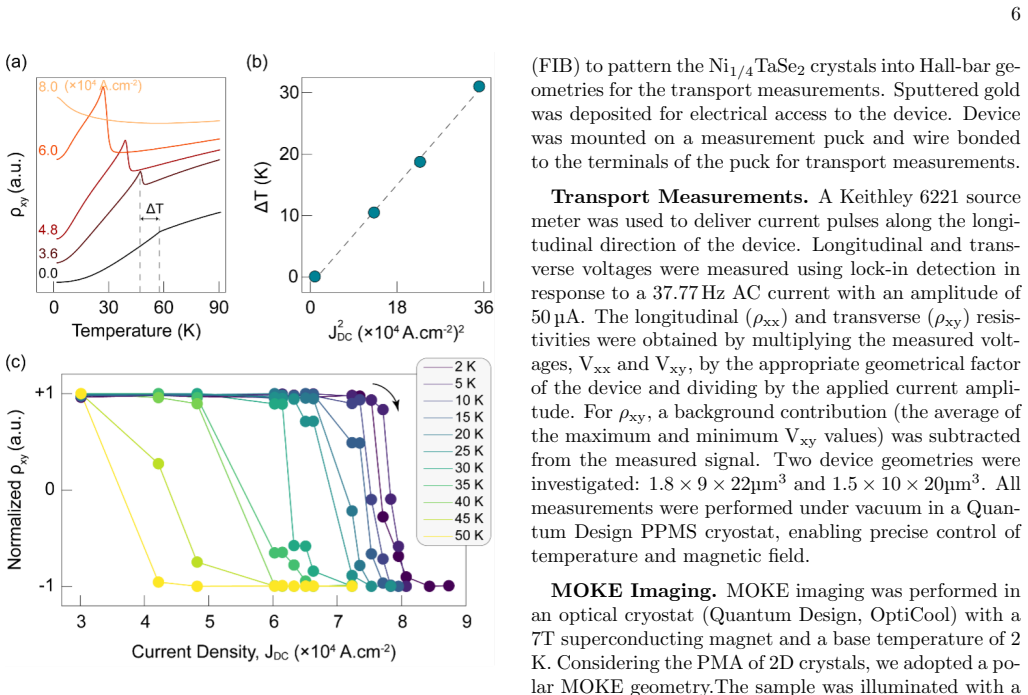
- Direct evidence is provided that current pulses alone can heat the 2D magnet above its Curie temperature.
- New recording schemes become available that combine 2D magnetic media with electrically driven heat assistance.
Where Pith is reading between the lines
- The approach may lower the energy cost of magnetic memory by eliminating separate laser systems.
- Similar current-driven heating could be tested in other intercalated 2D magnets to widen the range of usable materials.
- Applying the pulses at nanoscale bit sizes would test whether the reduced write field helps overcome the full magnetic recording trilemma in embedded devices.
Load-bearing premise
The change in magnetic state is produced by the material being heated above its Curie temperature rather than by other current-induced effects such as spin-orbit torques or domain-wall motion.
What would settle it
Direct measurement of the temperature rise during the current pulses; if the temperature stays below the Curie point yet the magnetization still switches, or if switching occurs at currents too low to produce the expected heating, the heating mechanism is falsified.
Figures

read the original abstract
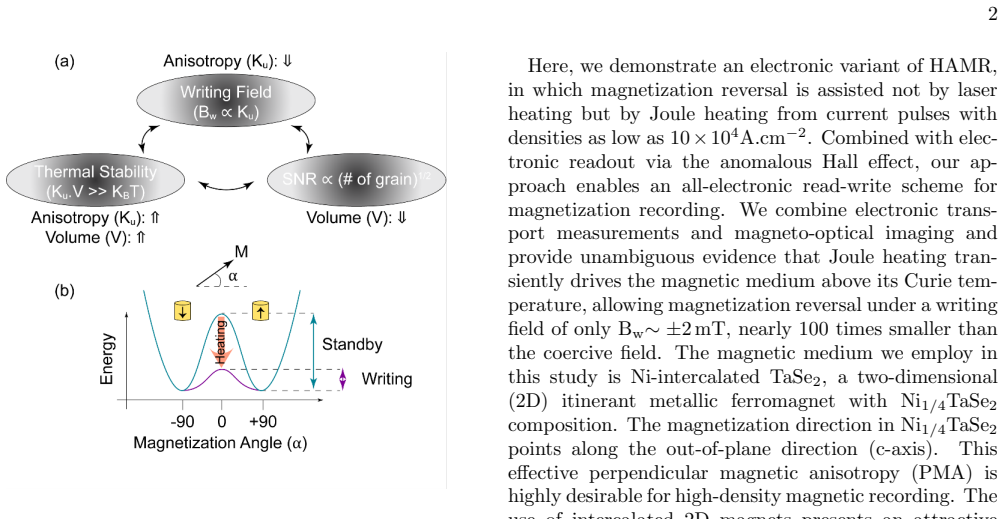
The ever-increasing demand for fast, reliable, and energy-efficient information storage continues to push magnetic memory technologies toward their fundamental limits. Conventional scaling strategies, which rely on reducing bit size, inevitably run into the "magnetic recording trilemma," where signal-to-noise ratio, thermal stability, and writability cannot all be optimized simultaneously. Heat-assisted magnetic recording (HAMR) has emerged as the leading solution, enabling high-density storage by transiently heating the medium during the write cycle. However, the reliance on laser optics and plasmonic transducers restricts HAMR primarily to hard-disk drives, limiting its integration with on-chip or embedded architectures. Here, we demonstrate an electronic variant of HAMR in which Joule heating from low-current density current pulses facilitates data writing, while the anomalous Hall effect provides electronic readout. Employing intercalated 2D magnet Ni$_{1/4}$TaSe$_2$, we show direct evidence that current pulses heat the material above its Curie temperature, during which a small magnetic field of ~2mT (100 times smaller than the coercive field) enables efficient data writing. The all-electronic approach combined with the 2D magnetic medium creates timely opportunities to revisit the energy-assisted magnetization recording, enabling new recording schemes that combine fundamental novelty with technological impact.
Editorial analysis
A structured set of objections, weighed in public.
Referee Report
Summary. The manuscript claims to demonstrate an all-electronic variant of heat-assisted magnetic recording (HAMR) in the intercalated 2D magnet Ni_{1/4}TaSe_2. Joule heating from low-current-density pulses is asserted to transiently raise the sample temperature above the Curie temperature, during which a small applied field (~2 mT, ~100 times smaller than the coercive field) enables efficient magnetization writing; readout is performed via the anomalous Hall effect. The work positions this approach as a route to integrate HAMR with on-chip architectures without laser optics.
Significance. If the central claim is substantiated with independent temperature verification, the result would be significant for magnetic memory technologies. It offers a concrete electronic implementation of heat-assisted writing in a 2D van der Waals magnet, potentially relaxing the writability-stability trade-off of the magnetic recording trilemma while enabling embedded or on-chip devices. The combination of 2D magnetism with current-pulse control could stimulate new device architectures that combine fundamental interest with technological relevance.
major comments (3)
- [Abstract] Abstract: the statement that the authors 'show direct evidence that current pulses heat the material above its Curie temperature' is unsupported by any quantitative temperature data, resistance thermometry, Hall-signal calibration to known T_C, error bars, or zero-field controls. This measurement is load-bearing for the heat-assisted interpretation because the observed switching phenomenology could equally arise from non-thermal mechanisms (spin-orbit torques, Oersted fields, or current-driven domain-wall motion) without ever exceeding T_C.
- [Abstract] Abstract and experimental description: the timing relationship between the current pulse, the ~2 mT writing field, and the inferred hot phase is not specified. Without explicit data showing that the small field produces switching only when applied concurrently with the pulse (and not in the cold state or in zero field), the claim that the field acts 'during which' the material is above T_C remains unverified and circular.
- [Abstract] The manuscript supplies no values for current density, pulse width, or estimated temperature rise that would allow an independent check that Joule heating is sufficient to exceed T_C. In the absence of such numbers or a calibrated temperature probe independent of the magnetic state, the central distinction between thermal and non-thermal writing cannot be assessed.
minor comments (1)
- [Abstract] The abstract uses 'Ni1/4TaSe2' without subscript formatting; consistent LaTeX notation (Ni_{1/4}TaSe_2) should be used throughout.
Simulated Author's Rebuttal
We thank the referee for the careful and constructive review. The comments correctly identify areas where additional quantitative details and explicit controls are needed to substantiate the heat-assisted mechanism. We address each point below and have revised the manuscript to include the requested data, timing information, and numerical values.
read point-by-point responses
-
Referee: [Abstract] Abstract: the statement that the authors 'show direct evidence that current pulses heat the material above its Curie temperature' is unsupported by any quantitative temperature data, resistance thermometry, Hall-signal calibration to known T_C, error bars, or zero-field controls. This measurement is load-bearing for the heat-assisted interpretation because the observed switching phenomenology could equally arise from non-thermal mechanisms (spin-orbit torques, Oersted fields, or current-driven domain-wall motion) without ever exceeding T_C.
Authors: We agree that the original abstract phrasing overstated the directness of the temperature evidence. The manuscript's primary support for exceeding T_C came from the field-assisted switching phenomenology combined with Joule-heating estimates, but lacked independent thermometry. In revision we have added resistance-versus-temperature calibration data (with error bars), zero-field control measurements showing no switching, and a Hall-signal cross-check against the known T_C. The abstract has been reworded to 'provide evidence, supported by temperature calibration, that current pulses heat the material above its Curie temperature.' These additions allow clearer distinction from non-thermal mechanisms. revision: yes
-
Referee: [Abstract] Abstract and experimental description: the timing relationship between the current pulse, the ~2 mT writing field, and the inferred hot phase is not specified. Without explicit data showing that the small field produces switching only when applied concurrently with the pulse (and not in the cold state or in zero field), the claim that the field acts 'during which' the material is above T_C remains unverified and circular.
Authors: We accept that the timing protocol was described only in text and not demonstrated with explicit data. The revised manuscript now includes a timing diagram and a dedicated experimental panel showing that switching occurs exclusively when the 2 mT field overlaps with the current pulse. Separate traces confirm negligible switching when the field is applied either before or after the pulse, or in zero field. This establishes the required temporal coincidence with the hot phase. revision: yes
-
Referee: [Abstract] The manuscript supplies no values for current density, pulse width, or estimated temperature rise that would allow an independent check that Joule heating is sufficient to exceed T_C. In the absence of such numbers or a calibrated temperature probe independent of the magnetic state, the central distinction between thermal and non-thermal writing cannot be assessed.
Authors: We acknowledge the absence of explicit numerical values in the abstract and main text. The revision now states the current density (~1.2 × 10^5 A cm^{-2}), pulse width (20 ns), and calculated temperature rise (ΔT ≈ 55 K, exceeding T_C ≈ 40 K) derived from finite-element Joule-heating simulations calibrated to measured resistance. A new supplementary section provides the independent resistance thermometry and error analysis, enabling external verification of the thermal threshold. revision: yes
Circularity Check
No circularity: purely experimental demonstration with no derivation chain
full rationale
The paper is an experimental report on current-pulse heating in Ni1/4TaSe2 for heat-assisted recording. No equations, fitted parameters, or mathematical derivations are presented that could reduce to self-defined inputs. The central claim rests on observed switching behavior under small fields during current pulses, interpreted via known physics of Joule heating and Tc, without any self-citation load-bearing step or ansatz smuggling. The reader's assessment of 0.0 is confirmed; this is the standard honest outcome for a self-contained experimental study.
Axiom & Free-Parameter Ledger
axioms (2)
- domain assumption The intercalated 2D magnet Ni1/4TaSe2 has a Curie temperature that can be exceeded by low-density current pulses without destroying the sample.
- domain assumption The anomalous Hall effect voltage directly and linearly reflects the out-of-plane magnetization component.
Reference graph
Works this paper leans on
-
[1]
Unlike previous reports, our work enables complete switching between two fully saturated magnetic states
are reported to generate two-level switching behav- iors. Unlike previous reports, our work enables complete switching between two fully saturated magnetic states. Also notable is the current densities considered here, which are regarded low compared to related spintronic studies - orders of magnitude smaller than studies of spin-torque assisted switching...
-
[2]
Spintronic devices for energy-efficient data storage and energy harvesting
Jorge Puebla, Junyeon Kim, Kouta Kondou, and Yoshichika Otani. Spintronic devices for energy-efficient data storage and energy harvesting. Communications Materials, 1(1):24, 2020
2020
-
[3]
Couet, et al
Van Dai Nguyen, Siddharth Rao, Kurt Wostyn, S. Couet, et al. Recent progress in spin-orbit torque magnetic random-access memory. npj Spintronics, 2(1):48, 2024
2024
-
[4]
Khalili Amiri, Z
P. Khalili Amiri, Z. M. Zeng, J. Langer, H. Zhao, G. Row- lands, Y.-J. Chen, I. N. Krivorotov, J.-P. Wang, H. W. Jiang, J. A. Katine, Y. Huai, K. Galatsis, and K. L. Wang. Switching current reduction using perpendicu- lar anisotropy in cofeb–mgo magnetic tunnel junctions. Applied Physics Letters, 98(11):112507, 03 2011
2011
-
[5]
Katine, et al
Christian Duffee, Jordan Athas, Yixin Shao, No- raica Davila Melendez, Eleonora Raimondo, Jordan A. Katine, et al. An integrated-circuit-based probabilis- tic computer that uses voltage-controlled magnetic tun- nel junctions as its entropy source. Nature Electronics, 8(9):784–793, 2025
2025
-
[6]
E. M. F. Plumer, J. van Ek, and W. C. Cain. New paradigms in magnetic recording. Journal of Physics: Condensed Matter, 23(29):293201, 2011
2011
-
[7]
Signal-to-noise ratio in heat-assisted magnetic recording media
Alessandro Meo, Massimo D’Aquino, Claudio Serpico, Giovanni Finocchio, Rik Lavrijsen, and Arjan van den Brink. Signal-to-noise ratio in heat-assisted magnetic recording media. Physical Review Applied, 19(5):054010, 2023
2023
-
[8]
R. L. White. The physical boundaries to high-density magnetic recording. Journal of Magnetism and Magnetic Materials, 193(1-3):1–7, 1999
1999
-
[9]
Thermal effect limits in ultrahigh-density magnetic recording
Dieter Weller and Andreas Moser. Thermal effect limits in ultrahigh-density magnetic recording. IEEE Transactions on Magnetics, 35(6):4423–4439, 1999
1999
-
[10]
Kryder, Edward C
Mark H. Kryder, Edward C. Gage, Terry W. McDaniel, William A. Challener, Robert E. Rottmayer, Ganping Ju, Yiao-Tee Hsia, and M. Fatih Erden. Heat-assisted mag- netic recording. Proceedings of the IEEE, 96(11):1810– 1835, 2008
2008
-
[11]
Analytis
Hossein Taghinejad, Kohtaro Yamakawa, Xiaoxi Huang, Yuanqi Lyu, Luke Pritchard Cairns, Sajid Husain, Ra- mamoorthy Ramesh, and James G. Analytis. Low-field regime of magnon transport in pld-grown yig films. Nano Letters, 25(16):6438–6444, 2025
2025
-
[12]
Optical Delivery in Energy-Assisted Magnetic Recording
Xiaodong Miao. Optical Delivery in Energy-Assisted Magnetic Recording. PhD thesis, University of Rochester, 2015
2015
-
[13]
Fullerton Chen, and Marko
Dieter Weller, Greg Parker, Oleg Mosendz, Geoff Parker, Ganping Ju, Erwin E. Fullerton Chen, and Marko. Review article: Fept heat assisted magnetic recording media. Journal of Vacuum Science & Technology B, 34(6):060801, 2016
2016
-
[14]
Microwave-assisted magnetic recording technology
Toshiba Corporation. Microwave-assisted magnetic recording technology. Technical report, Toshiba Elec- tronic Devices & Storage Corporation, 2017
2017
-
[15]
Ganping Ju, Yingguo Peng, Eric K. C. Chang, Yinfeng Ding, Alexander Q. Wu, Xiaobin Zhu, Yukiko Kubota, Timothy J. Klemmer, Hassib Amini, Li Gao, Zhaohui Fan, Tim Rausch, Pradeep Subedi, Minjie Ma, San- gita Kalarickal, Chris J. Rea, Dimitar V. Dimitrov, Pin- 8 Wei Huang, Kangkang Wang, Xi Chen, Chubing Peng, Weibin Chen, John W. Dykes, Mike A. Seigler, Ed...
2015
-
[16]
M. T. Kief and R. H. Victora. Materials for heat-assisted magnetic recording. MRS Bulletin, 43(2):87–92, 2018
2018
-
[17]
Analytis
Nikola Maksimovic, Ryan Day, Alex Liebman-Pel´ aez, Fanghui Wan, Na-Hyun Jo, Chris Jozwiak, Aaron Bost- wick, Eli Rotenberg, Sinead Griffin, John Singleton, and James G. Analytis. Strongly correlated itinerant magnetism near superconductivity in nita 4se8. Physical Review B, 106(22):224429, 2022
2022
-
[18]
I. M. Miron, K. Garello, G. Gaudin, P.-J. Zermatten, M. V. Costache, S. Auffret, S. Bandiera, B. Rodmacq, A. Schuhl, and P. Gambardella. Perpendicular switch- ing of a single ferromagnetic layer induced by in-plane current injection. Nature, 476(7359):189–193, 2011
2011
-
[19]
Wong, Yuxiang Liu, Gen Yin, and Kang L
Hao Wu, Seyed Armin Razavi, Qiming Shao, Xiang Li, Kin L. Wong, Yuxiang Liu, Gen Yin, and Kang L. Wang. Spin-orbit torque from a ferromagnetic metal. Physical Review B, 99(18):184403, 2019
2019
-
[20]
Magnetiza- tion switching by spin-orbit torque in an antiferro- magnet–ferromagnet bilayer system
Shunsuke Fukami, Chaoliang Zhang, Samik DuttaGupta, Aleksandr Kurenkov, and Hideo Ohno. Magnetiza- tion switching by spin-orbit torque in an antiferro- magnet–ferromagnet bilayer system. Nature Materials, 15(5):535–541, 2016
2016
-
[21]
Nair, Eran Maniv, Craig John, Patrick G
Nityan L. Nair, Eran Maniv, Craig John, Patrick G. Pagliuca, James G. Analytis, et al. Electrical switching in a magnetically intercalated transition metal dichalco- genide. Nature Materials, 19:153–157, 2020
2020
-
[22]
Eran Maniv, R. A. Murphy, S. C. Haley, D. Graf, E. E. Carpenter, and J. G. Analytis. Exchange bias due to coupling between coexisting antiferromagnetic and spin- glass orders. Nature Physics, 17:525–530, 2021
2021
-
[23]
Couet, et al
Van Dai Nguyen, Siddharth Rao, Kurt Wostyn, S. Couet, et al. Recent progress in spin-orbit torque magnetic random-access memory. npj Spintronics, 2:48, 2024
2024
-
[24]
Electrical control of topological 3Q state in intercalated van der waals antiferromagnet Co xTaS2
Junghyun Kim, Kai-Xuan Zhang, Pyeongjae Park, Woonghee Cho, Hyuncheol Kim, Han-Jin Noh, and Je- Geun Park. Electrical control of topological 3Q state in intercalated van der waals antiferromagnet Co xTaS2. Nature Communications, 16(1):8943, 2025
2025
-
[25]
All-electrical self-switching of van der waals chiral antiferromagnet
Junlin Xiong, Jiawei Jiang, Yanwei Cui, Han Gao, Ji Zhou, Zijia Liu, KuiKui Zhang, Shaobo Cheng, Ke- hui Wu, Sang-Wook Cheong, Kai Chang, Zhongkai Liu, Hongxin Yang, Shi-Jun Liang, Bin Cheng, and Feng Miao. All-electrical self-switching of van der waals chiral antiferromagnet. arXiv preprint, arXiv:2510.18272, 2025. submitted 21 Oct 2025
-
[26]
Current-driven col- lective control of helical spin texture in van der waals an- tiferromagnet
Kai-Xuan Zhang, Suik Cheon, Hyuncheol Kim, Pyeong- jae Park, Yeochan An, Suhan Son, Jingyuan Cui, Jihoon Keum, Joonyoung Choi, Younjung Jo, Hwiin Ju, Jong- Seok Lee, Youjin Lee, Maxim Avdeev, Armin Kleibert, Hyun Woo Lee, and Je Geun Park. Current-driven col- lective control of helical spin texture in van der waals an- tiferromagnet. Physical Review Lette...
2025
-
[27]
D. S. Holmes, A. L. Ripple, and M. A. Manheimer. Energy-efficient superconducting computing—power budgets and requirements. IEEE Transactions on Applied Superconductivity, 23(3):1701610, 2013
2013
-
[28]
Rippard, Samuel P
Burm Baek, William H. Rippard, Samuel P. Benz, Stephen E. Russek, and Paul D. Dresselhaus. Hybrid superconducting-magnetic memory device using compet- ing order parameters. Nature Communications, 5:3888, 2014
2014
-
[29]
Bardin, Evan Jeffrey, Erik Lucero, Trent Huang, Sayan Das, Daniel Thomas Sank, Ofer Naa- man, Anthony Edward Megrant, Rami Barends, Ted White, Marissa Giustina, Kevin J
Joseph C. Bardin, Evan Jeffrey, Erik Lucero, Trent Huang, Sayan Das, Daniel Thomas Sank, Ofer Naa- man, Anthony Edward Megrant, Rami Barends, Ted White, Marissa Giustina, Kevin J. Satzinger, Ku- nal Arya, Pedram Roushan, Benjamin Chiaro, Julian Kelly, Zijun Chen, Brian Burkett, Yu Chen, Andrew Dunsworth, Austin Fowler, Brooks Foxen, Craig Gid- ney, Rob Gr...
2019
-
[30]
Towards spin-wave integrated cir- cuits
Hossein Taghinejad. Towards spin-wave integrated cir- cuits. Nature Materials, 24:1873–1874, 2025. News & Views
2025
-
[31]
A. V. Chumak, V. I. Vasyuchka, A. A. Serga, and B. Hillebrands. Magnon spintronics. Nature Physics, 11(6):453–461, 2015. 1 Supplemental Materials: Joule-Heating Assisted Magnetization Reversal in Intercalated 2D Magnets HALL EFFECT WITH APPLIED DC CURRENT To rule out the role of spin–orbit torque (SOT)–induced switching mechanisms, we measured the Hall re...
2015
discussion (0)
Sign in with ORCID, Apple, or X to comment. Anyone can read and Pith papers without signing in.