Recognition: no theorem link
Asymptotic Convergence of Weniger's δ-Transformation for a Class of Superfactorially Divergent Stieltjes Series
Pith reviewed 2026-05-11 01:18 UTC · model grok-4.3
The pith
Weniger's δ-transformation converges asymptotically for superfactorially divergent Stieltjes series with (2n)! moment growth.
A machine-rendered reading of the paper's core claim, the machinery that carries it, and where it could break.
Core claim
For the class of Stieltjes series with moment sequence growing as (2n)!, Weniger's δ-transformation admits an exact integral representation of its truncation error. This representation yields the leading-order asymptotic behavior of the transformation error together with an estimate of the convergence rate for real positive arguments.
What carries the argument
Exact integral representation of the truncation error for Weniger's δ-transformation, obtained by direct application of converging-factor results for superfactorially divergent Stieltjes series.
If this is right
- The δ-transformation error follows a definite leading asymptotic form for real positive arguments.
- An explicit estimate of the convergence rate becomes available.
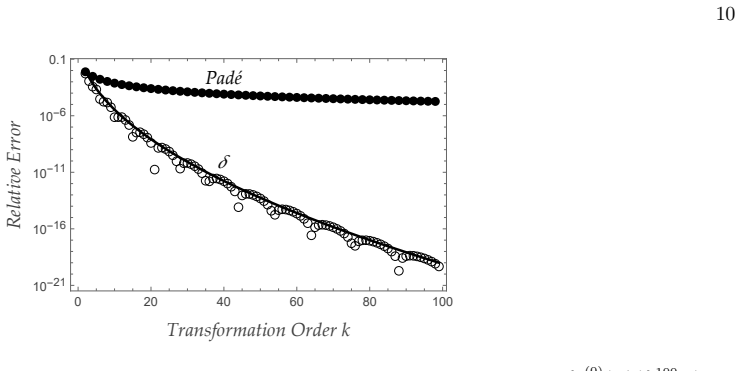
- The method supplies a computationally efficient alternative to Padé approximants for this class of series.
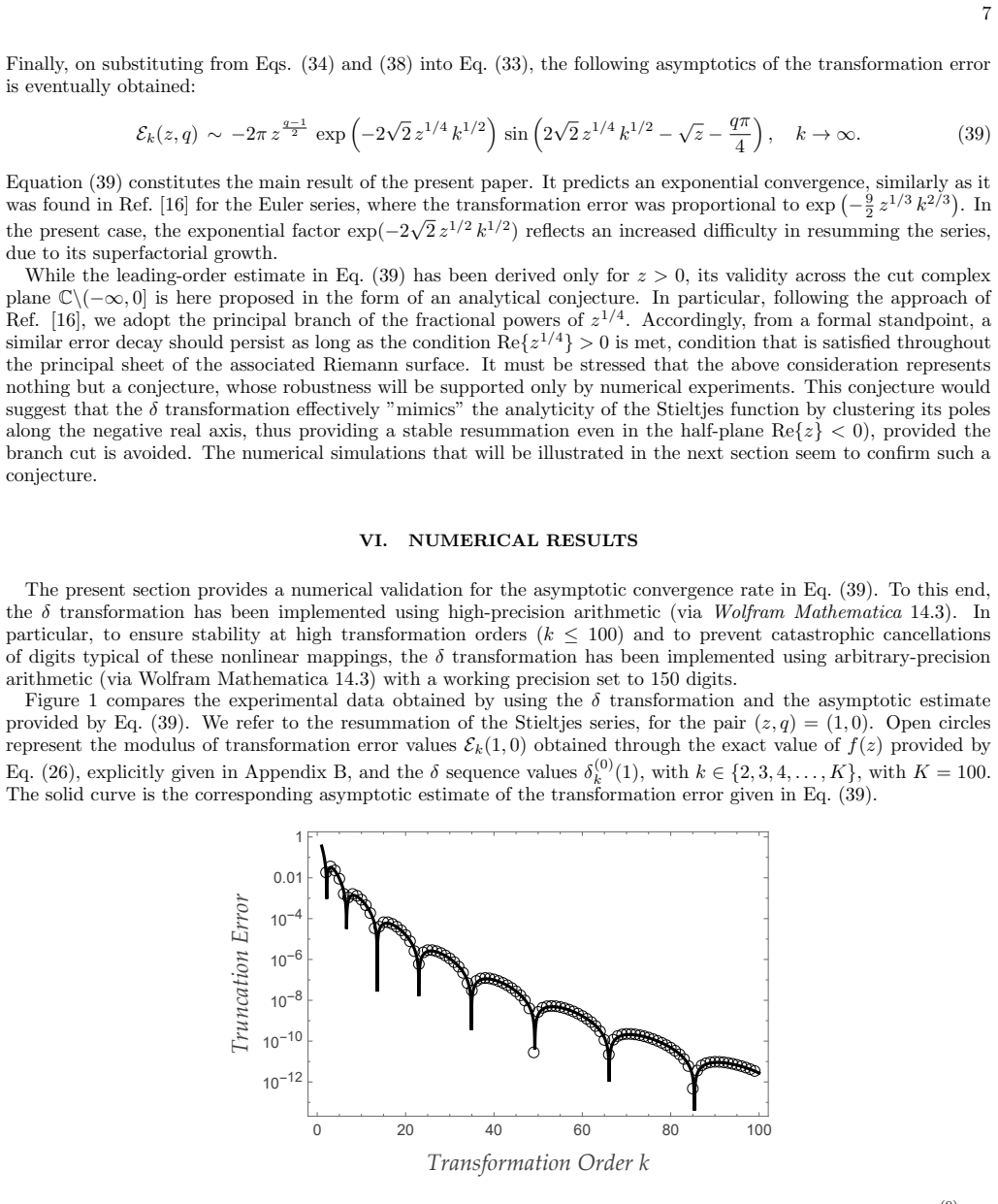
- Numerical experiments confirm the derived asymptotic predictions.
Where Pith is reading between the lines
- The integral-representation technique may transfer to the error analysis of other nonlinear transformations applied to similar divergent series.
- The same framework could be tested on series with different moment growth rates to map out the range of applicability.
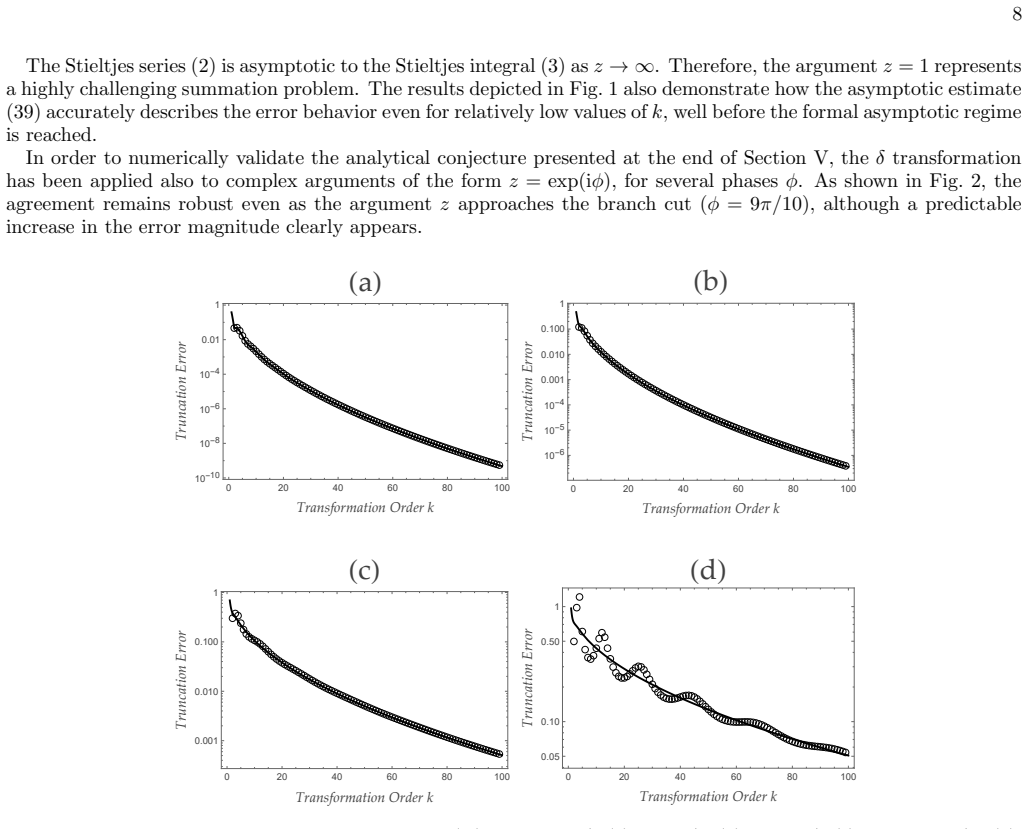
- Results for positive real arguments provide a foundation for exploring analytic continuation to complex values.
Load-bearing premise
Established results on converging factors for superfactorially divergent Stieltjes series apply directly to produce an exact integral representation of the truncation error specifically for Weniger's δ-transformation.
What would settle it
Numerical evaluation of the actual truncation error for a concrete series with moments proportional to (2n)! at successively higher transformation orders that deviates from the predicted leading asymptotic term would disprove the derivation.
Figures


read the original abstract
The resummation of superfactorially divergent series represents a significant computational challenge in mathematical physics. In the present paper the resummation of a specific class of Stieltjes series characterized by a moment sequence growing as $(2n)!$ will be addressed. Despite the fact that Carleman's condition is satisfied for these series, the convergence rate of Pad\'e approximants is severely hindered by the logarithmic divergence of the associated Carleman series. Weniger's $\delta$ transformation is proposed as a highly efficient alternative resummation tool. By employing recently established results on the converging factors of superfactorially divergent Stieltjes series, an exact integral representation for the truncation error is obtained. This representation enables the rigorous derivation of the leading-order asymptotic behavior of the transformation error, as well as the estimation of the related convergence rate, for real positive arguments. Numerical experiments strongly support the theoretical findings, suggesting that the $\delta$ transformation offers a robust and computationally efficient framework for decoding this class of wildly divergent expansions
Editorial analysis
A structured set of objections, weighed in public.
Referee Report
Summary. The paper addresses the resummation of superfactorially divergent Stieltjes series whose moments grow as (2n)!. It proposes Weniger's δ-transformation as an efficient alternative to Padé approximants, whose convergence is hindered by the logarithmic divergence of the associated Carleman series. By invoking recently established results on converging factors, the authors obtain an exact integral representation of the truncation error; this representation is then used to derive the leading-order asymptotic behavior of the transformation error and the associated convergence rate for positive real arguments. Numerical experiments are presented in support of the theoretical predictions.
Significance. If the derivation holds, the work supplies a rigorous, parameter-free asymptotic analysis for a resummation method applied to a class of series that arise in mathematical physics and for which standard Padé methods converge slowly. The reliance on external converging-factor results keeps the construction free of ad-hoc fitting, while the numerical experiments furnish falsifiable predictions of the convergence rate; both features strengthen the practical utility of the claimed result.
minor comments (2)
- [Abstract] Abstract: the phrase 'a specific class of Stieltjes series characterized by a moment sequence growing as (2n)!' would benefit from an explicit one-line definition of the underlying Stieltjes integral or generating function so that readers can immediately identify the precise series under study.
- [Numerical experiments] Numerical experiments section: the abstract states that the experiments 'strongly support' the theory, but does not indicate the range of positive real arguments tested or the observed scaling of the error; adding these quantitative details would make the corroboration easier to assess.
Simulated Author's Rebuttal
We thank the referee for the positive assessment of our work and for recommending minor revision. No specific major comments were provided in the report.
Circularity Check
No significant circularity; derivation applies external results to derive new asymptotics
full rationale
The paper obtains an exact integral representation for the truncation error of Weniger's δ-transformation by invoking recently established results on converging factors of (2n)!-moment Stieltjes series. From this representation it derives the leading-order asymptotic error behavior and convergence rate for positive real arguments. No load-bearing step reduces the claimed asymptotics to a quantity defined inside the paper by construction, self-fit, or self-citation chain; the construction is parameter-free, the cited results are treated as independent input, and numerical experiments are presented that can falsify the predicted rate. The derivation chain is therefore self-contained against external benchmarks.
Axiom & Free-Parameter Ledger
axioms (2)
- domain assumption The series under consideration is a Stieltjes series whose moment sequence grows as (2n)!
- standard math Carleman's condition is satisfied while the associated Carleman series diverges only logarithmically
Reference graph
Works this paper leans on
-
[1]
(30) and (35) into the numerator of Eq
Then, on substituting from Eqs. (30) and (35) into the numerator of Eq. (33), after changing the integration variablet∈[0,1] into the new variableθ∈[0, π], we have Z 1 0 tq/2 2F1 −k, k+q/2 1 +q/2 ;t Φ(t) dt∼ Γ q 2 + 1 2 √z √π k− 1+q 2 × Z π 0 sin √z 1 sin θ 2 −1 cos kθ− 1 +q 4 π sin 1+q 2 θ 2 cos3/2 θ 2 dθ , k→ ∞. (36) An asymptotic es...
work page 1971
-
[2]
Divergence of perturbation theory in quantum electrodynamics.Phys
Dyson, D.J. Divergence of perturbation theory in quantum electrodynamics.Phys. Rev.1952,85, 32 – 33
work page 1952
-
[3]
Bender, C.M.; Wu, T.T. Anharmonic oscillator.Phys. Rev.1969,184, 1231 – 1260
work page 1969
-
[4]
M´ emoires sur les s´ eries divergentes.Ann
Borel, E. M´ emoires sur les s´ eries divergentes.Ann. Sci.´Ec. Norm. Sup.1899,16, 9 – 136
-
[5]
Borel, E.Le¸ cons sur les S´ eries Divergentes, 2 ed.; Gautier-Villars: Paris, 1928
work page 1928
-
[6]
Sur la repr´ esentation approach´ ee d’une fonction par des fractions rationelles.Ann
Pad´ e, H. Sur la repr´ esentation approach´ ee d’une fonction par des fractions rationelles.Ann. Sci.´Ec. Norm. Sup.1892, 9, 3 – 93
-
[7]
Quantum-mechanical perturbation theory.Rep
Killingbeck, J. Quantum-mechanical perturbation theory.Rep. Prog. Phys.1977,40, 963 – 1031
work page 1977
-
[8]
Weniger, E.J.; ˇC´ ıˇ zek, J.; Vinette, F. The summation of the ordinary and renormalized perturbation series for the ground state energy of the quartic, sextic, and octic anharmonic oscillators using nonlinear sequence transformations.J. Math. Phys.1993,34, 571 – 609
work page 1993
-
[9]
Large-order behavior of perturbation theory.Phys
Bender, C.M.; Wu, T.T. Large-order behavior of perturbation theory.Phys. Rev. Lett.1971,27, 461 – 465
work page 1971
-
[10]
Bender, C.M.; Wu, T.T. Anharmonic oscillator. II. A study in perturbation theory in large order.Phys. Rev. D1973, 7, 1620 – 1636
-
[11]
Weniger, E.J. Nonlinear sequence transformations for the acceleration of convergence and the summation of divergent series.Comput. Phys. Rep.1989,10, 189 – 371
work page 1989
-
[12]
Development of non-linear transformations for improving convergence of sequences.Int
Levin, D. Development of non-linear transformations for improving convergence of sequences.Int. J. Comput. Math. B 1973,3, 371 – 388
work page 1973
-
[13]
Weniger, E.J. Mathematical properties of a new Levin-type sequence transformation introduced by ˇC´ ıˇ zek, Zamastil, and Sk´ ala. I. Algebraic theory.J. Math. Phys.2004,45, 1209 – 1246
work page 2004
-
[14]
Grotendorst, J. Maple programs for converting series expansions to rational functions using the Levin transformation automatic generation of FORTRAN functions for numerical applications.Comput. Phys. Commun.1989,55, 325 – 335
work page 1989
-
[15]
A Maple Package for Transforming Series, Sequences and Functions.Comput
Grotendorst, J. A Maple Package for Transforming Series, Sequences and Functions.Comput. Phys. Commun.1991, 67, 325 – 342
work page 1991
-
[16]
Baker, Jr., G.A.; Graves-Morris, P.Pad´ e Approximants, 2 ed.; Cambridge U. P.: Cambridge, 1996
work page 1996
-
[17]
Borghi, R.; Weniger, E.J. Convergence analysis of the summation of the factorially divergent Euler series by Pad´ e approximants and the delta transformation.Appl. Numer. Math.2015,94, 149 – 178
work page 2015
-
[18]
Borghi, R. Converging Factors of a Class of Superfactorially Divergent Stieltjes Series.Mathematics2025,13, 2974
-
[19]
On the Bessel Solution of Kepler’s Equation.Mathematics2024,12, 154
Borghi, R. On the Bessel Solution of Kepler’s Equation.Mathematics2024,12, 154
-
[20]
Factorial Series Representation of Stieltjes Series Converging Factors.Mathematics2024,12, 2330
Borghi, R. Factorial Series Representation of Stieltjes Series Converging Factors.Mathematics2024,12, 2330
-
[21]
Henrici, P.Applied and Computational Complex Analysis II; Wiley: New York, 1977
work page 1977
-
[22]
Bender, C.M.; Orszag, S.A.Advanced Mathematical Methods for Scientists and Engineers; McGraw-Hill: New York, 1978
work page 1978
-
[23]
Euler, L.Institutiones calculi differentialis cum eius usu in analysi finitorum ac doctrina serierum. Pars II.1. De transfor- matione serierum; Academia Imperialis Scientiarum Petropolitana: St. Petersburg, 1755. reprinted as vol. X ofLeonardi Euleri Opera Omnia, Seria Prima(Teubner, Leipzig and Berlin, 1913)
work page 1913
-
[24]
Airey, J.R. The “converging factor” in asymptotic series and the calculation of Bessel, Laguerre and other functions. Philos. Mag.1937,24, 521 – 552
work page 1937
-
[25]
Dingle, R.B.Asymptotic Expansions: Their Derivation and Interpretation; Academic Press: London, 1973
work page 1973
-
[26]
Olver, F.W.J.; Lozier, D.W.; Boisvert, R.F.; Clark, C.W., Eds.NIST Handbook of Mathematical Functions; Cambridge U. P.: Cambridge, 2010
work page 2010
-
[27]
Summation of divergent power series by means of factorial series.Appl
Weniger, E.J. Summation of divergent power series by means of factorial series.Appl. Numer. Math.2010,60, 1429 – 1441
work page 2010
-
[28]
Weniger, E.J.; Steinborn, E.O. Nonlinear sequence transformations for the efficient evaluation of auxiliary functions for GTO molecular integrals. In Proceedings of the Numerical Determination of the Electronic Structure of Atoms, Diatomic and Polyatomic Molecules; Defranceschi, M.; Delhalle, J., Eds., Dordrecht, 1989; NATO ASI Series, pp. 341 – 346. Proc...
work page 1989
-
[29]
QED effective action revisited.Can
Jentschura, U.D.; Gies, H.; Valluri, S.R.; Lamm, D.R.; Weniger, E.J. QED effective action revisited.Can. J. Phys.2002, 80, 267 – 284
work page 2002
-
[30]
Numerical calculation of Bessel, Hankel and Airy functions.Comput
Jentschura, U.D.; L¨ otstedt, E. Numerical calculation of Bessel, Hankel and Airy functions.Comput. Phys. Commun. 2012,183, 506 – 519. 19
work page 2012
-
[31]
Convergence acceleration via combined nonlinear-condensation transformations.Comput
Jentschura, U.D.; Mohr, P.J.; Soff, G.; Weniger, E.J. Convergence acceleration via combined nonlinear-condensation transformations.Comput. Phys. Commun.1999,116, 28 – 54
work page 1999
-
[32]
On the summation of some divergent hypergeometric series and related perturbation expansions.J
Weniger, E.J. On the summation of some divergent hypergeometric series and related perturbation expansions.J. Comput. Appl. Math.1990,32, 291 – 300
work page 1990
-
[33]
Interpolation between sequence transformations.Numer
Weniger, E.J. Interpolation between sequence transformations.Numer. Algor.1992,3, 477 – 486
work page 1992
-
[34]
On the efficiency of linear but nonregular sequence transformations
Weniger, E.J. On the efficiency of linear but nonregular sequence transformations. InNonlinear Numerical Methods and Rational Approximation II; Cuyt, A., Ed.; Kluwer: Dordrecht, 1994; pp. 269 – 282
work page 1994
-
[35]
Weniger, E.J. Computation of the Whittaker function of the second kind by summing its divergent asymptotic series with the help of nonlinear sequence transformations.Comput. Phys.1996,10, 496 – 503
work page 1996
-
[36]
Weniger, E.J. Irregular input data in convergence acceleration and summation processes: General considerations and some special Gaussian hypergeometric series as model problems.Comput. Phys. Commun.2001,133, 202 – 228
work page 2001
-
[37]
On the analyticity of Laguerre series.J
Weniger, E.J. On the analyticity of Laguerre series.J. Phys. A2008,41, 425207–1 – 425207–43
-
[38]
Rational approximations for the modified Bessel function of the second kind.Comput
Weniger, E.J.; ˇC´ ıˇ zek, J. Rational approximations for the modified Bessel function of the second kind.Comput. Phys. Commun.1990,59, 471 – 493
work page 1990
-
[39]
ˇC´ ıˇ zek, J.; Vinette, F.; Weniger, E.J. Examples on the use of symbolic computation in physics and chemistry: Applications of the inner projection technique and of a new summation method for divergent series.Int. J. Quantum Chem. Symp. 1991,25, 209 – 223
work page 1991
-
[40]
On the use of the symbolic language Maple in physics and chemistry: Several examples
ˇC´ ıˇ zek, J.; Vinette, F.; Weniger, E.J. On the use of the symbolic language Maple in physics and chemistry: Several examples. In Proceedings of the Proceedings of the Fourth International Conference on Computational Physics PHYSICS COMPUTING ’92; de Groot, R.A.; Nadrchal, J., Eds., Singapore, 1993; pp. 31 – 44
work page 1993
-
[41]
On the use of the symbolic language Maple in physics and chemistry: Several examples.Int
ˇC´ ıˇ zek, J.; Vinette, F.; Weniger, E.J. On the use of the symbolic language Maple in physics and chemistry: Several examples.Int. J. Mod. Phys. C1993,4, 257 – 270. Reprint of [39]
-
[42]
Caliceti, E.; Meyer-Hermann, M.; Ribeca, P.; Surzhykov, A.; Jentschura, U.D. From useful algorithms for slowly convergent series to physical predictions based on divergent perturbative expansions.Phys. Rep.2007,446, 1 – 96
work page 2007
-
[43]
New summation technique for rapidly divergent perturbation series
ˇC´ ıˇ zek, J.; Zamastil, J.; Sk´ ala, L. New summation technique for rapidly divergent perturbation series. Hydrogen atom in magnetic field.J. Math. Phys.2003,44, 962 – 968
work page 2003
-
[44]
Jentschura, U.D.; Becher, J.; Weniger, E.J.; Soff, G. Resummation of QED perturbation series by sequence transformations and the prediction of perturbative coefficients.Phys. Rev. Lett.2000,85, 2446 – 2449
work page 2000
-
[45]
Asymptotic improvement of resummations and perturbative predictions in quantum field theory.J
Jentschura, U.D.; Weniger, E.J.; Soff, G. Asymptotic improvement of resummations and perturbative predictions in quantum field theory.J. Phys. G2000,26, 1545 – 1568
-
[46]
Weniger, E.J. Nonlinear sequence transformations: A computational tool for quantum mechanical and quantum chemical calculations.Int. J. Quantum Chem.1996,57, 265 – 280
work page 1996
-
[47]
Weniger, E.J. Erratum: Nonlinear sequence transformations: A computational tool for quantum mechanical and quantum chemical calculations.Int. J. Quantum Chem.1996,58, 319 – 321
work page 1996
-
[48]
Weniger, E.J. A convergent renormalized strong coupling perturbation expansion for the ground state energy of the quartic, sextic, and octic anharmonic oscillator.Ann. Phys. (NY)1996,246, 133 – 165
work page 1996
-
[49]
Weniger, E.J. Construction of the strong coupling expansion for the ground state energy of the quartic, sextic and octic anharmonic oscillator via a renormalized strong coupling expansion.Phys. Rev. Lett.1996,77, 2859 – 2862
work page 1996
-
[50]
Performance of superconvergent perturbation theory.Phys
Weniger, E.J. Performance of superconvergent perturbation theory.Phys. Rev. A1997,56, 5165 – 5168
-
[51]
Weniger, E.J.; ˇC´ ıˇ zek, J.; Vinette, F. Very accurate summation for the infinite coupling limit of the perturbation series expansions of anharmonic oscillators.Phys. Lett. A1991,156, 169 – 174
-
[52]
Bender, C.M.; Weniger, E.J. Numerical evidence that the perturbation expansion for a non-HermitianPT-symmetric Hamiltonian is Stieltjes.J. Math. Phys.2001,42, 2167 – 2183
work page 2001
-
[53]
Summing Lax series for nonparaxial beam propagation.Opt
Borghi, R.; Santarsiero, M. Summing Lax series for nonparaxial beam propagation.Opt. Lett.2003,28, 774 – 776
work page 2003
-
[54]
Acceleration of electrons by a tightly focused intense laser beam.Opt
Li, J.X.; Zang, W.; Li, Y.D.; Tian, J. Acceleration of electrons by a tightly focused intense laser beam.Opt. Expr.2009, 17, 11850 – 11859
work page 2009
-
[55]
Simulation of Gaussian laser beams and electron dynamics by Weniger transformation method
Li, J.; Zang, W.; Tian, J. Simulation of Gaussian laser beams and electron dynamics by Weniger transformation method. Opt. Expr.2009,17, 4959 – 4969
work page 2009
-
[56]
Vacuum electron acceleration driven by a tightly focused radially polarized Gaussian beam.Opt
Dai, L.; Li, J.X.; Zang, W.P.; Tian, J.G. Vacuum electron acceleration driven by a tightly focused radially polarized Gaussian beam.Opt. Expr.2011,19, 9303 – 9308
work page 2011
-
[57]
Decoding divergent series in nonparaxial optics.Opt
Borghi, R.; Gori, F.; Guattari, G.; Santarsiero, M. Decoding divergent series in nonparaxial optics.Opt. Lett.2011, 36, 963 – 965
work page 2011
-
[58]
Evaluation of diffraction catastrophes by using Weniger transformation.Opt
Borghi, R. Evaluation of diffraction catastrophes by using Weniger transformation.Opt. Lett.2007,32, 226 – 228
work page 2007
-
[59]
Numerical computation of diffraction catastrophes with codimension eight.Phys
Borghi, R. Numerical computation of diffraction catastrophes with codimension eight.Phys. Rev. E2012,85, 046704–1 – 046704–14
-
[60]
Fast and stable rational approximation of generalized hypergeometric functions.Numer
Slevinsky, R. Fast and stable rational approximation of generalized hypergeometric functions.Numer. Algor.2025,98, 587 – 624
work page 2025
-
[61]
Borghi, R. Is Weniger’s Transformation Capable of Simulating the Stieltjes Function Branch Cut?Mathematics2026, 14, 376
-
[62]
A new method for deriving Pad´ e approximants for some hypergeometric functions.J
Sidi, A. A new method for deriving Pad´ e approximants for some hypergeometric functions.J. Comput. Appl. Math.1981, 7, 37 – 40
work page 1981
-
[63]
Prudnikov, A.P.; Brychkov, Y.A.; Marichev, O.I.Integrals and Series 2 Special Functions; Gordon Breach Publisher: New York, 1986
work page 1986
-
[64]
Olver, F.W.J.; Lozier, D.W.; Boisvert, R.F.; Clark, C.W., Eds.NIST Handbook of Mathematical Functions; Cambridge 20 U. P.: Cambridge, 2010. Print companion to [70]
work page 2010
-
[65]
Infinite Power Series: ”The Pad` e Approximant in Theoretical Physics.” George A
Simon, B. Infinite Power Series: ”The Pad` e Approximant in Theoretical Physics.” George A. Baker, Jr., and John L. Gammel, Eds. Academic Press, New York, 1970. xiv, 382 pp., illus.$17.50. Mathematics in Science and Engineering, vol. 71.Science1971,172, 368–368
work page 1970
-
[66]
Prudnikov, A.P.; Brychkov, Y.A.; Marichev, O.I.Integrals and Series Volume 1 Elementary Functions; Taylor & Francis: London, 1986
work page 1986
-
[67]
Luke, Y.L.The Special Functions and Their Approximations I; Academic Press: New York, 1969
work page 1969
-
[68]
Non-linear transformations of divergent and slowly convergent sequences.J
Shanks, D. Non-linear transformations of divergent and slowly convergent sequences.J. Math. and Phys. (Cambridge, Mass.)1955,34, 1 – 42
work page 1955
-
[69]
On a device for computing thee m(Sn) transformation.Math
Wynn, P. On a device for computing thee m(Sn) transformation.Math. Tables Aids Comput.1956,10, 91 – 96
work page 1956
-
[70]
The epsilon algorithm and related topics.J
Graves-Morris, P.R.; Roberts, D.E.; Salam, A. The epsilon algorithm and related topics.J. Comput. Appl. Math.2000, 122, 51 – 80. [70]http://dlmf.nist.gov/, 2010. Online companion to [63]
work page 2000
discussion (0)
Sign in with ORCID, Apple, or X to comment. Anyone can read and Pith papers without signing in.