Recognition: 2 theorem links
· Lean TheoremExtended Central Factorial Numbers and the Flickering Operator
Pith reviewed 2026-05-11 01:09 UTC · model grok-4.3
The pith
The flickering operator, a parity-dependent recurrence, generates extended central factorial numbers that unify alternating bit sequences and tangent-secant coefficients in one triangular array and enable integer-only power sum expansions.
A machine-rendered reading of the paper's core claim, the machinery that carries it, and where it could break.
Core claim
By applying the flickering operator, which adjusts the recurrence based on whether the index is even or odd, one obtains a triangular array of numbers that includes all terms of the alternating bit sequences and the tangent-secant coefficients as special cases. This array supplies an alternative expansion for power sums that remains entirely within the integers.
What carries the argument
The flickering operator: a recurrence relation for extended central factorial numbers whose form changes according to the parity of the row or column index, thereby filling out the full triangle.
If this is right
- Columns of the triangle recover alternating bit sequences and tangent-secant coefficients as special cases.
- The array provides complete integer sequences rather than only their odd-indexed parts.
- Power sums admit an expansion using these numbers without fractional coefficients.
- The structure offers a geometric view derived from finite difference tables.
Where Pith is reading between the lines
- Such a unified recurrence might simplify algorithmic implementations for generating these sequences in computational settings.
- Connections to finite differences suggest potential uses in numerical analysis for discrete derivatives and summations.
- Extending this parity adjustment to other combinatorial recurrences could reveal further unifications among triangular arrays.
Load-bearing premise
The parity-dependent recurrence relation produces the claimed unifications of the sequences and fully avoids fractional Bernoulli numbers without introducing equivalent hidden dependencies or requiring post-hoc adjustments.
What would settle it
Constructing the first several rows of the extended central factorial triangle using the parity-dependent recurrence and verifying that specific positions exactly reproduce the alternating bit sequences and the normalized tangent-secant coefficients, while confirming that the derived power sum formulas involve only integer values.
Figures
read the original abstract
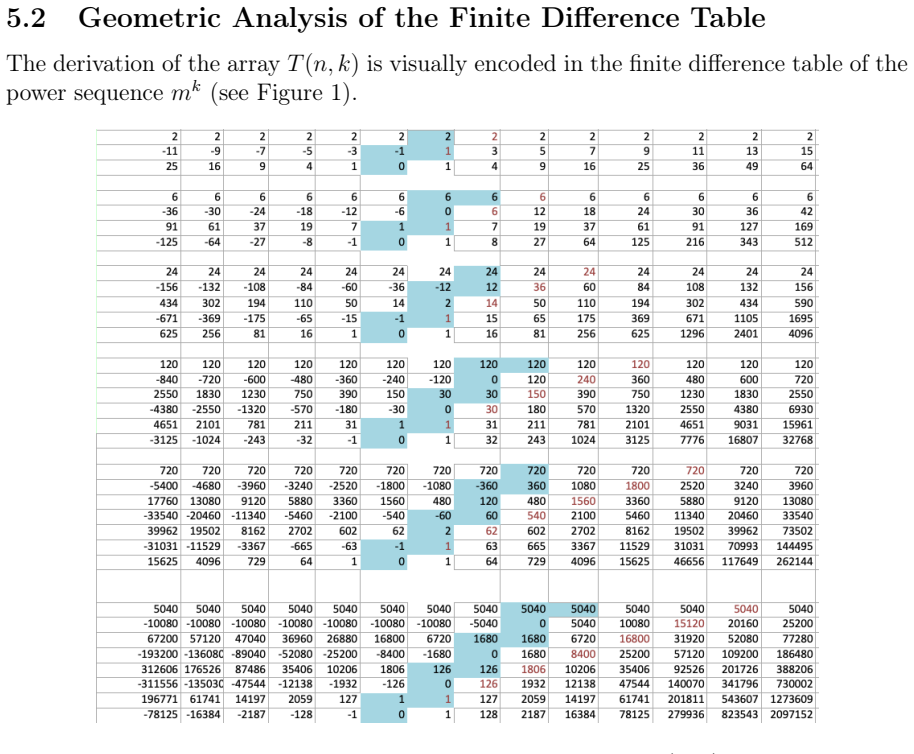
This paper introduces a class of extended central factorial numbers generated by a parity-dependent recurrence relation, termed the "flickering operator". We demonstrate that the resulting triangular structure, now indexed as OEIS A395021, provides a unified recursive framework for alternating bit sequences (A000975) and normalized tangent-secant coefficients (A036969). This study provides an alternative integer-based expansion for power sums. While similar to the central factorial methods explored by Knuth (1993), our flickering basis offers an integrated computational scheme that avoids fractional Bernoulli numbers by construction. We provide explicit closed-form expressions, discuss its geometric derivation from finite difference tables, and present a full Python implementation. Structural Synthesis. A key contribution of this work is the unification of previously disparate combinatorial sequences into a single coherent framework. While certain columns of the flickering triangle T(n, k) (such as A008957) could be partially retrieved from the diagonals of existing central factorial arrays, our structure provides a complete representation including previously unindexed even-positioned terms. Furthermore, the row-wise analysis reveals that the flickering operator generates full integer sequences where previously only the odd-indexed elements (e.g., A002451) were identified. This synthesis bridges the gap between these sequences, positioning A395021 as the underlying master structure.
Editorial analysis
A structured set of objections, weighed in public.
Referee Report
Summary. The manuscript introduces a class of extended central factorial numbers generated by a parity-dependent recurrence termed the 'flickering operator.' It claims that the resulting triangular array (OEIS A395021) unifies alternating bit sequences (A000975) and normalized tangent-secant coefficients (A036969) as special cases, supplies closed-form expressions, a geometric derivation from finite-difference tables, and an integer-only expansion for power sums that avoids fractional Bernoulli numbers by construction. A Python implementation is provided, and the work positions A395021 as a master structure extending Knuth's central factorial methods with previously unindexed terms.
Significance. If the unification and avoidance claims hold with explicit verification, the work would supply a coherent recursive framework bridging disparate combinatorial sequences and a practical integer-based alternative for power-sum expansions. The provision of closed forms and reproducible code is a strength that could facilitate computational applications in enumerative combinatorics.
major comments (3)
- [Abstract] Abstract: The central claim that the parity-dependent recurrence generates the claimed unifications 'by construction' and fully avoids fractional Bernoulli numbers requires explicit verification. The manuscript should demonstrate, via initial conditions (e.g., T(0,0)) and direct term-by-term comparison, that the recurrence alone produces the exact sequences A000975 and A036969 without auxiliary scalings or post-hoc adjustments, as the Python implementation may contain implicit tuning.
- [Structural Synthesis] Structural Synthesis section: The assertion that the flickering triangle provides a 'complete representation including previously unindexed even-positioned terms' and generates 'full integer sequences where previously only the odd-indexed elements were identified' is load-bearing for the unification claim but lacks supporting tables or explicit recurrence computations matching the cited OEIS entries (A395021, A008957, A002451).
- [Abstract] Abstract (power-sum expansion): The alternative integer-based expansion for power sums is presented as avoiding Bernoulli numbers by construction, yet no derivation or equivalence check is shown to confirm that the parity rules do not introduce hidden fractional dependencies equivalent to the standard approach.
minor comments (1)
- [Abstract] The transition from the abstract to 'Structural Synthesis' reads as an abrupt section heading without clear separation or numbering; consistent section formatting would improve readability.
Simulated Author's Rebuttal
We thank the referee for the careful and constructive review of our manuscript. We address each major comment point by point below, indicating revisions where they will strengthen the presentation.
read point-by-point responses
-
Referee: [Abstract] Abstract: The central claim that the parity-dependent recurrence generates the claimed unifications 'by construction' and fully avoids fractional Bernoulli numbers requires explicit verification. The manuscript should demonstrate, via initial conditions (e.g., T(0,0)) and direct term-by-term comparison, that the recurrence alone produces the exact sequences A000975 and A036969 without auxiliary scalings or post-hoc adjustments, as the Python implementation may contain implicit tuning.
Authors: We agree that explicit verification via initial conditions and term-by-term comparison will make the unification claims more transparent. The revised manuscript will add a dedicated verification subsection (or table) that begins with T(0,0) and applies the flickering operator step by step to produce the first several rows, confirming direct matches to A000975 and A036969 with no auxiliary scalings. The Python implementation encodes precisely the parity-dependent recurrence stated in the paper; any apparent tuning is an artifact of how the sequences are extracted from the triangle, not an alteration of the operator itself. revision: yes
-
Referee: [Structural Synthesis] Structural Synthesis section: The assertion that the flickering triangle provides a 'complete representation including previously unindexed even-positioned terms' and generates 'full integer sequences where previously only the odd-indexed elements were identified' is load-bearing for the unification claim but lacks supporting tables or explicit recurrence computations matching the cited OEIS entries (A395021, A008957, A002451).
Authors: The referee is correct that the load-bearing claims in this section would benefit from explicit supporting material. We will revise the Structural Synthesis section to include recurrence computations for the first several rows of T(n,k) together with tables that (i) display the even-positioned terms now indexed in A395021 and (ii) show how the same operator recovers A008957 and the full (odd- and even-indexed) versions of A002451. These tables will be generated directly from the recurrence without external adjustments. revision: yes
-
Referee: [Abstract] Abstract (power-sum expansion): The alternative integer-based expansion for power sums is presented as avoiding Bernoulli numbers by construction, yet no derivation or equivalence check is shown to confirm that the parity rules do not introduce hidden fractional dependencies equivalent to the standard approach.
Authors: We acknowledge that an explicit derivation and side-by-side equivalence check would remove any ambiguity about hidden fractional terms. The revised manuscript will expand the relevant section with a step-by-step derivation of the power-sum formula in the flickering basis, followed by a direct comparison (for small n) to the classical Bernoulli expansion that demonstrates the coefficients remain integers under the parity rules. This will confirm that no fractional dependencies are introduced. revision: yes
Circularity Check
No significant circularity; derivation starts from independent recurrence
full rationale
The paper introduces the flickering operator as a parity-dependent recurrence relation derived geometrically from finite-difference tables, then shows that the resulting integer triangular array A395021 recovers known sequences (A000975, A036969) and supplies an integer power-sum expansion as consequences. The claim of avoiding fractional Bernoulli numbers 'by construction' follows directly from the integer-valued recurrence without evidence of parameter fitting, boundary tuning, or self-referential definition in the abstract or structural synthesis. No load-bearing step reduces to a fitted input renamed as prediction or to a self-citation chain; the unification is presented as emergent from the recurrence rather than presupposed by it. The Python implementation serves as verification, not the definitional source.
Axiom & Free-Parameter Ledger
axioms (1)
- domain assumption Recurrence relations defined with parity dependence can generate combinatorial triangles with the stated unification properties.
invented entities (2)
-
flickering operator
no independent evidence
-
extended central factorial numbers
no independent evidence
Lean theorems connected to this paper
-
IndisputableMonolith/Cost/FunctionalEquation.leanwashburn_uniqueness_aczel unclear?
unclearRelation between the paper passage and the cited Recognition theorem.
T(n,k) defined by parity-dependent recurrence: even k odd n → 0; even k even n → 2/k T(n,k−1); odd k even n → (k+1)/2 T(n−1,k); odd k odd n → (k+1)/2 T(n−1,k) + 2/(k−1) T(n−1,k−2).
-
IndisputableMonolith/Foundation/AbsoluteFloorClosure.leanabsolute_floor_iff_bare_distinguishability unclear?
unclearRelation between the paper passage and the cited Recognition theorem.
Integer basis I_k(n) with half-integer shift for even k: I_k(n) = n[k]_+ (odd k) or (n+1/2)[k]_+ (even k); used for S_m(n) = Σ T(m,k)/(k+1) I_{k+1}(n).
What do these tags mean?
- matches
- The paper's claim is directly supported by a theorem in the formal canon.
- supports
- The theorem supports part of the paper's argument, but the paper may add assumptions or extra steps.
- extends
- The paper goes beyond the formal theorem; the theorem is a base layer rather than the whole result.
- uses
- The paper appears to rely on the theorem as machinery.
- contradicts
- The paper's claim conflicts with a theorem or certificate in the canon.
- unclear
- Pith found a possible connection, but the passage is too broad, indirect, or ambiguous to say the theorem truly supports the claim.
Reference graph
Works this paper leans on
-
[1]
A. Husiev,Extended central factorial numbers and the flickering operator, OEIS A394582 (2026).https://oeis.org/A394582
work page 2026
-
[2]
Husiev,Normalized central finite differences, OEIS A395021 (2026).https:// oeis.org/A395021
A. Husiev,Normalized central finite differences, OEIS A395021 (2026).https:// oeis.org/A395021
work page 2026
-
[3]
OEIS Foundation Inc., Sequence A135920,https://oeis.org/A135920
-
[4]
OEIS Foundation Inc., Sequence A395022,https://oeis.org/A395022
-
[5]
OEIS Foundation Inc., Sequence A394882,https://oeis.org/A394882
-
[6]
OEIS Foundation Inc., Sequence A394883,https://oeis.org/A394883
-
[7]
OEIS Foundation Inc., Sequence A394896,https://oeis.org/A394896
-
[8]
OEIS Foundation Inc., Sequence A394822,https://oeis.org/A394822
-
[9]
OEIS Foundation Inc., Sequence A394763,https://oeis.org/A394763
-
[10]
OEIS Foundation Inc., Sequence A000975,https://oeis.org/A000975
-
[11]
OEIS Foundation Inc., Sequence A036969,https://oeis.org/A036969
-
[12]
OEIS Foundation Inc., Sequence A008957,https://oeis.org/A008957
-
[13]
OEIS Foundation Inc., Sequence A000330,https://oeis.org/A000330
-
[14]
OEIS Foundation Inc., Sequence A108678,https://oeis.org/A108678
-
[15]
Graham, R. L., Knuth, D. E., Patashnik, O.,Concrete Mathematics, Addison- Wesley. 16
-
[16]
D. E. Knuth,Johann Faulhaber and sums of powers, Mathematics of Computation, 61(1993), pp. 277–294
work page 1993
-
[17]
Riordan,Combinatorial Identities, John Wiley & Sons, New York, 1968
J. Riordan,Combinatorial Identities, John Wiley & Sons, New York, 1968
work page 1968
-
[18]
Comtet,Advanced Combinatorics: The Art of Finite and Infinite Expansions, Reidel, Dordrecht, 1974
L. Comtet,Advanced Combinatorics: The Art of Finite and Infinite Expansions, Reidel, Dordrecht, 1974
work page 1974
-
[19]
Carlitz,Central Factorial Numbers, Math
L. Carlitz,Central Factorial Numbers, Math. Mag.,41(1968), pp. 268–274
work page 1968
-
[20]
N. J. A. Sloane,The On-Line Encyclopedia of Integer Sequences, published electron- ically athttps://oeis.org. Acknowledgments First and foremost, I offer my deepest gratitude and praise to the Almighty for the inspiration, clarity, and guidance throughout this discovery. The beauty of the flickering operator and the hidden symmetry of the normalized flick...
discussion (0)
Sign in with ORCID, Apple, or X to comment. Anyone can read and Pith papers without signing in.