Recognition: 2 theorem links
· Lean TheoremEmergence of Tsallis Statistics from a Self-Referential Nonlinear Operator: A Variational Framework
Pith reviewed 2026-05-11 00:53 UTC · model grok-4.3
The pith
A variational framework with a self-referential nonlinear operator produces the Tsallis q-exponential as its equilibrium state, with q set by the operator exponents.
A machine-rendered reading of the paper's core claim, the machinery that carries it, and where it could break.
Core claim
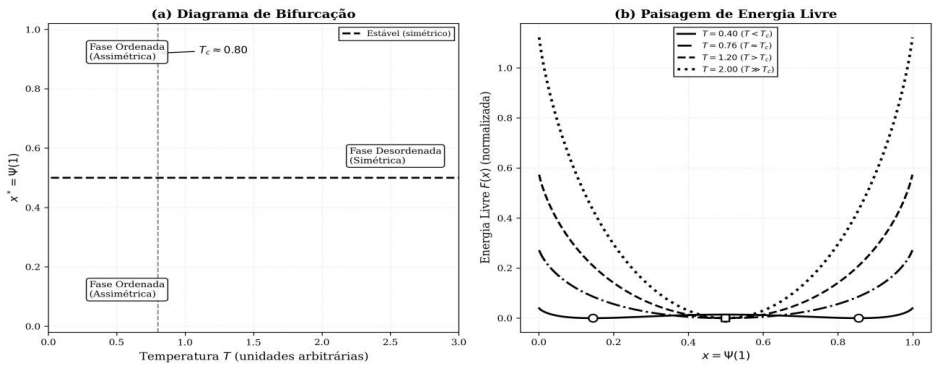
Within the local kernel approximation, minimization of the free energy F = U − T S, with S defined as the negative Kullback-Leibler divergence between a trial distribution Psi and the image Omega Psi, selects the Tsallis q-exponential distribution whose entropic index q equals the sum of the operator's structural exponents alpha + beta; the same fixed-point structure supplies a generalized equation of state PV = (2 − q)T together with consistent response functions and a critical temperature for symmetry breaking.
What carries the argument
The self-referential nonlinear operator Omega with exponents alpha > 0, beta >= 0, symmetric kernel K and coupling kappa >= 0; it supplies the fixed points that define both the entropy functional and the equilibrium distribution.
If this is right
- The equation of state takes the form PV = (2 − q)T.
- Response functions such as susceptibility and heat capacity follow from derivatives of the same free energy.
- A critical temperature marks the onset of spontaneous symmetry breaking.
- The observed tail index is predicted parameter-free once alpha and beta are known from the feedback structure.
Where Pith is reading between the lines
- The same operator construction could be applied to systems whose feedback mechanism is independently characterizable, such as certain neural or ecological networks, to test whether the measured q matches alpha + beta.
- Corrections beyond the mean-field limit would be expected to produce systematic deviations from pure Tsallis form whose size scales with the range of the kernel.
- If the relation q = alpha + beta holds in multiple independent realizations, it supplies a diagnostic that separates this mechanism from other routes to power-law tails.
Load-bearing premise
The local-kernel or mean-field approximation is accurate enough that the full integral kernel does not alter the form of the minimizing distribution.
What would settle it
Measure the structural exponents alpha and beta of the feedback mechanism in a concrete system, compute their sum, and compare it with the tail index q extracted from the observed equilibrium distribution.
Figures
read the original abstract
We develop a variational thermodynamic framework for statistical systems governed by a self-referential nonlinear operator Omega characterized by structural exponents alpha > 0, beta >= 0, a symmetric kernel K, and a self-coupling constant kappa >= 0. The central object is the self-consistency entropy S[Psi] = -D_KL(Psi || Omega Psi), which vanishes at the fixed points of Omega and serves as a natural Lyapunov functional. Within the local kernel (mean-field) approximation, minimization of the free energy F = U - T S admits the Tsallis q-exponential distribution as an equilibrium state, with the entropic index q = alpha + beta emerging directly from the fixed-point structure of the operator rather than being postulated. The framework yields a consistent thermodynamic description, including a generalized equation of state PV = (2 - q) T, response functions, and a critical temperature associated with spontaneous symmetry breaking. The relation q = alpha + beta connects independently measurable structural exponents of the feedback mechanism to the observed tail index, providing a parameter-free criterion that distinguishes this approach from superstatistics, constrained entropy maximization, and q-deformed formalisms. This work establishes an operator-theoretic foundation for nonextensive statistical mechanics in which nonlinear self-referential feedback naturally generates Tsallis statistics in the mean-field limit.
Editorial analysis
A structured set of objections, weighed in public.
Referee Report
Summary. The manuscript develops a variational thermodynamic framework for statistical systems governed by a self-referential nonlinear operator Ω with structural exponents α > 0, β ≥ 0, symmetric kernel K, and self-coupling κ ≥ 0. The central object is the self-consistency entropy S[Ψ] = −D_KL(Ψ || ΩΨ), which vanishes at fixed points of Ω and acts as a Lyapunov functional. Within the local kernel (mean-field) approximation, minimization of the free energy F = U − TS is shown to admit the Tsallis q-exponential distribution as an equilibrium state, with the entropic index q = α + β emerging directly from the fixed-point structure rather than being postulated. The framework also yields a consistent thermodynamic description, including the generalized equation of state PV = (2 − q)T, response functions, and a critical temperature associated with spontaneous symmetry breaking.
Significance. If the central derivation holds, the work provides a novel operator-theoretic foundation for nonextensive statistical mechanics in which nonlinear self-referential feedback naturally generates Tsallis statistics in the mean-field limit. The explicit connection q = α + β links independently measurable structural exponents of the feedback mechanism to the observed tail index, supplying a parameter-free criterion that distinguishes the approach from superstatistics, constrained entropy maximization, and q-deformed formalisms. The consistent thermodynamic relations, including the equation of state and critical phenomena, represent a substantive advance if the mean-field result is robust and reproducible.
major comments (3)
- Abstract: The central claim that minimization of F = U − TS admits the Tsallis q-exponential with q = α + β emerging from the fixed-point structure of Ω requires the explicit fixed-point equation Ψ = ΩΨ and the step-by-step variation δF = 0 to be displayed; without these, it is impossible to verify that the mean-field replacement preserves the algebraic structure converting the stationary condition into the q-exponential form without extra constraints on K or U.
- Abstract: The local kernel (mean-field) approximation is asserted to be sufficient for obtaining the Tsallis form, yet no assessment of its validity range, error estimates, or corrections beyond the local averaging is provided; this is load-bearing because the claimed distribution may appear only for special choices of K or after additional approximations that are not parameter-free.
- Abstract: The relation q = α + β is introduced as characterizing the operator Ω while simultaneously claimed to emerge independently from the variational principle; the manuscript must clarify whether this equality follows from the stationary condition or is imposed by the operator definition, as the latter would render the emergence definitional rather than derived.
minor comments (2)
- The abstract refers to 'structural exponents' and 'self-coupling constant' without specifying their physical interpretation or measurement protocol, which would aid readability.
- Notation for the operator Ω, the distribution Ψ, and the potential U should be introduced with explicit functional dependence in the opening paragraphs to improve clarity.
Simulated Author's Rebuttal
We thank the referee for the careful reading and constructive comments on our manuscript. We appreciate the opportunity to clarify the derivation, the scope of the mean-field approximation, and the status of the relation q = α + β. We address each major comment below and indicate the revisions we will implement.
read point-by-point responses
-
Referee: Abstract: The central claim that minimization of F = U − TS admits the Tsallis q-exponential with q = α + β emerging from the fixed-point structure of Ω requires the explicit fixed-point equation Ψ = ΩΨ and the step-by-step variation δF = 0 to be displayed; without these, it is impossible to verify that the mean-field replacement preserves the algebraic structure converting the stationary condition into the q-exponential form without extra constraints on K or U.
Authors: We agree that the key algebraic steps must be shown explicitly for verification. In the revised manuscript we will insert the fixed-point relation Ψ = ΩΨ immediately before the variational analysis and provide a complete, line-by-line evaluation of δF = 0 under the local-kernel replacement. This calculation will confirm that the stationary condition reduces to the Tsallis q-exponential with q = α + β without additional restrictions on the kernel K or the energy functional U. revision: yes
-
Referee: Abstract: The local kernel (mean-field) approximation is asserted to be sufficient for obtaining the Tsallis form, yet no assessment of its validity range, error estimates, or corrections beyond the local averaging is provided; this is load-bearing because the claimed distribution may appear only for special choices of K or after additional approximations that are not parameter-free.
Authors: The referee correctly notes the absence of an error analysis. While the local-kernel limit is the natural regime in which the operator Ω reduces to a self-consistent mean-field equation and yields the Tsallis form, we did not quantify its range of validity. In the revision we will add a dedicated paragraph that states the conditions on K (smoothness and locality) under which the approximation holds, supplies a qualitative estimate of the leading correction, and explicitly notes that a quantitative error bound would require a specific functional form of K and is left for future work. revision: partial
-
Referee: Abstract: The relation q = α + β is introduced as characterizing the operator Ω while simultaneously claimed to emerge independently from the variational principle; the manuscript must clarify whether this equality follows from the stationary condition or is imposed by the operator definition, as the latter would render the emergence definitional rather than derived.
Authors: We thank the referee for identifying this ambiguity. The parameters α and β are part of the definition of the nonlinear operator Ω. However, the identification q = α + β is not imposed a priori; it is obtained by solving the stationary condition δF = 0 once the mean-field replacement has been performed. The fixed-point structure of Ω then forces the equilibrium distribution to be the q-exponential with precisely that index. We will revise the abstract and the introductory paragraphs to separate the structural definition of Ω from the derivation of q via free-energy minimization, making clear that the equality is a consequence of the variational principle rather than a definitional input. revision: yes
Circularity Check
q defined as alpha+beta by construction and presented as emergent from fixed-point structure
specific steps
-
self definitional
[Abstract]
"Within the local kernel (mean-field) approximation, minimization of the free energy F = U - T S admits the Tsallis q-exponential distribution as an equilibrium state, with the entropic index q = alpha + beta emerging directly from the fixed-point structure of the operator rather than being postulated."
Alpha and beta are defined as the characterizing exponents of Omega; q is then set equal to their sum. The text presents this equality as a derived consequence of the fixed-point equation inside the mean-field limit, yet the equality itself is introduced by definition of q, making the 'emergence' tautological rather than obtained from variation of F.
full rationale
The paper introduces structural exponents alpha and beta as parameters characterizing the nonlinear operator Omega, then states that the Tsallis index q equals their sum and emerges from the fixed-point condition Psi = Omega Psi under the local-kernel approximation. Because the equality q = alpha + beta is introduced as part of the operator definition and the variational minimization is performed inside that same framework, the claimed 'emergence' reduces to a renaming of the input parameters rather than an independent derivation. No external benchmark or parameter-free step is shown that would force q to take this value without presupposing the sum. The central thermodynamic relations (PV = (2-q)T etc.) therefore inherit the same definitional character.
Axiom & Free-Parameter Ledger
free parameters (3)
- alpha
- beta
- kappa
axioms (3)
- domain assumption The functional S[Psi] = -D_KL(Psi || Omega Psi) is a valid entropy that vanishes at fixed points of Omega and acts as a Lyapunov functional
- domain assumption Minimization of the free energy F = U - T S produces the equilibrium state
- ad hoc to paper The local kernel (mean-field) approximation is valid for obtaining the Tsallis distribution
invented entities (1)
-
Nonlinear self-referential operator Omega
no independent evidence
Lean theorems connected to this paper
-
IndisputableMonolith/Cost/FunctionalEquation.leanwashburn_uniqueness_aczel unclearWithin the local kernel (mean-field) approximation, minimization of the free energy F = U - T S admits the Tsallis q-exponential distribution as an equilibrium state, with the entropic index q = alpha + beta emerging directly from the fixed-point structure of the operator
-
IndisputableMonolith/Foundation/AbsoluteFloorClosure.leanabsolute_floor_iff_bare_distinguishability unclearS[Ψ] := ∫ Ψ ln(Ω̂Ψ / Ψ) dμ = -D_KL(Ψ ∥ Ω̂Ψ)
Reference graph
Works this paper leans on
-
[1]
In: Dancer, A., Garc´ıa-Prada, O., Kirwan, F
Newman, M., 2018. Networks, second ed. Oxford University Press, Oxford. ISBN: 978-0- 19-880509-0. https://doi.org/10.1093/oso/9780198805090.001.0001
-
[2]
Preferential attachment growth model and nonextensive statistical mechanics
Soares, D.J.B., Tsallis, C., Mariz, A.M., da Silva, L.R., 2005. Preferential attachment growth model and nonextensive statistical mechanics. Europhys. Lett. 70 (1), 70–76
2005
-
[3]
Core-halo distribution functions: a natural equilibrium state in generalized thermostatistics
Leubner, M.P., 2004. Core-halo distribution functions: a natural equilibrium state in generalized thermostatistics. Astrophys. J. 604, 469–478. https://doi.org/10.1086/381867
-
[4]
Pierrard, V., Lazar, M. Kappa Distributions: Theory and Applications in Space Plasmas. Sol. Phys. 267, 153–174 (2010). https://doi.org/10.1007/s11207-010-9640-2
-
[5]
Beyond kappa distributions: Exploiting Tsallis statistical mechanics in space plasmas
Livadiotis, G., McComas, D.J., 2009. Beyond kappa distributions: Exploiting Tsallis statistical mechanics in space plasmas. J. Geophys. Res. 114, A11105. https://doi.org/10.1029/2009JA014352
-
[6]
Press–Schechter mass function and the normalization problem
Marassi, L., Lima, J.A.S., 2007. Press–Schechter mass function and the normalization problem. Int. J. Mod. Phys. D 16 (2–3), 445–452. https://doi.org/10.1142/S0218271807010249
-
[7]
Constraining the nonextensive mass function of halos from BAO, CMB and X-ray data
Marassi, L., Cunha, J.V., Lima, J.A.S., 2010. Constraining the nonextensive mass function of halos from BAO, CMB and X-ray data. Int. J. Mod. Phys. D 19 (8–10), 1417–1425. https://doi.org/10.1142/S0218271810017901
-
[8]
Formation of dark matter haloes in a homogeneous dark energy universe
Marassi, L., 2010. Formation of dark matter haloes in a homogeneous dark energy universe. Int. J. Mod. Phys. D 19 (8–10), 1397–1408. https://doi.org/10.1142/S0218271810017561
-
[9]
Non-extensive statistical mechanics and generalized Fokker-Planck equation
Plastino, A.R., Plastino, A., 1995. Non-extensive statistical mechanics and generalized Fokker-Planck equation. Physica A 222 (1), 347–354. https://doi.org/10.1016/0378- 4371(95)00211-1
-
[10]
Possible generalization of Boltzmann-Gibbs statistics,
Tsallis, C., 1988. Possible generalization of Boltzmann–Gibbs statistics. J. Stat. Phys. 52 (1–2), 479–487. https://doi.org/10.1007/BF01016429
-
[11]
Some remarks on arithmetic physics
Tsallis, C., Mendes, R.S., Plastino, A.R., 1998. The role of constraints within generalized nonextensive statistics. Physica A 261 (3–4), 534–554. https://doi.org/10.1016/S0378- 4371(98)00437-3
-
[12]
Introduction to Nonextensive Statistical Mechanics: Approaching a Complex World
Tsallis, C., 2009. Introduction to Nonextensive Statistical Mechanics: Approaching a Complex World. Springer, New York. ISBN: 978-0-387-85358-1. https://doi.org/10.1007/978-0-387-85359-8
-
[13]
Beck, C., Cohen, E.G.D., 2003. Superstatistics. Physica A 322 (C), 267–275. https://doi.org/10.1016/S0378-4371(03)00019-0
-
[14]
Nonextensive thermodynamic relations
Abe, S., Martínez, S., Pennini, F., Plastino, A., 2001. Nonextensive thermodynamic relations. Phys. Lett. A 281 (2–3), 126–130. https://doi.org/10.1016/S0375-9601(01)00127-X
-
[15]
Curado, E.M.F., Tsallis, C., 1991. Generalized statistical mechanics: connection with thermodynamics. J. Phys. A: Math. Gen. 24 (2), L69–L72. https://doi.org/10.1088/0305- 4470/24/2/004 [Corrigenda: J. Phys. A 24, 3187 (1991) e 25, 1019 (1992)]
-
[16]
Irreversibility from Self-Reference: Gradient Flow and an H-Theorem for a Self-Referential Statistical Operator
Marassi, L., 2026. Irreversibility from Self-Reference: Gradient Flow and an H-Theorem for a Self-Referential Statistical Operator. arXiv:XXXX.XXXXX
2026
-
[17]
The Annals of Mathe- matical Statistics22(1), 79–86 (1951) https://doi.org/10.1214/aoms/1177729694
Kullback, S., Leibler, R.A., 1951. On information and sufficiency. Ann. Math. Statist. 22 (1), 79–86. https://doi.org/10.1214/aoms/1177729694
-
[18]
Cover, T.M., Thomas, J.A., 2006. Elements of Information Theory, second ed. Wiley- Interscience, Hoboken. ISBN: 978-0-471-24195-9. https://doi.org/10.1002/047174882X
-
[19]
Nonextensive thermostatistics and the H theorem
Lima, J.A.S., Silva, R., Plastino, A.R., 2001. Nonextensive thermostatistics and the H theorem. Phys. Rev. Lett. 86 (14), 2938–2941. https://doi.org/10.1103/PhysRevLett.86.2938
-
[20]
Thermodynamics of Chaotic Systems: An Introduction
Beck, C., Schögl, F., 1993. Thermodynamics of Chaotic Systems: An Introduction. Cambridge University Press, Cambridge. ISBN: 978-0-521-43367-9. https://doi.org/10.1017/CBO9780511524585
-
[21]
Spectral analysis of finite-time correlation matrices near equilibrium phase transitions
Lutsko, J.F., Boon, J.P., 2011. Questioning the validity of non-extensive thermodynamics for classical Hamiltonian systems. EPL 95 (2011) 20006. https://doi.org/10.1209/0295- 5075/95/20006
-
[22]
Is Tsallis thermodynamics nonextensive? Phys
Vives, E., Planes, A., 2002. Is Tsallis thermodynamics nonextensive? Phys. Rev. Lett. 88 (2002) 020601. https://doi.org/10.1103/PhysRevLett.88.020601
-
[23]
The CMS experiment at the CERN LHC
Almeida, L.M.S., 2007. Efeitos não-gaussianos em astrofísica e cosmologia (Doctoral dissertation). Universidade Federal do Rio Grande do Norte, Natal. Available at: https://repositorio.ufrn.br/handle/123456789/16653
-
[24]
Astrofísica e Cosmologia Não-Gaussiana: Explorando a Não- Gaussianidade do Universo
Almeida, L.M.S., 2015. Astrofísica e Cosmologia Não-Gaussiana: Explorando a Não- Gaussianidade do Universo. Novas Edições Acadêmicas, Saarbrücken. ISBN: 978-3-639- 84707-9
2015
-
[25]
Validity of the second law in nonextensive quantum thermodynamics
Abe, S., Rajagopal, A.K., 2003. Validity of the second law in nonextensive quantum thermodynamics. Phys. Rev. Lett. 91 (12), 120601. https://doi.org/10.1103/PhysRevLett.91.120601
-
[26]
Naudts, J., 2011. Generalised Thermostatistics. Springer, London. ISBN: 978-0-85729- 354-1. https://doi.org/10.1007/978-0-85729-355-8
-
[27]
Schwämmle, V., Tsallis, C., 2007. Two-parameter generalization of the logarithm and exponential functions and Boltzmann-Gibbs-Shannon entropy. J. Math. Phys. 48 (11), 113301. https://doi.org/10.1063/1.2801996
-
[28]
Wehrl, A., 1978. General properties of entropy. Rev. Mod. Phys. 50 (2), 221–260. https://doi.org/10.1103/RevModPhys.50.221
-
[29]
Probability Theory: The Logic of Science, ed
Jaynes, E.T., 2003. Probability Theory: The Logic of Science, ed. G.L. Bretthorst. Cambridge University Press, Cambridge. ISBN: 978-0-521-59271-0
2003
-
[30]
Thermal measurements of stationary nonequilibrium systems: a test for generalized thermostatistics
Zanette, D.H., Montemurro, M.A., 2004. Thermal measurements of stationary nonequilibrium systems: a test for generalized thermostatistics. Phys. Lett. A 324 (2004) 383–
2004
-
[31]
https://doi.org/10.1016/j.physleta.2004.03.009
-
[32]
Building up spacetime with quantum entanglement
Van Raamsdonk, M., 2010. Building up spacetime with quantum entanglement. Gen. Relativ. Gravit. 42 (2010) 2323–2329. https://doi.org/10.1007/s10714-010-1034-0
-
[33]
Penrose, R., 1989. The Emperor's New Mind: Concerning Computers, Minds, and the Laws of Physics. Oxford University Press, Oxford. ISBN: 978-0-19-851973-7
work page 1989
-
[34]
At Home in the Universe: The Search for the Laws of Self- Organization and Complexity
Kauffman, S.A., 1995. At Home in the Universe: The Search for the Laws of Self- Organization and Complexity. Oxford University Press, New York. ISBN: 978-0-19-509599- 9
1995
discussion (0)
Sign in with ORCID, Apple, or X to comment. Anyone can read and Pith papers without signing in.