Recognition: 2 theorem links
· Lean TheoremThe Taylor Integral and a Generalization of the Discrete Fourier Transform
Pith reviewed 2026-05-11 00:44 UTC · model grok-4.3
The pith
A new integral based on Taylor measures generalizes the discrete Fourier transform and is invertible for any real or complex sequence under stated conditions.
A machine-rendered reading of the paper's core claim, the machinery that carries it, and where it could break.
Core claim
The Taylor integral based on Taylor measures emerges as a generalization of the discrete Fourier transform, and general conditions are identified for it to be invertible when applied to any real or complex sequence.
What carries the argument
The Taylor integral, defined using Taylor measures, which carries the generalization of the discrete Fourier transform and supports the stated invertibility.
If this is right
- Many standard mathematical concepts appear as special cases of the Taylor integral.
- The integral applies to arbitrary real or complex sequences.
- Invertibility is guaranteed once the identified general conditions are satisfied.
- Direct applications to problems in the mathematical sciences become available.
Where Pith is reading between the lines
- The same integral might serve as a common language for comparing different transforms that currently require separate theories.
- Numerical tests on finite sequences could quickly check whether the claimed reduction to the discrete Fourier transform holds in practice.
- If the measures extend naturally to continuous settings, the construction could link discrete and continuous Fourier analysis in a single framework.
Load-bearing premise
The Taylor measures can be defined rigorously so that the integral truly contains the discrete Fourier transform and satisfies the invertibility conditions without extra hidden restrictions.
What would settle it
A concrete real or complex sequence for which the Taylor integral fails to reduce to the discrete Fourier transform or for which inversion does not hold even though the proposed conditions are met.
Figures


read the original abstract
We propose a new integral based on Taylor measures, study its properties extensively, and we illustrate that it includes many concepts from mathematics as special cases. In particular, the new integral emerges as a generalization of the discrete Fourier transform, and we identify general conditions for it to be invertible when applied to any real or complex sequence. Applications to the mathematical sciences are also presented.
Editorial analysis
A structured set of objections, weighed in public.
Referee Report
Summary. The manuscript proposes a new integral based on Taylor measures, studies its properties, and claims that this integral generalizes the discrete Fourier transform while providing general conditions for invertibility when applied to arbitrary real or complex sequences. Applications to the mathematical sciences are also presented.
Significance. If the Taylor measures can be rigorously defined and the claimed reduction to the DFT holds without hidden restrictions on sequences or convergence, the work could provide a unifying framework bridging discrete transforms and integral representations, with potential utility in harmonic analysis and signal processing.
major comments (2)
- [Abstract] Abstract: The central claim that the Taylor integral generalizes the DFT for any real or complex sequence rests on the existence of suitable Taylor measures, but no explicit definition, construction, or axiomatic characterization of these measures is supplied, preventing verification of the reduction to the finite DFT sum over roots of unity.
- [Invertibility section (likely §4)] The invertibility conditions for arbitrary sequences require justification that no unstated restrictions (such as absolute summability, finite support, or analyticity) are implicitly imposed when interchanging limits, sums, and integrals in the definition; without this, the claim of applicability to any sequence cannot be assessed.
minor comments (1)
- [Introduction] Clarify notation for the new integral and measures upon first introduction to aid readability.
Simulated Author's Rebuttal
We thank the referee for their careful reading and constructive comments on our manuscript. We address each major comment below and will revise the paper accordingly to improve clarity and rigor.
read point-by-point responses
-
Referee: [Abstract] Abstract: The central claim that the Taylor integral generalizes the DFT for any real or complex sequence rests on the existence of suitable Taylor measures, but no explicit definition, construction, or axiomatic characterization of these measures is supplied, preventing verification of the reduction to the finite DFT sum over roots of unity.
Authors: We thank the referee for this observation. Section 2 of the manuscript introduces Taylor measures through an axiomatic characterization based on their moments reproducing Taylor coefficients (specifically, ∫ p(x) dμ(x) equals the constant term of the Taylor expansion of p for test functions p). The reduction to the DFT is illustrated in Section 3 via a specific choice of measure supported on roots of unity. However, we acknowledge that an explicit construction and direct verification of the finite sum were not presented in sufficient detail. In the revised manuscript, we will add a new subsection with an explicit construction using a weighted sum of Dirac measures at the Nth roots of unity and provide a step-by-step computation showing exact reduction to the standard DFT formula without hidden restrictions. revision: yes
-
Referee: [Invertibility section (likely §4)] The invertibility conditions for arbitrary sequences require justification that no unstated restrictions (such as absolute summability, finite support, or analyticity) are implicitly imposed when interchanging limits, sums, and integrals in the definition; without this, the claim of applicability to any sequence cannot be assessed.
Authors: We agree that explicit justification for interchanging limits, sums, and integrals is essential. The current derivation in Section 4 proceeds formally under the assumption that all expressions converge, which implicitly relies on conditions such as absolute convergence to apply Fubini or dominated convergence theorems. To address this, the revised version will include a dedicated proposition stating the minimal conditions (absolute summability for infinite sequences and finite support for the finite DFT case) under which the inversion formula holds rigorously, along with a brief discussion of cases where the integral is undefined for arbitrary sequences lacking these properties. This will remove any ambiguity about the scope of applicability. revision: yes
Circularity Check
No circularity identified; proposal presented without inspectable self-referential derivations or reductions.
full rationale
The paper proposes a new Taylor integral that generalizes the DFT and states invertibility conditions for sequences. No equations, definitions of Taylor measures, or derivation steps appear in the provided text (abstract only). Without specific mathematical content to quote or reduce (e.g., no self-definitional construction of the integral from DFT sums, no fitted parameters renamed as predictions, no load-bearing self-citations), no circular steps can be exhibited. The central claim remains a stated generalization rather than a derivation that collapses to its inputs by construction. This aligns with the default expectation of no circularity when no load-bearing reductions are visible.
Axiom & Free-Parameter Ledger
axioms (1)
- ad hoc to paper Taylor measures exist and can be used to define an integral with the claimed properties
invented entities (1)
-
Taylor integral
no independent evidence
Lean theorems connected to this paper
-
IndisputableMonolith/Cost/FunctionalEquation.leanwashburn_uniqueness_aczel unclearDefinition 1 (Taylor Integral)... I_{s,B}^{γ,a} = sum_{n in B} s_n a_n γ^n / n! = T_{γ, s·a}(B)
Reference graph
Works this paper leans on
-
[1]
Baraquin and N
I. Baraquin and N. Ratier. Uniqueness of the discrete Fourier transform.Signal Pro- cessing, 209:109041, 2023
2023
-
[2]
Beinert and M
R. Beinert and M. Hasannasab. Phase retrieval and system identification in dynamical sampling via Prony’s method.Advances in Computational Mathematics, 49(4):56, 2023
2023
-
[3]
N. L. Biggs.Codes: An introduction to information communication and cryptography. Springer, 2008
2008
-
[4]
Billingsley.Probability and Measure
P. Billingsley.Probability and Measure. John Wiley & Sons, 2013
2013
-
[5]
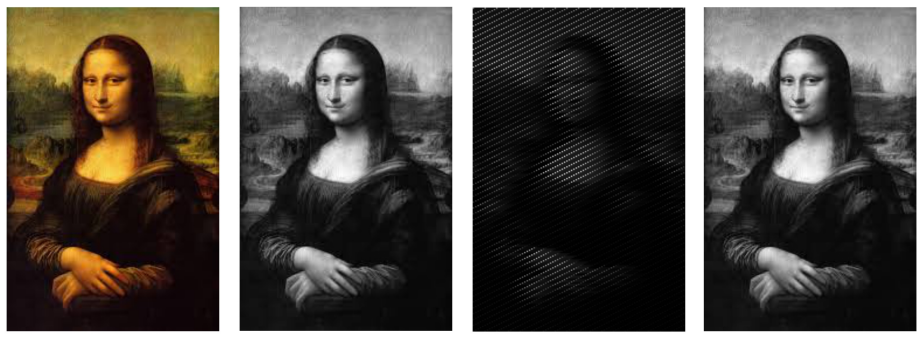
P. Borwein. An efficient algorithm for the Riemann zeta function. InCanadian Mathe- matical Society Conference Proceedings, volume 27, pages 29–34, 2000. 33 Figure 3: Left: The original Mona Lisa. Middle Left: Distorted image using Gaussian noise with mean 0 and standard deviationσ= 0.5. Middle Right: Smoothing of the distorted image. Right: Smoothing of ...
2000
-
[6]
K. S. Chan and F. Fekri. A block cipher cryptosystem using wavelet transforms over finite fields.IEEE Transactions on Signal Processing, 52(10):2975–2991, 2004
2004
-
[7]
T. S. Ferguson.A course in large sample theory. Routledge, Brookhaven, New York, 2017
2017
-
[8]
Freitag and R
E. Freitag and R. Busam.Complex analysis. Springer, 2005
2005
-
[9]
R. C. Gonzalez.Digital image processing. Pearson education India, 2009
2009
-
[10]
Guillera and J
J. Guillera and J. Sondow. Double integrals and infinite products for some classical constants via analytic continuations of Lerch’s transcendent.The Ramanujan Journal, 16(3):247–270, 2008
2008
-
[11]
Horv´ ath
L. Horv´ ath. Refining the integral Jensen inequality for finite signed measures using majorization.Revista de la Real Academia de Ciencias Exactas, F´ ısicas y Naturales. Serie A. Matem´ aticas, 118(3):129, 2024
2024
-
[12]
Horv´ ath
L. Horv´ ath. Integral Jensen–Mercer and related inequalities for signed measures with refinements.Mathematics, 13(3):539, 2025
2025
- [13]
-
[14]
Imran, A
M. Imran, A. B. Altamimi, W. Khan, S. Hussain, and M. Alsaffar. Quantum cryptogra- phy for future networks security: A systematic review.IEEE Access, 12:180048–180078, 2024. 34
2024
-
[15]
J. P. Keener.Principles of applied mathematics: transformation and approximation. CRC Press, 2018
2018
-
[16]
J. L. Massey. The discrete fourier transform in coding and cryptography.IEEE Inform, 1998
1998
-
[17]
A. McD. Mercer. A variant of Jensen’s inequality.J. Inequal. Pure Appl. Math, 4(4): 73, 2003
2003
-
[18]
A. C. Micheas.Theory of stochastic objects: probability, stochastic processes and infer- ence. Chapman and Hall/CRC, 2018
2018
-
[19]
A. C. Micheas. The Taylor measure and its applications.Mediterranean Journal of Mathematics, 22(8):1–23, 2025
2025
-
[20]
R. J. Muirhead.Aspects of multivariate statistical theory. John Wiley & Sons, 2009
2009
-
[21]
I. S. Reed and G. Solomon. Polynomial codes over certain finite fields.Journal of the society for industrial and applied mathematics, 8(2):300–304, 1960
1960
-
[22]
Roche, R
T. Roche, R. Gillard, and J.-L. Roch. Provable security against impossible differential cryptanalysis application to CS-cipher. InInternational Conference on Modelling, Com- putation and Optimization in Information Systems and Management Sciences, pages 597–606. Springer, 2008
2008
-
[23]
Salami and E
Y. Salami and E. Khajevand, V.and Zeinali. Cryptographic algorithms: a review of the literature, weaknesses and open challenges.J. Comput. Robot, 16(2):46–56, 2023
2023
-
[24]
Sasikumar and S
K. Sasikumar and S. Nagarajan. Comprehensive review and analysis of cryptography techniques in cloud computing.IEEE Access, 12:52325–52351, 2024
2024
-
[25]
W. Schramm. The Fourier transform of functions of the greatest common divisor. Integers, 8(1):1–7, 2008
2008
-
[26]
J. Sondow. Zeros of the alternating zeta function on the line r (s)= 1.The American mathematical monthly, 110(5):435–437, 2003
2003
-
[27]
S. E. Umbaugh.Digital image processing and analysis: human and computer vision applications with CVIPtools. CRC press, 2010
2010
-
[28]
Vaudenay
S. Vaudenay. On the security of CS-cipher. InInternational Workshop on Fast Software Encryption, pages 260–274. Springer, 1999
1999
-
[29]
P. T. Young. Global series for height 1 multiple zeta functions.European Journal of Mathematics, 9(4):99, 2023
2023
-
[30]
Zheng.Modern cryptography Volume 1: A classical introduction to informational and mathematical principle
Z. Zheng.Modern cryptography Volume 1: A classical introduction to informational and mathematical principle. Springer, 2022. 35
2022
discussion (0)
Sign in with ORCID, Apple, or X to comment. Anyone can read and Pith papers without signing in.