Recognition: no theorem link
Dynamic thermal sensitivity of microwave cryogenic sapphire resonator
Pith reviewed 2026-05-11 00:53 UTC · model grok-4.3
The pith
Cryogenic sapphire resonators show a memory effect in temperature sensitivity caused by Cr3+ impurity relaxation.
A machine-rendered reading of the paper's core claim, the machinery that carries it, and where it could break.
Core claim
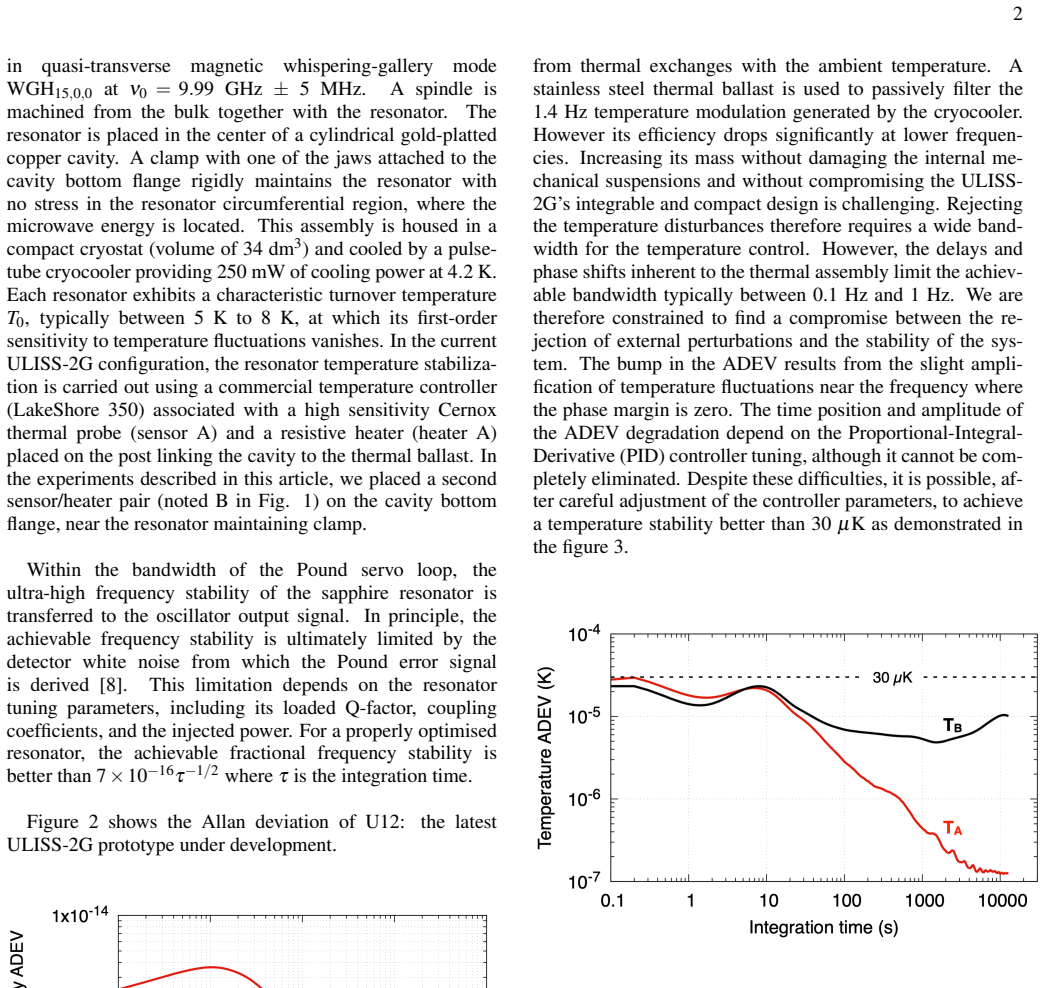
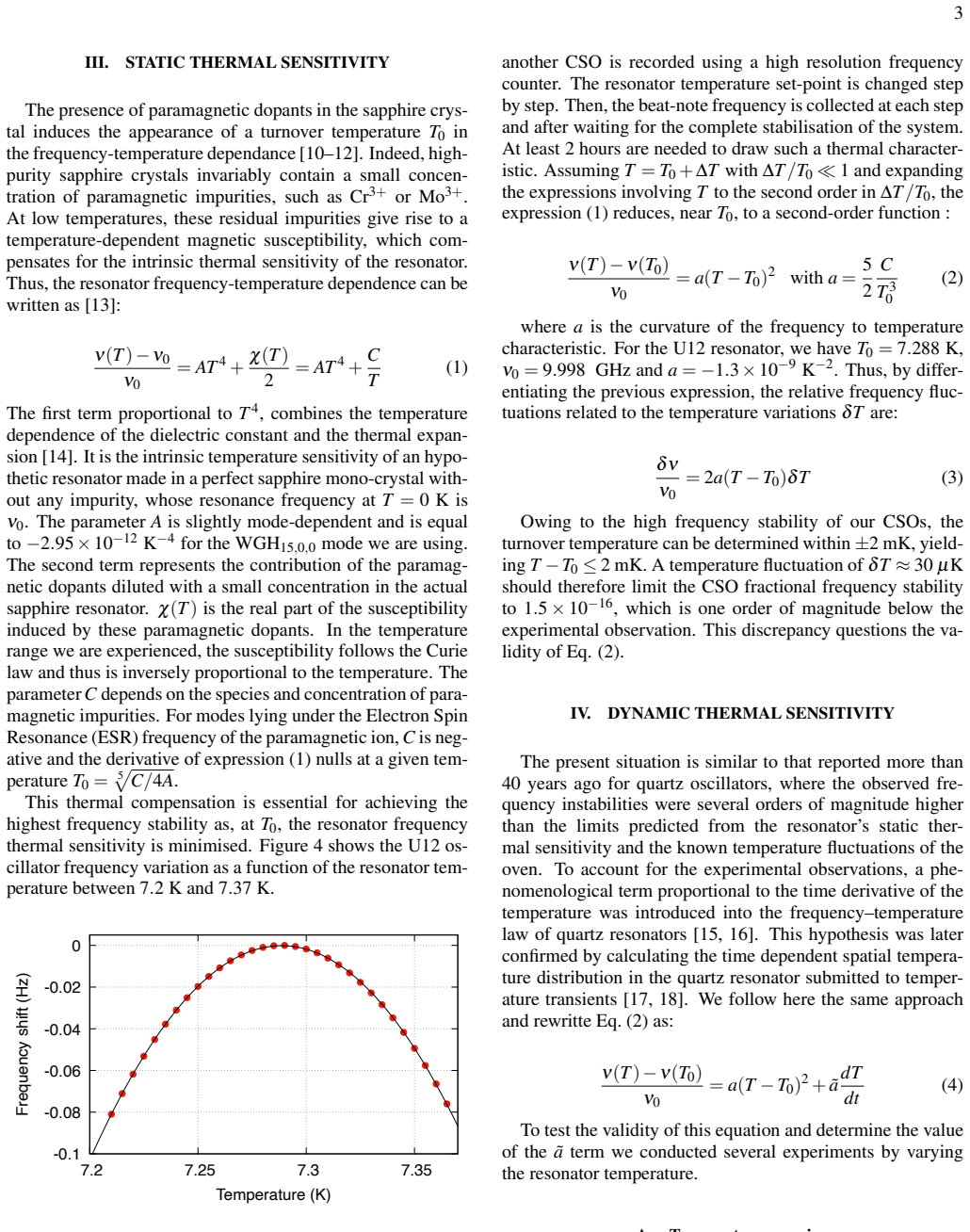
We have discovered a memory effect in the temperature sensitivity of a cryogenic sapphire microwave resonator, at the heart of the ultra-stable Cryogenic Sapphire Oscillators (CSOs). Such effect is due to the relaxation time of Cr3+ impurities, and results in hysteresis in the frequency vs temperature behavior. These paramagnetic impurities, always present in synthetic sapphire, produce a temperature turning point which is necessary to achieve ultimate frequency stability. The practical implication on the CSO is that the sapphire resonator's frequency depends on the rate of temperature change. This dynamical thermal sensitivity results in a wide bump in the Allan deviation at 10 s, where the
What carries the argument
The finite relaxation time of Cr3+ paramagnetic impurities, which produces a memory effect that makes resonator frequency sensitive to the rate of temperature change.
If this is right
- Resonator frequency depends on the rate of temperature change in addition to the absolute temperature value.
- A broad bump appears in the Allan deviation near 10 s integration time, degrading frequency stability.
- The magnitude of the stability degradation scales with the species and concentration of the dominant paramagnetic impurity.
- Hysteresis appears in the frequency-versus-temperature characteristic when temperature is swept in opposite directions.
Where Pith is reading between the lines
- Reducing Cr3+ concentration during crystal growth could suppress the rate-dependent sensitivity and improve short-term stability.
- The same relaxation mechanism may appear in other cryogenic dielectric resonators that contain paramagnetic centers.
- Active compensation of the memory effect could be achieved by controlling the temperature ramp rate during operation.
Load-bearing premise
The observed memory effect and hysteresis are produced by the relaxation dynamics of Cr3+ impurities, which dominate the temperature turning point and dynamic sensitivity.
What would settle it
A measurement showing no rate dependence of frequency or no hysteresis in a resonator fabricated from sapphire with negligible Cr3+ concentration would falsify the claim.
Figures




read the original abstract
We have discovered a memory effect in the temperature sensitivity of a cryogenic sapphire microwave resonator, at the heart of the ultra-stable Cryogenic Sapphire Oscillators (CSOs). Such effect is due to the relaxaxtion time of Cr3+ impurities, and results in hysteresis in the frequency vs temperature behavior, These paramagnetic impurities, always present in synthetic sapphire, produce a temperature turning point which is necessary to achieve ultimate frequency stability. The practical implication on the CSO is that the sapphire resonators's frequency depends on the rate of temperature change. This dynamical thermal sensitivity results in a wide bump in the Allan deviation at 10 s integration time, where the frequency stability is degraded. The actual degradation depends on the specie and on the amount of the dominant paramagnetic impurity.
Editorial analysis
A structured set of objections, weighed in public.
Referee Report
Summary. The manuscript reports the discovery of a memory effect in the temperature sensitivity of cryogenic sapphire microwave resonators used in Cryogenic Sapphire Oscillators (CSOs). The effect is attributed to the finite relaxation time of Cr^{3+} paramagnetic impurities always present in synthetic sapphire, producing hysteresis in the frequency-temperature curve and making the resonator frequency dependent on the rate of temperature change. This dynamic sensitivity is said to cause a bump in the Allan deviation around 10 s integration time, degrading stability in a manner that depends on the type and concentration of the dominant paramagnetic impurity.
Significance. If the causal attribution holds and is quantified, the result would be significant for ultra-stable frequency metrology, as it identifies a previously unrecognized dynamic limit on CSO performance at short averaging times beyond the well-known static paramagnetic turning point. This could inform material selection, impurity control, and thermal regulation strategies to improve oscillator stability.
major comments (2)
- Abstract: the central claim that the observed hysteresis and Allan-deviation bump at ~10 s arise specifically from the spin-lattice relaxation time of Cr^{3+} impurities is load-bearing but unsupported by any quantitative comparison of measured transient time constants to literature values for Cr^{3+} at cryogenic temperatures or by controlled variation of Cr concentration.
- Abstract: no experimental details, measurement protocols, error analysis, or controls are described that would permit verification of the memory effect or its attribution, limiting the defensibility of the stability-degradation claim.
minor comments (2)
- Abstract contains a typographical error: 'relaxaxtion' should be 'relaxation'.
- Abstract: 'specie' should be 'species'.
Simulated Author's Rebuttal
We thank the referee for their detailed and constructive review. The comments identify important areas for strengthening the attribution and presentation of our results on the dynamic thermal sensitivity in cryogenic sapphire resonators. We address each major comment below and indicate the revisions we will make.
read point-by-point responses
-
Referee: [—] Abstract: the central claim that the observed hysteresis and Allan-deviation bump at ~10 s arise specifically from the spin-lattice relaxation time of Cr^{3+} impurities is load-bearing but unsupported by any quantitative comparison of measured transient time constants to literature values for Cr^{3+} at cryogenic temperatures or by controlled variation of Cr concentration.
Authors: We agree that a direct quantitative comparison between our measured transient time constants and published spin-lattice relaxation times for Cr^{3+} in sapphire at cryogenic temperatures would strengthen the causal link. In the revised manuscript we will add this comparison, citing relevant literature values and showing that the observed hysteresis timescales are consistent with them. On controlled variation of Cr concentration, our data were obtained on available high-purity synthetic sapphire samples in which Cr^{3+} is the dominant paramagnetic impurity; we have noted the dependence on impurity species and concentration through comparison with resonators having different dominant impurities. A dedicated series of samples with systematically varied Cr doping is not available to us at present and would constitute a separate study, but we will clarify this limitation in the text. revision: partial
-
Referee: [—] Abstract: no experimental details, measurement protocols, error analysis, or controls are described that would permit verification of the memory effect or its attribution, limiting the defensibility of the stability-degradation claim.
Authors: The abstract is written to be concise. Full experimental protocols—including the temperature-ramp procedures used to reveal the memory effect, the microwave measurement chain, the Allan-deviation analysis, and the controls (comparison of static versus dynamic temperature conditions and multiple ramp rates)—are provided in the Methods and Results sections. We will revise the abstract to include a brief statement of the key experimental approach and controls so that the central claim is more readily verifiable from the abstract alone. revision: yes
Circularity Check
No circularity: purely experimental observation with no derivation or self-referential fitting
full rationale
The manuscript reports laboratory measurements of hysteresis and rate-dependent frequency shifts in a cryogenic sapphire resonator, attributing the ~10 s memory effect to the known spin-lattice relaxation of Cr3+ ions. No equations, ansatzes, fitted parameters, or predictions appear; the central claim is an empirical correlation between observed time scales and established impurity physics. No self-citations are invoked to justify uniqueness or to close a logical loop. The paper therefore contains no load-bearing step that reduces to its own inputs by construction.
Axiom & Free-Parameter Ledger
Reference graph
Works this paper leans on
-
[1]
Fluhr, B
C. Fluhr, B. Dubois, C. E. Calosso, F. Vernotte, E. Rubiola, and V . Giordano, Applied Physics Letters123, 044107 (2023)
2023
-
[2]
Giordano, S
V . Giordano, S. Grop, B. Dubois, P.-Y . Bourgeois, Y . Kersalé, E. Rubiola, G. Haye, V . Dolgovskiy, N. Bucalovicy, G. D. Domenico, S. Schilt, J. Chauvin, and D. Valat, Review of Sci- entific Instruments83(2012)
2012
-
[3]
J. G. Hartnett, N. R. Nand, and C. Lu, Applied Physics Letters 100, 183501(1 (2012)
2012
-
[4]
Fluhr, B
C. Fluhr, B. Dubois, G. Le Tetu, V . Soumann, J. Paris, E. Ru- biola, and V . Giordano, IEEE Transactions on Instrumentation and Measurement72, 1 (2023)
2023
-
[5]
Fluhr, S
C. Fluhr, S. Grop, B. Dubois, Y . Kersalé, E. Rubiola, and V . Giordano, IEEE Transactions on Ultrasonics, Ferroelectrics and Frequency Control63, 915 (2016)
2016
-
[6]
Fluhr, B
C. Fluhr, B. Dubois, S. Grop, J. Paris, G. Le Tetû, and V . Gior- dano, Cryogenics80, 164 (2016)
2016
-
[7]
https://www.femto-engineering.fr/en/realisation/uliss- cryogenic-sapphire-oscillator/
-
[8]
Giordano, C
V . Giordano, C. Fluhr, B. Dubois, and E. Rubiola, Review of Scientific Instruments87, 084702 (2016)
2016
-
[9]
Giordano, J.-L
V . Giordano, J.-L. Masson, G. Cabodevila, E. Rubiola, Y . Ker- salé, P.-Y . Bourgeois, G. Haye, S. Grop, and B. Dubois, in2013 Joint European Frequency and Time Forum & International Frequency Control Symposium (EFTF/IFC)(IEEE, 2013) pp. 442–444
2013
-
[10]
Bun’kov, V
S. Bun’kov, V . Konstantinov, V . Masalov, and P. Smirnov, Mea- surement Techniques29, 101 (1986)
1986
-
[11]
Giles, A
A. Giles, A. Mann, S. Jones, D. Blair, and M. Buckingham, Physica B: Condensed Matter165, 145 (1990)
1990
-
[12]
Giordano, C
V . Giordano, C. Fluhr, S. Grop, and B. Dubois, IEEE Transac- tions on Microwave Theory and Techniques64, 78 (2016)
2016
-
[13]
A. G. Mann, A. J. Giles, D. G. Blair, and M. J. Buckingham, J. Phys. D: Appl. Phys.25, 1105 (1992)
1992
-
[14]
A. N. Luiten, A. G. Mann, and D. G. Blair, J. Phys. D: Appl. Phys.29, 2082 (1996)
2082
-
[15]
Ballato, IEEE Transactions on Sonics Ultrasonics26, 299 (1979)
A. Ballato, IEEE Transactions on Sonics Ultrasonics26, 299 (1979). 8
1979
-
[16]
Gagnepain, inProceedings of the 43rd Annual Symposium on Frequency Control(IEEE, 1989) pp
J.-J. Gagnepain, inProceedings of the 43rd Annual Symposium on Frequency Control(IEEE, 1989) pp. 242–247
1989
-
[17]
Valentin, G
J. Valentin, G. Theobald, and J. Gagnepain, inProceedings of the Annual IEEE International Frequency Control Symposium (1984) pp. 157–163
1984
-
[18]
Y . S. Shmaliy, O. P. Kurochka, E. G. Sokolinskiy, and O. E. Rudnev, ieee transactions on ultrasonics, ferroelectrics, and fre- quency control46, 1396 (1999)
1999
-
[19]
Ekin,Experimental techniques for low-temperature measure- ments: cryostat design, material properties and superconductor critical-current testing(Oxford university press, 2006)
J. Ekin,Experimental techniques for low-temperature measure- ments: cryostat design, material properties and superconductor critical-current testing(Oxford university press, 2006)
2006
-
[20]
Section 6.7 D. M. Pozar,Microwave engineering(John Wiley & Sons, 2011)
2011
-
[21]
K. J. Standley and R. A. Vaughan, Physical Review139, 355 (1965)
1965
-
[22]
Bates, J
C. Bates, J. Bentley, R. Lees, and W. Moore, Journal of Physics C: Solid State Physics2, 1970 (1969)
1970
-
[23]
V . K. Sewani, R. J. Stöhr, R. Kolesov, H. H. Vallabhapurapu, T. Simmet, A. Morello, and A. Laucht, Physical Review B102, 104114 (2020)
2020
-
[24]
D. W. Hahn and M. N. Özisik,Heat conduction(John Wiley & Sons, 2012)
2012
-
[25]
A. E. Siegman,Microwave Solid-state Maser(McGraw-Hill, New York, 1964)
1964
-
[26]
Rubiola and F
E. Rubiola and F. Vernotte, IEEE Transactions on Microwave Theory and Techniques , 1 (2023)
2023
-
[27]
Q. Bao, M. Xu, A. Tsuchiya, and R. Li, inIOP conference series: materials science and engineering, V ol. 101 (IOP Pub- lishing, 2015) p. 012136
2015
-
[28]
X. Zhi, R. Cao, C. Huang, K. Wang, and L. Qiu, Applied Ther- mal Engineering192, 116921 (2021)
2021
-
[29]
E. G. Sharoyan, O. S. Torosyan, E. A. Markosyan, and V . T. Gabrielyan, Physica Status Solidi (b)65(1974)
1974
-
[30]
Giordano, S
V . Giordano, S. Grop, C. Fluhr, B. Dubois, Y . Kersalé, and E. Rubiola, Journal of Physics: Conference Series723, 012030 (2016)
2016
discussion (0)
Sign in with ORCID, Apple, or X to comment. Anyone can read and Pith papers without signing in.