Recognition: 2 theorem links
· Lean TheoremExploring the Boundaries of Differentiable Radiation Transport and Detector Simulation
Pith reviewed 2026-05-11 00:46 UTC · model grok-4.3
The pith
Stopping gradient flow at unstable material boundaries yields usable derivatives for optimizing radiation detector designs.
A machine-rendered reading of the paper's core claim, the machinery that carries it, and where it could break.
Core claim
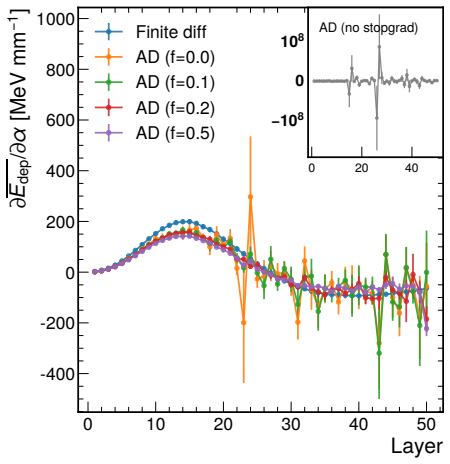
When step-wise radiation transport is differentiated, rare extreme sensitivities at material boundaries drive exploding gradients that propagate through subsequent shower development. Detecting these identifiable unstable conditions and stopping gradient flow through the associated boundary-crossing operations removes the explosion while preserving the original forward simulation. The resulting derivatives are stable and directly usable for optimization, as shown in a detector-design problem.
What carries the argument
Targeted stopping of gradient propagation through boundary-crossing operations under identifiable unstable conditions.
If this is right
- Stable, optimization-ready gradients become available for detector design tasks involving electromagnetic showers.
- The forward particle transport and shower development remain identical to the non-differentiated case.
- Gradient explosions that previously made differentiation impractical are prevented from propagating through multiple transport steps.
- The method applies to Geant4-like simulations with full electromagnetic physics without requiring changes to the underlying physics models.
Where Pith is reading between the lines
- The same boundary-stopping idea could be tested in other Monte Carlo codes that contain discontinuities at material interfaces.
- End-to-end differentiable pipelines that combine transport with downstream reconstruction or machine-learning layers become feasible.
- The technique may generalize to any simulation whose discontinuities are localized and detectable at runtime.
Load-bearing premise
Unstable boundary conditions can be detected reliably enough that halting gradients there preserves useful optimization information without bias or missed sensitivities.
What would settle it
Run the mitigated differentiable simulator to optimize a detector geometry parameter such as layer thickness, then compare the obtained optimum against the true minimum found by a grid search or derivative-free optimizer on the same forward model; mismatch beyond numerical tolerance would falsify the claim.
Figures




read the original abstract
We present an application of automatic differentiation for particle transport through matter using a Geant4-like radiation transport simulation with a full electromagnetic physics model. When differentiating this step-based transport, we observe exploding gradients driven by rare but extreme sensitivities at material boundaries, which propagate through subsequent transport and shower development. To obtain usable derivatives for optimization, we introduce a targeted mitigation strategy that stops gradient propagation through boundary-crossing operations under identifiable unstable conditions while leaving the forward (primal) simulation unchanged. We demonstrate that this enables stable, optimization-ready gradients in a detector-design problem.
Editorial analysis
A structured set of objections, weighed in public.
Referee Report
Summary. The manuscript applies automatic differentiation to a Geant4-like radiation transport simulation with a full electromagnetic physics model. It identifies exploding gradients caused by rare but extreme sensitivities at material boundaries during step-based transport and shower development. The authors introduce a mitigation that stops gradient propagation through boundary-crossing operations under identifiable unstable conditions while leaving the forward simulation unchanged, and they claim this produces stable, optimization-ready gradients for a detector-design problem.
Significance. If the mitigation can be shown to preserve physically relevant sensitivities without bias, the work would be significant for enabling gradient-based optimization in full-physics detector simulations, a longstanding challenge in the field. The targeted, non-invasive handling of numerical instability is a pragmatic contribution that could influence differentiable physics approaches more broadly. The current lack of quantitative validation metrics, however, prevents a firm assessment of practical utility.
major comments (2)
- [Abstract] Abstract: the central claim that the mitigation 'enables stable, optimization-ready gradients in a detector-design problem' is presented without any quantitative results, validation metrics, implementation details on unstable-condition detection, or comparison to unmitigated gradients. This absence makes it impossible to determine whether the reported stability is usable for optimization or merely numerical.
- [mitigation strategy] Description of the mitigation strategy: stopping gradients at detected unstable boundary crossings risks omitting dominant sensitivities at material interfaces, which control shower containment, energy deposition, and detector response. The manuscript provides no evidence or test that the heuristic reliably separates unstable from stable contributions without introducing bias into the loss landscape or missing critical parameter sensitivities.
minor comments (2)
- [Abstract] The abstract does not specify the detector-design objective function, the parameters being optimized, or the scale of the simulation used in the demonstration.
- Notation for 'unstable conditions' and the precise criterion for stopping gradients is not defined in the provided summary, which hinders reproducibility.
Simulated Author's Rebuttal
We thank the referee for their constructive review and recognition of the potential significance of applying automatic differentiation to full-physics radiation transport. We address each major comment below and will revise the manuscript to incorporate additional quantitative details and validation as outlined.
read point-by-point responses
-
Referee: [Abstract] Abstract: the central claim that the mitigation 'enables stable, optimization-ready gradients in a detector-design problem' is presented without any quantitative results, validation metrics, implementation details on unstable-condition detection, or comparison to unmitigated gradients. This absence makes it impossible to determine whether the reported stability is usable for optimization or merely numerical.
Authors: We agree that the abstract is concise and omits specific quantitative metrics. The manuscript body presents a detector-design optimization example in which unmitigated gradients explode while the mitigated version yields stable derivatives that enable convergence to a physically reasonable design. We will revise the abstract to include a brief reference to the observed gradient stability improvement and optimization success, and we will expand the main text with explicit implementation details on the unstable-condition detection criteria along with a direct comparison of gradient behavior with and without mitigation. revision: yes
-
Referee: [mitigation strategy] Description of the mitigation strategy: stopping gradients at detected unstable boundary crossings risks omitting dominant sensitivities at material interfaces, which control shower containment, energy deposition, and detector response. The manuscript provides no evidence or test that the heuristic reliably separates unstable from stable contributions without introducing bias into the loss landscape or missing critical parameter sensitivities.
Authors: This concern is well-founded and we acknowledge that the current manuscript does not provide explicit quantitative tests isolating the effect on interface sensitivities. The mitigation is applied only under identifiable unstable conditions (extreme local sensitivities during boundary crossings in step-based transport) while the forward simulation remains completely unchanged, preserving all physical quantities such as energy deposition and shower development. In the detector-design example the resulting gradients produce optimization outcomes consistent with expected physics. To address the gap, we will add in the revision a set of controlled tests comparing the loss landscape, gradient norms, and final optimized parameters with and without the heuristic, including checks that critical material-interface sensitivities are retained. revision: yes
Circularity Check
No significant circularity; mitigation is an independent engineering response to observed instability
full rationale
The paper identifies exploding gradients as an observed numerical issue arising at material boundaries during differentiation of step-based EM transport. It then proposes an explicit mitigation—stopping gradient propagation through boundary-crossing operations only under identifiable unstable conditions—while leaving the primal forward simulation unchanged. This is demonstrated on a detector-design optimization task. No equations or claims reduce by construction to fitted inputs, self-definitions, or load-bearing self-citations; the forward pass and the gradient-stopping rule are described as separate interventions. The derivation chain is therefore self-contained against external benchmarks and does not exhibit any of the enumerated circularity patterns.
Axiom & Free-Parameter Ledger
axioms (2)
- standard math Standard automatic differentiation rules apply to step-based particle transport operations
- domain assumption Unstable boundary conditions can be identified without altering the forward physics
Lean theorems connected to this paper
-
IndisputableMonolith/Foundation/AlexanderDuality.leanalexander_duality_circle_linking unclear?
unclearRelation between the paper passage and the cited Recognition theorem.
we introduce a targeted mitigation strategy that stops gradient propagation through boundary-crossing operations under identifiable unstable conditions
-
IndisputableMonolith/Cost/FunctionalEquation.leanwashburn_uniqueness_aczel unclear?
unclearRelation between the paper passage and the cited Recognition theorem.
the realized step length L = min(Lphys, Lbnd)
What do these tags mean?
- matches
- The paper's claim is directly supported by a theorem in the formal canon.
- supports
- The theorem supports part of the paper's argument, but the paper may add assumptions or extra steps.
- extends
- The paper goes beyond the formal theorem; the theorem is a base layer rather than the whole result.
- uses
- The paper appears to rely on the theorem as machinery.
- contradicts
- The paper's claim conflicts with a theorem or certificate in the canon.
- unclear
- Pith found a possible connection, but the passage is too broad, indirect, or ambiguous to say the theorem truly supports the claim.
Reference graph
Works this paper leans on
-
[1]
Agostinelli Set al.2003 Geant4—a simulation toolkitNucl. Instrum. Methods Phys. Res., Sect. A506250–303 doi:10.1016/S0168-9002(03)01368-8
-
[2]
Allison Jet al.2006 Geant4 developments and applicationsIEEE Trans. Nucl. Sci.53270–278 doi:10.1109/TNS.2006.869826
-
[3]
Allison Jet al.2016 Recent developments in Geant4Nucl. Instrum. Methods Phys. Res., Sect. A835186–225 doi:10.1016/j.nima.2016.06.125
-
[4]
Zein S A, Bordage M C, Francis Z, Macetti G, Genoni A, Cappello C D, Shin W G and Incerti S 2021 Electron transport in DNA bases: An extension of the Geant4-DNA Monte Carlo toolkit Nucl. Instrum. Methods Phys. Res., Sect. B48870–82 doi:10.1016/j.nimb.2020.11.021
-
[5]
Dom´ ınguez-Mu˜ noz A D, Gallardo M I, Bordage M C, Francis Z, Incerti S and Cort´ es- Giraldo M A 2022 A model for Geant4-DNA to simulate ionization and excitation of liquid water by protons travelling above 100 MeVRadiat. Phys. Chem.199110363 doi:10.1016/j.radphyschem.2022.110363
-
[6]
Ganjgah A A and Taherparvar P 2024 The effects of cell displacement on DNA damages in targeted radiation therapy using Geant4-DNASci. Rep.1481863 doi:10.1038/s41598-024- 81863-4
-
[7]
Tabbakh F 2024 Significance of the proton energy loss mechanism to gold nanoparticles in proton therapy: a Geant4 simulationScientific Reports1476244 doi:10.1038/s41598-024-76244-w
-
[8]
Shin W Get al.2021 A Geant4-DNA Evaluation of Radiation-Induced DNA Damage on a Human FibroblastCancers134940 doi:10.3390/cancers13194940
-
[9]
Chappuis F, Tran H N, Zein S A, Bailat C, Incerti S, Bochud F and Desorgher L 2023 The general-purpose Geant4 Monte Carlo toolkit and its Geant4-DNA extension to investigate mechanisms underlying the FLASH effect in radiotherapy: Current status and challenges Physica Med.110102601 doi:10.1016/j.ejmp.2023.102601
-
[10]
Simhony Y, Segal A, Amrani O and Etzion E 2025 High-end space electronics: Active shielding to mitigate catastrophic single-event effectsAerosp. Sci. Technol.169111344 doi:10.1016/j.ast.2025.111344
-
[11]
Negm H and Ohgaki H 2024 Validation of GEANT4 simulation for active materials in- terrogation using nuclear resonance fluorescenceJ. Radiat. Res. Appl. Sci.17101209 doi:10.1016/j.jrras.2024.101209
-
[12]
MacFadden N, Peggs S and Gulliford C 2018 Development and Validation of a Geant4 Radiation Shielding Simulation Framework doi:10.2172/1515417
-
[13]
Baydin A G, Pearlmutter B A, Radul A A and Siskind J M 2018 Automatic differentiation in machine learning: a surveyJ. Mach. Learn. Res.181–43 doi:10.48550/arXiv.1502.05767 15
-
[14]
Graphics371–12 doi:10.1145/3272127.3275109
Li T M, Aittala M, Durand F and Lehtinen J 2018 Differentiable Monte Carlo ray tracing through edge samplingACM Trans. Graphics371–12 doi:10.1145/3272127.3275109
-
[15]
Nimier-David M, Vicini D, Zeltner T and Jakob W 2019 Mitsuba 2: A Retargetable Forward and Inverse RendererACM Trans. Graphics381–17 doi:10.1145/3355089.3356498
-
[16]
Hu Y, Anderson L, Li T M, Sun Q, Carr N, Ragan-Kelley J and Durand F 2020 DiffTaichi: Differentiable Programming for Physical SimulationICLR 2020doi:10.48550/arXiv.1910.00935
-
[17]
Newbury R, Collins J, He K, Pan J, Posner I, Howard D and Cosgun A 2024 A Review of Differentiable SimulatorsIEEE Access1297581–97604 doi:10.1109/ACCESS.2024.3425448
-
[18]
Chen R T Q, Rubanova Y, Bettencourt J and Duvenaud D K 2018 Neural Ordi- nary Differential EquationsAdvances in Neural Information Processing Systemsvol 31 doi:10.48550/arXiv.1806.07366
-
[19]
Aehle M, Nov´ ak M, Vassilev V, Gauger N R, Heinrich L, Kagan M and Lange D 2024 Optimization Using Pathwise Algorithmic Derivatives of Electromagnetic Shower Simulations Comput. Phys. Commun.309109491 doi:10.1016/j.cpc.2024.109491
-
[20]
Nov´ ak M 2023 HepEmShow: a compact EM shower simulation application documentation, accessed 2026-01-20 URLhttps://hepemshow.readthedocs.io/en/latest/index.html
2023
-
[21]
Nov´ ak M, Hahnfeld J and Morgan B 2022 g4hepem: The G4HepEm R&D Project gitHub repository, accessed 2026-01-20 URLhttps://github.com/mnovak42/g4hepem
2022
-
[22]
Fabjan C W and Gianotti F 2003 Calorimetry for particle physicsRev. Mod. Phys.751243–1286 doi:10.1103/RevModPhys.75.1243
-
[23]
Atwood W Bet al.2009 The Large Area Telescope on the Fermi Gamma-Ray Space Telescope MissionAstrophys. J.6971071–1102 doi:10.1088/0004-637X/697/2/1071
-
[24]
Seuntjens J and Duane S 2009 Photon absorbed dose standardsMetrologia46S39–S58 doi:10.1088/0026-1394/46/2/S04
-
[25]
Aehle M, Nguyen X T, Nov´ ak M, Dorigo T, Gauger N R, Kieseler J, Klute M and Vassilev V 2024 Efficient Forward-Mode Algorithmic Derivatives of Geant4 doi:10.48550/arXiv.2407.02966
-
[26]
Kagan M and Heinrich L 2023 Branches of a Tree: Taking Derivatives of Programs with Discrete and Branching Randomness in High Energy Physics doi:10.48550/arXiv.2308.16680
-
[27]
Instrum.17P08021 doi:10.1088/1748-0221/17/08/p08021
Cheong S, Frisch J C, Gasiorowski S, Hogan J M, Kagan M, Safdari M, Schwartzman A and Vandegar M 2022 Novel light field imaging device with enhanced light collection for cold atom cloudsJ. Instrum.17P08021 doi:10.1088/1748-0221/17/08/p08021
-
[28]
Strong G Cet al.2024 TomOpt: differential optimisation for task- and constraint-aware design of particle detectors in the context of muon tomographyMach. Learn.: Sci. Technol.5035002 doi:10.1088/2632-2153/ad52e7
-
[29]
Gasiorowski S, Chen Y, Nashed Y, Granger P, Mironov C, Tsang K V, Ratner D and Terao K 2024 Differentiable simulation of a liquid argon time projection chamberMach. Learn.: Sci. Technol.5025012 doi:10.1088/2632-2153/ad2cf0 16
-
[30]
Alterkait O, Jes´ us-Valls C, Matsumoto R, de Perio P and Terao K 2026 End-to-end Differentiable Calibration and Reconstruction for Optical Particle Detectors doi:10.48550/arXiv.2602.24129
-
[31]
Aehle Met al.2025 Progress in end-to-end optimization of fundamental physics ex- perimental apparata with differentiable programmingReviews in Physics13100120 doi:10.1016/j.revip.2025.100120
-
[32]
Mokhtar F, Pata J, Garcia D, Wulff E, Zhang M, Kagan M and Duarte J 2025 Fine-tuning machine-learned particle-flow reconstruction for new detector geometries in future colliders Phys. Rev. D111doi:10.1103/physrevd.111.092015
-
[33]
Adelmann Aet al.2022 New directions for surrogate models and differentiable programming for High Energy Physics detector simulationSnowmass 2021doi:10.48550/arXiv.2203.08806
-
[34]
Shirobokov S, Belavin V, Kagan M, Ustyuzhanin A and Baydin A G 2020 Black-Box Optimization with Local Generative SurrogatesAdvances in Neural Information Pro- cessing SystemsURL https://proceedings.neurips.cc/paper_files/paper/2020/file/ a878dbebc902328b41dbf02aa87abb58-Paper.pdf
2020
-
[35]
Wozniak K A, Mulligana S, Kieseler J, Klute M, Fleuret F and Golling T 2025 End-to-End Optimal Detector Design with Mutual Information SurrogatesMach. Learn.: Sci. Technol.6 045047 doi:10.1088/2632-2153/ae1acb
-
[36]
Schmidt Ket al.2025 End-to-End Detector Optimization with Diffusion Models: A Case Study in Sampling CalorimetersParticles847 doi:10.3390/particles8020047
-
[37]
Dorigo T (MODE Collaboration) 2023 Toward the end-to-end optimization of par- ticle physics instruments with differentiable programmingRev. Phys.10100085 doi:10.1016/j.revip.2023.100085
-
[38]
Dorigo T (MODE Collaboration) 2023 Toward artificial-intelligence assisted design of experi- mentsNucl. Instrum. Methods Phys. Res., Sect. A1047167873 doi:10.1016/j.nima.2022.167873
-
[39]
Dorigo T (MODE Collaboration) 2026 On the Codesign of Scientific Experiments and Industrial Systems doi:10.48550/arXiv.2603.26613
-
[40]
Instrum.15P05009 doi:10.1088/1748-0221/15/05/P05009
Cisbani Eet al.2020 AI-optimized detector design for the future Electron-Ion Collider: the dual-radiator RICH caseJ. Instrum.15P05009 doi:10.1088/1748-0221/15/05/P05009
-
[41]
Instrum.19C07001 doi:10.1088/1748-0221/19/07/C07001
Diefenthaler M (AID(2)E Collaboration) 2024 AI-assisted detector design for the EIC (AID(2)E) J. Instrum.19C07001 doi:10.1088/1748-0221/19/07/C07001
-
[42]
Roussel Ret al.2024 Bayesian optimization algorithms for accelerator physicsPhys. Rev. Accel. Beams27(8) 084801 doi:10.1103/PhysRevAccelBeams.27.084801
-
[43]
Fanelli Cet al.2023 AI-assisted optimization of the ECCE tracking system at the Electron Ion ColliderNucl. Instrum. Methods Phys. Res., Sect. A1047167748 doi:10.1016/j.nima.2022.167748
-
[44]
Qasim S R, Owen P and Serra N 2025 Physics Instrument Design with Reinforcement Learning Mach. Learn.: Sci. Technol.035033 doi:10.1088/2632-2153/adf7ff 17
-
[45]
Kortus T, Keidel R, Gauger N R and Kieseler J (Bergen pCT) 2026 Constrained collaborative optimization of charged particle tracking with multi-agent reinforcement learningMach. Learn.: Sci. Technol.7015021 doi:10.1088/2632-2153/ae352b
-
[46]
Zoccheddu S, Qasim S R, Owen P and Serra N 2026 Large Language Models for Physics Instrument Design doi:10.48550/arXiv.2601.07580
-
[47]
Nguyen X T, Chen L, Dorigo T, Gauger N R, Vischia P, Nardi F, Awais M, Hanif H, Abbas S and Kapoor R 2026 Differentiable Surrogate for Detector Simulation and Design with Diffusion Models doi:10.48550/arXiv.2601.07859
work page internal anchor Pith review Pith/arXiv arXiv doi:10.48550/arxiv.2601.07859 2026
-
[48]
Hill J and Ryoo H J 2026 GRACE: an Agentic AI for Particle Physics Experiment Design and Simulation doi:10.48550/arXiv.2602.15039
-
[49]
SciCompKL 2024 CoDiPack (Code Differentiation Package) gitHub repository, accessed 2026- 01-20 URLhttps://github.com/SciCompKL/CoDiPack
2024
-
[50]
Methods Software331207–1231 doi:10.1080/10556788.2018.1471140
Sagebaum M, Albring T and Gauger N R 2018 Expression templates for primal value taping in the reverse mode of algorithmic differentiationOptim. Methods Software331207–1231 doi:10.1080/10556788.2018.1471140
-
[51]
M Sagebaum T Albring N G 2019 High-Performance Derivative Computations using CoDiPack ACM Trans. Math. Software (TOMS)45doi:10.1145/3356900
-
[52]
com/mnovak42/hepemshow
Nov´ ak M 2023 HepEmShow gitHub repository, accessed 2026-01-20 URL https://github. com/mnovak42/hepemshow
2023
-
[53]
Urb´ an L 2006 A Model for Multiple Scattering in GEANT4 Tech. Rep. CERN-OPEN-2006-077 CERN URLhttps://cds.cern.ch/record/1004190 A Supplementary Results 18 fPropagation Stopgrad Fraction (%) Energy Steps Tracks 0.0 Track-only 9.3 20.2 11.8 Track + desc. 15.1 26.9 32.3 0.05 Track-only 9.6 20.4 11.9 Track + desc. 15.5 27.2 32.8 0.1 Track-only 9.9 20.7 12.2...
discussion (0)
Sign in with ORCID, Apple, or X to comment. Anyone can read and Pith papers without signing in.