Recognition: no theorem link
Decaying spin-3/2 dark matter from baryon number violation
Pith reviewed 2026-05-11 00:55 UTC · model grok-4.3
The pith
Spin-3/2 dark matter with baryon-violating quark couplings achieves the observed relic density through freeze-in.
A machine-rendered reading of the paper's core claim, the machinery that carries it, and where it could break.
Core claim
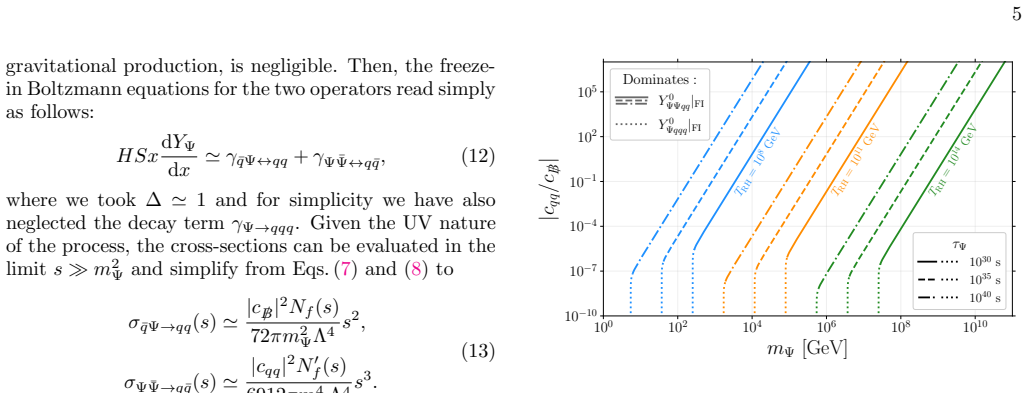
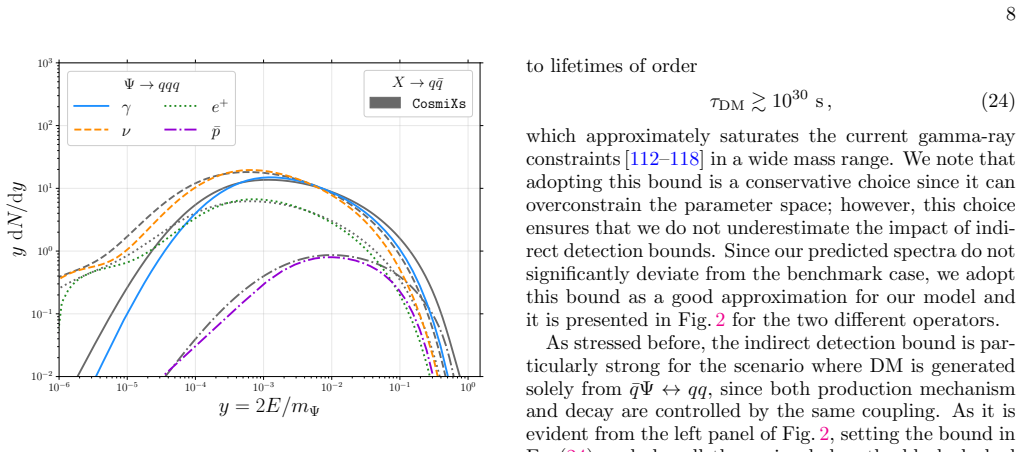
In an effective field theory, the leading baryon-number violating operator connecting a spin-3/2 state to Standard Model quarks permits the observed dark matter relic density to be generated through UV freeze-in and Boltzmann-suppressed freeze-in. The freeze-out region is completely excluded. Relic production is controlled by the interplay between baryon-violating single-particle processes and baryon-conserving pair production. The viable parameter space is constrained by indirect detection, direct detection, and LHC monojet bounds with strong complementarity, especially when the same operator governs both production and decay. A dark QCD-like ultraviolet completion is presented in which the
What carries the argument
The leading baryon-number violating effective operator coupling the spin-3/2 dark matter candidate to three Standard Model quarks, which sets both the production rate and the decay lifetime.
If this is right
- The observed dark matter abundance is reproduced only in the UV freeze-in and Boltzmann-suppressed freeze-in regimes.
- Indirect detection bounds become especially stringent when production and decay are controlled by the same operator.
- Direct detection and LHC monojet searches supply complementary constraints that together cover large portions of the parameter space.
- The composite realization in a confining dark sector provides a consistent ultraviolet origin for the spin-3/2 state.
Where Pith is reading between the lines
- Baryon-violating portals may offer a general route to viable higher-spin dark matter models beyond the spin-3/2 case examined here.
- The requirement of freeze-in production implies that similar models without baryon violation would need alternative mechanisms to avoid overproduction.
- A full test of the framework would combine collider, direct, and indirect probes rather than relying on any single channel.
Load-bearing premise
The effective field theory description remains valid up to the high scales of freeze-in production, and the dark QCD-like ultraviolet completion adds no extra light states that would alter the low-energy phenomenology.
What would settle it
An observation of a spin-3/2 dark matter particle whose mass and coupling strength place its relic density in the freeze-out regime while remaining consistent with all experimental bounds would falsify the complete exclusion of freeze-out.
Figures

read the original abstract
We explore an uncharted corner of dark matter phenomenology: non-supersymmetric spin-$3/2$ dark matter with baryon number violating interactions. In an effective field theory description, we identify the leading baryonic portal between the spin-$3/2$ state and Standard Model quarks and show that it can account for the observed dark matter abundance through UV freeze-in and Boltzmann-suppressed freeze-in, while the freeze-out region is completely excluded. The resulting phenomenology is distinctive, with relic production controlled by the competition between baryon-violating single-particle processes and baryon-conserving pair production. We map the viable parameter space against indirect detection, direct detection, and LHC monojet bounds, finding strong complementarity between these probes and especially stringent limits when production and decay are tied to the same operator. We also present a dark QCD-like ultraviolet completion in which the spin-$3/2$ particle arises as a composite baryon, naturally generating the effective interactions and mitigating the main theoretical obstacles of elementary higher-spin states. This framework opens a novel and testable connection between baryonic portals, confining dark sectors, and higher-spin dark matter.
Editorial analysis
A structured set of objections, weighed in public.
Referee Report
Summary. The paper explores spin-3/2 dark matter with baryon-number-violating interactions in an EFT framework. It identifies the leading baryonic portal to SM quarks and argues that this operator can reproduce the observed relic density via UV freeze-in and Boltzmann-suppressed freeze-in, while completely excluding the freeze-out regime. The work maps the viable parameter space against indirect/direct detection and LHC monojet bounds, highlights complementarity between probes, and presents a dark-QCD-like UV completion in which the spin-3/2 state is a composite baryon.
Significance. If the relic-density calculations and EFT validity hold, the framework provides a novel, testable link between baryon violation, higher-spin DM, and confining dark sectors. The UV completion addresses unitarity issues for elementary Rarita-Schwinger fields and the competition between single-particle baryon-violating and pair-production channels yields distinctive phenomenology. Strong complementarity between cosmological, direct-detection, and collider constraints is a positive feature.
major comments (2)
- [DM production section (likely §3)] The central claim that UV freeze-in and Boltzmann-suppressed freeze-in reproduce the observed abundance while freeze-out is excluded rests on unshown Boltzmann equations, numerical solutions, and parameter scans. Explicit equations, integration limits, and error bars on the relic-density contours are required to substantiate the boundaries between production regimes.
- [UV completion and EFT validity] §4 (UV freeze-in discussion): The EFT description assumes the cutoff Λ satisfies T_prod ≪ Λ throughout the relevant epoch, yet no quantitative bounds on Λ relative to the freeze-in temperature or the dark-sector confinement scale are provided. If additional composite resonances lie near or below T_prod, new channels would alter the Boltzmann equations and the excluded freeze-out region.
minor comments (2)
- [EFT Lagrangian] Notation for the Rarita-Schwinger field and the dimension-6 operator should be defined explicitly at first use, with a clear statement of the assumed Lorentz and gauge structure.
- [Phenomenology plots] Figure captions for the parameter-space plots should include the precise values of fixed parameters (e.g., m_χ, Λ) and the definition of the plotted contours.
Simulated Author's Rebuttal
We thank the referee for the careful reading and constructive comments on our manuscript. The points raised are helpful for improving the clarity and rigor of the presentation. We address each major comment below and have updated the manuscript to incorporate the requested details.
read point-by-point responses
-
Referee: The central claim that UV freeze-in and Boltzmann-suppressed freeze-in reproduce the observed abundance while freeze-out is excluded rests on unshown Boltzmann equations, numerical solutions, and parameter scans. Explicit equations, integration limits, and error bars on the relic-density contours are required to substantiate the boundaries between production regimes.
Authors: We agree that the relic-density calculation requires more explicit documentation. In the revised manuscript we have added the full set of Boltzmann equations governing the UV freeze-in and Boltzmann-suppressed freeze-in regimes in Section 3, together with a description of the numerical integration procedure, the temperature integration limits (from T_prod down to T=0), and the treatment of the Hubble expansion. We have also included uncertainty bands on the relic-density contours that reflect variations in the numerical tolerances and the leading-order approximations used. These additions make the separation between the three production regimes and the complete exclusion of freeze-out quantitatively transparent. revision: yes
-
Referee: The EFT description assumes the cutoff Λ satisfies T_prod ≪ Λ throughout the relevant epoch, yet no quantitative bounds on Λ relative to the freeze-in temperature or the dark-sector confinement scale are provided. If additional composite resonances lie near or below T_prod, new channels would alter the Boltzmann equations and the excluded freeze-out region.
Authors: We appreciate this observation on EFT validity. In the revised Section 4 we now provide explicit estimates: we require Λ ≳ 20 T_prod (with T_prod ≈ m_DM/25 for the relevant parameter space) to maintain the validity of the dimension-6 operator throughout freeze-in. For the dark-QCD UV completion we set the confinement scale such that the lightest composite resonances lie above 5 T_prod, ensuring that additional channels remain Boltzmann-suppressed or kinematically closed during the production epoch. We discuss the resulting suppression factors and confirm that they do not reopen the freeze-out window within the displayed parameter space. A full non-perturbative treatment would ultimately require lattice input, but the added bounds suffice to justify the EFT analysis as presented. revision: yes
Circularity Check
No significant circularity; derivation relies on standard EFT and freeze-in calculations
full rationale
The paper identifies the leading baryon-violating operator in an EFT framework and computes the relic density via standard UV freeze-in and Boltzmann-suppressed channels, with freeze-out excluded by overproduction or bounds. These steps use external inputs (observed DM abundance, LHC monojet limits, direct/indirect detection constraints) without fitting parameters to a subset of data and then relabeling the output as a prediction. The same operator governing both production and decay is presented as a physical linkage rather than a self-definitional reduction. The dark QCD UV completion is offered as a motivating construction, not invoked via self-citation as a uniqueness theorem or to smuggle an ansatz. No load-bearing step reduces by construction to the paper's own inputs or prior self-referential results; the analysis remains self-contained against external benchmarks.
Axiom & Free-Parameter Ledger
free parameters (1)
- baryon-violating portal coupling
axioms (1)
- domain assumption Effective field theory description is valid below the cutoff scale for freeze-in temperatures
invented entities (1)
-
composite spin-3/2 baryon in dark QCD-like sector
no independent evidence
Reference graph
Works this paper leans on
-
[1]
+ (symm.IJ K) = 0,(B2) where the numbers are the labels for momenta, we have used Shouten’s identity and the fact that the amplitude is symmetrised in the little-group indicesIJ Kof each particle. The resulting amplitude is proportional toϵ IJ , meaning that it transforms trivially under these little- group indices and consequentely vanishing given the sy...
-
[2]
Moreover, taking thes≫m 2 Ψ limit, the cross sections are dominated by term with the highest power ofsand their expression are (see Eq
F reeze-in approximations Since the non-renormalisable freeze-in is a UV domi- nated process [93], we can neglect the spin-3/2 mass ap- pearing in the lower limit of thesintegral and in the K¨ allen functions, where we have terms like p s−m 2 Ψ ≃ s. Moreover, taking thes≫m 2 Ψ limit, the cross sections are dominated by term with the highest power ofsand t...
-
[3]
F reeze-out approximations Let us discuss now the approximation needed in the freeze-out case. Considering the DM freezing out when non-relativistic (x≫1), we have two contributions to the thermally averaged cross-section integrand that change rapidly withs, namely the Bessel functionK 1(√s/T) and the K¨ allen functions. The Bessel function is expo- nenti...
-
[4]
Zwicky,Die Rotverschiebung von extragalaktischen Nebeln,Helv
F. Zwicky,Die Rotverschiebung von extragalaktischen Nebeln,Helv. Phys. Acta6(1933) 110
1933
-
[5]
J. P. Ostriker and P. J. E. Peebles,A Numerical Study of the Stability of Flattened Galaxies: or, can Cold Galaxies Survive?,Astrophys. J.186(1973) 467. [3]Planckcollaboration,Planck 2015 results. XIII. Cosmological parameters,Astron. Astrophys.594 (2016) A13 [1502.01589]. [4]Planckcollaboration,Planck 2018 results. VI. Cosmological parameters,Astron. Ast...
work page Pith review arXiv 1973
- [6]
-
[7]
A direct empirical proof of the existence of dark matter
D. Clowe, M. Bradac, A. H. Gonzalez, M. Markevitch, S. W. Randall, C. Jones et al.,A direct empirical proof of the existence of dark matter,Astrophys. J. Lett.648 (2006) L109 [astro-ph/0608407]
work page Pith review arXiv 2006
-
[8]
E. W. Kolb and M. S. Turner,The Early Universe, vol. 69. Taylor and Francis, 5, 2019, 10.1201/9780429492860
-
[9]
McDonald,Thermally generated gauge singlet scalars as selfinteracting dark matter,Phys
J. McDonald,Thermally generated gauge singlet scalars as selfinteracting dark matter,Phys. Rev. Lett. 88(2002) 091304 [hep-ph/0106249]
-
[10]
L. J. Hall, K. Jedamzik, J. March-Russell and S. M. West,Freeze-In Production of FIMP Dark Matter, JHEP03(2010) 080 [0911.1120]
work page Pith review arXiv 2010
- [11]
-
[12]
R. Ding and Y. Liao,Spin 3/2 Particle as a Dark Matter Candidate: an Effective Field Theory Approach,JHEP04(2012) 054 [1201.0506]
- [13]
-
[14]
C.-F. Chang, X.-G. He and J. Tandean,Exploring Spin-3/2 Dark Matter with Effective Higgs Couplings, Phys. Rev. D96(2017) 075026 [1704.01904]
- [15]
- [16]
- [17]
- [18]
- [19]
- [20]
-
[21]
D. Z. Freedman, P. van Nieuwenhuizen and S. Ferrara, Progress Toward a Theory of Supergravity,Phys. Rev. D13(1976) 3214
1976
-
[22]
Deser and B
S. Deser and B. Zumino,Consistent Supergravity, Phys. Lett. B62(1976) 335
1976
- [23]
-
[24]
Pagels and J
H. Pagels and J. R. Primack,Supersymmetry, Cosmology and New TeV Physics,Phys. Rev. Lett.48 (1982) 223
1982
-
[25]
Moroi, H
T. Moroi, H. Murayama and M. Yamaguchi, Cosmological constraints on the light stable gravitino, Phys. Lett. B303(1993) 289
1993
- [26]
-
[27]
W. Buchmuller, L. Covi, K. Hamaguchi, A. Ibarra and T. Yanagida,Gravitino Dark Matter in R-Parity Breaking Vacua,JHEP03(2007) 037 [hep-ph/0702184]
- [28]
- [29]
- [30]
- [31]
- [32]
- [33]
-
[34]
A. Mitridate, M. Redi, J. Smirnov and A. Strumia, Dark Matter as a weakly coupled Dark Baryon,JHEP 10(2017) 210 [1707.05380]
- [35]
-
[36]
Appelquist et al.,Stealth Dark Matter: Dark scalar baryons through the Higgs portal,Phys
T. Appelquist et al.,Stealth Dark Matter: Dark scalar baryons through the Higgs portal,Phys. Rev. D92 (2015) 075030 [1503.04203]
- [37]
-
[38]
Velo and D
G. Velo and D. Zwanziger,Propagation and quantization of Rarita-Schwinger waves in an external electromagnetic potential,Phys. Rev.186(1969) 1337
1969
-
[39]
Velo and D
G. Velo and D. Zwanziger,Noncausality and other defects of interaction lagrangians for particles with spin one and higher,Phys. Rev.188(1969) 2218. 15
1969
-
[40]
E. W. Kolb, A. J. Long, E. McDonough and J. Wang, Creation of spin-3/2 dark matter via cosmological gravitational particle production,2512.16976
work page internal anchor Pith review Pith/arXiv arXiv
- [41]
- [42]
- [43]
-
[44]
I. Antoniadis, K. Benakli and W. Ke,Salvage of too slow gravitinos,JHEP11(2021) 063 [2105.03784]
-
[45]
A. Castellano, A. Font, A. Herraez and L. E. Ib´ a˜ nez,A gravitino distance conjecture,JHEP08(2021) 092 [2104.10181]
-
[46]
N. Cribiori, D. Lust and M. Scalisi,The gravitino and the swampland,JHEP06(2021) 071 [2104.08288]
-
[47]
Terada,Minimal supergravity inflation without slow gravitino,Phys
T. Terada,Minimal supergravity inflation without slow gravitino,Phys. Rev. D103(2021) 125022 [2104.05731]
- [48]
-
[49]
B. Bellazzini, A. Pomarol, M. Romano and F. Sciotti, (Super) gravity from positivity,JHEP03(2026) 028 [2507.12535]
-
[50]
T. Gherghetta and W. Ke,Supergravity from the bottom up,JHEP01(2026) 067 [2507.12538]
-
[51]
M. T. Grisaru and H. N. Pendleton,Soft Spin 3/2 Fermions Require Gravity and Supersymmetry,Phys. Lett. B67(1977) 323
1977
-
[52]
Schroer,The role of positivity and causality in interactions involving higher spin,Nucl
B. Schroer,The role of positivity and causality in interactions involving higher spin,Nucl. Phys. B941 (2019) 91 [1712.02346]
-
[53]
N. Afkhami-Jeddi, S. Kundu and A. Tajdini,A Bound on Massive Higher Spin Particles,JHEP04(2019) 056 [1811.01952]
-
[54]
Trott,Causality, unitarity and symmetry in effective field theory,JHEP07(2021) 143 [2011.10058]
T. Trott,Causality, unitarity and symmetry in effective field theory,JHEP07(2021) 143 [2011.10058]
- [55]
-
[56]
Chikashige, R
Y. Chikashige, R. N. Mohapatra and R. D. Peccei,Are There Real Goldstone Bosons Associated with Broken Lepton Number?,Phys. Lett. B98(1981) 265
1981
-
[57]
Schechter and J
J. Schechter and J. W. F. Valle,Neutrino Decay and Spontaneous Violation of Lepton Number,Phys. Rev. D25(1982) 774
1982
-
[58]
G. Lazarides, M. Reig, Q. Shafi, R. Srivastava and J. W. F. Valle,Spontaneous Breaking of Lepton Number and the Cosmological Domain Wall Problem, Phys. Rev. Lett.122(2019) 151301 [1806.11198]
-
[59]
W. Chao and Y.-Q. Peng,Majorana Majoron and the Baryon Asymmetry of the Universe,2311.06469
- [60]
-
[61]
A. Pilaftsis,Radiatively induced neutrino masses and large Higgs neutrino couplings in the standard model with Majorana fields,Z. Phys. C55(1992) 275 [hep-ph/9901206]
-
[62]
W. H. Furry,On transition probabilities in double beta-disintegration,Phys. Rev.56(1939) 1184
1939
- [63]
-
[64]
S. M. Bilenky and S. T. Petcov,Massive Neutrinos and Neutrino Oscillations,Rev. Mod. Phys.59(1987) 671
1987
-
[65]
M. Doi, T. Kotani and E. Takasugi,Double beta Decay and Majorana Neutrino,Prog. Theor. Phys. Suppl.83 (1985) 1
1985
-
[66]
Weinberg,Baryon and Lepton Nonconserving Processes,Phys
S. Weinberg,Baryon and Lepton Nonconserving Processes,Phys. Rev. Lett.43(1979) 1566
1979
-
[67]
R. N. Mohapatra and R. E. Marshak,Local B-L Symmetry of Electroweak Interactions, Majorana Neutrinos and Neutron Oscillations,Phys. Rev. Lett. 44(1980) 1316
1980
-
[68]
D. Curtin et al.,Long-Lived Particles at the Energy Frontier: The MATHUSLA Physics Case,Rept. Prog. Phys.82(2019) 116201 [1806.07396]
- [69]
-
[70]
Cui, Natural Baryogenesis from Unnatural Supersymmetry, JHEP12, 067, arXiv:1309.2952 [hep- ph]
Y. Cui,Natural Baryogenesis from Unnatural Supersymmetry,JHEP12(2013) 067 [1309.2952]
- [71]
- [72]
-
[73]
S. Ipek and J. March-Russell,Baryogenesis via Particle-Antiparticle Oscillations,Phys. Rev. D93 (2016) 123528 [1604.00009]
- [74]
-
[75]
CP Violating Baryon Oscillations
D. McKeen and A. E. Nelson,CP Violating Baryon Oscillations,Phys. Rev. D94(2016) 076002 [1512.05359]
work page Pith review arXiv 2016
-
[76]
H. Davoudiasl, D. E. Morrissey, K. Sigurdson and S. Tulin,Hylogenesis: A Unified Origin for Baryonic Visible Matter and Antibaryonic Dark Matter,Phys. Rev. Lett.105(2010) 211304 [1008.2399]
-
[77]
H. Davoudiasl and Y. Zhang,Baryon Number Violation via Majorana Neutrinos in the Early Universe, at the LHC, and Deep Underground,Phys. Rev. D92(2015) 016005 [1504.07244]
- [78]
- [79]
-
[80]
C. Cheung and K. Ishiwata,Baryogenesis with Higher Dimension Operators,Phys. Rev. D88(2013) 017901 [1304.0468]
discussion (0)
Sign in with ORCID, Apple, or X to comment. Anyone can read and Pith papers without signing in.