Recognition: 2 theorem links
· Lean TheoremTowards black-hole horizons and geodesic focusing in causal sets
Pith reviewed 2026-05-11 01:13 UTC · model grok-4.3
The pith
Causal sets can identify black-hole horizons by tracking a sign change in discrete geodesic expansion using ladders and fuzzy ladders.
A machine-rendered reading of the paper's core claim, the machinery that carries it, and where it could break.
Core claim
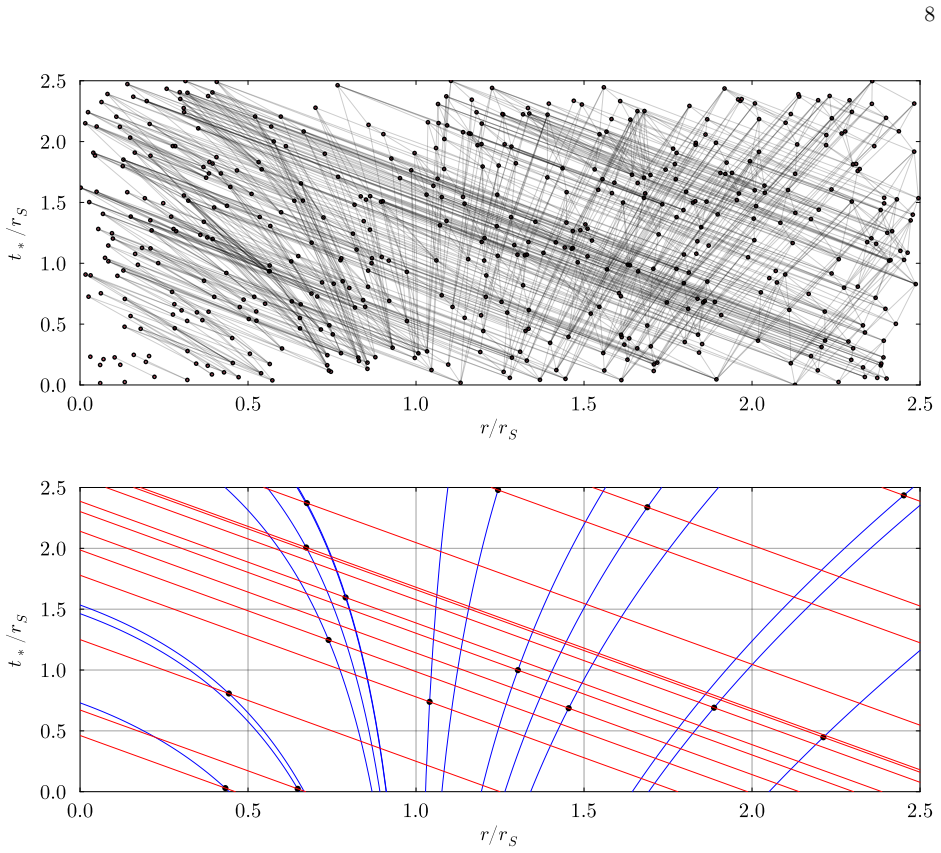
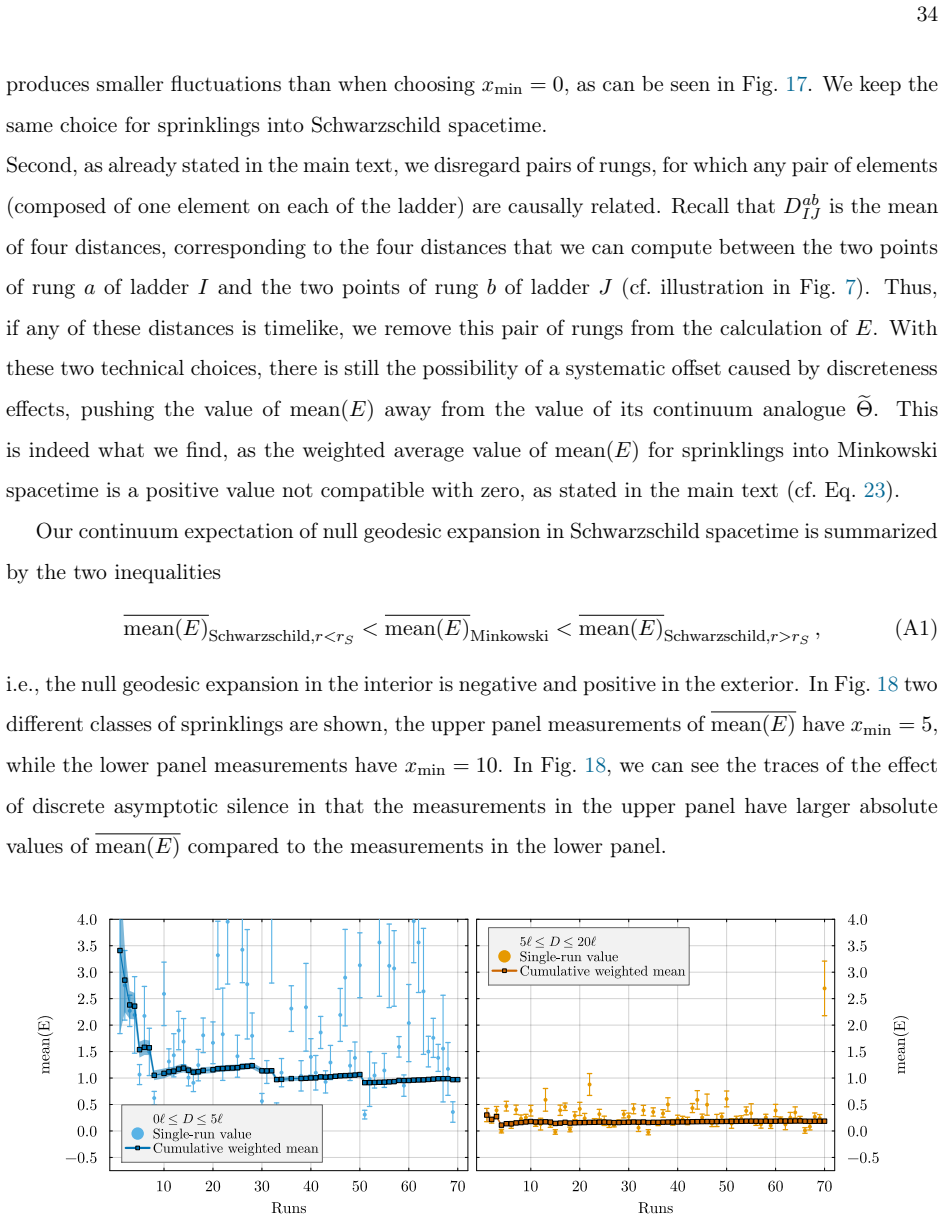
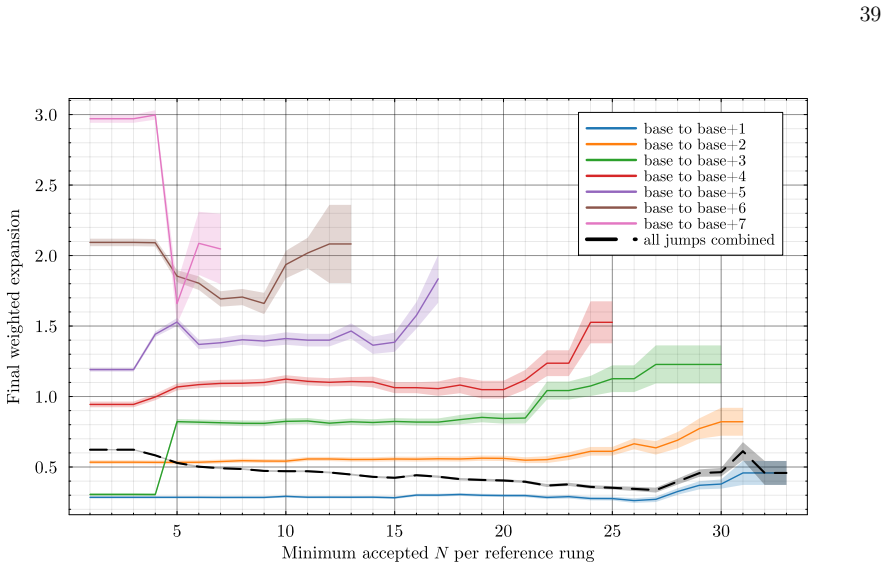
We construct a local diagnostic to approximate a global event horizon based on discrete timelike curves. We then use ladders as tracers of null geodesics and find that a discrete counterpart of the expansion changes sign across the black-hole horizon. Finally, we introduce fuzzy ladders, which enable us to track null geodesics for larger intervals of the affine parameter, and thereby construct a portion of a discrete horizon in a toy-model for a black-hole spacetime in 1+1 dimensions.
What carries the argument
Ladders and fuzzy ladders, discrete chains of points that trace null geodesics by following causal relations with controlled spacings, used to compute a discrete expansion that flips sign at the horizon.
If this is right
- A sign change in the discrete expansion serves as a local marker for the apparent horizon without requiring knowledge of the entire spacetime.
- Fuzzy ladders extend the range over which null geodesics can be followed, allowing construction of finite segments of discrete horizons.
- The same ladder technique provides a discrete counterpart to geodesic focusing that can be checked directly on the causal set.
- The method supplies a practical diagnostic that can be applied to any causal set that approximates a black-hole geometry.
Where Pith is reading between the lines
- The approach could be applied to causal sets that include matter or that evolve dynamically to study horizon formation.
- Refinements of the ladder spacing rules might reduce residual discretization effects and improve accuracy in higher-dimensional models.
- Similar discrete tracers could be tested for other causal boundaries, such as cosmological horizons.
Load-bearing premise
The ladders and fuzzy ladders faithfully approximate continuum null geodesics and horizon properties without discretization artifacts that would invalidate the observed sign change.
What would settle it
In the 1+1D toy model, if the computed discrete expansion fails to change sign at the location where the continuum horizon is expected, or if the fuzzy-ladder construction of the horizon portion does not converge to the known continuum horizon as the causal-set density is increased.
Figures






read the original abstract
The event horizon of a black hole is arguably the most dramatic manifestation of the fact that in General Relativity, causal structure is dynamical and spacetimes can be separated into distinct regions by causal boundaries. Causal set quantum gravity is an approach to quantum gravity in which causal relations between spacetime points constitute the basic structure on which the theory is based. This raises the question how a discrete horizon can be identified in a causal set. In our paper, we first construct a local diagnostic to approximate a global concept, namely the event horizon, based on discrete timelike curves. We then turn to the concept of an apparent horizon, which is based on local properties of geodesics, rather than global properties of the entire spacetime. We undertake first steps towards detecting apparent horizons in causal sets, using so-called ladders as tracers of null geodesics. We find that a discrete counterpart of the expansion changes sign across the black-hole horizon, as it should. Finally, we introduce the notion of a fuzzy ladder, which enables us to track null geodesics for larger intervals of the affine parameter. Thereby, we construct a portion of a discrete horizon in a toy-model for a black-hole spacetime in 1+1 dimensions.
Editorial analysis
A structured set of objections, weighed in public.
Referee Report
Summary. The manuscript develops techniques to detect black-hole horizons in causal sets. It constructs a local diagnostic for event horizons using discrete timelike curves, then introduces ladders as tracers of null geodesics to define a discrete expansion for apparent horizons. In a 1+1D toy-model black-hole spacetime, the discrete expansion changes sign across the horizon as expected, and fuzzy ladders are used to construct a portion of the discrete horizon.
Significance. If the ladder-based constructions prove robust, this constitutes a meaningful advance in causal-set quantum gravity by providing explicit, local diagnostics for horizons and geodesic focusing. The constructive approach in a controlled toy model supplies a clear proof-of-principle that can be tested for convergence and extended to higher dimensions. The work directly addresses a recognized gap between causal-set structure and classical GR observables.
major comments (2)
- [Ladders and discrete expansion] The central claim that the discrete expansion changes sign across the horizon (abstract and the section introducing ladders) is load-bearing. The manuscript must demonstrate that this discrete expansion converges to the continuum expansion scalar in the limit of increasing sprinkling density; without such a check or analytic argument, the observed sign change could be a discretization artifact of the ladder spacing or causal-set relations.
- [Fuzzy ladders and horizon construction] The fuzzy-ladder construction that yields the portion of the discrete horizon (final section) relies on specific rules for allowing deviations in the causal relations. These rules must be stated precisely, and the location of the constructed horizon must be shown to be insensitive to the choice of fuzziness tolerance and sprinkling density; otherwise the construction risks being an artifact of the ad-hoc fuzzy prescription.
minor comments (2)
- The abstract states that a 'portion' of the discrete horizon is constructed; the main text should quantify the affine-parameter range covered relative to the full horizon in the toy model and discuss any truncation effects.
- Figures showing the sign change or horizon construction would benefit from multiple independent sprinklings with error bands to illustrate statistical stability.
Simulated Author's Rebuttal
We thank the referee for the careful reading of our manuscript and the constructive comments. We address each major point below and will incorporate revisions to strengthen the presentation.
read point-by-point responses
-
Referee: The central claim that the discrete expansion changes sign across the horizon (abstract and the section introducing ladders) is load-bearing. The manuscript must demonstrate that this discrete expansion converges to the continuum expansion scalar in the limit of increasing sprinkling density; without such a check or analytic argument, the observed sign change could be a discretization artifact of the ladder spacing or causal-set relations.
Authors: We agree that convergence to the continuum limit is essential to establish the result beyond the specific toy-model realization. The current work shows the expected sign change for a fixed sprinkling density in the 1+1D model, where direct comparison with the known continuum expansion is possible. In the revised manuscript we will add numerical checks at several higher sprinkling densities, confirming that the discrete expansion approaches the continuum scalar and that the sign change persists. We will also include a short analytic argument based on the fact that the ladder links approximate null geodesics whose expansion is recovered in the continuum limit of the causal set. revision: yes
-
Referee: The fuzzy-ladder construction that yields the portion of the discrete horizon (final section) relies on specific rules for allowing deviations in the causal relations. These rules must be stated precisely, and the location of the constructed horizon must be shown to be insensitive to the choice of fuzziness tolerance and sprinkling density; otherwise the construction risks being an artifact of the ad-hoc fuzzy prescription.
Authors: We acknowledge that the fuzzy-ladder rules require a more precise algorithmic statement. In the revision we will provide an explicit definition of the allowed deviations in causal relations and the precise value of the fuzziness tolerance used. We will also add numerical tests demonstrating that the location of the constructed horizon segment remains stable under moderate variations of the tolerance parameter and across different sprinkling densities, thereby showing that the construction is not an artifact of the specific choice. revision: yes
Circularity Check
No circularity: constructive definitions of discrete ladders and expansion are independent of target results
full rationale
The paper defines new discrete objects (timelike curves, ladders, fuzzy ladders) and a discrete expansion scalar directly from causal-set relations in a 1+1D toy model. The observed sign change of this expansion across the horizon and the construction of a discrete horizon portion are reported outcomes of applying these definitions, not quantities fitted to data or derived by renaming prior results. No self-citations are invoked as load-bearing uniqueness theorems, and no ansatz is smuggled in; the work remains self-contained against external benchmarks by explicit construction rather than reduction to inputs.
Axiom & Free-Parameter Ledger
axioms (1)
- domain assumption Causal sets provide a discrete fundamental structure whose causal relations approximate the geometry and causal structure of continuum spacetime.
invented entities (1)
-
fuzzy ladder
no independent evidence
Lean theorems connected to this paper
-
IndisputableMonolith/Foundation/AlexanderDuality.leanalexander_duality_circle_linking (D=3 forcing) unclear?
unclearRelation between the paper passage and the cited Recognition theorem.
We undertake first steps towards detecting apparent horizons in causal sets, using so-called ladders as tracers of null geodesics. We find that a discrete counterpart of the expansion changes sign across the black-hole horizon
-
IndisputableMonolith/Foundation/ArithmeticFromLogic.leanLogicNat recovery and embed_strictMono unclear?
unclearRelation between the paper passage and the cited Recognition theorem.
Definition 1 (Causal ladder L_k) ... Definition 2 (Fuzzy causal ladder L(M)_k)
What do these tags mean?
- matches
- The paper's claim is directly supported by a theorem in the formal canon.
- supports
- The theorem supports part of the paper's argument, but the paper may add assumptions or extra steps.
- extends
- The paper goes beyond the formal theorem; the theorem is a base layer rather than the whole result.
- uses
- The paper appears to rely on the theorem as machinery.
- contradicts
- The paper's claim conflicts with a theorem or certificate in the canon.
- unclear
- Pith found a possible connection, but the passage is too broad, indirect, or ambiguous to say the theorem truly supports the claim.
Reference graph
Works this paper leans on
-
[1]
The continuum quantity The induced spatial distance on a constantt∗ hypersurface forr > r S in a Schwarzschild space- time is given by the spatial line element ds2 = 1− rS r −1 dr2 = 1− rS r(r∗) dr2 ∗.(15) The continuum analogue to the above discrete expansion in Eq. 14 is eΘext(t, δ) = f(t+δ)−f(t) f(t) withf(t) = Z r∗2(t) r∗1(t) dr∗ r 1− rS r(r∗) ,(16) w...
-
[2]
Discrete expansion in Minkowski spacetime We first calculatemean(E)in sprinklings into Minkowski spacetime. In the continuum, we expectE= 0, i.e., pairs of outgoing (or ingoing) null geodesics remain parallel to each other in Minkowski spacetime. In a sprinkling, our illustration in Fig. 7 already highlights that, because rung pairs do not occur equidista...
-
[3]
Discrete expansion in Schwarzschild spacetime We expect mean(E)to change sign across the event horizon of a black hole. To test this hypothesis, and to discover whethermean(E)constitutes a discrete observable capable of detecting the (approximate) location of the apparent horizon, we computemean(E)separately in sprinklings into the interior and sprinkling...
-
[4]
for alli∈Iwithi > M, one has M−1≤ |[p i−M , pi]| ≤2M−1,
-
[5]
for alli∈Iwithi > M, one has M−1≤ |[q i−M , qi]| ≤2M−1. “Fuzzy ladders” allow controlled violations of the rigidity conditions. Additional elements can exist between the two sides of the ladder, because the intervals betweenpi andq j withj > i+ 1 are no longer constrained. The conditions 4. and 5. permit up toMadditional elements within the causal interva...
work page 2020
-
[6]
15 and only discuss the asymptotic behavior explicitly
Exterior region of the black hole In the main text, we defined the continuum analogue of the discrete measurementEin the exterior region of the black hole by eΘext(t, δ) = f(t+δ)−f(t) f(t) withf(t) = Z r∗2(t) r∗1(t) dr∗ r 1− rS r(r∗) .(A1) Inserting the functionf, we had written eΘext(t, δ) = R r∗2+δ r∗1+δ dr∗ q 1− rS r(r∗) − R r∗2 r∗1 dr∗ q 1− rS r(r∗) R...
-
[7]
Interior region of the black hole Analogously, we defined the continuum analogue of the discrete measurementEin the interior region of the black hole by eΘint(r, δ) = g(r+δ)−g(r) g(r) withg(r) = Z t2(r) t1(r) dt r rS r −1,(A10) 33 FIG. 16. Examples of the interior analogue of our discrete expansion measurementeΘint(r, δ)for various values of the parameter...
-
[8]
Properties of fuzzy ladders For a small subset of ladders, giving up the rigidity conditions of the original ladder definition results in problems. The first problem is that a single null geodesic may be approximated by a family of ladders, differing from one another only by a small number of points. To remove this redundancy in our results, one ladder wa...
-
[9]
The discrete expansion with fuzzy ladders We now turn our attention towards the discrete expansion with fuzzy ladders. For fuzzy ladders, there are two competing effects on the discrete expansion. On the one hand, their greater length 37 FIG. 19. Examples of a joint configuration of two fuzzy ladders in Schwarzschild and Minkowski. Before separation, thes...
- [10]
- [11]
-
[12]
M. Dafermos and J. Luk, Ann. Math. (2)202, 309 (2025), arXiv:1710.01722 [gr-qc]
-
[13]
J. Sbierski, Invent. Math.243, 961 (2026), arXiv:2409.18838 [gr-qc]. 43
-
[14]
Van de Moortel, Comptes Rendus
M. Van de Moortel, (2025), arXiv:2501.13180 [gr-qc]
-
[15]
S. W. Hawking, Phys. Rev. D14, 2460 (1976)
work page 1976
-
[16]
The Swampland: Introduction and Review
E. Palti, Fortsch. Phys.67, 1900037 (2019), arXiv:1903.06239 [hep-th]
work page Pith review arXiv 2019
-
[17]
M. van Beest, J. Calderón-Infante, D. Mirfendereski, and I. Valenzuela, Phys. Rept.989, 1 (2022), arXiv:2102.01111 [hep-th]
- [18]
- [19]
- [20]
-
[21]
Is the gravitational-wave ringdown a probe of the event horizon?
V. Cardoso, E. Franzin, and P. Pani, Phys. Rev. Lett.116, 171101 (2016), [Erratum: Phys.Rev.Lett. 117, 089902 (2016)], arXiv:1602.07309 [gr-qc]
work page Pith review arXiv 2016
-
[22]
L. Bombelli, J. Lee, D. Meyer, and R. Sorkin, Phys. Rev. Lett.59, 521 (1987)
work page 1987
-
[23]
L. Bombelli, J. Henson, and R. D. Sorkin, Mod. Phys. Lett. A24, 2579 (2009), arXiv:gr-qc/0605006
-
[24]
A. Bhattacharya, A. Mathur, and S. Surya, Gen. Rel. Grav.55, 32 (2023), arXiv:2301.06480 [gr-qc]
-
[25]
S. W. Hawking, A. R. King, and P. J. Mccarthy, J. Math. Phys.17, 174 (1976)
work page 1976
-
[26]
D. B. Malament, Journal of mathematical physics18, 1399 (1977)
work page 1977
-
[27]
F. Dowker, Causal sets and the deep structure of spacetime, in100 Years Of Relativity: space-time structure: Einstein and beyond, edited by A. Ashtekar (2005) pp. 445–464, arXiv:gr-qc/0508109
-
[28]
S. Surya, Living Rev. Rel.22, 5 (2019), arXiv:1903.11544 [gr-qc]
- [29]
- [30]
- [31]
-
[32]
S. Surya, Class. Quant. Grav.29, 132001 (2012), arXiv:1110.6244 [gr-qc]
- [33]
-
[34]
A. Eichhorn, Class. Quant. Grav.35, 044001 (2018), arXiv:1709.10419 [gr-qc]
- [35]
-
[36]
A. Eichhorn, J. Phys. Conf. Ser.1275, 012010 (2019), arXiv:1902.00391 [gr-qc]
-
[37]
de Boeret al., (2022), arXiv:2207.10618 [hep-th]
J. de Boeret al., (2022), arXiv:2207.10618 [hep-th]
- [38]
-
[39]
Zalel, Covariant Growth Dynamics (2024) arXiv:2302.10582 [gr-qc]
S. Zalel, Covariant Growth Dynamics (2024) arXiv:2302.10582 [gr-qc]
- [40]
- [41]
- [42]
- [43]
-
[44]
D. Rideout and P. Wallden, Class. Quant. Grav.26, 155013 (2009), arXiv:0810.1768 [gr-qc]. 44
- [45]
- [46]
-
[47]
S. Aslanbeigi, M. Saravani, and R. D. Sorkin, JHEP06, 024, arXiv:1403.1622 [hep-th]
-
[48]
A. Eichhorn, S. Surya, and F. Versteegen, Class. Quant. Grav.36, 105005 (2019), arXiv:1809.06192 [gr-qc]
- [49]
- [50]
-
[51]
Feynman Propagator for a Free Scalar Field on a Causal Set,
S. Johnston, Phys. Rev. Lett.103, 180401 (2009), arXiv:0909.0944 [hep-th]
- [52]
-
[53]
E. Albertini, F. Dowker, A. Nasiri, and S. Zalel, Phys. Rev. D109, 106014 (2024), arXiv:2402.08555 [hep-th]
-
[54]
Dou, On Horizon Molecules and Entropy in Causal Sets (2024) arXiv:2307.04150 [gr-qc]
D. Dou, On Horizon Molecules and Entropy in Causal Sets (2024) arXiv:2307.04150 [gr-qc]
- [55]
-
[56]
Jubb, Interacting Quantum Scalar Field Theory on a Causal Set (2024) arXiv:2306.12484 [hep-th]
I. Jubb, Interacting Quantum Scalar Field Theory on a Causal Set (2024) arXiv:2306.12484 [hep-th]
-
[57]
Glaser, Computer Simulations of Causal Sets (2024) arXiv:2306.09904 [gr-qc]
L. Glaser, Computer Simulations of Causal Sets (2024) arXiv:2306.09904 [gr-qc]
-
[58]
X., Quantum Field Theory on Causal Sets (2024) arXiv:2306.04800 [hep-th]
N. X., Quantum Field Theory on Causal Sets (2024) arXiv:2306.04800 [hep-th]
-
[59]
F. Ashmead and D. D. Reid, Estimating the Manifold Dimension of Causal Sets (2024)
work page 2024
- [60]
-
[61]
Mathur, Toward the Emergence of Continuum Spacetime in Causal Set Theory (2024)
A. Mathur, Toward the Emergence of Continuum Spacetime in Causal Set Theory (2024)
work page 2024
- [62]
-
[63]
V. Homšak and S. Veroni, Phys. Rev. D110, 026015 (2024), arXiv:2404.11670 [gr-qc]
- [64]
- [65]
-
[66]
A. Ashtekar, J. Olmedo, and P. Singh, (2023), arXiv:2301.01309 [gr-qc]
-
[67]
Singularity-free gravitational collapse: From regular black holes to horizonless objects,
R. Carballo-Rubio, F. Di Filippo, S. Liberati, and M. Visser, (2023), arXiv:2302.00028 [gr-qc]
-
[68]
Towards a Non-singular Paradigm of Black Hole Physics
R. Carballo-Rubioet al., JCAP05, 003, arXiv:2501.05505 [gr-qc]
- [69]
-
[70]
A. Eichhorn and P. G. S. Fernandes, (2025), arXiv:2508.00686 [gr-qc]
-
[71]
R. Carballo-Rubio, Nature Commun.17, 1399 (2026), arXiv:2507.15920 [gr-qc]
-
[72]
J. Borissova and R. Carballo-Rubio, (2026), arXiv:2602.16773 [gr-qc]
-
[73]
S. A. Hayward, Phys. Rev. Lett.96, 031103 (2006), arXiv:gr-qc/0506126
work page Pith review arXiv 2006
-
[74]
Geodesic incompleteness of some popular regular black holes,
T. Zhou and L. Modesto, Phys. Rev. D107, 044016 (2023), arXiv:2208.02557 [gr-qc]
-
[75]
Isolated and dynamical horizons and their applications
A. Ashtekar and B. Krishnan, Living Rev. Rel.7, 10 (2004), arXiv:gr-qc/0407042
work page Pith review arXiv 2004
-
[76]
Booth, Black hole boundaries, Can
I. Booth, Can. J. Phys.83, 1073 (2005), arXiv:gr-qc/0508107
-
[77]
E. Poisson,A Relativist’s Toolkit: The Mathematics of Black-Hole Mechanics(Cambridge University 45 Press, 2009)
work page 2009
-
[78]
L. Philpott, F. Dowker, and R. D. Sorkin, Phys. Rev. D79, 124047 (2009), arXiv:0810.5591 [gr-qc]
- [79]
discussion (0)
Sign in with ORCID, Apple, or X to comment. Anyone can read and Pith papers without signing in.