Recognition: 2 theorem links
· Lean TheoremMajorana bound states in chiral ferromagnet-superconductor heterostructures revisited
Pith reviewed 2026-05-11 01:13 UTC · model grok-4.3
The pith
Analytical expressions for Majorana bound states in skyrmion-vortex pairs demonstrate that spin-orbit coupling is essential for their stabilization, with results matching numerical simulations.
A machine-rendered reading of the paper's core claim, the machinery that carries it, and where it could break.
Core claim
Our analytical results explicitly demonstrate the critical role of spin-orbit coupling for the stabilization of Majorana modes and provides approximate analytical expressions for low-lying states localized at the vortex, both with and without an accompanying skyrmion. The derived analytical results show excellent agreement with numerical simulations.
Load-bearing premise
The Bogoliubov-de Gennes model with idealized skyrmion-vortex pairing and dominant spin-orbit coupling accurately captures the low-energy physics, without critical interference from unmodeled effects like disorder or higher-order interactions.
Figures




read the original abstract
Majorana zero modes are central to the pursuit of fault-tolerant topological quantum computation. While traditionally sought in one-dimensional hybrid nanowires, a robust alternative platform involves heterostructures combining superconductors with noncollinear magnets. This work focuses on a particularly promising system: a chiral ferromagnet hosting a magnetic skyrmion coupled to a superconducting film containing a superconducting vortex. Such skyrmion-vortex pairs have recently been realized experimentally and are theorized to harbor localized Majorana states, offering a potential pathway for braiding operations. We present a comprehensive theoretical analysis of the low-energy quasiparticle bound states in these heterostructures. Extending previous studies, we develop an analytical framework for the Majorana wavefunctions as well as the wavefunctions and spectrum of other lowlying states within a Bogoliubov-de Gennes approach. Our analytical results explicitly demonstrate the critical role of spin-orbit coupling for the stabilization of Majorana modes and provides approximate analytical expressions for low-lying states localized at the vortex, both with and without an accompanying skyrmion. The derived analytical results show excellent agreement with numerical simulations. We further elucidate the role of realistic effects, including vector potentials and texture perturbations from stray magnetic fields, to assess their impact.
Editorial analysis
A structured set of objections, weighed in public.
Referee Report
Summary. The manuscript revisits Majorana bound states in chiral ferromagnet-superconductor heterostructures with skyrmion-vortex pairs. It develops an analytical framework within the Bogoliubov-de Gennes formalism to derive approximate expressions for the wavefunctions and spectra of low-lying states, including Majorana zero modes, both with and without skyrmions. The work highlights the essential role of spin-orbit coupling in stabilizing these modes and reports excellent quantitative agreement between the analytical results and numerical simulations. Additional considerations include the effects of vector potentials and stray magnetic fields from the texture.
Significance. If the analytical derivations hold, this provides a valuable tool for understanding Majorana modes in an experimentally realized platform. The explicit demonstration of the necessity of spin-orbit coupling, the approximate analytical expressions for vortex-localized states, and the reported quantitative agreement with numerics are strengths that could aid design of topological quantum computing elements. Inclusion of realistic corrections like vector potentials and stray fields enhances applicability.
Simulated Author's Rebuttal
We thank the referee for their positive assessment of our manuscript and for recommending acceptance. The referee's summary correctly identifies the central contributions: the analytical Bogoliubov-de Gennes framework for low-energy states in skyrmion-vortex pairs, the explicit demonstration that spin-orbit coupling is required to stabilize Majorana zero modes, the approximate analytical expressions for vortex-localized states, and the quantitative agreement with numerics. We also appreciate the referee's note that inclusion of vector potentials and stray-field effects strengthens the applicability to experiment.
Circularity Check
No significant circularity; derivations are self-contained
full rationale
The paper develops analytical expressions for low-lying quasiparticle states (including Majorana modes) directly from the Bogoliubov-de Gennes Hamiltonian for the chiral ferromagnet-superconductor heterostructure, with explicit dependence on spin-orbit coupling. These are compared to independent numerical simulations for validation, and the framework incorporates vector-potential and stray-field corrections without reducing to parameter fits or self-referential definitions. No load-bearing step equates a claimed prediction to its own input by construction, and external benchmarks (numerics) provide falsifiable checks outside any fitted values.
Axiom & Free-Parameter Ledger
axioms (1)
- domain assumption Bogoliubov-de Gennes equations describe the quasiparticle spectrum in the presence of magnetic textures and superconductivity
Lean theorems connected to this paper
-
IndisputableMonolith/Cost/FunctionalEquation.lean (washburn_uniqueness_aczel, Jcost)J_uniquely_calibrated_via_higher_derivative unclear?
unclearRelation between the paper passage and the cited Recognition theorem.
Our analytical results explicitly demonstrate the critical role of spin-orbit coupling for the stabilization of Majorana modes and provides approximate analytical expressions for low-lying states localized at the vortex, both with and without an accompanying skyrmion.
What do these tags mean?
- matches
- The paper's claim is directly supported by a theorem in the formal canon.
- supports
- The theorem supports part of the paper's argument, but the paper may add assumptions or extra steps.
- extends
- The paper goes beyond the formal theorem; the theorem is a base layer rather than the whole result.
- uses
- The paper appears to rely on the theorem as machinery.
- contradicts
- The paper's claim conflicts with a theorem or certificate in the canon.
- unclear
- Pith found a possible connection, but the passage is too broad, indirect, or ambiguous to say the theorem truly supports the claim.
Reference graph
Works this paper leans on
-
[1]
The Majorana state localized at the vortex Now we discuss the region of existence of Majorana solutions of Eq. (17). We assume that the vector poten- tialA φ(r) and the magnetic texture angleθ(r) decay fast enough asr→ ∞. We start from the solution localized at the origin (the center of the superconducting vortex). Detailed analysis of Eq. (18) (see Appen...
-
[2]
The Majorana state localized at the edge Now, we will discuss the conditions for the existence of the Majorana state localized near the edge of the sys- tem. We assume that the system is in the form of a disk with a radiusL, which is larger than all other relevant scales. This means that we setA φ(r) = 0,θ(r) = 0, and ∆(r) = ∆∞ near the edge. To formulate...
-
[3]
Uniform magnetizationθ≡0 Even forA φ = 0 andθ= 0 the analytical solution of Eq. (17) is hardly possible. Assuming the exchange couplingJis the largest energy scale, J+µ≫max(∆ ∞, mα2),(31) but the ratiomα 2(J+µ)/∆ 2 ∞ can be of an arbitrary magnitude, we find solution of Eq. (17) within the WKB- type approximation, that describes the Majorana state localiz...
-
[4]
However, it is instructive to discuss shortly the case with homogeneousm=−e z, or θ(r)≡ ±π
Uniform magnetizationθ≡ ±π For the most part of the paper we assume that mag- netizationmis directed in thez-direction far from the vortex,m→e z atr→ ∞. However, it is instructive to discuss shortly the case with homogeneousm=−e z, or θ(r)≡ ±π. The speculations as given in the beginning of the sub- section III A hold true here. Again we consider Eq. (17) ...
-
[5]
Sinceϑ(r= 0) = 0, no rotation is needed for the boundary condition atr= 0
Rotation for the non-uniform magnetization In order to solve the eigenvalue problem (17) in the presence of spatially dependent angleθ, it is convenient to perform a unitary transformation of the Hamiltonian H ± and rotate the solutionϕ ±(r) as H ± =e iϑσy/2H ±e−iϑσy/2, ϕ ± =e −iϑσy/2ϕ±,(35) where functionϑ(r) can be conveniently chosen asϑ(r) = θ(r)−θ(r=...
-
[6]
Analytical solution for small non-uniformθ(r) Now we can calculate an approximate solution for the case of non-uniform magnetization,ϑ(r) =θ(r) =θ v(r), 8 which is produced by the superconducting vortex, see Eq. (25). Assuming λ≫ℓ w ≳R J ≳max " γℓw m|α| 1/2 , γℓw m∆ 1/3# (38) we can neglect the angleθ(r) and its derivatives in the Hamiltonian (36). Then t...
-
[7]
Analytical expression In order to derive an analytical expression for the Ma- jorana state we use the rotation of the Hamiltonian, de- scribed in subsection III A 3. It seems impossible to treat the Hamiltonian (36) analytically in its full glory. In or- der to demonstrate the effect of a skyrmion on the Ma- jorana state localized near the center of the v...
-
[8]
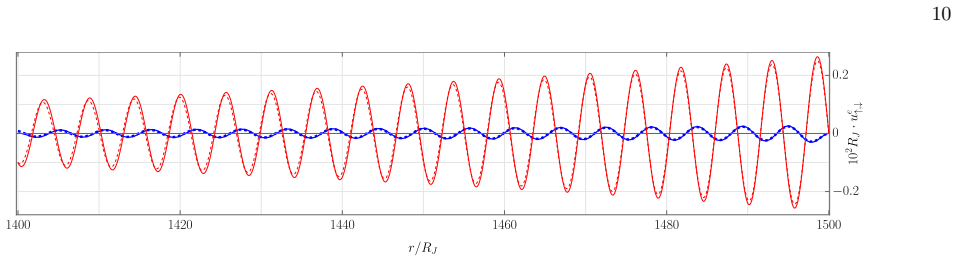
Survival probability As we have seen above, the Majorana state is located at the center of the vortex, whether there is a skyrmion presents or not. However, because the skyrmion can be disrupted by fluctuations, it is important to estimate the probability that the Majorana state will still be located at 10 FIG. 5. Majorana state localized at the edge: com...
-
[9]
Spectrum of the edge-localized states The spectrum of the states localized near the edge of the system can be easily described perturba- tively. Indeed, let’s write the Hamiltonian (14) as H(l) ≃H (0) +V l, where Vl = l(1−σ zτz) +l 2τz 2mr2 + αlσxτz r ,(52) Here, we neglect the effect of the vector potential as in the previous sections. At larger, which a...
-
[10]
States localized near the vortex core To describe the second branch analytically we assume the exchange couplingJto be the largest energy scale, see condition (31), and neglect the vector potential,A φ = 0, as well as the magnetization rotation,θ v = 0. Then we can find the bound states Φ v l ={u v ↑,l, uv ↓,l, vv ↓,l,−v v ↑,l}T approximately within the s...
work page 2025
-
[11]
The regimer→0 In order to study the asymptotic behavior of the Majo- rana mode in the region near the origin, it is convenient to use the parametrizationϕ η (o)(r) ={H ↑(r), rH↓(r)}. Then the functionsH ↑,↓(r) solve the following equations −∂2 r Hσ −(2−σ)r −1∂rHσ +X σ(r)Hσ +Y σ(r)H−σ +2mασrσ∂rH−σ = 0.(A1) Here the functionsX σ andY σ are defined as Xσ(r)=...
-
[12]
It is convenient to introduce ˜ϕη (o)(r) = √rϕη (o)(r)
The regimer→ ∞ Now we analyze the behavior of the solution atr→ ∞. It is convenient to introduce ˜ϕη (o)(r) = √rϕη (o)(r). Then ˜ϕη (o)(r) obeys the following equation h − 1 2m ∂2 r + 1 4r2 − 1−σ z 2r2 −µ+J σ z +iη∆ ∞σy +iασy∂r + ασx 2r i ˜ϕη (o) = 0.(A5) 16 Let us seek its solution as an expansion in powers of 1/r: ˜ϕη (o)(r) =e −Qr h 1 ζQ + 1 rz βQ,↑ βQ...
-
[13]
The case of the uniform magnetization,θ= 0, and large Pearl length,A φ = 0. In this section we construct the solution for the wave function of the Majorana state localized near the center of the vortex for the uniform magnetization. We start from the case of infinite Pearl length,λ→ ∞. Then we can setθanda φ to zero in Eqs. (B1). A key idea is that since ...
-
[14]
The case of the uniform magnetization,θ= 0, and a finite Pearl length,A φ ̸= 0. In this section we demontrate how the presence of non- zero vector potential affects the solution for the wave function of the Majorana state localized at the vortex. Using the parametrization (B2), we find the following (yet exact) equations: ∂2 xAv ↑ + 2i∂xAv ↑ + Av ↑ 4x2 −a...
-
[15]
The case of the presence of a skyrmion Now we describe how to construct the wave function of the Majorana state localized at the vortex in the pres- ence of the skyrmion. We consider the rotated Hamil- tonian (36). We assume that the Pearl length is large enough and, thus, omit the vector potential. As be- fore, we seek the zero eigenmodes of the rotated ...
-
[16]
The case of the uniform magnetization,θ= 0 We start from rewriting Eq. (13) explicitly for the wave function components in terms of dimensionless pa- 20 rameters: ∂2 xu↑ + 1 x ∂xu↑ − l2 x2 u↑ −u ↑ J−µ J+µ + ¯Elu↑ = ¯α(∂xu↓ + l+ 1 x u↓) + ¯∆(x)v↓,(D1) ∂2 xu↓ + 1 x ∂xu↓ − (l+ 1) 2 x2 u↓ + (1 + ¯El)u↓ =−¯α(∂xu↑ − l x u↑)− ¯∆(x)v↑,(D2) ∂2 xv↓ + 1 x ∂xv↓ − (l−...
-
[17]
1+i(2l−1)(2l−1+2 cosϑ) 8x ¯∆ −i 1+i(2l+1)(2l+1+2 cosϑ) 8x |¯α| # ,(D34) B↓=ble−S(r)
The case of the presence of a skyrmion Now we construct solution for the wave functions for the state with non-zerollocalized on a superconduct- ing vortex with a coaxial skyrmion. We employ the uni- tary transformation (35) to the HamiltonianH (l), cf. Eq. (14). Then we obtain H(l) =− τz 2mR2 J ∂2 x + 1 x ∂x + τz 2mR2 J x2 l+ 1 2 τz −σ z cosϑ+σ x sinϑ 2 ...
-
[18]
Kitaev, Fault-tolerant quantum computation by anyons, Ann
A. Kitaev, Fault-tolerant quantum computation by anyons, Ann. Phys.303, 2 (2003)
work page 2003
- [19]
-
[20]
A. Y. Kitaev, Unpaired Majorana fermions in quantum wires, Phys. Usp.44, 131 (2001)
work page 2001
-
[21]
Y. Oreg, G. Refael, and F. von Oppen, Helical liquids and Majorana bound states in quantum wires, Phys. Rev. Lett.105, 177002 (2010)
work page 2010
-
[22]
R. M. Lutchyn, J. D. Sau, and S. Das Sarma, Ma- jorana fermions and a topological phase transition in semiconductor-superconductor heterostructures, Phys. Rev. Lett.105, 077001 (2010)
work page 2010
-
[23]
J. D. Sau, R. M. Lutchyn, S. Tewari, and S. Das Sarma, Generic new platform for topological quantum compu- tation using semiconductor heterostructures, Phys. Rev. Lett.104, 040502 (2010)
work page 2010
- [24]
-
[25]
A. Das, Y. Ronen, Y. Most, Y. Oreg, M. Heiblum, and H. Shtrikman, Zero-bias peaks and splitting in an Al–InAs nanowire topological superconductor as a signa- ture of Majorana fermions, Nat. Phys.8, 887–895 (2012)
work page 2012
- [26]
-
[27]
M. Sato and Y. Ando, Topological superconductors: A review, Rep. Prog. Phys.80, 076501 (2017)
work page 2017
-
[28]
M. Aghaee, A. Akkala, Z. Alam, R. Ali, A. A. Ramirez, M. Andrzejczuk, A. E. Antipov, P. Aseev, M. Astafev, B. Bauer, J. Becker, S. Boddapati, F. Boekhout, J. Bom- mer, E. B. Hansen, T. Bosma, L. Bourdet, S. Boutin, P. Caroff, L. Casparis, M. Cassidy, A. W. Chris- tensen, N. Clay, W. S. Cole, F. Corsetti, A. Cui, P. Dalampiras, A. Dokania, G. de Lange, M. ...
work page 2023
-
[29]
S. D. Sarma, In search of Majorana, Nat. Phys.19, 165 (2023)
work page 2023
- [30]
-
[31]
S. Nakosai, Y. Tanaka, and N. Nagaosa, Two-dimensional p-wave superconducting states with magnetic moments on a conventionals-wave superconductor, Phys. Rev. B 88, 180503 (2013)
work page 2013
-
[32]
K. Bj¨ ornson and A. M. Black-Schaffer, Vortex states and Majorana fermions in spin-orbit coupled semiconductor- superconductor hybrid structures, Phys. Rev. B88, 024501 (2013)
work page 2013
-
[33]
W. Chen and A. P. Schnyder, Majorana edge states in superconductor-noncollinear magnet interfaces, Phys. Rev. B92, 214502 (2015)
work page 2015
- [34]
-
[35]
S. Rex, I. V. Gornyi, and A. D. Mirlin, Majorana modes in emergent-wire phases of helical and cycloidal magnet- superconductor hybrids, Phys. Rev. B102, 224501 (2020)
work page 2020
-
[36]
A. O. Zlotnikov, M. S. Shustin, and A. D. Fedoseev, Aspects of topological superconductivity in 2D systems: Non-collinear magnetism, skyrmions, and higher-order topology, J. Supercond. Nov. Magn.34, 3053 (2021)
work page 2021
-
[37]
V. V. Val’kov, M. S. Shustin, S. V. Aksenov, A. O. Zlot- nikov, A. D. Fedoseev, V. A. Mitskan, and M. Y. Ka- gan, Topological superconductivity and Majorana states in low-dimensional systems, Phys. Usp.65, 2 (2022)
work page 2022
- [38]
-
[39]
A. B. Borisov, Localized structures in magnetic sys- tems without the center of inversion, Phys. Usp.63, 269 (2020)
work page 2020
-
[40]
B. G¨ obel, I. Mertig, and O. A. Tretiakov, Beyond skyrmions: Review and perspectives of alternative mag- netic quasiparticles, Phys. Rep.895, 1 (2021)
work page 2021
-
[41]
A. P. Petrovi´ c, C. Psaroudaki, P. Fischer, M. Garst, and C. Panagopoulos, Colloquium: Quantum properties and functionalities of magnetic skyrmions, Rev. Mod. Phys 97, 031001 (2025)
work page 2025
-
[42]
S. S. Pershoguba, S. Nakosai, and A. V. Balatsky, Skyrmion-induced bound states in a superconductor, Phys. Rev. B94, 064513 (2016)
work page 2016
-
[43]
G. Yang, P. Stano, J. Klinovaja, and D. Loss, Majorana bound states in magnetic skyrmions, Phys. Rev. B93, 224505 (2016)
work page 2016
-
[44]
U. G¨ ung¨ ord¨ u, S. Sandhoefner, and A. A. Kovalev, Stabi- lization and control of Majorana bound states with elon- gated skyrmions, Phys. Rev. B97, 115136 (2018). 24
work page 2018
-
[45]
M. Garnier, A. Mesaros, and P. Simon, Topological su- perconductivity with deformable magnetic skyrmions, Commun. Phys.2, 126 (2019)
work page 2019
- [46]
-
[47]
S. Rex, I. V. Gornyi, and A. D. Mirlin, Majorana bound states in magnetic skyrmions imposed onto a supercon- ductor, Phys. Rev. B100, 064504 (2019)
work page 2019
- [48]
-
[49]
K. M. D. Hals, M. Schecter, and M. S. Rudner, Compos- ite topological excitations in ferromagnet-superconductor heterostructures, Phys. Rev. Lett.117, 017001 (2016)
work page 2016
-
[50]
J. Baumard, J. Cayssol, F. S. Bergeret, and A. Buzdin, Generation of a superconducting vortex via N´ eel skyrmions, Phys. Rev. B99, 014511 (2019)
work page 2019
-
[51]
S. Dahir, Ferromagnetic superconducting heterostruc- tures with magnetic skyrmions, Master’s thesis, Bochum (2018)
work page 2018
-
[52]
S. M. Dahir, A. F. Volkov, and I. M. Eremin, Interac- tion of skyrmions and Pearl vortices in superconductor- chiral ferromagnet heterostructures, Phys. Rev. Lett. 122, 097001 (2019)
work page 2019
-
[53]
R. M. Menezes, J. F. S. Neto, C. C. de Souza Silva, and M. V. Miloˇ sevi´ c, Manipulation of magnetic skyrmions by superconducting vortices in ferromagnet-superconductor heterostructures, Phys. Rev. B100, 014431 (2019)
work page 2019
-
[54]
S. M. Dahir, A. F. Volkov, and I. M. Eremin, Meissner currents induced by topological magnetic textures in hy- brid superconductor/ferromagnet structures, Phys. Rev. B102, 014503 (2020)
work page 2020
-
[55]
E. S. Andriyakhina and I. S. Burmistrov, Interaction of a N´ eel-type skyrmion with a superconducting vortex, Phys. Rev. B103(2021)
work page 2021
-
[56]
E. S. Andriyakhina, S. Apostoloff, and I. S. Burmistrov, Repulsion of a N´ eel-type skyrmion from a Pearl vortex in thin ferromagnet–superconductor heterostructures, JETP Letters116, 825 (2022)
work page 2022
-
[57]
S. Apostoloff, E. S. Andriyakhina, and I. S. Burmistrov, The effect of Pearl vortices on the shape and position of N´ eel-type skyrmions in superconductor–chiral ferromag- net heterostructures, Phys. Usp.68, 1092 (2025)
work page 2025
-
[58]
A. P. Petrovi´ c, M. Raju, X. Y. Tee, A. Louat, I. Maggio- Aprile, R. M. Menezes, M. J. Wyszy´ nski, N. K. Duong, M. Reznikov, C. Renner, M. V. Milosevi´ c, and C. Panagopoulos, Skyrmion-(Anti)vortex coupling in a chiral magnet-superconductor heterostructure, Phys. Rev. Lett.126, 117205 (2021)
work page 2021
-
[59]
P. Machain, Skyrmion-vortex interactions in chiral- magnet/superconducting hybrid systems, Nanyang Tech- nological University (2021)
work page 2021
-
[60]
Y. Xie, A. Qian, B. He, Y. Wu, S. Wang, G. Y. Bing Xu, X. Han, and X. Qiu, Visualization of skyrmion- superconducting vortex pairs in a chiral magnet- superconductor heterostructure, Phys. Rev. Lett.133, 166706 (2024)
work page 2024
-
[61]
J. Nothhelfer, S. A. D´ ıaz, S. Kessler, T. Meng, M. Rizzi, K. M. D. Hals, and K. Everschor-Sitte, Steering Majo- rana braiding via skyrmion-vortex pairs: A scalable plat- form, Phys. Rev. B105, 224509 (2022)
work page 2022
-
[62]
S. T. Konakanchi, J. I. V¨ ayrynen, Y. P. Chen, P. Upad- hyaya, and L. P. Rokhinson, Platform for braiding Ma- jorana modes with magnetic skyrmions, Phys. Rev. Res. 5, 033109 (2023)
work page 2023
-
[63]
J. Bardeen, R. K¨ ummel, A. E. Jacobs, and L. Tewordt, Structure of vortex lines in pure superconductors, Phys. Rev.187, 556 (1969)
work page 1969
-
[64]
F. Gygi and M. Schl¨ uter, Self-consistent electronic struc- ture of a vortex line in a type-II superconductor, Phys. Rev. B43, 7609 (1991)
work page 1991
-
[65]
G. Carneiro and E. H. Brandt, Vortex lines in films: Fields and interactions, Phys. Rev. B61, 6370 (2000)
work page 2000
-
[66]
Pearl, Current distribution in superconducting films carrying quantized fluxoids, Appl
J. Pearl, Current distribution in superconducting films carrying quantized fluxoids, Appl. Phys. Lett.5, 65 (1964)
work page 1964
-
[67]
S. S. Apostoloff, E. S. Andriyakhina, and I. S. Bur- mistrov, Deformation of a N´ eel-type skyrmion in a weak inhomogeneous magnetic field: Magnetization ansatz and interaction with a Pearl vortex, Phys. Rev. B109(2024)
work page 2024
-
[68]
D. S. Katkov, S. S. Apostoloff, and I. S. Burmistrov, Bound states and scattering of magnons on a super- conducting vortex in ferromagnet–superconductor het- erostructures, JETP Lett.120, 655 (2024)
work page 2024
-
[69]
S. S. Apostoloff, E. S. Andriyakhina, P. A. Vorobyev, O. A. Tretiakov, and I. S. Burmistrov, Chirality inversion and radius blowup of a N´ eel-type skyrmion by a Pearl vortex, Phys. Rev. B107, L220409 (2023)
work page 2023
- [70]
-
[71]
R. Hess, H. F. Legg, D. Loss, and J. Klinovaja, Joseph- son transistor from the superconducting diode effect in domain wall and skyrmion magnetic racetracks, Phys. Rev. B108, 174516 (2023)
work page 2023
-
[72]
H. Bateman and A. Erdelyi,Higher Transcendental Func- tions, Vol. 2 (McGraw-Hill, New York, 1953)
work page 1953
discussion (0)
Sign in with ORCID, Apple, or X to comment. Anyone can read and Pith papers without signing in.