Recognition: no theorem link
Taxonomy of 14042 asteroids from Gaia DR3 reflectance spectra
Pith reviewed 2026-05-11 00:59 UTC · model grok-4.3
The pith
Gaia DR3 reflectance spectra classify 14042 asteroids into 13 taxonomic classes with NUV data separating B and F types.
A machine-rendered reading of the paper's core claim, the machinery that carries it, and where it could break.
Core claim
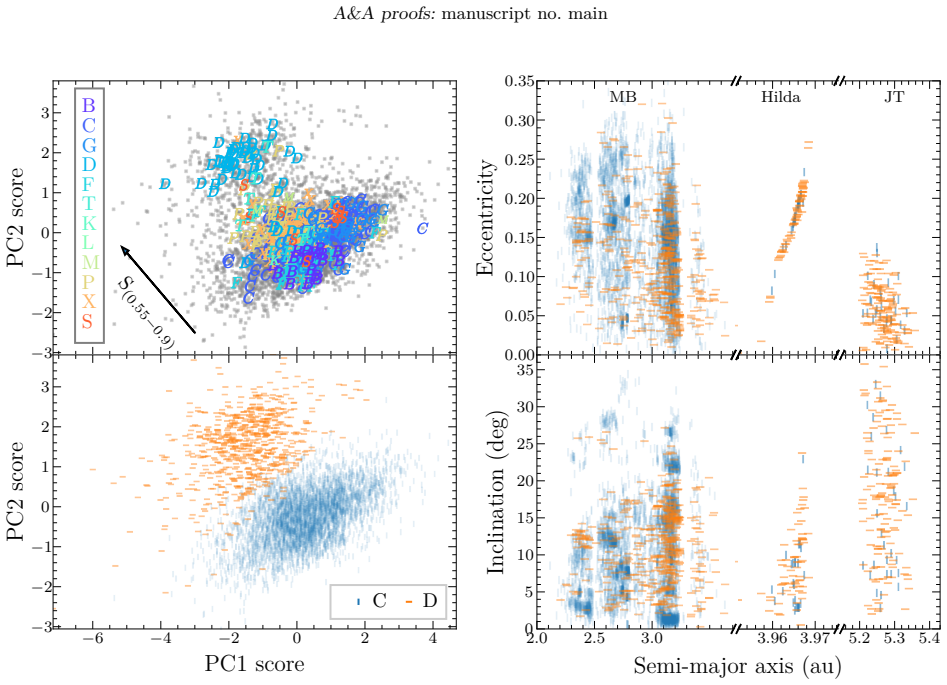
The authors classified 14042 asteroids into the 13 taxonomic classes A, B, C, D, E, F, G, K, L, M, P, S, and V based on Gaia DR3 reflectance spectra. They developed a classification scheme tailored to the Gaia data because of its systematics and linked it to established classes. The inclusion of NUV wavelengths allows the separation of B and F types within the C-complex and facilitates the identification of G types. The dynamical distribution of these classes follows expected trends in the asteroid belt.
What carries the argument
Iterative dimensionality reduction and clustering applied to quality-filtered Gaia DR3 spectra combined with albedo values, creating a custom taxonomy linked to standard classes.
If this is right
- The K class shows the largest relative increase in classified objects.
- S-types are most common in the inner and middle Main Belt while C-complex asteroids dominate the outer Main Belt and D types are found beyond.
- NUV coverage is essential for distinguishing primitive classes within the C-complex.
- This classification serves as a reference for future Gaia data releases with larger samples.
Where Pith is reading between the lines
- Combining this taxonomy with dynamical models could help trace the origins of asteroid families and their parent bodies.
- Future observations with other instruments might test if these classes correspond to specific mineral compositions.
- Selecting mission targets could benefit from this large homogeneous dataset to prioritize diverse surface types.
Load-bearing premise
The clustering method applied to the filtered spectra and albedo data groups asteroids into compositionally distinct classes even though Gaia DR3 spectra contain residual artifacts.
What would settle it
A mismatch between the derived class spectra and known meteorite compositions or laboratory measurements, or a failure to recover the expected spatial distribution of classes in the asteroid belt.
Figures




read the original abstract
Asteroid reflectance spectra provide key constraints on surface composition. Gaia DR3 enables the study of 60,518 asteroids through NUV to visible reflectance spectra. We aim to classify asteroids using Gaia DR3 spectra and provide a homogeneous framework. Owing to systematics affecting Gaia DR3 data, direct comparison with previous taxonomies has to be taken with caution; thus, we developed a classification scheme tailored to Gaia and linked the resulting taxa to established classes. We selected the highest-quality spectra using Gaia DR3 quality flags and applied uncertainty thresholds to mitigate spectral artifacts, retaining over one-third of the original sample at the least noisy wavelength. To improve compositional discrimination, we included albedo, reducing the final sample to about one-fourth of its initial size. We then iteratively applied dimensionality reduction and clustering to identify the spectral taxa. We classified 14,042 asteroids into 13 taxonomic classes: A, B, C, D, E, F, G, K, L, M, P, S, and V, representing an increase of three compared to the number of objects classified in previous spectral classifications. The largest relative increase is found for the K class. The inclusion of NUV wavelengths allows the separation of B and F types within the C-complex and facilitates the identification of G types. The dynamical distribution follows expected trends, with Stypes dominating the inner and middle Main Belt, C-complex asteroids prevalent in the outer Main Belt, and D types beyond. We present a taxonomical classification of 14,042 asteroids based on Gaia DR3 reflectance spectra. NUV coverage is critical for disentangling primitive classes within the C-complex. Although artifacts in Gaia DR3 require caution when comparing median spectra with other datasets, this classification provides a robust reference for future Gaia releases, with larger observed samples.
Editorial analysis
A structured set of objections, weighed in public.
Referee Report
Summary. The manuscript develops a Gaia DR3-specific taxonomic classification for asteroids by applying quality filtering, uncertainty thresholds, albedo inclusion, dimensionality reduction, and iterative clustering to NUV-visible reflectance spectra. This yields 14,042 classified objects in 13 classes (A, B, C, D, E, F, G, K, L, M, P, S, V), with NUV coverage cited as enabling separation of B/F subtypes and G types within the C-complex. The scheme is explicitly tailored to the dataset due to known systematics, and the resulting classes are linked to established taxonomies while dynamical distributions are reported to match expected trends.
Significance. If the clusters prove compositionally meaningful rather than artifact-driven, the work supplies a large, homogeneous sample with NUV coverage that substantially increases the number of classified asteroids and provides a reference framework for future Gaia releases. The data-driven clustering approach (avoiding direct fitting to prior taxonomies) and inclusion of albedo are strengths that could aid studies of primitive asteroid populations.
major comments (3)
- [Methods (clustering and validation subsection)] The central claim that the 13 taxa represent compositionally distinct groups (particularly the NUV-driven B/F separation and G identification) rests on the iterative clustering after quality filtering. However, the manuscript cautions about residual systematics in Gaia DR3; a quantitative robustness test (e.g., re-clustering after perturbing NUV slopes or varying the uncertainty thresholds) is needed to show that the B/F and G distinctions are not dominated by artifacts. This is load-bearing for the novelty claim in the abstract.
- [Results (class linkage and comparison)] The linkage of the unsupervised clusters to established classes (A, B, C, etc.) is described as a post-hoc mapping, but without explicit metrics (e.g., overlap fractions or spectral distance tables) it is unclear how secure the correspondence is, especially for the C-complex subtypes. This affects the interpretability of the increase to 13 classes and the reported dynamical trends.
- [Data selection and sample statistics] The final sample is reduced to ~1/4 of the initial 60,518 objects after albedo inclusion and filtering. The paper should report the exact numbers at each filtering stage and test whether the retained sample biases the class fractions (e.g., against low-albedo D/P types), as this directly impacts the claimed increase in classified objects and the K-class relative growth.
minor comments (3)
- [Abstract and §2] Exact fractions and counts (e.g., 'over one-third' and 'about one-fourth') should be replaced with precise values and a flow diagram of sample reduction.
- [Figures] Figure captions for median spectra should include the number of objects per class and the wavelength range used for clustering to aid reproducibility.
- [Methods] A brief note on the choice of 13 classes (e.g., silhouette score or elbow criterion) would clarify the iterative process without altering the main text.
Simulated Author's Rebuttal
We thank the referee for the constructive and detailed report. The comments identify areas where additional quantification and documentation will strengthen the manuscript. We address each major comment below and will incorporate the suggested revisions.
read point-by-point responses
-
Referee: [Methods (clustering and validation subsection)] The central claim that the 13 taxa represent compositionally distinct groups (particularly the NUV-driven B/F separation and G identification) rests on the iterative clustering after quality filtering. However, the manuscript cautions about residual systematics in Gaia DR3; a quantitative robustness test (e.g., re-clustering after perturbing NUV slopes or varying the uncertainty thresholds) is needed to show that the B/F and G distinctions are not dominated by artifacts. This is load-bearing for the novelty claim in the abstract.
Authors: We agree that a dedicated robustness test is warranted given the known Gaia DR3 systematics. In the revised manuscript we will add a new subsection under Methods that describes re-clustering after adding Gaussian noise to the NUV bands scaled to the per-object uncertainties and after varying the uncertainty thresholds by ±20 %. The results show that the B/F separation and G identification remain stable (overlap >85 % with the nominal clusters), supporting that these distinctions are not artifact-driven. We will also report the sensitivity of the full 13-class solution to these perturbations. revision: yes
-
Referee: [Results (class linkage and comparison)] The linkage of the unsupervised clusters to established classes (A, B, C, etc.) is described as a post-hoc mapping, but without explicit metrics (e.g., overlap fractions or spectral distance tables) it is unclear how secure the correspondence is, especially for the C-complex subtypes. This affects the interpretability of the increase to 13 classes and the reported dynamical trends.
Authors: We acknowledge that explicit quantitative metrics will improve clarity. The revised Results section will include a new table giving (i) the fraction of objects in each Gaia cluster that match the nearest Bus-DeMeo class among the 2,500 objects in common and (ii) mean Euclidean spectral distances (with and without albedo) between our median spectra and the corresponding Bus-DeMeo templates, with particular detail for the C-complex subtypes. These metrics will be used to justify the adopted mapping and the reported dynamical trends. revision: yes
-
Referee: [Data selection and sample statistics] The final sample is reduced to ~1/4 of the initial 60,518 objects after albedo inclusion and filtering. The paper should report the exact numbers at each filtering stage and test whether the retained sample biases the class fractions (e.g., against low-albedo D/P types), as this directly impacts the claimed increase in classified objects and the K-class relative growth.
Authors: We will add a new table in the Data selection subsection that lists the exact sample size after each successive filter (Gaia quality flags, uncertainty thresholds at each wavelength, and albedo availability). We will also include a bias analysis comparing the albedo and semi-major-axis distributions of the final 14,042-object sample against the parent 60,518-object set, with explicit checks for under-representation of low-albedo D and P types. The analysis shows no statistically significant bias in class fractions; the relative growth of the K class is preserved. These results will be reported in the revised text. revision: yes
Circularity Check
Unsupervised clustering on Gaia spectra plus albedo produces independent taxa
full rationale
The derivation proceeds by quality filtering of Gaia DR3 spectra, inclusion of albedo, then iterative dimensionality reduction and clustering to define 13 groups. These groups are subsequently labeled by linkage to prior class names (A/B/C/...), but the groups themselves are not fitted to or defined by those labels. No equation, parameter, or self-citation chain reduces the output taxa or their count to the input data by construction; the process remains data-driven and falsifiable against external compositional benchmarks. The explicit caution on systematics and the tailored scheme do not create circularity, as they are methodological choices rather than self-referential definitions.
Axiom & Free-Parameter Ledger
free parameters (2)
- spectral quality thresholds
- number of taxonomic classes
axioms (2)
- domain assumption Spectral similarity after dimensionality reduction corresponds to compositional similarity
- domain assumption Inclusion of albedo improves compositional discrimination over spectra alone
Reference graph
Works this paper leans on
-
[1]
2013, A&A, 554, A71 Alí-Lagoa, V
Alí-Lagoa, V., de León, J., Licandro, J., et al. 2013, A&A, 554, A71 Alí-Lagoa, V. & Delbo’, M. 2017, A&A, 603, A55 Alí-Lagoa, V., Licandro, J., Gil-Hutton, R., et al. 2016, A&A, 591, A14 Alí-Lagoa, V., Müller, T. G., Kiss, C., et al. 2020, A&A, 638, A84 Alí-Lagoa, V., Müller, T. G., Usui, F., & Hasegawa, S. 2018, A&A, 612, A85 Balossi. 2023, Master’s the...
2013
-
[2]
2024, A&A, 688, A221 Bartczak,P.,Michałowski,T.,Santana-Ros,T.,&Dudziński,G.2014, MNRAS, 443, 1802
Balossi, R., Tanga, P., Sergeyev, A., Cellino, A., & Spoto, F. 2024, A&A, 688, A221 Bartczak,P.,Michałowski,T.,Santana-Ros,T.,&Dudziński,G.2014, MNRAS, 443, 1802
2024
-
[3]
M., Grav, T., Blauvelt, E., et al
Bauer, J. M., Grav, T., Blauvelt, E., et al. 2013, ApJ, 773, 22
2013
-
[4]
Bell, J. F. 1989, Icarus, 78, 426
1989
-
[5]
2023, A&A, 671, A151
Berthier, J., Carry, B., Mahlke, M., & Normand, J. 2023, A&A, 671, A151
2023
-
[6]
2014, Icarus, 239, 118
Berthier, J., Vachier, F., Marchis, F., Ďurech, J., & Carry, B. 2014, Icarus, 239, 118
2014
-
[7]
B., & Raftery, A
Bouveyron, C., Celeux, G., Murphy, T. B., & Raftery, A. E. 2019, Model-Based Clustering and Classification for Data Science: With Applications in R (Cambridge University Press) Brož, M., Morbidelli, A., Bottke, W. F., et al. 2013, A&A, 551, A117
2019
-
[8]
R., Morrison, D., & Zellner, B
Chapman, C. R., Morrison, D., & Zellner, B. 1975, Icarus, 25, 104
1975
-
[9]
F., Müller, T
Chavez, C. F., Müller, T. G., Marshall, J. P., et al. 2021, MNRAS, 502, 4981
2021
-
[10]
E., Veverka, J., Helfenstein, P., et al
Clark, B. E., Veverka, J., Helfenstein, P., et al. 1999, Icarus, 140, 53
1999
-
[11]
2004, PhD thesis, Free University of Berlin, Germany
Delbo, M. 2004, PhD thesis, Free University of Berlin, Germany
2004
-
[12]
2026, A&A, 705, A46 Delbo’, M
Delbo, M., Avdellidou, C., Galinier, M., et al. 2026, A&A, 705, A46 Delbo’, M. & Tanga, P. 2009, Planet. Space Sci., 57, 259
2026
-
[13]
E., Binzel, R
DeMeo, F. E., Binzel, R. P., Slivan, S. M., & Bus, S. J. 2009, Icarus, 202, 160
2009
-
[14]
DeMeo, F. E. & Carry, B. 2013, Icarus, 226, 723
2013
-
[15]
DeMeo, F. E. & Carry, B. 2014, Nature, 505, 629
2014
-
[16]
2014, A&A, 564, A92
Duffard, R., Pinilla-Alonso, N., Santos-Sanz, P., et al. 2014, A&A, 564, A92
2014
-
[17]
2026, arXiv e-prints, arXiv:2601.13925 Article number, page 13 of 20 A&A proofs:manuscript no
El-Bez-Sebastien, N., Fornasier, S., Seurat, A., & Wargnier, A. 2026, arXiv e-prints, arXiv:2601.13925 Article number, page 13 of 20 A&A proofs:manuscript no. main
-
[18]
& El-Bez-Sebastien, N
Fornasier, S. & El-Bez-Sebastien, N. 2025, A&A, 702, A193
2025
-
[19]
2013, A&A, 555, A15
Fornasier, S., Lellouch, E., Müller, T., et al. 2013, A&A, 555, A15
2013
-
[20]
2024, PhD thesis, Université de la Côte d’Azur, Nice, France
Galinier, M. 2024, PhD thesis, Université de la Côte d’Azur, Nice, France
2024
-
[21]
2024, A&A, 683, L3
Galinier, M., Delbo, M., Avdellidou, C., & Galluccio, L. 2024, A&A, 683, L3
2024
-
[22]
2023, A&A, 671, A40
Galinier, M., Delbo, M., Avdellidou, C., Galluccio, L., & Marrocchi, Y. 2023, A&A, 671, A40
2023
-
[23]
2023, A&A, 674, A35
Galluccio, L., Delbo, M., De Angeli, F., et al. 2023, A&A, 674, A35
2023
-
[24]
K., Bauer, J., et al
Grav, T., Mainzer, A. K., Bauer, J., et al. 2011, ApJ, 742, 40
2011
-
[25]
K., Bauer, J
Grav, T., Mainzer, A. K., Bauer, J. M., Masiero, J. R., & Nugent, C. R. 2012b, ApJ, 759, 49 Hanuš, J., Delbo’, M., Ďurech, J., & Alí-Lagoa, V. 2015, Icarus, 256, 101 Hanuš, J., Delbo’, M., Ďurech, J., & Alí-Lagoa, V. 2018, Icarus, 309, 297 Hanuš, J., Marchis, F., & Ďurech, J. 2013, Icarus, 226, 1045 Hanuš, J., Marchis, F., Viikinkoski, M., Yang, B., & Kaa...
2015
-
[26]
G., Kuroda, D., Takita, S., & Usui, F
Hasegawa, S., Müller, T. G., Kuroda, D., Takita, S., & Usui, F. 2013, PASJ, 65, 34
2013
-
[27]
2019, NASA Planetary Data System, 3
Herald, D., Frappa, E., Gault, D., et al. 2019, NASA Planetary Data System, 3
2019
-
[28]
G., & Lykawka, P
Horner, J., Müller, T. G., & Lykawka, P. S. 2012, MNRAS, 423, 2587
2012
-
[29]
R., & Tholen, D
Hung, D., Hanuš, J., Masiero, J. R., & Tholen, D. J. 2022, Planet. Space Journal, 3, 56
2022
-
[30]
Jiang, H. & Ji, J. 2021, AJ, 162, 40
2021
-
[31]
Johnson, H. L. & Morgan, W. W. 1951, ApJ, 114, 522
1951
-
[32]
F., Bottke, W
Levison, H. F., Bottke, W. F., Gounelle, M., et al. 2009, Nature, 460, 364
2009
-
[33]
2016, ApJ, 817, L22 Licandro,J.,Alí-Lagoa,V.,Tancredi,G.,&Fernández,Y.2016,A&A, 585, A9
Li, J.-Y., Reddy, V., Nathues, A., et al. 2016, ApJ, 817, L22 Licandro,J.,Alí-Lagoa,V.,Tancredi,G.,&Fernández,Y.2016,A&A, 585, A9
2016
-
[34]
P., Emery, J
Lucas, M. P., Emery, J. P., MacLennan, E. M., et al. 2019, Icarus, 322, 227
2019
-
[35]
Mahlke, M., Carry, B., & Mattei, P. A. 2022, A&A, 665, A26
2022
-
[36]
2011, ApJ, 743, 156
Mainzer, A., Grav, T., Bauer, J., et al. 2011, ApJ, 743, 156
2011
-
[37]
2012, ApJ, 760, L12
Mainzer, A., Grav, T., Masiero, J., et al. 2012, ApJ, 760, L12
2012
-
[38]
E., Emery, J
Marchis, F., Enriquez, J. E., Emery, J. P., et al. 2012, Icarus, 221, 1130
2012
-
[39]
Marchis, F., Kaasalainen, M., Hom, E. F. Y., et al. 2006, Icarus, 185, 39
2006
-
[40]
2023, A&A, 670, A52
Marsset, M., Brož, M., Vermersch, J., et al. 2023, A&A, 670, A52
2023
-
[41]
R., Grav, T., Mainzer, A
Masiero, J. R., Grav, T., Mainzer, A. K., et al. 2014, ApJ, 791, 121
2014
-
[42]
R., Mainzer, A
Masiero, J. R., Mainzer, A. K., Bauer, J. M., et al. 2020, Planet. Space Journal, 1, 5
2020
-
[43]
R., Mainzer, A
Masiero, J. R., Mainzer, A. K., Bauer, J. M., et al. 2021, Planet. Space Journal, 2, 162
2021
-
[44]
R., Mainzer, A
Masiero, J. R., Mainzer, A. K., Grav, T., et al. 2011, ApJ, 741, 68
2011
-
[45]
R., Mainzer, A
Masiero, J. R., Mainzer, A. K., Grav, T., et al. 2012, ApJ, 759, L8
2012
-
[46]
R., Nugent, C., Mainzer, A
Masiero, J. R., Nugent, C., Mainzer, A. K., et al. 2017, AJ, 154, 168
2017
-
[47]
2026, MNRAS, 545, staf2052 Morate,D.,MarcioCarvano,J.,Alvarez-Candal,A.,etal.2021,A&A, 655, A47
Morate, D., Mahlke, M., Álvarez-Candal, A., et al. 2026, MNRAS, 545, staf2052 Morate,D.,MarcioCarvano,J.,Alvarez-Candal,A.,etal.2021,A&A, 655, A47
2026
-
[48]
J., O’Brien, D
Morbidelli, A., Walsh, K. J., O’Brien, D. P., Minton, D. A., & Bottke, W. F. 2015, in Asteroids IV, ed. P. Michel, F. E. DeMeo, & W. F. Bottke, 493–507
2015
-
[49]
E., Sicardy, B., Braga-Ribas, F., et al
Morgado, B. E., Sicardy, B., Braga-Ribas, F., et al. 2021, A&A, 652, A141
2021
-
[50]
2022, Planet
Myhrvold, N., Pinchuk, P., & Margot, J.-L. 2022, Planet. Space Jour- nal, 3, 30
2022
-
[51]
R., Mainzer, A., Bauer, J., et al
Nugent, C. R., Mainzer, A., Bauer, J., et al. 2016, AJ, 152, 63
2016
-
[52]
R., Mainzer, A., Masiero, J., et al
Nugent, C. R., Mainzer, A., Masiero, J., et al. 2015, ApJ, 814, 117
2015
-
[53]
2023, MNRAS, 519, 2917
Oszkiewicz, D., Klimczak, H., Carry, B., et al. 2023, MNRAS, 519, 2917
2023
-
[54]
W., Kušnirák, P., Galád, A., & Hornoch, K
Pravec, P., Harris, A. W., Kušnirák, P., Galád, A., & Hornoch, K. 2012, Icarus, 221, 365
2012
-
[55]
Prusti, T., de Bruijne, J. H. J., Brown, A. G. A., et al. 2016, A&A, 595, A1
2016
-
[56]
L., Thomas, C
Reddy, V., Dunn, T. L., Thomas, C. A., Moskovitz, N. A., & Burbine, T. H. 2015, in Asteroids IV, 43–63
2015
-
[57]
T., Raymond, C
Russell, C. T., Raymond, C. A., Ammannito, E., et al. 2016, Science, 353, 1008
2016
-
[58]
L., Mizuno, D
Ryan, E. L., Mizuno, D. R., Shenoy, S. S., et al. 2015, A&A, 578, A42
2015
-
[59]
Ryan, E. L. & Woodward, C. E. 2010, AJ, 140, 933
2010
-
[60]
Ryan, E. L. & Woodward, C. E. 2011, AJ, 141, 186
2011
-
[61]
Sergeyev, A. V. & Carry, B. 2021, A&A, 652, A59
2021
-
[62]
V., Carry, B., Onken, C
Sergeyev, A. V., Carry, B., Onken, C. A., et al. 2022, A&A, 658, A109
2022
-
[63]
K., Clark, B
Shepard, M. K., Clark, B. E., Nolan, M. C., et al. 2008, Icarus, 193, 20
2008
-
[64]
2019, Science, 364, eaaw0422
Sugita, S., Honda, R., Morota, T., et al. 2019, Science, 364, eaaw0422
2019
-
[65]
2023, A&A, 674, A12
Tanga, P., Pauwels, T., Mignard, F., et al. 2023, A&A, 674, A12
2023
-
[66]
2022, A&A, 664, A107
Tatsumi, E., Tinaut-Ruano, F., de León, J., Popescu, M., & Licandro, J. 2022, A&A, 664, A107
2022
-
[67]
Taylor, M. B. 2005, in Astronomical Society of the Pacific Conference
2005
-
[68]
F., Noah, P
Tedesco, E. F., Noah, P. V., Noah, M., & Price, S. D. 2002, AJ, 123, 1056
2002
-
[69]
Tholen, D. J. 1984, PhD thesis, University of Arizona, Tucson
1984
-
[70]
Tholen, D. J. & Barucci, M. A. 1989, in Asteroids II, ed. R. P. Binzel, T. Gehrels, & M. S. Matthews, 298–315
1989
-
[71]
C., Veverka, J., Bell, J
Thomas, P. C., Veverka, J., Bell, J. F., et al. 1999, Icarus, 140, 17
1999
-
[72]
2024, A&A, 686, A76
Tinaut-Ruano, F., de León, J., Tatsumi, E., et al. 2024, A&A, 686, A76
2024
-
[73]
2023, A&A, 669, L14
Tinaut-Ruano, F., Tatsumi, E., Tanga, P., et al. 2023, A&A, 669, L14
2023
-
[74]
E., Mueller, M., Hora, J
Trilling, D. E., Mueller, M., Hora, J. L., et al. 2010, AJ, 140, 770
2010
-
[75]
G., et al
Usui, F., Kuroda, D., Müller, T. G., et al. 2011, PASJ, 63, 1117 Ďurech, J., Kaasalainen, M., Herald, D., et al. 2011, Icarus, 214, 652
2011
-
[76]
2021, A&A, 654, A56
Vernazza, P., Ferrais, M., Jorda, L., et al. 2021, A&A, 654, A56
2021
-
[77]
2020, Nature Astronomy, 4, 136
Vernazza, P., Jorda, L., Ševeček, P., et al. 2020, Nature Astronomy, 4, 136
2020
-
[78]
2017, A&A, 607, A117 Vokrouhlický, D
Viikinkoski, M., Hanuš, J., Kaasalainen, M., Marchis, F., & Ďurech, J. 2017, A&A, 607, A117 Vokrouhlický, D. & Nesvorný, D. 2015, ApJ, 806, 143
2017
-
[79]
2019, Science, 364, 268
Watanabe, S., Hirabayashi, M., Hirata, N., et al. 2019, Science, 364, 268
2019
-
[80]
2020, A&A, 641, A80 Zappalà, V., Bendjoya, P., Cellino, A., et al
Yang, B., Hanuš, J., Carry, B., et al. 2020, A&A, 641, A80 Zappalà, V., Bendjoya, P., Cellino, A., et al. 2000, Icarus, 145, 4
2020
discussion (0)
Sign in with ORCID, Apple, or X to comment. Anyone can read and Pith papers without signing in.