Recognition: no theorem link
Many-body theory predictions of positron binding energies in five-membered heterocycles involving N, O, S and NH substituents
Pith reviewed 2026-05-11 00:49 UTC · model grok-4.3
The pith
Many-body theory predicts positron binding energies and localization preferences in five-membered heterocycles with N, O, S, and NH groups.
A machine-rendered reading of the paper's core claim, the machinery that carries it, and where it could break.
Core claim
Positron binding energies and Dyson orbitals for five-membered heterocycles with N, O, S and NH substituents are predicted ab initio via many-body theory. The positron-molecule correlation potential is calculated via solution of Bethe-Salpeter equations that describe the positron-induced polarization of the target and screening of the electron-positron Coulomb interaction at the GW@BSE level, the infinite electron-positron ladder series that describes the crucially important process of virtual positronium formation, and the analogous positron-hole ladder series. The all-order calculations employ Gaussian-orbital bases and are implemented in the EXCITON+ code. The effect of substituting N, O,
What carries the argument
The all-order solution of the Bethe-Salpeter equations for the positron self-energy at the GW@BSE level, together with summation of the electron-positron and positron-hole ladder series, which builds the correlation potential responsible for binding.
If this is right
- The positron is typically localized next to one or two substituents, following the preference order N, S, O, then NH.
- Many molecular orbitals contribute significantly to the correlation potential.
- Aromaticity and the presence of double pi bonds in the ring influence both the binding energy and the shape of the Dyson orbital.
- The binding energies and localization depend on the specific combination and positions of the N, O, S, and NH substituents.
Where Pith is reading between the lines
- The calculated localization patterns could guide the choice of molecules for positron-trapping experiments.
- Extending the same computational approach to six-membered rings or additional heteroatoms might reveal broader trends in binding affinities.
- Direct comparison of these predictions with measured annihilation rates would test the importance of the virtual positronium ladder series.
Load-bearing premise
The Gaussian basis sets and all-order Bethe-Salpeter and ladder-series solutions capture the dominant correlation effects without significant truncation or basis-set errors for these systems.
What would settle it
An experimental measurement of the positron binding energy for a molecule such as furan or pyrrole that differs substantially from the predicted value would challenge the central claim.
Figures



read the original abstract
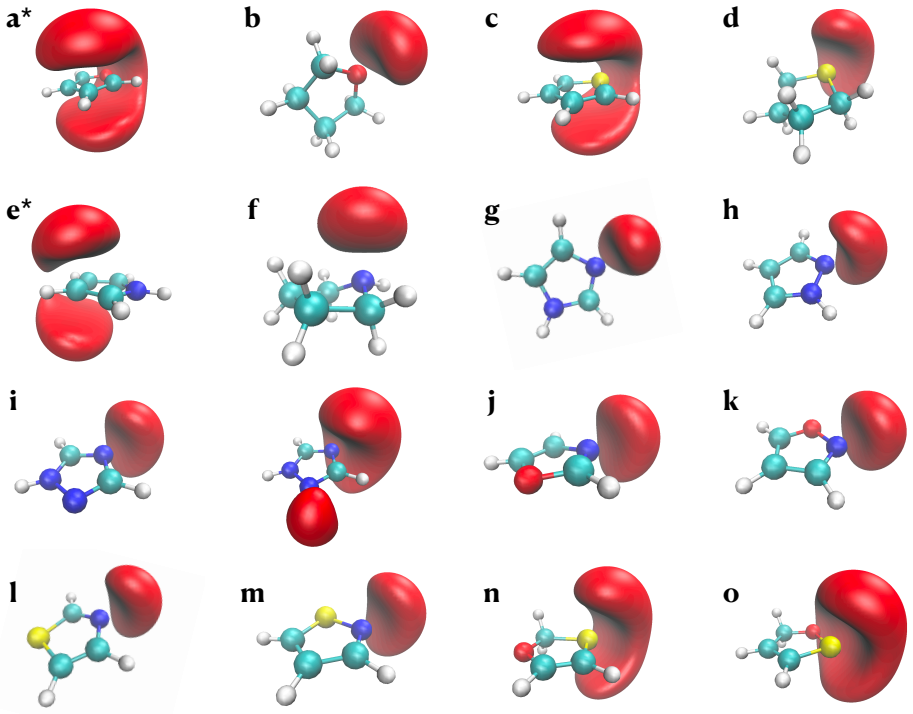
Positron binding energies and Dyson orbitals for five-membered heterocycles with N, O, S and NH substituents are predicted \emph{ab initio} via many-body theory. The positron-molecule correlation potential (self energy) is calculated via solution of Bethe-Salpeter equations that describe the positron-induced polarization of the target and screening of the electron-positron Coulomb interaction at the $GW$@BSE level, the infinite electron-positron ladder series that describes the crucially important process of virtual positronium formation, and the analogous positron-hole ladder series. The all-order calculations employ Gaussian-orbital bases and are implemented in the {\tt EXCITON+} code. The effect of substituting combinations of N, O and S atoms, and the NH group in the molecule's ring is studied, and the role of individual molecular orbitals, many of which are found to significantly contribute to the correlation potential, quantified. Analysis of the positron bound-state Dyson orbitals shows that the positron is typically localized next to one or two of the substituents in the ring, with the order of preference N, S, O, then NH, and is also influenced by aromaticity and the presence of double ($\pi$) bonds in the ring.
Editorial analysis
A structured set of objections, weighed in public.
Referee Report
Summary. The manuscript presents ab initio many-body theory calculations of positron binding energies and Dyson orbitals for five-membered heterocycles with N, O, S, and NH substituents. The positron-molecule correlation potential is obtained from all-order solutions of Bethe-Salpeter equations at the GW@BSE level, supplemented by the infinite electron-positron ladder series (virtual positronium formation) and the positron-hole ladder series, implemented with Gaussian bases in the EXCITON+ code. The work quantifies the effects of substituent combinations, the contributions of individual molecular orbitals to the self-energy, and the localization of the positron bound-state Dyson orbitals, which preferentially localize near N, then S, O, and NH, modulated by aromaticity and π bonds.
Significance. If the results hold, the paper delivers parameter-free predictions of positron binding in these systems that can guide future experiments in positron chemistry. Credit is due for the explicit all-order summation of the relevant ladder diagrams without fitted parameters, the use of Dyson orbitals to map localization, and the systematic quantification of orbital contributions to the correlation potential. These elements strengthen the analysis of substituent effects beyond what is available from simpler models.
major comments (1)
- [Computational methods / EXCITON+ implementation] The central claim that the all-order GW@BSE plus electron-positron and positron-hole ladder summations in Gaussian bases capture the dominant correlation effects without material truncation or basis-set incompleteness errors is load-bearing for the reported binding energies and localization order. The manuscript does not appear to include explicit basis-set extrapolation, convergence tables with respect to the number of virtual orbitals, or tests of ladder-series truncation for the studied heterocycles; such tests are needed to substantiate the quantitative predictions.
minor comments (3)
- The abstract states that the positron is 'typically localized next to one or two of the substituents' but does not indicate how many distinct molecules were examined or list their binding energies; adding a summary table of all computed systems would improve immediate readability.
- [Results and discussion] When presenting the preference order N > S > O > NH, the text should cross-reference the specific Dyson-orbital figures or tables that illustrate this ordering for representative cases, rather than leaving the connection implicit.
- [Methods] Notation for the self-energy components (GW@BSE, electron-positron ladder, positron-hole ladder) is clear in the abstract but would benefit from a short schematic diagram in the methods section showing how these terms are combined.
Simulated Author's Rebuttal
We are grateful to the referee for their positive evaluation of our work, the recommendation of minor revision, and the constructive comment on computational validation. We address the point below and have revised the manuscript to incorporate the requested details.
read point-by-point responses
-
Referee: [Computational methods / EXCITON+ implementation] The central claim that the all-order GW@BSE plus electron-positron and positron-hole ladder summations in Gaussian bases capture the dominant correlation effects without material truncation or basis-set incompleteness errors is load-bearing for the reported binding energies and localization order. The manuscript does not appear to include explicit basis-set extrapolation, convergence tables with respect to the number of virtual orbitals, or tests of ladder-series truncation for the studied heterocycles; such tests are needed to substantiate the quantitative predictions.
Authors: We thank the referee for this observation, which correctly identifies a point where additional documentation strengthens the quantitative claims. The EXCITON+ implementation performs all-order summations of the ladder series through iterative solution of the Bethe-Salpeter and Dyson equations, and the Gaussian bases were selected from families previously validated for positron binding. Nevertheless, the original manuscript presented only the final results without explicit convergence tables or extrapolation. In the revised version we have added a new paragraph in the Computational Methods section together with a supplementary table that reports positron binding energies for representative molecules (furan, pyrrole, thiophene) computed with successively larger basis sets (cc-pVDZ through cc-pVQZ) and increasing numbers of virtual orbitals. The table shows that the binding energies stabilize to within 0.01 eV once the virtual space exceeds approximately 200 orbitals and that the iterative ladder summation converges to machine precision in fewer than ten iterations. These additions substantiate the central claim without changing any reported binding energies or localization conclusions. revision: yes
Circularity Check
No significant circularity detected
full rationale
The derivation consists of direct numerical solution of the Bethe-Salpeter equations at the GW@BSE level together with all-order electron-positron and positron-hole ladder summations, implemented in the EXCITON+ Gaussian-orbital code. Binding energies and Dyson orbitals are computed outputs of these independent many-body equations applied to the molecular Hamiltonians; no parameters are fitted to the target quantities, no self-definitional closure occurs, and no load-bearing step reduces to a prior self-citation or ansatz by construction. The central results therefore remain self-contained ab initio predictions.
Axiom & Free-Parameter Ledger
axioms (2)
- domain assumption The GW@BSE level of the Bethe-Salpeter equation plus infinite ladder series accurately describe the positron-molecule correlation potential including virtual positronium formation.
- domain assumption Gaussian-orbital bases in the EXCITON+ implementation are sufficient to converge the binding energies for the studied molecules.
Reference graph
Works this paper leans on
-
[1]
Defect identification in semiconductors with positron annihilation: Exper- iment and theory,Rev
(1) Tuomisto, F.; Makkonen, I. Defect identification in semiconductors with positron annihilation: Exper- iment and theory,Rev. Mod. Phys.2013,85,
2013
-
[2]
Positrons in surface physics,Surf
(2) Hugenschmidt, C. Positrons in surface physics,Surf. Sci. Rep.2016,71,
2016
-
[3]
D.; Mariazzi, S.; Moskal, P.; Stępień, E
(3) Bass, S. D.; Mariazzi, S.; Moskal, P.; Stępień, E. Colloquium: Positronium physics and biomedical applications,Rev. Mod. Phys.2023,95, 021002. (4) Moskal, P.; Baran, J., et al. Positronium image of the human brain in vivo,Science Advances2024, 10, eadp2840. (5) Moskal, P.; Bilewicz, A.; Das, M.; Huang, B.; Khreptak, A.; Parzych, S.; Qi, J.; Rominger, ...
2023
-
[4]
M.; Diehl, R.; Ferrière, K.; Guessoum, N.; Jean, P.; Knoedlseder, J.; Marcowith, A.; Moskalenko, I
(6) Prantzos, N.; Boehm, C.; Bykov, A. M.; Diehl, R.; Ferrière, K.; Guessoum, N.; Jean, P.; Knoedlseder, J.; Marcowith, A.; Moskalenko, I. V.; Strong, A.; Weidenspointner, G. The 511 keV emission from positron annihilation in the Galaxy,Rev. Mod. Phys.2011,83,
2011
-
[5]
M.; Kusenko, A.; Radice, D.; Takhistov, V
(7) Fuller, G. M.; Kusenko, A.; Radice, D.; Takhistov, V. Positrons and 511 keV Radiation as Tracers of Recent Binary Neutron Star Mergers,Phys. Rev. Lett.2019,122, 121101. (8) Flambaum, V. V.; Samsonov, I. B. Radiation from matter-antimatter annihilation in the quark nugget model of dark matter,Phys. Rev. D2021,104, 063042. (9) Drachman, R. J. Why positr...
2019
-
[6]
F.; Young, J
(10) Gribakin, G. F.; Young, J. A.; Surko, C. M. Positron-molecule interactions: Resonant attachment, annihilation, and bound states,Rev. Mod. Phys.2010,82,
2010
-
[7]
R.; Dubin, D
(11) Danielson, J. R.; Dubin, D. H. E.; Greaves, R. G.; Surko, C. M. Plasma and trap-based techniques for science with positrons,Rev. Mod. Phys.2015,87,
2015
-
[8]
G.; Ludlow, J
(12) Green, D. G.; Ludlow, J. A.; Gribakin, G. F. Positron scattering and annihilation on noble-gas atoms, Phys. Rev. A2014,90, 032712. (13) Green, D. G.; Gribakin, G. F.γSpectra and Enhancement Factors for Positron Annihilation with Core Electrons,Phys. Rev. Lett.2015,114, 093201. (14) Hofierka, J.; Cunningham, B.; Rawlins, C. M.; Patterson, C. H.; Green...
2015
-
[9]
M.; Hofierka, J.; Cunningham, B.; Patterson, C
(15) Rawlins, C. M.; Hofierka, J.; Cunningham, B.; Patterson, C. H.; Green, D. G. Many-Body Theory Calculations of Positron Scattering and Annihilation inH2,N 2, andCH4,Phys. Rev. Lett.2023,130, 263001. (16) Cassidy, D. B. Experimental progress in positronium laser physics,Eur. Phys. J. D2018,72,
2023
-
[10]
(19) Gabrielse, G. et al. Trapped Antihydrogen in Its Ground State,Phys. Rev. Lett.2012,108, 113002. (20) Amole, C. et al. Resonant quantum transitions in trapped antihydrogen atoms,Nature2012,483, 439–443. (21) Amole, C. et al. An experimental limit on the charge of antihydrogen,Nat. Commun.2014,5,
2012
-
[11]
(23) Ahmadi, M. et al. An improved limit on the charge of antihydrogen from stochastic acceleration, Nature2016,529, 373–376. 18 (24) Ahmadi, M. et al. Antihydrogen accumulation for fundamental symmetry tests,Nat. Commun.2017, 8,
2017
-
[12]
(27) Amsler, C. et al. Pulsed production of antihydrogen,Comm. Phys.2021,4,
2021
-
[13]
(28) Moskal, P. et al. Testing CPT symmetry in ortho-positronium decays with positronium annihilation tomography,Nat. Commun.2021,12,
2021
-
[14]
(30) Anderson, E. K. et al. Observation of the effect of gravity on the motion of antimatter,Nature2023, 621, 716–722. (31) Gribakin, G. F.; Stanton, J. F.; Danielson, J. R.; Natisin, M. R.; Surko, C. M. Mode coupling and multiquantum vibrational excitations in Feshbach-resonant positron annihilation in molecules,Phys. Rev. A2017,96, 062709. (32) Swann, A...
2020
-
[15]
F.; Ludlow, J
(35) Gribakin, G. F.; Ludlow, J. Many-body theory of positron-atom interactions,Phys. Rev. A2004,70, 032720. (36) Cassidy,J.P.;Hofierka,J.;Cunningham,B.;Green,D.G.Many-bodytheorycalculationsofpositronic- bonded molecular dianions,J. Chem. Phys.2024,160, 084304. (37) Crawford, O. H. Bound states of a charged particle in a dipole field,Proceedings of the Ph...
2024
-
[16]
A.; Franz, J.; Buenker, R
(39) Gianturco, F. A.; Franz, J.; Buenker, R. J.; Liebermann, H.-P.; Pichl, L. š.; Rost, J.-M.; Tachikawa, M.; Kimura, M. Positron binding to alkali-metal hydrides: The role of molecular vibrations,Phys. Rev. A2006,73, 022705. (40) Charry, J.; Romero, J.; Varella, M. T. d. N.; Reyes, A. Calculation of positron binding energies of amino acids with the any-...
2014
-
[17]
(44) Tachikawa, M.; Kita, Y.; Buenker, R. J. Bound states of the positron with nitrile species with a con- figuration interaction multi-component molecular orbital approach,Phys. Chem. Chem. Phys.2011, 13, 2701–2705. 19 (45) Tachikawa, M. Positron-attachment to acetonitrile, acetaldehyde, and acetone molecules: Vibrational enhancement of positron affiniti...
2011
-
[18]
Can a positron bind to the para-benzoquinone molecule?,Eur
(48) Moreira, G.; Bettega, M. Can a positron bind to the para-benzoquinone molecule?,Eur. Phys. J. D 2024,78. (49) Frighetto, F. F.; Barbosa, A. S.; Sanchez, S. d. Improved positron-molecule scattering calculations with the Schwinger multichannel method,Phys. Rev. A2025,112, 042803. (50) Danby, G.; Tennyson, J. Positron-Hf Collisions: Prediction of a Weak...
2024
-
[19]
Non-Born–Oppenheimer study of positronic molecular systems: e+LiH, J
(53) Bubin, S.; Adamowicz, L. Non-Born–Oppenheimer study of positronic molecular systems: e+LiH, J. Chem. Phys.2004,120, 6051–6055. (54) Kita, Y.; Maezono, R.; Tachikawa, M.; Towler, M.; Needs, R. J. Ab initio quantum Monte Carlo study of the positronic hydrogen cyanide molecule,J. Chem. Phys.2009,131, 134310. (55) Yamada, Y.; Kita, Y.; Tachikawa, M. Theo...
2004
-
[20]
(63) Kelly, H. P. Many-Body Perturbation Theory Applied to Atoms,Phys. Rev.1964,136, B896. (64) Kelly, H. P. Many-Body Perturbation Theory Applied to Open-Shell Atoms,Phys. Rev.1966,144,
1964
-
[21]
Y.; Cherepkov, N
(65) Amusia, M. Y.; Cherepkov, N. A.; Chernysheva, L. V.; Shapiro, S. G. Elastic scattering of slow positrons by helium,J. Phys. B: Atom. Mol. Phys.1976,9, L531. (66) Gribakin, G. F.; Ludlow, J. Many-body theory of positron-atom interactions,Phys. Rev. A2004,70, 032720. 20 (67) Harabati, C.; Dzuba, V.; Flambaum, V. Identification of atoms that can bind po...
1976
-
[22]
(71) Arthur-Baidoo, E.; Danielson, J. R.; Surko, C. M.; Cassidy, J. P.; Gregg, S. K.; Hofierka, J.; Cunning- ham, B.; Patterson, C. H.; Green, D. G. Positron annihilation and binding in aromatic and other ring molecules,Phys. Rev. A2024,109, 062801. (72) Gregg, S. K.; Hofierka, J.; Cunningham, B.; Green, D. G. Many-body theory calculations of positron bin...
-
[23]
(73) Hofierka, J.; Rawlins, C. M.; Cunningham, B.; Waide, D. T.; Green, D. G. Many-body theory calcu- lations of positron scattering and annihilation in noble-gas atoms via the solution of Bethe–Salpeter equations using the Gaussian-basis code EXCITON+,Front. in Physics2023,11. (74) Gregg, S. K.; Cassidy, J. P.; Swann, A. R.; Hofierka, J.; Cunningham, B.;...
-
[24]
(75) Cassella, G.; Foulkes, W. M. C.; Pfau, D.; Spencer, J. S. Neural network variational Monte Carlo for positronic chemistry,Nat. Commun.2024,15,
2024
-
[25]
(76) Upadhyay, S.; Benali, A.; Jordan, K. D. Capturing Correlation Effects in Positron Binding to Atoms and Molecules,J. Chem. Theory Comput.2024,20, 9879–9893. (77) Riso, R. R.; Trabski, J. H. M.; Rossi, F.; Green, D.; Koch, H. Coupled cluster theory for positron binding in anions and polyatomic molecules, arXiv:2603.19948 [physics.chem-ph],
-
[26]
G.; Gribakin, G
(80) Green, D. G.; Gribakin, G. F. Positron scattering and annihilation in hydrogenlike ions,Phys. Rev. A 2013,88, 032708. (81) Kendall, R. A.; Dunning Jr, T.; Harrison, R. J. Electron affinities of the first-row atoms revisited. Systematic basis sets and wave functions,J. Chem. Phys.1992,96,
2013
-
[27]
R.; Ghosh, S.; Surko, C
(85) Danielson, J. R.; Ghosh, S.; Surko, C. M. Enhancement of positron binding energy in molecules containingπbonds,Phys. Rev. A2022,106, 032811. (86) Danielson, J. R.; Arthur-Baidoo, E.; Surko, C. M. Improved positron-molecule binding energies and estimations using molecular parameters,Phys. Rev. A2025,111, 042809. (87) Gribakin, G. InNew Directions in A...
2001
discussion (0)
Sign in with ORCID, Apple, or X to comment. Anyone can read and Pith papers without signing in.