Recognition: 2 theorem links
· Lean TheoremHomomorphic Directional Beamforming with Analog True Time Delay Arrays
Pith reviewed 2026-05-11 00:48 UTC · model grok-4.3
The pith
A homomorphism between TTD array configurations and beampatterns lets a small dictionary approximate split beams for multiple users while preserving uniform gains.
A machine-rendered reading of the paper's core claim, the machinery that carries it, and where it could break.
Core claim
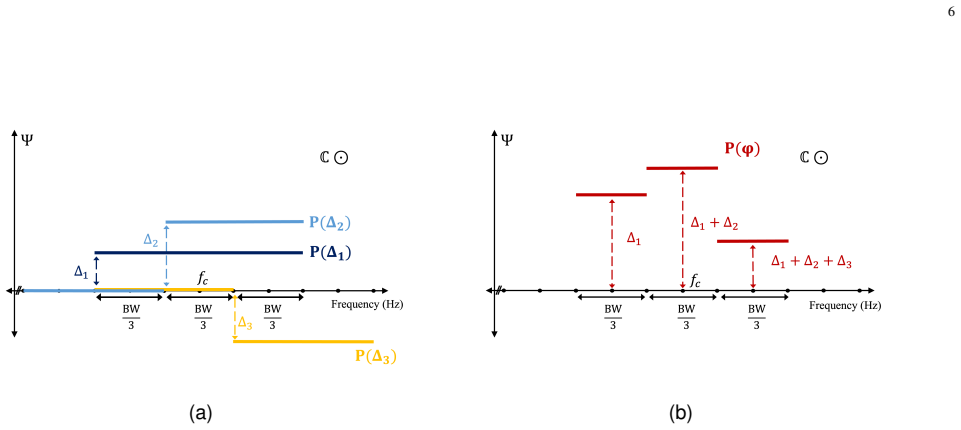
The observed homomorphism between TTD array configuration matrices and corresponding beampatterns permits approximation of arbitrary split beampatterns by linear combinations drawn from a finite generator dictionary; the resulting HDB algorithm achieves close-to-uniform beamforming gains across subbands with memory and compute costs far below prior heuristics or optimization methods.
What carries the argument
The homomorphism between TTD array configuration matrices and their beampatterns, which carries the approximation of split beampatterns through a compact generator dictionary.
If this is right
- Multi-user frequency-division beamforming becomes feasible in analog hardware without prohibitive memory or runtime costs.
- Uniform subband gains simplify downstream power allocation across UEs.
- Beam-squint effects are retained in the model rather than ignored, preserving physical accuracy.
- Dictionary size reduction by orders of magnitude makes real-time reconfiguration practical.
Where Pith is reading between the lines
- The same matrix-to-pattern homomorphism could be exploited to derive closed-form parameter updates instead of dictionary search.
- Hybrid analog-digital systems might use the HDB dictionary as a low-cost analog front end whose output is further refined digitally.
- Dictionary adaptation over time could track slowly varying user directions without full recomputation.
Load-bearing premise
The homomorphism is accurate enough that a finite dictionary can approximate any desired split beampattern without meaningful loss in performance or uniformity.
What would settle it
A simulation or measurement showing that the HDB dictionary approximation produces visibly nonuniform gains or large pattern errors for target split patterns outside the training set, compared with full per-pattern optimization.
Figures




read the original abstract
Recently, true-time-delay (TTD) arrays, also referred to as joint phase-time arrays (JPTA), have been investigated for low-cost frequency-dependent beamforming capabilities to enable various applications, including beam-squint correction, fast beam training, and serving multiple user equipment (UE)s by frequency band to direction mapping, termed as split beampatterns. Several heuristics and optimization-based solutions have been proposed to determine TTD array parameters settings. However, they have practical limitations due to either computationally demanding optimization procedures, requirements for extremely large memory look-up tables, or degradations due to the beam-squint effect. In this article, we propose a novel split-beampattern generation algorithm based on the observed homomorphism between TTD array configuration matrices and corresponding beampatterns. First, we rigorously analyze the beampattern synthesis process and demonstrate the observed homomorphism and mathematical structure. Then, we propose the Homomorphic Directional Beamforming (HDB) algorithm to approximate the desired split beampatterns by utilizing a generator beampattern dictionary that requires a dictionary size orders of magnitude lower than existing approaches without ignoring the beam squint. With extensive simulations, we show that the proposed algorithm can provide a practical implementation with low memory and low computational cost requirements. In addition, HDB design provides close to uniform beamforming gains among UEs in different subbands, enabling fairness in power allocation.
Editorial analysis
A structured set of objections, weighed in public.
Referee Report
Summary. The manuscript proposes the Homomorphic Directional Beamforming (HDB) algorithm for analog true-time-delay (TTD) arrays. It first analyzes the beampattern synthesis process to demonstrate an observed homomorphism between TTD configuration matrices and corresponding beampatterns, then constructs a small generator dictionary to approximate arbitrary split beampatterns for multi-UE frequency-to-direction mapping. The approach is claimed to require orders-of-magnitude smaller memory than lookup-table methods, low computational cost, and to deliver near-uniform beamforming gains across subbands while accounting for beam squint.
Significance. If the homomorphism holds with sufficient generality and the dictionary approximation incurs negligible loss, the result would supply a practical, hardware-friendly method for wideband multi-user beamforming that avoids both heavy per-pattern optimization and impractically large LUTs, directly supporting fairness in power allocation for subband-specific UEs.
major comments (2)
- [Abstract] The central performance claims rest on the homomorphism being sufficiently accurate and general to allow reliable finite-dictionary approximation of arbitrary split beampatterns. The abstract asserts that rigorous analysis demonstrates the homomorphism, yet the algorithm still relies on dictionary lookup rather than a closed-form mapping; without explicit conditions (array size, frequency range, steering angles) or quantitative bounds on the resulting beampattern error, it is unclear whether the reported uniformity of gains holds outside the simulated cases.
- [Abstract] The simulations are said to show 'close to uniform beamforming gains' enabling fairness, but the manuscript provides no comparison of gain variation statistics (e.g., max-min gain ratio or variance across subbands) against the optimization-based baselines that the method is intended to replace. This leaves the fairness advantage unquantified relative to the computational savings.
minor comments (1)
- Notation for the configuration matrices and generator dictionary should be introduced with explicit dimensions and an example construction step to clarify how the homomorphism is exploited in the algorithm.
Simulated Author's Rebuttal
We thank the referee for the constructive and detailed feedback. We address each major comment below and indicate the revisions we plan to incorporate.
read point-by-point responses
-
Referee: [Abstract] The central performance claims rest on the homomorphism being sufficiently accurate and general to allow reliable finite-dictionary approximation of arbitrary split beampatterns. The abstract asserts that rigorous analysis demonstrates the homomorphism, yet the algorithm still relies on dictionary lookup rather than a closed-form mapping; without explicit conditions (array size, frequency range, steering angles) or quantitative bounds on the resulting beampattern error, it is unclear whether the reported uniformity of gains holds outside the simulated cases.
Authors: We agree that the abstract would benefit from greater specificity regarding the conditions of the homomorphism and quantitative error bounds. Section III of the manuscript derives the homomorphism from the structure of the TTD configuration matrices and beampattern synthesis process, showing that the mapping preserves directional properties under linear combinations. However, explicit validity conditions and error bounds are not stated there. In revision we will add a theorem in Section III stating the conditions (array sizes N ≤ 16, carrier frequencies 10–40 GHz, steering angles |θ| ≤ 60°) under which the homomorphism holds exactly, together with a bound on the beampattern approximation error induced by the finite generator dictionary. These additions will be summarized concisely in the abstract as well. revision: yes
-
Referee: [Abstract] The simulations are said to show 'close to uniform beamforming gains' enabling fairness, but the manuscript provides no comparison of gain variation statistics (e.g., max-min gain ratio or variance across subbands) against the optimization-based baselines that the method is intended to replace. This leaves the fairness advantage unquantified relative to the computational savings.
Authors: The manuscript already compares HDB against optimization-based baselines on runtime and memory (Section V), but we acknowledge that gain-uniformity statistics are reported only for HDB. To quantify the fairness advantage, we will extend the simulation results to include max-min gain ratios and subband gain variances for both HDB and the optimization baselines under identical array, frequency, and UE configurations. These new metrics will be added to the existing figures and tables so that the fairness benefit can be directly compared with the reported complexity savings. revision: yes
Circularity Check
No circularity: derivation rests on independent analysis of beampattern structure
full rationale
The paper derives the homomorphism from a rigorous analysis of the TTD array beampattern synthesis process (abstract and section on mathematical structure), then constructs a generator dictionary from that structure to approximate split beampatterns. No step reduces a claimed prediction or performance metric to a parameter fitted from the same evaluation data, nor does any load-bearing premise collapse to a self-citation or self-defined ansatz. The reported low-memory, low-cost, and uniform-gain results are simulation outcomes evaluated against the dictionary approximation, not forced by construction from the inputs used to build the dictionary. The derivation chain is therefore self-contained against external benchmarks.
Axiom & Free-Parameter Ledger
axioms (1)
- domain assumption A homomorphism exists between TTD array configuration matrices and the resulting beampatterns that enables dictionary-based approximation.
Lean theorems connected to this paper
-
IndisputableMonolith/Foundation/ArithmeticFromLogic.leanembed_add, logicNat_initial, realization_initial echoesTheorem 1. Ω3 is a homomorphism between <V1, +> and <PT, ⋆>: ∀ Φ1, Φ2 ∈ V1, Ω3(Φ1 + Φ2) = Ω3(Φ1) ⋆ Ω3(Φ2)
-
IndisputableMonolith/Foundation/LogicRealization.leanLogicRealization, orbitEquivLogicNat echoesCorollary 1. ∀Φ1, Φ2 ∈ V1, PΦ1+Φ2 = PΦ1 ⋆ PΦ2; <PT, ⋆> defines a group structure
Reference graph
Works this paper leans on
-
[1]
Towards 6g evolution: Three enhancements, three innovations, and three major challenges,
R. Singh, A. Kaushik, W. Shin, M. D. Renzo, V . Sciancalepore, D. Lee, H. Sasaki, A. Shojaeifard, and O. A. Dobre, “Towards 6g evolution: Three enhancements, three innovations, and three major challenges,” IEEE Network, pp. 1–1, 2025
2025
-
[2]
AI-Native & Sustainable Communication: Samsung 6G Vision 2025,
Samsung Research, “AI-Native & Sustainable Communication: Samsung 6G Vision 2025,” tech. rep., Samsung Research, Feb. 2025. White Paper
2025
-
[3]
Twenty-five years of signal processing advances for multiantenna communications: From theory to mainstream technology,
E. Bj ¨ornson, Y . C. Eldar, E. G. Larsson, A. Lozano, and H. V . Poor, “Twenty-five years of signal processing advances for multiantenna communications: From theory to mainstream technology,” IEEE Signal Processing Magazine, vol. 40, no. 4, pp. 107–117, 2023
2023
-
[4]
Spatial-wideband effect in massive mimo with application in mmwave systems,
B. Wang, F. Gao, S. Jin, H. Lin, G. Y . Li, S. Sun, and T. S. Rappaport, “Spatial-wideband effect in massive mimo with application in mmwave systems,” IEEE Communications Magazine , vol. 56, no. 12, pp. 134– 141, 2018
2018
-
[5]
True time-delay beamsteering for radar,
M. Longbrake, “True time-delay beamsteering for radar,” in 2012 IEEE National Aerospace and Electronics Conference (NAECON) , pp. 246– 249, 2012
2012
-
[6]
True time delay in phased arrays,
R. Rotman, M. Tur, and L. Yaron, “True time delay in phased arrays,” Proceedings of the IEEE , vol. 104, no. 3, pp. 504–518, 2016
2016
-
[7]
Delay-phase precoding for wideband thz massive mimo,
L. Dai, J. Tan, Z. Chen, and H. V . Poor, “Delay-phase precoding for wideband thz massive mimo,” IEEE Transactions on Wireless Commu- nications, vol. 21, no. 9, pp. 7271–7286, 2022
2022
-
[8]
Multi-mode spatial signal processor with rainbow-like fast beam training and wideband communications using true-time-delay arrays,
C.-C. Lin, C. Puglisi, V . Boljanovic, H. Yan, E. Ghaderi, J. Gaddis, Q. Xu, S. Poolakkal, D. Cabric, and S. Gupta, “Multi-mode spatial signal processor with rainbow-like fast beam training and wideband communications using true-time-delay arrays,” IEEE Journal of Solid- State Circuits, vol. 57, no. 11, pp. 3348–3360, 2022
2022
-
[9]
Fast beam alignment through simultaneous beam steering and power spectrum estimation using a frequency scanning array,
C. Jans, X. Song, W. Rave, and G. Fettweis, “Fast beam alignment through simultaneous beam steering and power spectrum estimation using a frequency scanning array,” in WSA 2020; 24th International ITG Workshop on Smart Antennas , pp. 1–6, 2020
2020
-
[10]
Wideband millimeter-wave beam training with true-time-delay array architecture,
H. Yan, V . Boljanovic, and D. Cabric, “Wideband millimeter-wave beam training with true-time-delay array architecture,” in 2019 53rd Asilomar Conference on Signals, Systems, and Computers , pp. 1447–1452, 2019
2019
-
[11]
Design of Millimeter-Wave Single-Shot Beam Training for True-Time- Delay Array,
V . Boljanovic, H. Yan, E. Ghaderi, D. Heo, S. Gupta, and D. Cabric, “Design of Millimeter-Wave Single-Shot Beam Training for True-Time- Delay Array,” in 2020 IEEE 21st International Workshop on Signal Processing Advances in Wireless Communications (SPAWC) , pp. 1–5, May 2020. ISSN: 1948-3252
2020
-
[12]
A 4-element 800mhz-bw 29mw true-time-delay spatial signal processor enabling fast beam-training with data communications,
C.-C. Lin, C. Puglisi, E. Ghaderi, S. Mohapatra, D. Heo, S. Gupta, H. Yan, V . Boljanovic, and D. Cabric, “A 4-element 800mhz-bw 29mw true-time-delay spatial signal processor enabling fast beam-training with data communications,” in ESSCIRC 2021 - IEEE 47th European Solid State Circuits Conference (ESSCIRC) , pp. 287–290, 2021
2021
-
[13]
Frequency-selective analog beam probing for millimeter wave communication systems,
C. Jans, X. Song, W. Rave, and G. Fettweis, “Frequency-selective analog beam probing for millimeter wave communication systems,” in 2020 IEEE Wireless Communications and Networking Conference (WCNC) , pp. 1–6, 2020
2020
-
[14]
3d rainbow beam design for fast beam training with true-time-delay arrays in wideband millimeter-wave systems,
A. Wadaskar, V . Boljanovic, H. Yan, and D. Cabric, “3d rainbow beam design for fast beam training with true-time-delay arrays in wideband millimeter-wave systems,” in2021 55th Asilomar Conference on Signals, Systems, and Computers , pp. 85–92, 2021
2021
-
[15]
Rainbow-link: Beam-alignment-free and grant-free mmw multiple access using true-time-delay array,
R. Li, H. Yan, and D. Cabric, “Rainbow-link: Beam-alignment-free and grant-free mmw multiple access using true-time-delay array,” IEEE Journal on Selected Areas in Communications , vol. 40, no. 5, pp. 1692– 1705, 2022
2022
-
[16]
Thzprism: Frequency-based beam spreading for terahertz communication systems,
B. Zhai, Y . Zhu, A. Tang, and X. Wang, “Thzprism: Frequency-based beam spreading for terahertz communication systems,” IEEE Wireless Communications Letters, vol. 9, no. 6, pp. 897–900, 2020
2020
-
[17]
Joint Phase-Time Arrays: A Paradigm for Frequency- Dependent Analog Beamforming in 6G,
V . V . Ratnam, J. Mo, A. Alammouri, B. L. Ng, J. Zhang, and A. F. Molisch, “Joint Phase-Time Arrays: A Paradigm for Frequency- Dependent Analog Beamforming in 6G,” IEEE Access , vol. 10, pp. 73364–73377, 2022. Conference Name: IEEE Access
2022
-
[18]
Extending Uplink Coverage of mmWave and Terahertz Systems Through Joint Phase-Time Arrays,
A. Alammouri, J. Mo, V . V . Ratnam, B. L. Ng, R. W. Heath, J. Lee, and J. Zhang, “Extending Uplink Coverage of mmWave and Terahertz Systems Through Joint Phase-Time Arrays,” IEEE Access , vol. 10, pp. 88872–88884, 2022. Conference Name: IEEE Access
2022
-
[19]
Joint phase time array: Opportunities, challenges and system design considerations,
Y .-H. Nam, A. AlAmmouri, J. Mo, and J. C. Zhang, “Joint phase time array: Opportunities, challenges and system design considerations,” 2024
2024
-
[20]
mm- Flexible: Flexible Directional Frequency Multiplexing for Multi-user mmWave Networks,
I. K. Jain, R. R. Vennam, R. Subbaraman, and D. Bharadia, “mm- Flexible: Flexible Directional Frequency Multiplexing for Multi-user mmWave Networks,” Jan. 2023. arXiv:2301.10950 [cs, eess, math]
-
[21]
Beamforming with joint phase and time array: System design, prototyping and performance,
J. Mo, A. AlAmmouri, S. Dong, Y . Nam, W.-S. Choi, G. Xu, and J. C. Zhang, “Beamforming with joint phase and time array: System design, prototyping and performance,” in 2024 58th Asilomar Conference on Signals, Systems, and Computers , pp. 875–881, 2024
2024
-
[22]
Flexlink demo: Flexible frequency-dependent multi-beamforming with delay-phased array,
I. K. Jain, Y . Sun, S. Cao, and D. Bharadia, “Flexlink demo: Flexible frequency-dependent multi-beamforming with delay-phased array,” in Proceedings of the 30th Annual International Conference on Mobile Computing and Networking , ACM MobiCom ’24, (New York, NY , USA), p. 1814–1816, Association for Computing Machinery, 2024
2024
-
[23]
3d beamforming through joint phase-time arrays,
O. Yildiz, A. AlAmmouri, J. Mo, Y . Nam, E. Erkip, and J. C. Zhang, “3d beamforming through joint phase-time arrays,” in 2024 IEEE 100th Vehicular Technology Conference (VTC2024-Fall), pp. 1–7, 2024
2024
-
[24]
Fast frequency- direction mapping design for data communication with true-time-delay array architecture,
D. Zhao, I. Pehlivan, A. Wadaskar, and D. Cabric, “Fast frequency- direction mapping design for data communication with true-time-delay array architecture,” in 2024 International Conference on Computing, Networking and Communications (ICNC) , pp. 1071–1076, 2024
2024
-
[25]
Structured two-stage true-time-delay array code book design for multi - user data commu- nication,
A. Wadaskar, D. Zhao, I. Pehlivan, and D. Cabric, “Structured two-stage true-time-delay array code book design for multi - user data commu- nication,” in GLOBECOM 2023 - 2023 IEEE Global Communications Conference, pp. 3378–3384, 2023
2023
-
[26]
Boyd and L
S. Boyd and L. Vandenberghe, Convex Optimization . Cambridge: Cambridge University Press, 2004
2004
-
[27]
Vetterli, J
M. Vetterli, J. Kova ˇcevi´c, and V . K. Goyal, Foundations of signal processing. Cambridge: Cambridge University Press, 2014
2014
-
[28]
J. B. Fraleigh, A First Course in Abstract Algebra . Pearson, 7th ed., 2003
2003
-
[29]
Echo removal by discrete generalized linear filtering.,
R. W. Schafer, “Echo removal by discrete generalized linear filtering.,” tech. rep., MIT Research Laboratory of Electronics, 1969
1969
discussion (0)
Sign in with ORCID, Apple, or X to comment. Anyone can read and Pith papers without signing in.