Recognition: 2 theorem links
· Lean TheoremProtoSSL: Interpretable Prototype Learning from Unlabeled Time-Series Data
Pith reviewed 2026-05-11 00:49 UTC · model grok-4.3
The pith
ProtoSSL learns reusable prototypes from unlabeled time-series data by separating motif discovery from task alignment.
A machine-rendered reading of the paper's core claim, the machinery that carries it, and where it could break.
Core claim
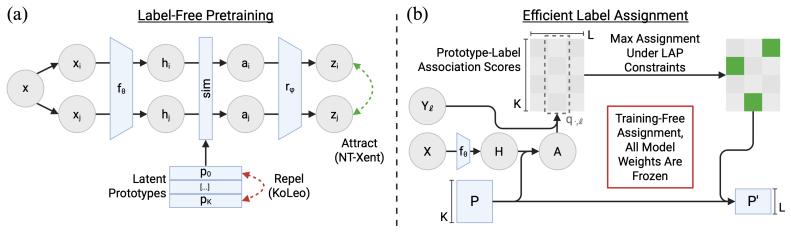
ProtoSSL first learns a reusable prototype bank using a self-supervised objective applied directly to prototype activations, and then aligns these prototypes to downstream tasks through an efficient assignment procedure. This separation enables learning generalizable prototypes from unlabeled data before the downstream label space is known, and supports subsequent assignment of interpretable, projection-grounded prototypes to new time-series tasks.
What carries the argument
Self-supervised objective applied to prototype activations that discovers reusable motifs independent of labels, followed by an assignment procedure that aligns the fixed prototype bank to a new task.
If this is right
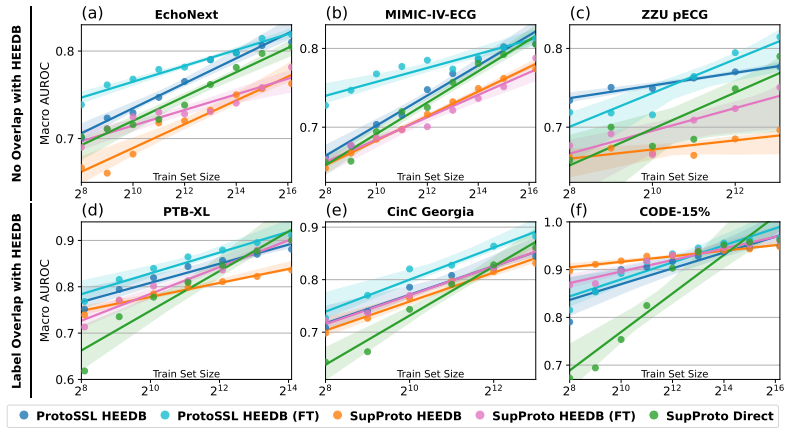
- ProtoSSL outperforms supervised prototype baselines on ECG datasets with as few as 256 labeled examples.
- After fine-tuning, ProtoSSL exceeds supervised prototype performance even when all labels are available.
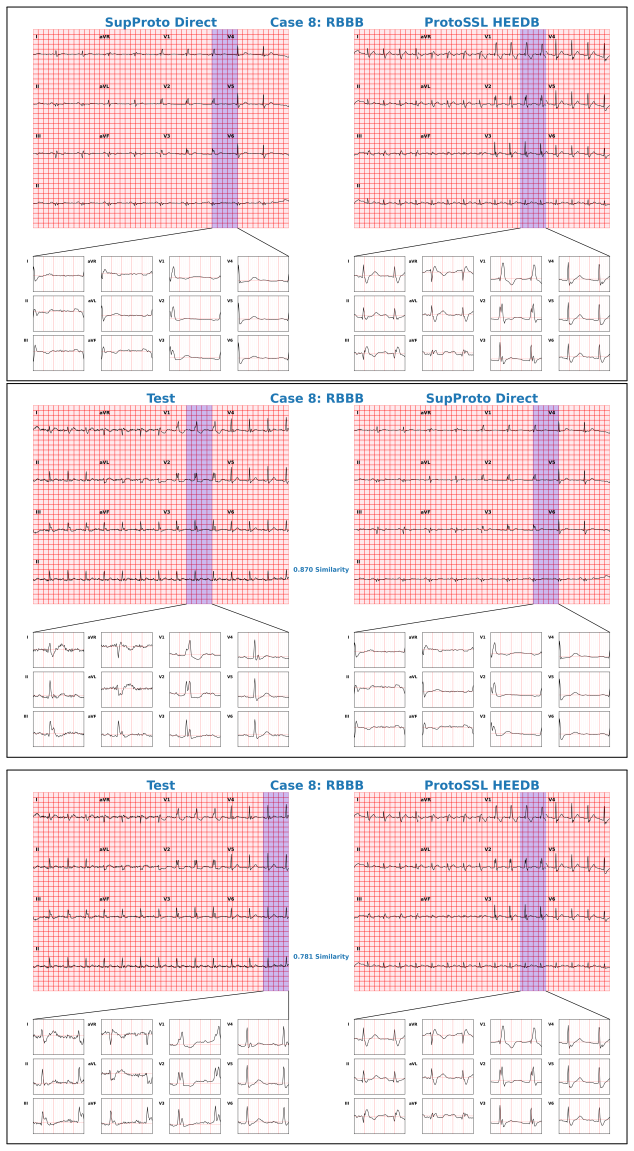
- Human evaluators rate ProtoSSL prototypes and prototype-based explanations more favorably than those trained with direct label supervision.
- The same framework applies to audio classification with similar gains in label efficiency.
Where Pith is reading between the lines
- A large pool of unlabeled time-series data from multiple sources could be used to pre-train a shared prototype bank that then supports many separate downstream tasks with minimal labels.
- The motif-to-label assignment step might be replaced by a learned mapper if the initial self-supervised motifs prove stable across sensor types or recording conditions.
- If the discovered prototypes transfer across domains, the approach could reduce the need to collect fresh labels when moving from one medical monitoring setting to another.
Load-bearing premise
The motifs discovered by self-supervision stay general enough to align to arbitrary downstream labels without large losses in accuracy or explanation quality.
What would settle it
A test on a new time-series task whose labels are unrelated to the pre-discovered motifs, where ProtoSSL requires at least as many labels as a supervised baseline to match its accuracy.
Figures




read the original abstract
In time-series domains where both predictive performance and interpretability are essential, deep neural networks achieve strong results but provide limited insight into how their predictions are made. Projection-based prototype networks address this limitation by grounding predictions in similarity to representative training examples, enabling case-based explanations and global prototype inspection. However, existing approaches rely on label supervision, tying prototypes to a specific task and requiring large labeled datasets. We introduce ProtoSSL, a novel framework for learning interpretable, projection-based prototypes from unlabeled time-series data and adapting them to downstream tasks. Our key idea is to separate motif discovery from label alignment. ProtoSSL first learns a reusable prototype bank using a self-supervised objective applied directly to prototype activations, and then aligns these prototypes to downstream tasks through an efficient assignment procedure. Across six electrocardiography (ECG) datasets, ProtoSSL improves label efficiency, outperforming supervised prototype baselines in low-data regimes with as few as 256 labeled examples; with fine-tuning, ProtoSSL outperforms supervised prototype baselines at full dataset scale. In a human evaluation study, ProtoSSL produces prototypes and prototype-based explanations that are judged more favorably than those learned with direct label supervision. We further show that the framework extends to audio classification. Thus, ProtoSSL enables both learning generalizable prototypes from unlabeled data before the downstream label space is known, and subsequent assignment of interpretable, projection-grounded prototypes to new time-series tasks.
Editorial analysis
A structured set of objections, weighed in public.
Referee Report
Summary. The paper introduces ProtoSSL, a framework that first learns a reusable bank of projection-based prototypes from unlabeled time-series data via a self-supervised objective applied to prototype activations, then aligns these prototypes to a downstream task through an efficient post-hoc assignment procedure. On six ECG datasets, ProtoSSL is reported to improve label efficiency over supervised prototype baselines in low-data regimes (as few as 256 labels) and, after fine-tuning, at full scale; a human study finds its prototypes and case-based explanations preferred over those from direct supervision. The method is also shown to extend to audio classification.
Significance. If the central claims hold, ProtoSSL would meaningfully advance label-efficient, interpretable prototype learning for time-series by decoupling motif discovery from label semantics, which is valuable in domains such as ECG analysis where labeled data is costly and explanations are required. The multi-dataset evaluation, fine-tuning results, and human preference study provide concrete evidence of practical utility; the separation of SSL pretraining from alignment is a clean architectural contribution that could generalize beyond the reported domains.
major comments (3)
- [§4.2, Eq. (5)] §4.2 and Eq. (5): the self-supervised loss is defined solely on prototype activations without an explicit diversity or coverage term; this leaves open whether the learned bank can remain sufficiently general for arbitrary downstream label spaces, directly bearing on the label-efficiency claims with 256 examples and the human preference results.
- [Table 2, §5.1] Table 2 (low-data regime) and §5.1: performance gains are reported without standard deviations across multiple random seeds or statistical significance tests; given the small labeled-set sizes, this omission prevents verification that the reported improvements over supervised prototype baselines are robust rather than sensitive to particular splits.
- [§5.3] §5.3 (human evaluation): the protocol for selecting and presenting prototypes to participants is not fully specified (e.g., how many prototypes per class, whether explanations are shown in isolation or with model predictions); this detail is load-bearing for the claim that ProtoSSL explanations are judged more favorably.
minor comments (2)
- [§3.3] Notation for the assignment procedure in §3.3 is introduced without a clear algorithmic listing or pseudocode, making the “efficient” claim hard to verify at a glance.
- [Figure 3] Figure 3 caption does not state the number of prototypes shown or the exact similarity metric used for visualization.
Simulated Author's Rebuttal
We thank the referee for the constructive and detailed comments on our manuscript. We address each major comment point by point below, providing the strongest honest defense of the work while acknowledging where revisions will improve clarity and rigor.
read point-by-point responses
-
Referee: [§4.2, Eq. (5)] §4.2 and Eq. (5): the self-supervised loss is defined solely on prototype activations without an explicit diversity or coverage term; this leaves open whether the learned bank can remain sufficiently general for arbitrary downstream label spaces, directly bearing on the label-efficiency claims with 256 examples and the human preference results.
Authors: We acknowledge that Eq. (5) applies the self-supervised objective directly to prototype activations without an added explicit diversity or coverage regularizer. The formulation relies on the activation-based loss to encourage prototypes to capture distinct, recurring motifs across the unlabeled data distribution, which in practice promotes sufficient coverage for downstream transfer. This is supported by consistent gains across six ECG datasets with heterogeneous label spaces and by the human preference results. Nevertheless, we agree that an explicit discussion of generality would strengthen the paper. We will revise §4.2 to include a paragraph analyzing the implicit coverage properties of the activation loss and will add a brief ablation comparing performance with and without a simple diversity penalty. This constitutes a partial revision that clarifies rather than alters the core method. revision: partial
-
Referee: [Table 2, §5.1] Table 2 (low-data regime) and §5.1: performance gains are reported without standard deviations across multiple random seeds or statistical significance tests; given the small labeled-set sizes, this omission prevents verification that the reported improvements over supervised prototype baselines are robust rather than sensitive to particular splits.
Authors: The referee is correct that Table 2 currently presents single-run point estimates without standard deviations or significance testing. Given the small labeled-set sizes (down to 256 examples), this is a substantive limitation for assessing robustness. We will re-run the low-data regime experiments using five independent random seeds for both data splits and model initialization, report mean performance with standard deviations in the revised Table 2, and include statistical significance tests (paired t-tests) against the supervised prototype baselines. These updates will be described in §5.1 and will directly address concerns about sensitivity to particular splits. revision: yes
-
Referee: [§5.3] §5.3 (human evaluation): the protocol for selecting and presenting prototypes to participants is not fully specified (e.g., how many prototypes per class, whether explanations are shown in isolation or with model predictions); this detail is load-bearing for the claim that ProtoSSL explanations are judged more favorably.
Authors: We agree that the human-study protocol requires fuller specification in the main text to support the preference claims. While additional details appear in the supplementary material, §5.3 will be expanded to state: (i) the top three prototypes per class were selected by average activation strength on the unlabeled pretraining set, (ii) each prototype was presented together with its three nearest time-series segments but without the downstream model prediction or class label to isolate explanation quality, (iii) twenty participants with ECG domain familiarity completed a forced-choice preference task using a 5-point Likert scale, and (iv) the exact questionnaire wording. These clarifications will be added without changing the study design or results. revision: yes
Circularity Check
No significant circularity: self-supervised stage independent of downstream alignment
full rationale
The paper's core derivation separates motif discovery (self-supervised objective applied directly to prototype activations on unlabeled data) from label alignment (efficient post-hoc assignment procedure). No equations reduce claimed improvements in label efficiency or human-judged interpretability to quantities defined by the same fitted parameters. The self-supervised bank is reusable and task-agnostic by construction, with performance gains evaluated on separate downstream ECG and audio tasks; no self-citation chains or ansatzes are invoked as load-bearing uniqueness results. The derivation remains self-contained against external benchmarks.
Axiom & Free-Parameter Ledger
axioms (1)
- domain assumption Time-series data contain reusable motifs that can be discovered independently of task labels via self-supervision on prototype activations.
Lean theorems connected to this paper
-
IndisputableMonolith/Cost/FunctionalEquation.leanwashburn_uniqueness_aczel unclear?
unclearRelation between the paper passage and the cited Recognition theorem.
ProtoSSL first learns a reusable prototype bank using a self-supervised objective applied directly to prototype activations... LProtoSSL = LNT-Xent + LKoLeo
-
IndisputableMonolith/Foundation/RealityFromDistinction.leanreality_from_one_distinction unclear?
unclearRelation between the paper passage and the cited Recognition theorem.
reduction of this problem to the rectangular linear assignment problem... Q = (Q̄+ − Q̄−)/√(½(Q+var + Q−var))
What do these tags mean?
- matches
- The paper's claim is directly supported by a theorem in the formal canon.
- supports
- The theorem supports part of the paper's argument, but the paper may add assumptions or extra steps.
- extends
- The paper goes beyond the formal theorem; the theorem is a base layer rather than the whole result.
- uses
- The paper appears to rely on the theorem as machinery.
- contradicts
- The paper's claim conflicts with a theorem or certificate in the canon.
- unclear
- Pith found a possible connection, but the passage is too broad, indirect, or ambiguous to say the theorem truly supports the claim.
Reference graph
Works this paper leans on
-
[1]
Burkhart, Nipun Bhandari, Bashar Ramadan, and Brett Beaulieu-Jones
Sahil Sethi, David Chen, Thomas Statchen, Michael C. Burkhart, Nipun Bhandari, Bashar Ramadan, and Brett Beaulieu-Jones. ProtoECGNet: Case-Based Interpretable Deep Learning for Multi-Label ECG Classification with Contrastive Learning. In Proceedings of the 10th Machine Learning for Healthcare Conference, volume 298 of Proceedings of Machine Learning Resea...
2025
-
[2]
Alina Jade Barnett, Zhicheng Guo, Jin Jing, Wendong Ge, Peter W. Kaplan, Wan Yee Kong, Ioannis Karakis, Aline Herlopian, Lakshman Arcot Jayagopal, Olga Taraschenko, Olga Selioutski, Gamaleldin Osman, Daniel Goldenholz, Cynthia Rudin, and M. Brandon Westover. Improving Clinician Performance in Classifying EEG Pat- terns on the Ictal–Interictal Injury Conti...
-
[3]
RenéHeinrich, LukasRauch, BernhardSick, andChristophScholz. AudioProtoPNet: An interpretable deep learning model for bird sound classification.Ecological Informatics, 87: 103081, 2025. ISSN 1574-9541. doi: https://doi.org/10.1016/j.ecoinf.2025.103081. URL https://www.sciencedirect.com/science/article/pii/S1574954125000901
-
[4]
An Interpretable Deep Learning Model for Automatic Sound Classification.Electronics, 10(7), 2021
Pablo Zinemanas, Martín Rocamora, Marius Miron, Frederic Font, and Xavier Serra. An Interpretable Deep Learning Model for Automatic Sound Classification.Electronics, 10(7), 2021. ISSN 2079-9292. doi: 10.3390/electronics10070850. URL https://www. mdpi.com/2079-9292/10/7/850
-
[5]
X-CHAR: A Concept-based Explainable Complex Human Activity Recognition Model
Jeya Vikranth Jeyakumar, Ankur Sarker, Luis Antonio Garcia, and Mani Srivastava. X-CHAR: A Concept-based Explainable Complex Human Activity Recognition Model. Proc. ACM Interact. Mob. Wearable Ubiquitous Technol., 7(1), March 2023. doi: 10. 1145/3580804. URLhttps://doi.org/10.1145/3580804
-
[6]
Cynthia Rudin. Stop explaining black box machine learning models for high stakes decisions and use interpretable models instead.Nature Machine Intelligence, 1(5): 206–215, May 2019. ISSN 2522-5839. doi: 10.1038/s42256-019-0048-x. URLhttps: //www.nature.com/articles/s42256-019-0048-x
-
[7]
Alina Jade Barnett, Fides Regina Schwartz, Chaofan Tao, Chaofan Chen, Yinhao Ren, Joseph Y. Lo, and Cynthia Rudin. A case-based interpretable deep learning model for classification of mass lesions in digital mammography.Nature Machine Intelligence, 3 (12):1061–1070, December 2021. ISSN 2522-5839. doi: 10.1038/s42256-021-00423-x. URLhttps://www.nature.com/...
-
[8]
This Looks Like That: Deep Learning for Interpretable Image Recognition
Chaofan Chen, Oscar Li, Daniel Tao, Alina Barnett, Cynthia Rudin, and Jonathan K Su. This Looks Like That: Deep Learning for Interpretable Image Recognition. InAdvances in Neural Information Processing Systems, volume 32. Curran Asso- ciates, Inc., 2019. URL https://proceedings.neurips.cc/paper_files/paper/ 2019/hash/adf7ee2dcf142b0e11888e72b43fcb75-Abstract.html
2019
-
[9]
Interpretable Image Recogni- tion with Hierarchical Prototypes, August 2019
Peter Hase, Chaofan Chen, Oscar Li, and Cynthia Rudin. Interpretable Image Recogni- tion with Hierarchical Prototypes, August 2019. URLhttp://arxiv.org/abs/1906. 10651. arXiv:1906.10651 [cs]
-
[10]
Multiscale Vision Transformers , isbn =
Jiaqi Wang, Huafeng Liu, Xinyue Wang, and Liping Jing. Interpretable Image Recogni- tion by Constructing Transparent Embedding Space. In2021 IEEE/CVF International Conference on Computer Vision (ICCV), pages 875–884, October 2021. doi: 10.1109/ ICCV48922.2021.00093. URLhttps://ieeexplore.ieee.org/document/9709918
-
[11]
Interpretable Image Classification with Differentiable Prototypes Assignment
Dawid Rymarczyk, Łukasz Struski, Michał Górszczak, Koryna Lewandowska, Jacek Tabor, and Bartosz Zieliński. Interpretable Image Classification with Differentiable Prototypes Assignment. In Shai Avidan, Gabriel Brostow, Moustapha Cissé, Gio- vanni Maria Farinella, and Tal Hassner, editors,Computer Vision – ECCV 2022, pages 351–368, Cham, 2022. Springer Natu...
-
[12]
This Looks Like Those: Illuminating Prototypical Concepts Using Multiple Visualizations
Chiyu Ma, Brandon Zhao, Chaofan Chen, and Cynthia Rudin. This Looks Like Those: Illuminating Prototypical Concepts Using Multiple Visualizations. Advances in Neural Information Processing Systems, 36:39212–39235, December
-
[13]
URL https://proceedings.neurips.cc/paper_files/paper/2023/hash/ 7b76eea0c3683e440c3d362620f578cd-Abstract-Conference.html
2023
-
[14]
Part-Prototype Models in Medical Imaging: Applications and Current Challenges.BioMedInformatics, 4(4):2149–2172, December
Lisa Anita De Santi, Franco Italo Piparo, Filippo Bargagna, Maria Filomena Santarelli, Simona Celi, and Vincenzo Positano. Part-Prototype Models in Medical Imaging: Applications and Current Challenges.BioMedInformatics, 4(4):2149–2172, December
-
[15]
doi: 10.3390/biomedinformatics4040115
ISSN 2673-7426. doi: 10.3390/biomedinformatics4040115. URL https://www. mdpi.com/2673-7426/4/4/115
-
[16]
Gianluca Carloni, Andrea Berti, Chiara Iacconi, Maria Antonietta Pascali, and Sara Colantonio. On the Applicability of Prototypical Part Learning in Medical Images: Breast Masses Classification Using ProtoPNet. In Jean-Jacques Rousseau and Bill Kapralos, editors,Pattern Recognition, Computer Vision, and Image Processing. ICPR 2022 International Workshops ...
-
[17]
A Simple Framework for Contrastive Learning of Visual Representations
Ting Chen, Simon Kornblith, Mohammad Norouzi, and Geoffrey Hinton. A Simple Framework for Contrastive Learning of Visual Representations. In Hal Daumé III and Aarti Singh, editors,Proceedings of the 37th International Conference on Machine Learning, volume 119 ofProceedings of Machine Learning Research, pages 1597–1607. PMLR, July 2020. URLhttps://proceed...
2020
-
[18]
Contrastive Learning of General- Purpose Audio Representations, October 2020
Aaqib Saeed, David Grangier, and Neil Zeghidour. Contrastive Learning of General- Purpose Audio Representations, October 2020. URL http://arxiv.org/abs/2010. 10915. arXiv:2010.10915 [cs]
-
[19]
Unsupervised Learning of Visual Features by Contrasting Cluster Assignments
Mathilde Caron, Ishan Misra, Julien Mairal, Priya Goyal, Piotr Bojanowski, and Armand Joulin. Unsupervised Learning of Visual Features by Contrasting Cluster Assignments. InAdvances in Neural Information Processing Systems, volume 33, pages 9912–9924. Curran Associates, Inc., 2020. URLhttps://papers.neurips.cc/paper/2020/hash/ 70feb62b69f16e0238f741fab228...
2020
-
[20]
PrototypicalContrastiveLearning of Unsupervised Representations
JunnanLi, PanZhou, CaimingXiong, andStevenHoi. PrototypicalContrastiveLearning of Unsupervised Representations. InInternational Conference on Learning Representa- tions, October 2020. URLhttps://openreview.net/forum?id=KmykpuSrjcq
2020
-
[21]
Yongjie Du, Deyun Zhou, Yu Xie, Yu Lei, and Jiao Shi. Prototype-Guided Feature Learning for Unsupervised Domain Adaptation.Pattern Recognition, 135:109154, March 2023. ISSN 0031-3203. doi: 10.1016/j.patcog.2022.109154. URLhttps://www. sciencedirect.com/science/article/pii/S0031320322006331
-
[22]
2022, TS2Vec: Towards Universal Representation of Time Series
Zhihan Yue, Yujing Wang, Juanyong Duan, Tianmeng Yang, Congrui Huang, Yunhai Tong, and Bixiong Xu. TS2Vec: Towards Universal Representation of Time Series, February 2022. URLhttp://arxiv.org/abs/2106.10466. arXiv:2106.10466 [cs]
-
[23]
Robust Classification with Convolutional Prototype Learning
Hong-Ming Yang, Xu-Yao Zhang, Fei Yin, and Cheng-Lin Liu. Robust Classification with Convolutional Prototype Learning. In2018 IEEE/CVF Conference on Computer Vision and Pattern Recognition (CVPR), pages 3474–3482, Los Alamitos, CA, USA, June 2018. IEEE Computer Society. doi: 10.1109/CVPR.2018.00366. URL https: //doi.ieeecomputersociety.org/10.1109/CVPR.2018.00366
-
[24]
Transferrable Prototypical Networks for Unsupervised Domain Adaptation
Yingwei Pan, Ting Yao, Yehao Li, Yu Wang, Chong-Wah Ngo, and Tao Mei. Transferrable Prototypical Networks for Unsupervised Domain Adaptation. In2019 IEEE/CVF Conference on Computer Vision and Pattern Recognition (CVPR), pages 2234–2242, Los Alamitos, CA, USA, June 2019. IEEE Computer Society. doi: 10.1109/CVPR.2019.00234. URL https://doi.ieeecomputersocie...
-
[25]
Emerging properties in self-supervised vision transformers.arXiv preprint arXiv:2104.14294,
Mathilde Caron, Hugo Touvron, Ishan Misra, Hervé Jégou, Julien Mairal, Piotr Bo- janowski, and Armand Joulin. Emerging Properties in Self-Supervised Vision Trans- formers, May 2021. URLhttp://arxiv.org/abs/2104.14294. arXiv:2104.14294 [cs]
-
[26]
Maxime Oquab, Timothée Darcet, Théo Moutakanni, Huy V. Vo, Marc Szafraniec, Vasil Khalidov, Pierre Fernandez, Daniel HAZIZA, Francisco Massa, Alaaeldin El- Nouby, Mido Assran, Nicolas Ballas, Wojciech Galuba, Russell Howes, Po-Yao Huang, Shang-Wen Li, Ishan Misra, Michael Rabbat, Vasu Sharma, Gabriel Synnaeve, Hu Xu, Herve Jegou, Julien Mairal, Patrick La...
2024
-
[27]
Nathaniel Diamant, Erik Reinertsen, Steven Song, Aaron D. Aguirre, Collin M. Stultz, and Puneet Batra. Patient contrastive learning: A performant, expressive, and practical approach to electrocardiogram modeling.PLOS Computational Biology, 18(2):e1009862, February 2022. ISSN 1553-7358. doi: 10.1371/journal.pcbi.1009862. URLhttps:// journals.plos.org/plosc...
-
[28]
CLAR: Contrastive Learning of Auditory Representations
Haider Al-Tahan and Yalda Mohsenzadeh. CLAR: Contrastive Learning of Auditory Representations. In Arindam Banerjee and Kenji Fukumizu, editors,Proceedings of The 24th International Conference on Artificial Intelligence and Statistics, volume 130 of Proceedings of Machine Learning Research, pages 2530–2538. PMLR, April 2021. URL https://proceedings.mlr.pre...
2021
-
[29]
Bootstrap Your Own Latent - A New Approach to Self-Supervised Learning
Jean-Bastien Grill, Florian Strub, Florent Altché, Corentin Tallec, Pierre Richemond, Elena Buchatskaya, Carl Doersch, Bernardo Avila Pires, Zhaohan Guo, Mohammad Gheshlaghi Azar, Bilal Piot, koray kavukcuoglu, Remi Munos, and Michal Valko. Bootstrap Your Own Latent - A New Approach to Self-Supervised Learning. In Advances in Neural Information Processing...
2020
-
[30]
Meike Nauta, Jörg Schlötterer, Maurice van Keulen, and Christin Seifert. PIP-Net: Patch-Based Intuitive Prototypes for Interpretable Image Classification. In2023 IEEE/CVF Conference on Computer Vision and Pattern Recognition (CVPR), pages 2744–2753, 2023. doi: 10.1109/CVPR52729.2023.00269
-
[31]
Interpretable Image Classification via Non-parametric Part Prototype Learning
Zhijie Zhu, Lei Fan, Maurice Pagnucco, and Yang Song. Interpretable Image Classification via Non-parametric Part Prototype Learning. In2025 Proceedings of the IEEE/CVF Conference on Computer Vision and Pattern Recognition (CVPR), pages 9762–9771, 2025. URLhttps://openaccess.thecvf.com/content/CVPR2025/ html/Zhu_Interpretable_Image_Classification_via_Non-p...
2025
-
[32]
Omid Davoodi, Shayan Mohammadizadehsamakosh, and Majid Komeili. On the in- terpretability of part-prototype based classifiers: a human centric analysis.Scientific Reports, 13(1):23088, December 2023. ISSN 2045-2322. doi: 10.1038/s41598-023-49854-z. URLhttps://doi.org/10.1038/s41598-023-49854-z
-
[33]
Aguirre, Valdery Moura Junior, Jiarui Jin, Che Liu, Lanhai Zhong, Chenxi Sun, Gari Clifford, M
Jun Li, Aaron D. Aguirre, Valdery Moura Junior, Jiarui Jin, Che Liu, Lanhai Zhong, Chenxi Sun, Gari Clifford, M. Brandon Westover, and Shenda Hong. An Electro- cardiogram Foundation Model Built on over 10 Million Recordings.NEJM AI, 2(7): AIoa2401033, 2025. doi: 10.1056/AIoa2401033. URL https://ai.nejm.org/doi/ full/10.1056/AIoa2401033
-
[34]
Spreading vectors for similarity search
Alexandre Sablayrolles, Matthijs Douze, Cordelia Schmid, and Hervé Jégou. Spreading vectors for similarity search. InInternational Conference on Learning Representations, September 2018. URLhttps://openreview.net/forum?id=SkGuG2R5tm
2018
-
[35]
H. W. Kuhn. The Hungarian method for the assignment problem.Naval Research Logistics Quarterly, 2(1-2):83–97, 1955. ISSN 1931-9193. doi: 10.1002/nav.3800020109. URLhttps://onlinelibrary.wiley.com/doi/abs/10.1002/nav.3800020109. 12
-
[36]
Daniel Lakens. Calculating and reporting effect sizes to facilitate cumulative science: a practical primer for t-tests and ANOVAs.Frontiers in Psychology, Volume 4 - 2013, 2013. ISSN 1664-1078. doi: 10.3389/fpsyg.2013.00863. URLhttps://www.frontiersin.org/ journals/psychology/articles/10.3389/fpsyg.2013.00863
-
[37]
Aguirre, Erik Reinertsen, Steven Song, Shenda Hong, David E
Zuzana Koscova, Qiao Li, Chad Robichaux, Valdery Moura Junior, Manohar Ghanta, Aditya Gupta, Jonathan Rosand, Aaron D. Aguirre, Erik Reinertsen, Steven Song, Shenda Hong, David E. Albert, Joel Xue, Aarya Parekh, Reza Sameni, Matthew A. Reyna, M. Brandon Westover, and Gari D. Clifford. The Harvard- Emory ECG Database.Scientific Data, 13(1):516, February 20...
2026
-
[38]
URL https://www.nature.com/articles/ s41597-026-06861-9
doi: 10.1038/s41597-026-06861-9. URL https://www.nature.com/articles/ s41597-026-06861-9
-
[39]
Guiding Masked Repre- sentation Learning to Capture Spatio-Temporal Relationship of Electrocardiogram
Yeongyeon Na, Minje Park, Yunwon Tae, and Sunghoon Joo. Guiding Masked Repre- sentation Learning to Capture Spatio-Temporal Relationship of Electrocardiogram. In The Twelfth International Conference on Learning Representations, October 2023. URL https://openreview.net/forum?id=WcOohbsF4H
2023
-
[40]
M. A. Al-Masud, Juan Lopez Alcaraz, and Nils Strodthoff. Benchmarking ECG FMs: A Reality Check Across Clinical Tasks. InThe Fourteenth International Confer- ence on Learning Representations, 2026. URLhttps://openreview.net/forum?id= xXRqWpt3Xr
2026
-
[41]
Deep learning for case-based reasoning through prototypes: a neural network that explains its predictions
Oscar Li, Hao Liu, Chaofan Chen, and Cynthia Rudin. Deep learning for case-based reasoning through prototypes: a neural network that explains its predictions. InPro- ceedings of the Thirty-Second AAAI Conference on Artificial Intelligence and Thirtieth Innovative Applications of Artificial Intelligence Conference and Eighth AAAI Sympo- sium on Educational...
2018
-
[42]
Burkhart, Nipun Bhandari, Bashar Ramadan, and Brett Beaulieu-Jones
Sahil Sethi, David Chen, Michael C. Burkhart, Nipun Bhandari, Bashar Ramadan, and Brett Beaulieu-Jones. Prototype Learning to Create Refined Interpretable Digital Phenotypes from ECGs. InBiocomputing 2026, pages 679–693. December 2025. doi: 10.1142/9789819824755_0049. URL https://www.worldscientific.com/doi/abs/ 10.1142/9789819824755_0049
-
[43]
Hugues Turbé, Mina Bjelogrlic, Christian Lovis, and Gianmarco Mengaldo. Evaluation of post-hoc interpretability methods in time-series classification.Nature Machine Intel- ligence, 5(3):250–260, March 2023. ISSN 2522-5839. doi: 10.1038/s42256-023-00620-w. URLhttps://www.nature.com/articles/s42256-023-00620-w
-
[44]
Lunze, Wojciech Samek, and Tobias Schaeffter
Patrick Wagner, Nils Strodthoff, Ralf-Dieter Bousseljot, Dieter Kreiseler, Fatima I. Lunze, Wojciech Samek, and Tobias Schaeffter. PTB-XL, a large publicly avail- able electrocardiography dataset.Scientific Data, 7(1):154, May 2020. ISSN 2052-
2020
-
[45]
PTB-XL, a large publicly available electrocardiography dataset.Scientific data, 7 (1):1–15, 2020
doi: 10.1038/s41597-020-0495-6. URL https://www.nature.com/articles/ s41597-020-0495-6
-
[46]
Gemmeke, Daniel P
Jort F. Gemmeke, Daniel P. W. Ellis, Dylan Freedman, Aren Jansen, Wade Lawrence, R. Channing Moore, Manoj Plakal, and Marvin Ritter. Audio Set: An ontology and human-labeled dataset for audio events. InProc. IEEE ICASSP 2017, New Orleans, LA, 2017
2017
-
[47]
A Dataset and Taxonomy for Urban Sound Research
Justin Salamon, Christopher Jacoby, and Juan Pablo Bello. A Dataset and Taxonomy for Urban Sound Research. InProceedings of the 22nd ACM international conference on Multimedia, MM ’14, pages 1041–1044, New York, NY, USA, November 2014. Association for Computing Machinery. ISBN 978-1-4503-3063-3. doi: 10.1145/2647868.2655045. URLhttps://dl.acm.org/doi/10.1...
-
[48]
Carlos Busso, Murtaza Bulut, Chi-Chun Lee, Abe Kazemzadeh, Emily Mower, Samuel Kim, Jeannette Chang, Sungbok Lee, and Shrikanth S. Narayanan. IEMOCAP: Inter- active emotional dyadic motion capture database.Journal of Language Resources and Evaluation, 42(4):335–359, December 2008. doi: 10.1007/s10579-008-9076-6. 13
-
[49]
V oxCeleb: A Large-Scale Speaker Identification Dataset
A. Nagrani, J. S. Chung, and A. Zisserman. VoxCeleb: a large-scale speaker identification dataset. InProc. Interspeech 2017, pages 2616–2620, 2017. doi: 10.21437/Interspeech. 2017-950
-
[50]
Jordan Frank, Shie Mannor, Joelle Pineau, and Doina Precup. Time Series Analysis Using Geometric Template Matching.IEEE Transactions on Pattern Analysis and Machine Intelligence, 35(3):740–754, 2013. doi: 10.1109/TPAMI.2012.121
-
[51]
Template Matching Advances and Applications in Image Analysis, October
Nazanin Sadat Hashemi, Roya Babaie Aghdam, Atieh Sadat Bayat Ghiasi, and Parastoo Fatemi. Template Matching Advances and Applications in Image Analysis, October
- [52]
-
[53]
Noise tolerant QRS detection using template matching with short-term autocorrelation
Yozaburo Nakai, Shintaro Izumi, Masanao Nakano, Ken Yamashita, Takahide Fujii, Hiroshi Kawaguchi, and Masahiko Yoshimoto. Noise tolerant QRS detection using template matching with short-term autocorrelation. In2014 36th Annual International Conference of the IEEE Engineering in Medicine and Biology Society, pages 34–37, 2014. doi: 10.1109/EMBC.2014.6943522
-
[54]
Can Ye, B. V. K. Vijaya Kumar, and Miguel Tavares Coimbra. Heartbeat Classification Using Morphological and Dynamic Features of ECG Signals.IEEE Transactions on Biomedical Engineering, 59(10):2930–2941, 2012. doi: 10.1109/TBME.2012.2213253
-
[55]
Anupreet Kaur Singh and Sridhar Krishnan. ECG signal feature extraction trends in methods and applications.BioMedical Engineering OnLine, 22(1):22, March 2023. ISSN 1475-925X. doi: 10.1186/s12938-023-01075-1. URL https://doi.org/10.1186/ s12938-023-01075-1
-
[56]
McCradden, and Anna Goldenberg
Sana Tonekaboni, Shalmali Joshi, Melissa D. McCradden, and Anna Goldenberg. What Clinicians Want: Contextualizing Explainable Machine Learning for Clinical End Use. InProceedings of the 4th Machine Learning for Healthcare Conference, pages 359–380. PMLR, October 2019. URLhttps://proceedings.mlr.press/v106/tonekaboni19a. html
2019
-
[57]
A Unified Approach to Interpreting Model Predictions
Scott M Lundberg and Su-In Lee. A Unified Approach to Interpreting Model Predictions. In I. Guyon, U. Von Luxburg, S. Bengio, H. Wallach, R. Fergus, S. Vishwanathan, and R. Garnett, editors,Advances in Neural Information Processing Systems, volume 30. Curran Associates, Inc., 2017. URLhttps://proceedings.neurips.cc/paper_files/ paper/2017/file/8a20a862197...
2017
-
[58]
Meike Nauta, Jan Trienes, Shreyasi Pathak, Elisa Nguyen, Michelle Peters, Yasmin Schmitt, Jörg Schlötterer, Maurice van Keulen, and Christin Seifert. From Anecdotal Evidence to Quantitative Evaluation Methods: A Systematic Review on Evaluating Explainable AI.ACM Comput. Surv., 55(13s), July 2023. ISSN 0360-0300. doi: 10.1145/3583558. URLhttps://doi.org/10...
-
[59]
Thomas Rojat, Raphaël Puget, David Filliat, Javier Del Ser, Rodolphe Gelin, and Natalia Díaz-Rodríguez. Explainable Artificial Intelligence (XAI) on TimeSeries Data: A Survey, April 2021. URLhttp://arxiv.org/abs/2104.00950. arXiv:2104.00950 [cs]
-
[60]
Sanity checks for saliency maps
Julius Adebayo, Justin Gilmer, Michael Muelly, Ian Goodfellow, Moritz Hardt, and Been Kim. Sanity checks for saliency maps. InProceedings of the 32nd International Conference on Neural Information Processing Systems, NIPS’18, pages 9525–9536, Red Hook, NY, USA, 2018. Curran Associates Inc
2018
-
[61]
Jaakkola
David Alvarez-Melis and Tommi S. Jaakkola. Towards robust interpretability with self-explaining neural networks. InProceedings of the 32nd International Conference on Neural Information Processing Systems, NIPS’18, pages 7786–7795, Red Hook, NY, USA, 2018. Curran Associates Inc
2018
-
[62]
Time series shapelets: a new primitive for data mining
Lexiang Ye and Eamonn Keogh. Time series shapelets: a new primitive for data mining. InProceedings of the 15th ACM SIGKDD international conference on Knowledge discovery and data mining, KDD ’09, pages 947–956, New York, NY, USA, June 2009. 14 Association for Computing Machinery. ISBN 978-1-60558-495-9. doi: 10.1145/1557019. 1557122. URLhttps://dl.acm.org...
-
[63]
Learning time-series shapelets
Josif Grabocka, Nicolas Schilling, Martin Wistuba, and Lars Schmidt-Thieme. Learning time-series shapelets. InProceedings of the 20th ACM SIGKDD international conference on Knowledge discovery and data mining, KDD ’14, pages 392–401, New York, NY, USA, August 2014. Association for Computing Machinery. ISBN 978-1-4503-2956-9. doi: 10. 1145/2623330.2623613....
-
[64]
BasisFormer: Attention- based Time Series Forecasting with Learnable and Interpretable Basis
Zelin Ni, Hang Yu, Shizhan Liu, Jianguo Li, and Weiyao Lin. BasisFormer: Attention- based Time Series Forecasting with Learnable and Interpretable Basis. InThirty- seventh Conference on Neural Information Processing Systems, 2023. URLhttps: //openreview.net/forum?id=xx3qRKvG0T
2023
-
[65]
Domjan Barić, Petar Fumić, Davor Horvatić, and Tomislav Lipic. Benchmarking Attention-Based Interpretability of Deep Learning in Multivariate Time Series Pre- dictions.Entropy, 23(2), 2021. ISSN 1099-4300. doi: 10.3390/e23020143. URL https://www.mdpi.com/1099-4300/23/2/143
-
[66]
Learning Opti- mal Summaries of Clinical Time-series with Concept Bottleneck Models
Carissa Wu, Sonali Parbhoo, Marton Havasi, and Finale Doshi-Velez. Learning Opti- mal Summaries of Clinical Time-series with Concept Bottleneck Models. In Zachary Lipton, Rajesh Ranganath, Mark Sendak, Michael Sjoding, and Serena Yeung, editors, Proceedings of the 7th Machine Learning for Healthcare Conference, volume 182 of Proceedings of Machine Learnin...
2022
-
[67]
Ričards Marcinkevičs, Patricia Reis Wolfertstetter, Ugne Klimiene, Kieran Chin-Cheong, Alyssia Paschke, Julia Zerres, Markus Denzinger, David Niederberger, Sven Well- mann, Ece Ozkan, Christian Knorr, and Julia E. Vogt. Interpretable and intervenable ultrasonography-based machine learning models for pediatric appendicitis.Medical Image Analysis, 91:103042...
work page doi:10.1016/j 2024
-
[68]
An Overview of Prototype Formulations for Interpretable Deep Learning, January 2026
Maximilian Xiling Li, Korbinian Franz Rudolf, Paul Mattes, Nils Blank, and Rudolf Lioutikov. An Overview of Prototype Formulations for Interpretable Deep Learning, January 2026. URLhttp://arxiv.org/abs/2410.08925. arXiv:2410.08925 [cs]
- [69]
-
[70]
Arteaga, Marius Aasan, Rwiddhi Chakraborty, Martine Hjelkrem-Tan, Thalles Silva, Michael Kampffmeyer, and Adín Ramírez Rivera
Gabriel Y. Arteaga, Marius Aasan, Rwiddhi Chakraborty, Martine Hjelkrem-Tan, Thalles Silva, Michael Kampffmeyer, and Adín Ramírez Rivera. Why Prototypes Collapse: Diagnosing and Preventing Partial Collapse in Prototypical Self-Supervised Learning. InThe Fourteenth International Conference on Learning Representations,
-
[71]
URLhttps://openreview.net/forum?id=fVJEWdwvLO
-
[72]
Computing Receptive Fields of Convolutional Neural Networks.Distill, 4(11):e21, November 2019
André Araujo, Wade Norris, and Jack Sim. Computing Receptive Fields of Convolutional Neural Networks.Distill, 4(11):e21, November 2019. ISSN 2476-0757. doi: 10.23915/ distill.00021. URLhttps://distill.pub/2019/computing-receptive-fields
2019
-
[73]
Understand- ing the Effective Receptive Field in Deep Convolutional Neural Networks
Wenjie Luo, Yujia Li, Raquel Urtasun, and Richard Zemel. Understand- ing the Effective Receptive Field in Deep Convolutional Neural Networks. In Advances in Neural Information Processing Systems, volume 29. Curran Asso- ciates, Inc., 2016. URL https://proceedings.neurips.cc/paper/2016/hash/ c8067ad1937f728f51288b3eb986afaa-Abstract.html
2016
-
[74]
Qiuqiang Kong, Yin Cao, Turab Iqbal, Yuxuan Wang, Wenwu Wang, and Mark D. Plumbley. PANNs: Large-Scale Pretrained Audio Neural Networks for Audio Pattern Recognition.IEEE/ACM Transactions on Audio, Speech, and Language Processing, 28: 2880–2894, 2020. doi: 10.1109/TASLP.2020.3030497. 15
-
[75]
Erick A Perez Alday, Annie Gu, Amit J Shah, Chad Robichaux, An-Kwok Ian Wong, Chengyu Liu, Feifei Liu, Ali Bahrami Rad, Andoni Elola, Salman Seyedi, Qiao Li, Ashish Sharma, Gari D Clifford, and Matthew A Reyna. Classification of 12-lead ECGs: the PhysioNet/Computing in Cardiology Challenge 2020.Physiological Measurement, 41(12):124003, December 2020. ISSN...
-
[76]
MIMIC-IV-ECG: Diagnostic Electrocardiogram Matched Subset
Brian Gow, Tom Pollard, Larry A Nathanson, Alistair Johnson, Benjamin Moody, Chrystinne Fernandes, Nathaniel Greenbaum, Jonathan W Waks, Parastou Eslami, Tan- ner Carbonati, Ashish Chaudhari, Elizabeth Herbst, Dana Moukheiber, Seth Berkowitz, Roger Mark, and Steven Horng. MIMIC-IV-ECG: Diagnostic Electrocardiogram Matched Subset. URLhttps://physionet.org/...
-
[77]
Enhancing clin- ical decision support with physiological waveforms — A multimodal benchmark in emergency care.Computers in Biology and Medicine, 192:110196, June 2025
Juan Miguel Lopez Alcaraz, Hjalmar Bouma, and Nils Strodthoff. Enhancing clin- ical decision support with physiological waveforms — A multimodal benchmark in emergency care.Computers in Biology and Medicine, 192:110196, June 2025. ISSN 0010-
2025
-
[78]
doi: 10.1016/j.compbiomed.2025.110196. URL https://www.sciencedirect. com/science/article/pii/S0010482525005475
-
[79]
Nils Strodthoff, Juan Miguel Lopez Alcaraz, and Wilhelm Haverkamp. Prospects for artificial intelligence-enhanced electrocardiogram as a unified screening tool for cardiac and non-cardiac conditions: an explorative study in emergency care.European Heart Journal - Digital Health, 5(4):454–460, July 2024. ISSN 2634-3916. doi: 10.1093/ehjdh/ ztae039. URLhttp...
-
[80]
Poterucha, Linyuan Jing, Ramon Pimentel Ricart, Michael Adjei-Mosi, Joshua Finer, Dustin Hartzel, Christopher Kelsey, Aaron Long, Daniel Rocha, Jeffrey A
Timothy J. Poterucha, Linyuan Jing, Ramon Pimentel Ricart, Michael Adjei-Mosi, Joshua Finer, Dustin Hartzel, Christopher Kelsey, Aaron Long, Daniel Rocha, Jeffrey A. Ruhl, David vanMaanen, Marc A. Probst, Brock Daniels, Shalmali D. Joshi, Olivier Tastet, Denis Corbin, Robert Avram, Joshua P. Barrios, Geoffrey H. Tison, I.-Min Chiu, David Ouyang, Alexander...
2025
discussion (0)
Sign in with ORCID, Apple, or X to comment. Anyone can read and Pith papers without signing in.