Recognition: 2 theorem links
· Lean TheoremMultilane Asymmetric Exclusion Process with stationary Bernoulli measure
Pith reviewed 2026-05-11 00:57 UTC · model grok-4.3
The pith
For a special choice of hopping rates, the multilane asymmetric exclusion process has an exact Bernoulli product stationary measure from which currents follow directly as functions of the densities.
A machine-rendered reading of the paper's core claim, the machinery that carries it, and where it could break.
Core claim
The central claim is that there exists a choice of the hopping rates in the multilane asymmetric exclusion process such that the stationary measure is a Bernoulli product measure. For this measure, the stationary particle currents are calculated explicitly as functions of the average particle densities.
What carries the argument
The specially chosen intra- and inter-lane hopping rates that enforce the product Bernoulli stationary measure while preserving hardcore exclusion and per-lane particle conservation.
If this is right
- The steady currents become simple algebraic functions of the lane densities alone.
- Particle number remains conserved separately on each lane.
- The model supplies an exactly solvable case of interacting multi-lane exclusion dynamics.
- Flow predictions follow without solving the full time-dependent master equation.
Where Pith is reading between the lines
- The construction could benchmark numerical schemes for more complex lane-interaction rules.
- Analogous rate choices may exist in other conserved-quantity exclusion models used in traffic or biological transport.
- Small random perturbations to the rates would test how fragile the exact product measure is.
Load-bearing premise
A non-trivial set of inter-lane and intra-lane hopping rates exists that makes the stationary probability exactly a product of independent Bernoulli factors for each site.
What would settle it
Direct computation of the two-point correlation function between sites on neighboring lanes under the stated rates; any deviation from the product of the one-point marginals would falsify the Bernoulli property.
Figures
read the original abstract
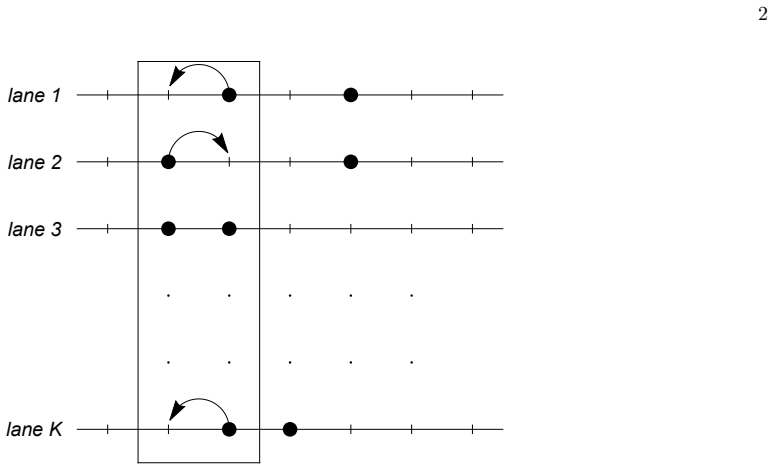
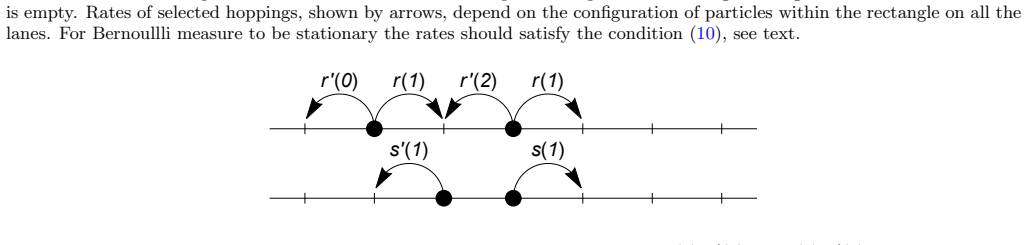
We consider an Asymmetric Exclusion Process evolving on parallel mutually interacting lanes with neighbouring nearest hoppings of hardcore particles. Number of particles on each lane is conserved. We find a choice of the hopping rates, for which the process has Bernouilli stationary product measure, and calculate the stationary particle currents as a function of average particle densities.
Editorial analysis
A structured set of objections, weighed in public.
Referee Report
Summary. The manuscript considers an asymmetric exclusion process on multiple parallel lanes with nearest-neighbor hopping of hardcore particles. The number of particles is conserved on each lane separately. The authors find a specific choice of the hopping rates (intra-lane and inter-lane) such that the stationary measure is a product Bernoulli measure. They then calculate the stationary particle currents as functions of the average particle densities on the lanes.
Significance. If the construction is valid, the paper provides an exactly solvable multilane ASEP with product stationary measure, which is a notable achievement given the usual complexity of interacting multi-lane systems. The explicit current formulas are a direct consequence and allow for analytical study of the steady-state transport. This adds to the literature on solvable nonequilibrium models in statistical mechanics.
minor comments (2)
- The spelling 'Bernouilli' in the abstract should be corrected to 'Bernoulli'.
- The phrasing 'neighbouring nearest hoppings' is unclear; consider rephrasing to 'nearest-neighbor hops between neighboring sites'.
Simulated Author's Rebuttal
We thank the referee for their accurate summary of our work and for the positive assessment of its potential significance as an exactly solvable multilane ASEP. We are pleased with the recommendation for minor revision. No specific major comments were raised, so we interpret this as general acceptance of the construction and results, subject to minor adjustments.
Circularity Check
No significant circularity; derivation solves algebraic conditions for product measure
full rationale
The paper identifies a specific choice of intra- and inter-lane hopping rates such that the generator annihilates the Bernoulli product measure (preserving particle number per lane), then computes currents directly as expectations under that measure. This is a standard constructive approach: the rates are solved from the master-equation conditions rather than fitted to outputs or renamed from prior results. No load-bearing step reduces by definition or self-citation to the target currents; the construction is self-contained against the exclusion-process generator.
Axiom & Free-Parameter Ledger
axioms (1)
- domain assumption The dynamics consist of nearest-neighbor hops only, with hardcore exclusion and conserved particle number per lane.
Lean theorems connected to this paper
-
IndisputableMonolith/Cost/FunctionalEquation.leanwashburn_uniqueness_aczel unclear?
unclearRelation between the paper passage and the cited Recognition theorem.
We find a choice of the hopping rates, for which the process has Bernouilli stationary product measure, and calculate the stationary particle currents as a function of average particle densities.
-
IndisputableMonolith/Foundation/ArithmeticFromLogic.leanembed_injective unclear?
unclearRelation between the paper passage and the cited Recognition theorem.
the difference ˜r_α = r_α − r'_α ... ˜r_α = B_α + Σ γ_αμ/2 (n_μk + n_μk+1)
What do these tags mean?
- matches
- The paper's claim is directly supported by a theorem in the formal canon.
- supports
- The theorem supports part of the paper's argument, but the paper may add assumptions or extra steps.
- extends
- The paper goes beyond the formal theorem; the theorem is a base layer rather than the whole result.
- uses
- The paper appears to rely on the theorem as machinery.
- contradicts
- The paper's claim conflicts with a theorem or certificate in the canon.
- unclear
- Pith found a possible connection, but the passage is too broad, indirect, or ambiguous to say the theorem truly supports the claim.
Reference graph
Works this paper leans on
-
[1]
MacDonald J T, Gibbs J H and Pipkin A C Biopolymers 6 1 (1968)
1968
-
[2]
Olivier Golinelli and Kirone Mallick, The asymmetric simple exclusion process: an integrable model for non-equilibrium statistical mechanics, J. Phys. A: Math. Gen. 39, 12679 ( 2006)
2006
-
[3]
Kirone Mallick, Some exact results for the exclusion process, J. Stat. Mech. P01024 (2011)
2011
-
[4]
Johansson, Shape fluctuation and random matrices, Comm
K. Johansson, Shape fluctuation and random matrices, Comm. Math. Phys. 209, 437 (2000)
2000
-
[5]
Sch\"utz G. M. 2001 Exactly solvable models for many-body systems far from equilibrium, in: Phase Transitions and Critical Phenomena. Vol. 19, eds C Domb and J Lebowitz (London: Academic Press)
2001
-
[6]
Popkov and M
V. Popkov and M. Salerno, Hydrodynamic limit of multi-chain driven diffusive models, Phys. Rev. E 69, 046103 (2004)
2004
-
[7]
Popkov and G
V. Popkov and G. M. Sch\" u tz, Shocks and excitation dynamics in
-
[8]
Popkov, A
V. Popkov, A. Schadschneider, J. Schmidt, and G.M. Sch\" u tz, Fibonacci family of dynamical universality classes, PNAS, vol. 112 no. 41, 12645-12650 (2015),
2015
-
[9]
Mech 033209 (2024)
Dipankar Roy, Abhishek Dhar, Konstantin Khanin, Manas Kulkarni and Herbert Spohn, Universality in coupled stochastic Burgers systems with degenerate flux Jacobian, J.Stat. Mech 033209 (2024)
2024
-
[10]
Herbert Spohn The Popkov-Schütz two-lane lattice gas: Universality for general jump rates J. Stat. Mech. 023203 (2026)
2026
-
[11]
Schmidt, Z
J. Schmidt, Z. Krajnik and V. Popkov, Universality in driven systems with a multiply-degenerate umbilic point, J.Stat. Mech. 033202 (2026),
2026
-
[12]
Batista and R
C. Batista and R. Somma, Phys. Rev. Lett. 109, 227203 (2012)
2012
discussion (0)
Sign in with ORCID, Apple, or X to comment. Anyone can read and Pith papers without signing in.