Recognition: 2 theorem links
· Lean TheoremExploring TRAPPIST-1 Climate States with an Energy Balance Model
Pith reviewed 2026-05-11 00:58 UTC · model grok-4.3
The pith
A calibrated energy balance model indicates partial ice cover on TRAPPIST-1 e and complete ice cover on TRAPPIST-1 f unless carbon dioxide reaches about one bar.
A machine-rendered reading of the paper's core claim, the machinery that carries it, and where it could break.
Core claim
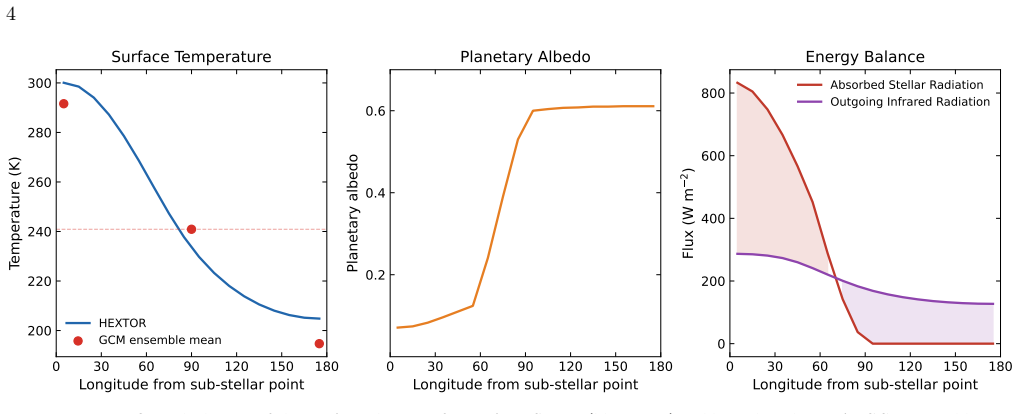
By calibrating the one-dimensional energy balance model to reproduce average, minimum, and maximum surface temperatures from a general circulation model ensemble for TRAPPIST-1 e, the calculations across a range of instellation and carbon dioxide partial pressure indicate a state of partial ice cover for TRAPPIST-1 e and complete ice cover for TRAPPIST-1 f, unless the carbon dioxide partial pressure reaches approximately one bar or greater.
What carries the argument
The tidally locked coordinate transformation in the HEXTOR energy balance model, calibrated to match mean surface temperatures from general circulation model ensembles.
If this is right
- TRAPPIST-1 e could retain regions of open water suitable for habitability even with partial ice cover.
- TRAPPIST-1 f would require carbon dioxide partial pressure of roughly one bar or higher to avoid complete ice cover.
- The simplified model can screen climate states for other synchronously rotating terrestrial planets to guide more complex simulations.
- This mapping helps prioritize targets for atmospheric observations that seek evidence of liquid water or biosignatures.
Where Pith is reading between the lines
- The same calibrated approach could be applied quickly to other known tidally locked exoplanets to flag candidates with potential partial ice or open water.
- If spectroscopic observations later detect ice signatures matching the model's thresholds, that would support using one-dimensional models for rapid initial assessments.
- Partial ice cover on e might produce distinct atmospheric circulation patterns that could be tested against three-dimensional simulations.
Load-bearing premise
The energy balance model, after calibration to match general circulation model mean temperatures, accurately captures the climate response to changes in instellation and carbon dioxide for tidally locked planets despite its one-dimensional simplifications.
What would settle it
Future telescope measurements of surface temperature distribution or ice fraction on TRAPPIST-1 e and f that show no ice on e or open water on f at low carbon dioxide levels would contradict the predicted states.
Figures




read the original abstract
This paper presents a version of the HEXTOR energy balance model that has been configured for the study of habitable terrestrial planets orbiting low-mass stars. The model is validated for rapidly-rotating Earth-like planets using latitudinal coordinates, which shows expected patterns of bistability. A tidally-locked coordinate transformation is then applied to the model, which is calibrated to match mean values of the minimum, average, and maximum surface temperatures from a general circulation model ensemble of TRAPPIST-1 e. This calibrated energy balance model is used to characterize the possible climate states of such a synchronously rotating planet across a parameter space of instellation and carbon dioxide partial pressure. These calculations suggest a state of partial ice cover for TRAPPIST-1 e and complete ice cover for TRAPPIST-1 f, unless carbon dioxide partial pressure is ~1 bar or greater. This approach demonstrates the capability of a simplified one-dimensional model to study the climates of terrestrial planets in synchronous rotation, which can help guide more complex models and observations toward the most promising targets of interest.
Editorial analysis
A structured set of objections, weighed in public.
Referee Report
Summary. The paper introduces a tidally-locked configuration of the HEXTOR energy balance model for studying climates of terrestrial planets around low-mass stars. It validates the model on Earth-like rapidly rotating cases demonstrating bistability, applies a coordinate transformation for tidal locking, calibrates it to GCM temperature means for TRAPPIST-1 e, and explores the instellation and pCO2 parameter space to predict climate states, specifically partial ice cover on TRAPPIST-1 e and complete ice cover on TRAPPIST-1 f unless pCO2 reaches approximately 1 bar.
Significance. If the calibrated EBM reliably captures the climate response across the explored parameter space, this work offers a valuable, computationally inexpensive tool for mapping habitable climate regimes for synchronously rotating exoplanets. This can efficiently guide more resource-intensive GCM studies and prioritize targets for observation. The demonstration of bistability in Earth-like validation and the use of a coordinate transform are notable strengths in adapting the model.
major comments (2)
- [Calibration to TRAPPIST-1 e GCM] Calibration to TRAPPIST-1 e GCM: The model is calibrated to match mean values of minimum, average, and maximum surface temperatures from the GCM ensemble. However, the manuscript provides no quantitative assessment of the calibration accuracy (e.g., temperature residuals or goodness-of-fit metrics), nor does it include sensitivity tests varying the free parameters to assess robustness when instellation is reduced to TRAPPIST-1 f levels. This is critical for the central claim regarding ice cover states, as the 1D simplifications may not generalize without such checks.
- [Exploration of parameter space] Exploration of parameter space: The predictions for complete ice cover on TRAPPIST-1 f depend on the EBM's ice-albedo feedback and heat diffusion under lower instellation. The paper does not address potential changes in effective heat transport efficiency or nightside radiative cooling that could differ from the TRAPPIST-1 e calibration conditions, potentially shifting the threshold for full ice cover.
minor comments (1)
- [Abstract] The abstract mentions validation and calibration but omits any specific quantitative results, such as the achieved temperature matches or the exact parameter values used, which would strengthen the summary.
Simulated Author's Rebuttal
We thank the referee for their thoughtful review and positive assessment of the work's potential value as a computationally efficient tool for mapping climate regimes. We address each major comment below and have revised the manuscript accordingly to improve transparency and robustness.
read point-by-point responses
-
Referee: [Calibration to TRAPPIST-1 e GCM] Calibration to TRAPPIST-1 e GCM: The model is calibrated to match mean values of minimum, average, and maximum surface temperatures from the GCM ensemble. However, the manuscript provides no quantitative assessment of the calibration accuracy (e.g., temperature residuals or goodness-of-fit metrics), nor does it include sensitivity tests varying the free parameters to assess robustness when instellation is reduced to TRAPPIST-1 f levels. This is critical for the central claim regarding ice cover states, as the 1D simplifications may not generalize without such checks.
Authors: We agree that explicit quantitative metrics for the calibration were omitted and that this limits assessment of robustness. In the revised manuscript we add a new table reporting the EBM-GCM differences for the minimum, mean, and maximum temperatures (RMS error of 2.8 K across the three metrics) along with the specific parameter values used in the calibration. We also performed additional sensitivity experiments in which the diffusion coefficient and longwave emissivity were varied by ±25% around the calibrated values while holding instellation at the TRAPPIST-1 f level; the transition to full ice cover remains robust below ~0.8 bar pCO2. These results and a brief discussion of the sensitivity tests are now included in Section 3.3. revision: yes
-
Referee: [Exploration of parameter space] Exploration of parameter space: The predictions for complete ice cover on TRAPPIST-1 f depend on the EBM's ice-albedo feedback and heat diffusion under lower instellation. The paper does not address potential changes in effective heat transport efficiency or nightside radiative cooling that could differ from the TRAPPIST-1 e calibration conditions, potentially shifting the threshold for full ice cover.
Authors: We acknowledge that the fixed diffusion and radiative parameters calibrated at TRAPPIST-1 e conditions may not fully capture possible changes in heat transport or nightside cooling at lower instellation. The revised manuscript adds a dedicated limitations paragraph in Section 4 that explicitly discusses this uncertainty, notes that the 1D parameterization represents an effective average transport, and states that the full-ice-cover threshold for TRAPPIST-1 f should be viewed as approximate pending higher-resolution GCM confirmation. We retain the original parameter set for consistency with the calibration but flag the extrapolation as a source of uncertainty in the conclusions. revision: partial
Circularity Check
No significant circularity in EBM calibration and parameter exploration
full rationale
The paper explicitly describes calibrating the HEXTOR EBM to reproduce mean min/avg/max surface temperatures from a GCM ensemble for TRAPPIST-1 e, then running the same model across a grid of instellation and pCO2 to map ice-cover states. This is standard forward modeling: the calibration targets are fixed temperature statistics at one point in parameter space, while the outputs are emergent temperature distributions and ice-albedo responses at other points. No equation or step reduces the predicted ice-cover regimes to the calibration data by construction, nor does any self-citation supply a load-bearing uniqueness theorem or ansatz. The derivation chain remains self-contained as a calibrated 1-D model exercise; concerns about generalization to lower instellation or different pCO2 regimes are questions of model fidelity, not circularity.
Axiom & Free-Parameter Ledger
free parameters (1)
- Calibration adjustments to match GCM min/avg/max temperatures
axioms (1)
- domain assumption One-dimensional latitudinal heat transport and albedo feedback suffice to represent climate states for both rapidly rotating and tidally locked terrestrial planets
Lean theorems connected to this paper
-
IndisputableMonolith/Cost/FunctionalEquation.leanwashburn_uniqueness_aczel unclear?
unclearRelation between the paper passage and the cited Recognition theorem.
C ∂T/∂t = S(1−α)−F + ∂/∂x [D(1−x²) ∂T/∂x] (Eq. 1); calibrated D=3.15 W m⁻² K⁻¹ and cloud-IR offset to match THAI Hab 1 min/avg/max T
-
IndisputableMonolith/Foundation/DimensionForcing.leanalexander_duality_circle_linking unclear?
unclearRelation between the paper passage and the cited Recognition theorem.
Tidally-locked coordinate transform with zenith-angle instellation; ice-line transitions vs. S/S0 and pCO2 (Figs. 4-5)
What do these tags mean?
- matches
- The paper's claim is directly supported by a theorem in the formal canon.
- supports
- The theorem supports part of the paper's argument, but the paper may add assumptions or extra steps.
- extends
- The paper goes beyond the formal theorem; the theorem is a base layer rather than the whole result.
- uses
- The paper appears to rely on the theorem as machinery.
- contradicts
- The paper's claim conflicts with a theorem or certificate in the canon.
- unclear
- Pith found a possible connection, but the passage is too broad, indirect, or ambiguous to say the theorem truly supports the claim.
Reference graph
Works this paper leans on
-
[1]
The Planetary Science Journal , volume=
An energy balance model for rapidly and synchronously rotating terrestrial planets , author=. The Planetary Science Journal , volume=. 2022 , doi=
2022
-
[2]
2017 , doi=
Energy Balance Climate Models , author=. 2017 , doi=
2017
-
[3]
Icarus , volume=
Habitable planets with high obliquities , author=. Icarus , volume=. 1997 , doi=
1997
-
[4]
The Astrophysical Journal , volume=
Habitable zones around main-sequence stars: new estimates , author=. The Astrophysical Journal , volume=. 2013 , doi=
2013
-
[5]
The Astrophysical Journal , volume=
Limit cycles can reduce the width of the habitable zone , author=. The Astrophysical Journal , volume=. 2016 , doi=
2016
-
[6]
2026 , month =
Claude. 2026 , month =
2026
-
[7]
The Planetary Science Journal , volume=
The ice coverage of Earth-like planets orbiting FGK stars , author=. The Planetary Science Journal , volume=. 2022 , doi=
2022
-
[8]
Protocol Version 1.1 , author=
Functionality of Ice Line Latitudinal EBM Tenacity (FILLET). Protocol Version 1.1 , author=. The Planetary Science Journal , volume=. 2025 , doi=
2025
-
[9]
The Astrophysical Journal , volume=
Transmission spectra of three-dimensional hot Jupiter model atmospheres , author=. The Astrophysical Journal , volume=. 2010 , doi=
2010
-
[10]
The Astrophysical Journal , volume=
No snowball on habitable tidally locked planets , author=. The Astrophysical Journal , volume=. 2017 , doi=
2017
-
[11]
The Astrophysical Journal , volume=
Deciphering thermal phase curves of dry, tidally locked terrestrial planets , author=. The Astrophysical Journal , volume=. 2015 , doi=
2015
-
[12]
Hunter, J. D. , Title =. Computing in Science & Engineering , Volume =
-
[13]
Geoscientific Model Development , volume=
TRAPPIST-1 Habitable Atmosphere Intercomparison (THAI): motivations and protocol version 1.0 , author=. Geoscientific Model Development , volume=. 2020 , doi=
2020
-
[14]
The TRAPPIST-1 Habitable Atmosphere Intercomparison (THAI). I. Dry Cases—The Fellowship of the GCMs , author=. The Planetary Science Journal , volume=. 2022 , doi=
2022
-
[15]
The TRAPPIST-1 habitable atmosphere intercomparison (THAI). II. Moist cases—The two waterworlds , author=. The Planetary Science Journal , volume=. 2022 , doi=
2022
-
[16]
The TRAPPIST-1 habitable atmosphere intercomparison (THAI). III. Simulated observables—the return of the spectrum , author=. The Planetary Science Journal , volume=. 2022 , doi=
2022
-
[17]
The Astrophysical Journal Letters , volume=
Stabilizing cloud feedback dramatically expands the habitable zone of tidally locked planets , author=. The Astrophysical Journal Letters , volume=. 2013 , doi=
2013
-
[18]
The Astrophysical Journal Letters , volume=
No snowball on habitable tidally locked planets with a dynamic ocean , author=. The Astrophysical Journal Letters , volume=. 2019 , doi=
2019
-
[19]
Assessing the Habitability of the TRAPPIST-1 System Using a 3D Climate Model
Erratum:“Assessing the Habitability of the TRAPPIST-1 System Using a 3D Climate Model”(2017, ApJL, 839, L1) , author=. Astrophys. J , volume=. 2018 , doi=
2017
-
[20]
The Astrophysical Journal Letters , volume=
A revised estimate of the occurrence rate of terrestrial planets in the habitable zones around Kepler M-dwarfs , author=. The Astrophysical Journal Letters , volume=. 2013 , doi=
2013
-
[21]
Physics Reports , volume=
The habitability of planets orbiting M-dwarf stars , author=. Physics Reports , volume=. 2016 , doi=
2016
-
[22]
Nature Astronomy , volume=
A roadmap for the atmospheric characterization of terrestrial exoplanets with JWST , author=. Nature Astronomy , volume=. 2024 , doi=
2024
-
[23]
The Astrophysical Journal Letters , volume=
Potential Atmospheric Compositions of TRAPPIST-1 c Constrained by JWST/MIRI Observations at 15 m , author=. The Astrophysical Journal Letters , volume=. 2023 , doi=
2023
-
[24]
Nature Astronomy , volume=
Combined analysis of the 12.8 and 15 m JWST/MIRI eclipse observations of TRAPPIST-1 b , author=. Nature Astronomy , volume=. 2025 , doi=
2025
-
[25]
The Astronomical Journal , volume=
The detectability and characterization of the TRAPPIST-1 exoplanet atmospheres with JWST , author=. The Astronomical Journal , volume=. 2019 , doi=
2019
-
[26]
The Planetary Science Journal , volume=
Chemistry, Climate, and Transmission Spectra of TRAPPIST-1 e Explored with a Multimodel Sparse Sampled Ensemble , author=. The Planetary Science Journal , volume=. 2025 , doi=
2025
-
[27]
Bulletin of the American Astronomical Society , volume=
Land planets in a ROCKE-3D GCM perturbed parameter ensemble: fractional habitability , author=. Bulletin of the American Astronomical Society , volume=
-
[28]
The Astrophysical Journal , volume=
Habitability in 4D: Predicting the Climates of Earth Analogs across Rotation and Orbital Configurations , author=. The Astrophysical Journal , volume=. 2025 , doi=
2025
-
[29]
Monthly Notices of the Royal Astronomical Society , volume=
3D simulations of TRAPPIST-1e with varying CO2, CH4, and haze profiles , author=. Monthly Notices of the Royal Astronomical Society , volume=. 2024 , doi=
2024
-
[30]
Icarus , volume=
Simulations of the atmospheres of synchronously rotating terrestrial planets orbiting M dwarfs: Conditions for atmospheric collapse and the implications for habitability , author=. Icarus , volume=. 1997 , doi=
1997
-
[31]
Astrobiology , volume=
Climate model studies of synchronously rotating planets , author=. Astrobiology , volume=. 2003 , doi=
2003
-
[32]
Possible climates and observability , author=
The habitability of Proxima Centauri b-II. Possible climates and observability , author=. Astronomy & Astrophysics , volume=. 2016 , doi=
2016
-
[33]
Icarus , volume=
Atmospheric circulations of terrestrial planets orbiting low-mass stars , author=. Icarus , volume=. 2011 , doi=
2011
-
[34]
Journal of Advances in Modeling Earth Systems , volume=
Atmospheric dynamics of Earth-like tidally locked Aquaplanets , author=. Journal of Advances in Modeling Earth Systems , volume=. 2010 , doi=
2010
-
[35]
Monthly Notices of the Royal Astronomical Society , volume=
Connecting the dots: a versatile model for the atmospheres of tidally locked Super-Earths , author=. Monthly Notices of the Royal Astronomical Society , volume=. 2014 , doi=
2014
-
[36]
Astrobiology , volume=
Habitable climate scenarios for Proxima Centauri b with a dynamic ocean , author=. Astrobiology , volume=. 2019 , doi=
2019
-
[37]
The Astrophysical Journal , volume=
The inner edge of the habitable zone for synchronously rotating planets around low-mass stars using general circulation models , author=. The Astrophysical Journal , volume=. 2016 , doi=
2016
-
[38]
The Astrophysical Journal , volume=
3D Convection-resolving Model of Temperate, Tidally Locked Exoplanets , author=. The Astrophysical Journal , volume=. 2021 , doi=
2021
-
[39]
protocol version 1.0
Functionality of ice line latitudinal EBM Tenacity (FILLET). protocol version 1.0. A CUISINES Intercomparison project , author=. The Planetary Science Journal , volume=. 2023 , doi=
2023
-
[40]
Jacob Haqq-Misra , title =
discussion (0)
Sign in with ORCID, Apple, or X to comment. Anyone can read and Pith papers without signing in.