Recognition: no theorem link
Real-Time Quantum Dynamics on the Fuzzy Sphere: Chaos and Entanglement
Pith reviewed 2026-05-11 01:12 UTC · model grok-4.3
The pith
The bosonic matrix model on the fuzzy sphere respects the Maldacena-Shenker-Stanford chaos bound at all temperatures.
A machine-rendered reading of the paper's core claim, the machinery that carries it, and where it could break.
Core claim
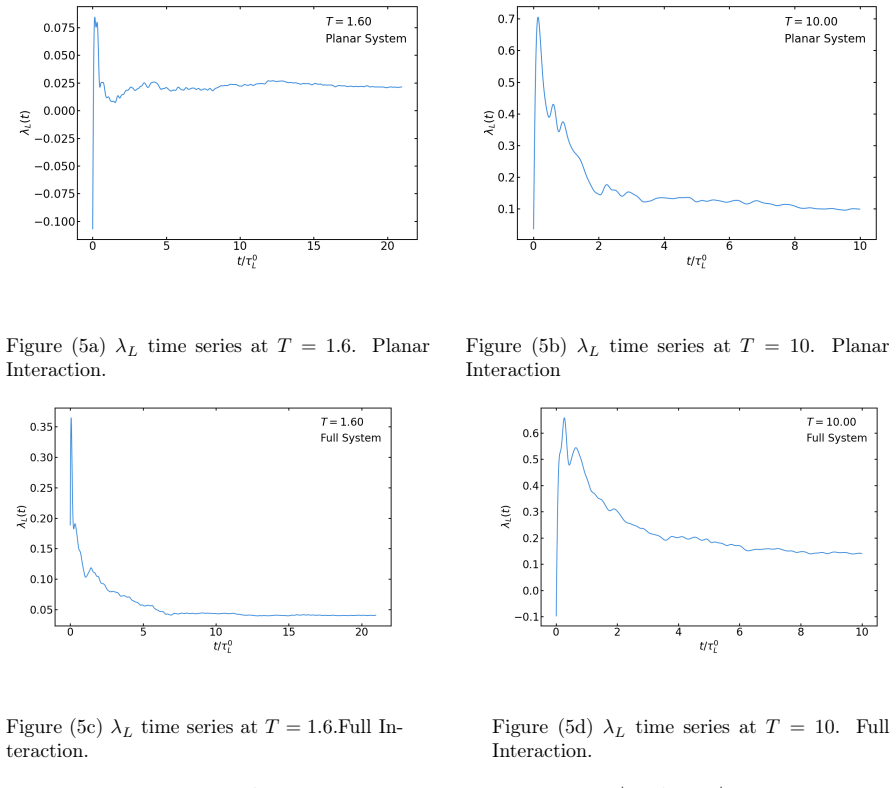
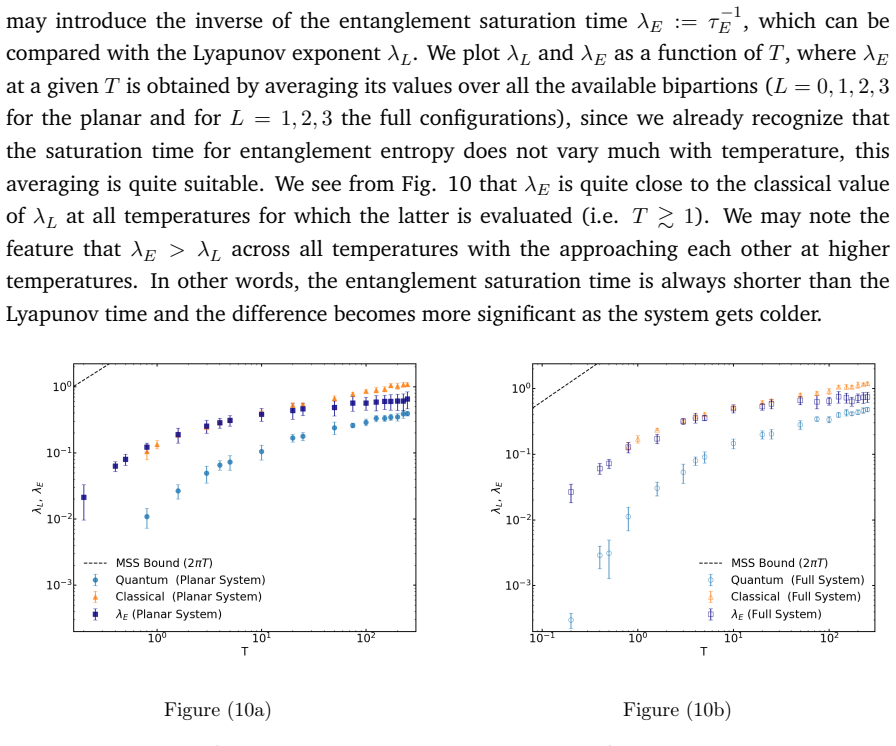
Starting from the Hamiltonian of two bosonic fields on the fuzzy sphere, the Gaussian-state equations of motion are solved for thermal and near-thermal initial conditions. The largest Lyapunov exponent extracted from the real-time correlators tends to zero at a finite temperature, thereby respecting the Maldacena-Shenker-Stanford bound at every temperature, while the same exponent approaches its classical chaotic value at high temperature. Simultaneously, the entanglement entropy computed for successive bipartitions grows linearly, demonstrating fast scrambling.
What carries the argument
The closed nonlinear system of differential equations for the one- and two-point correlation functions obtained via Wick contraction within the Gaussian-state ansatz; this system directly yields the time-dependent out-of-time-order correlators from which the Lyapunov exponent is read off.
If this is right
- The model never violates the Maldacena-Shenker-Stanford bound on the rate of chaos.
- At sufficiently high temperature the dynamics recover the classically chaotic regime.
- Entanglement entropy grows linearly with time for multiple spatial bipartitions, indicating fast scrambling.
- The thermal state is completely fixed by maximizing the von Neumann entropy subject to the Gaussian constraint.
Where Pith is reading between the lines
- Similar finite-temperature suppression of the Lyapunov exponent may appear in other matrix models or fuzzy-geometry systems once the Gaussian approximation is relaxed.
- Adding fermions or increasing the matrix size N would provide a direct test of whether the zero-temperature bound continues to hold.
- The same real-time equations could be used to compute additional diagnostics such as the spectral form factor or higher-point OTOCs to cross-check the scrambling picture.
Load-bearing premise
The Gaussian state approximation remains accurate throughout the real-time evolution and the chosen initial states are sufficiently close to thermal equilibrium to extract a meaningful Lyapunov exponent.
What would settle it
A full quantum simulation or exact diagonalization of the same matrix model at intermediate temperatures that finds a positive Lyapunov exponent persisting all the way to zero temperature.
Figures





read the original abstract
We study the real time quantum dynamics of a matrix model consisting two bosonic fields on the fuzzy sphere using the Gaussian state approximation. Starting from the Hamiltonian formulation and using Wick's theorem, we derive a closed set of coupled nonlinear differential equations governing the time evolution of the one- and two-point correlation functions. Thermal equation of state is found by maximizing the von Neumann entropy over Gaussian states and solving algebraic self-consistency equation(s) leading to a complete determination of the symplectic spectrum of the covariance matrix. We identify near thermal initial conditions and use them to solve the equations of motion and employ our findings to probe chaos by calculating the largest Lyapunov exponent at various temperatures. Our results demonstrate that the latter tends to zero at a finite temperature indicating that the quantum dynamics respect the Maldacena,Shenker,Stanford bound across all temperatures, while approaching toward the classically chaotic regime at high temperatures. Finally, we examine the entanglement dynamics of the model in real-time by considering a sequence of bipartitions of the Hilbert space and computing the entanglement entropy and clearly exhibit the fast scrambling features that emerge in due detail.
Editorial analysis
A structured set of objections, weighed in public.
Referee Report
Summary. The paper studies real-time quantum dynamics of a two-bosonic-field matrix model on the fuzzy sphere within the Gaussian state approximation. Starting from the Hamiltonian, Wick's theorem is used to close the Heisenberg equations into a set of nonlinear ODEs for one- and two-point functions. Thermal states are obtained by maximizing von Neumann entropy subject to algebraic self-consistency conditions on the covariance matrix, fully determining its symplectic spectrum. Near-thermal Gaussian initial conditions are evolved to extract the largest Lyapunov exponent, which is reported to vanish at finite temperature (respecting the MSS bound) while approaching the classical value at high T. Entanglement entropy is computed for a sequence of bipartitions and shown to exhibit fast scrambling.
Significance. If the Gaussian truncation remains accurate, the work supplies a concrete finite-dimensional example in which the MSS bound is respected at all temperatures with a controlled high-T crossover to classical chaos, together with explicit real-time entanglement growth. Such results could benchmark holographic models and studies of scrambling in matrix quantum mechanics.
major comments (3)
- [Derivation of the closed ODEs and real-time evolution] The closure of the equations of motion via Wick's theorem assumes the state remains Gaussian throughout the evolution. In a chaotic system, non-Gaussian cumulants can be generated and back-react on the two-point sector, potentially altering the extracted Lyapunov exponent. No diagnostic (time-dependent fourth cumulants, deviation from Wick factorization, or comparison to a truncated BBGKY hierarchy) is supplied to verify that the Gaussian ansatz survives up to the Lyapunov time at the temperatures where λ_L is reported to vanish.
- [Numerical extraction of the Lyapunov exponent] The central claim that λ_L tends to zero at finite temperature rests on numerical integration of the ODEs, yet the manuscript reports neither error bars, convergence tests with respect to integrator step size or cutoff, nor validation against exact results for small matrix sizes. Without these, it is impossible to assess whether the reported vanishing is robust or an artifact of the truncation and discretization.
- [Thermal state and initial conditions] The thermal covariance matrix is fixed by entropy maximization subject to the same self-consistency equations that define the Gaussian state. It is therefore unclear whether the subsequent real-time Lyapunov computation is independent of this fitting procedure or whether the initial conditions are already constrained in a manner that suppresses exponential growth by construction.
minor comments (2)
- [Abstract] The abstract states that the symplectic spectrum is 'completely determined' but does not specify the matrix size N or the fuzzy-sphere cutoff used in the numerics; these parameters should be stated explicitly when reporting temperature dependence.
- [Entanglement dynamics] The sequence of bipartitions used for the entanglement-entropy calculation is not described in detail (e.g., equal-size vs. unequal-size cuts, or how the fuzzy-sphere geometry enters the partitioning). A short clarification would strengthen the fast-scrambling claim.
Simulated Author's Rebuttal
We thank the referee for the thorough review and valuable feedback on our manuscript. We address each of the major comments in detail below, providing clarifications and indicating the revisions we will make to improve the presentation and robustness of our results.
read point-by-point responses
-
Referee: The closure of the equations of motion via Wick's theorem assumes the state remains Gaussian throughout the evolution. In a chaotic system, non-Gaussian cumulants can be generated and back-react on the two-point sector, potentially altering the extracted Lyapunov exponent. No diagnostic (time-dependent fourth cumulants, deviation from Wick factorization, or comparison to a truncated BBGKY hierarchy) is supplied to verify that the Gaussian ansatz survives up to the Lyapunov time at the temperatures where λ_L is reported to vanish.
Authors: We acknowledge the validity of this concern. The Gaussian state approximation is a truncation that closes the hierarchy at the two-point level using Wick's theorem, and it is indeed possible for higher cumulants to develop in chaotic dynamics. In the current work, this approximation is adopted to obtain a closed, solvable system of ODEs that captures the real-time quantum dynamics and allows computation of the Lyapunov exponent and entanglement entropy. We will revise the manuscript to include an expanded discussion of the limitations of the Gaussian ansatz, including references to its successful application in related models of quantum chaos and matrix quantum mechanics. Additionally, we will report on the time evolution of the deviation from Wick factorization for a representative case to provide a basic diagnostic of the approximation's consistency up to the Lyapunov time. revision: partial
-
Referee: The central claim that λ_L tends to zero at finite temperature rests on numerical integration of the ODEs, yet the manuscript reports neither error bars, convergence tests with respect to integrator step size or cutoff, nor validation against exact results for small matrix sizes. Without these, it is impossible to assess whether the reported vanishing is robust or an artifact of the truncation and discretization.
Authors: We agree that additional numerical validation is necessary to support the robustness of the results. In the revised manuscript, we will include error estimates on the Lyapunov exponent obtained from ensembles of initial perturbations, convergence tests varying the integrator step size and simulation cutoff time, and a discussion of numerical stability. For validation against exact results, we note that for the fuzzy sphere matrix sizes used (N ≥ 4 or higher, leading to large Hilbert spaces), exact diagonalization is not feasible due to exponential scaling. We will add this clarification and, where possible, compare to smaller toy models or classical limits. revision: yes
-
Referee: The thermal covariance matrix is fixed by entropy maximization subject to the same self-consistency equations that define the Gaussian state. It is therefore unclear whether the subsequent real-time Lyapunov computation is independent of this fitting procedure or whether the initial conditions are already constrained in a manner that suppresses exponential growth by construction.
Authors: The entropy maximization procedure determines the equilibrium thermal covariance matrix, which serves as a fixed point of the equations of motion. However, the Lyapunov exponent is extracted by evolving the system from initial conditions that are small perturbations of this thermal covariance (e.g., by adding a small random or structured deviation to the two-point functions while maintaining the Gaussian property). The time evolution is then governed by the full set of nonlinear ODEs derived from the Hamiltonian, independent of the entropy maximization step. The growth (or lack thereof) of the perturbation is a dynamical property of the equations. We will revise the manuscript to explicitly describe the construction of these near-thermal initial conditions and demonstrate that the procedure does not artificially suppress growth. revision: yes
- Direct numerical validation against exact quantum dynamics for the matrix sizes employed in the fuzzy sphere model, as exact diagonalization is computationally intractable for these dimensions.
Circularity Check
No significant circularity; derivation is self-contained under stated approximation
full rationale
The paper derives a closed set of nonlinear ODEs for one- and two-point functions by applying Wick's theorem to the Heisenberg equations under the Gaussian state ansatz. Thermal states are obtained by entropy maximization subject to algebraic self-consistency conditions on the covariance matrix, yielding initial conditions for the ODEs. The largest Lyapunov exponent is then extracted from the time-dependent solutions of those ODEs at various temperatures. This extraction is not equivalent to the thermal fit parameters by construction; the nonlinear evolution can in principle produce growth rates independent of the static self-consistency solution. No load-bearing self-citations, uniqueness theorems, or renamings of known results are present. The Gaussian closure is an explicit approximation whose validity is assumed rather than derived from the target observable, but the reported temperature dependence of λ_L is not forced by re-labeling of inputs.
Axiom & Free-Parameter Ledger
axioms (2)
- domain assumption The Gaussian state approximation yields a closed set of equations for the one- and two-point functions via Wick's theorem.
- domain assumption Maximizing the von Neumann entropy over Gaussian states produces the correct thermal equation of state.
Reference graph
Works this paper leans on
-
[1]
Y. Sekino and L. Susskind, “Fast Scramblers,” JHEP10, 065 (2008) [arXiv:0808.2096 [hep-th]]
work page Pith review arXiv 2008
-
[2]
Evidence for fast thermalization in the plane-wave matrix model,
C. Asplund, D. Berenstein and D. Trancanelli, “Evidence for fast thermalization in the plane-wave matrix model,” Phys. Rev. Lett.107, 171602 (2011) [arXiv:1104.5469 [hep-th]]
-
[3]
Black holes and the butterfly effect
S. H. Shenker and D. Stanford, “Black holes and the butterfly effect,” JHEP03, 067 (2014) [arXiv:1306.0622 [hep-th]]
work page Pith review arXiv 2014
-
[4]
Chaos in Classical D0-Brane Mechanics,
G. Gur-Ari, M. Hanada and S. H. Shenker, “Chaos in Classical D0-Brane Mechanics,” JHEP02, 091 (2016) [arXiv:1512.00019 [hep-th]]
-
[5]
Smallest matrix black hole model in the classical limit,
D. Berenstein and D. Kawai, “Smallest matrix black hole model in the classical limit,” Phys. Rev. D95, no.10, 106004 (2017) [arXiv:1608.08972 [hep-th]]
-
[6]
J. Maldacena, S. H. Shenker and D. Stanford, “A bound on chaos,” JHEP08, 106 (2016) [arXiv:1503.01409 [hep-th]]
work page Pith review arXiv 2016
-
[7]
Comments on the Sachdev-Ye-Kitaev model
J. Maldacena and D. Stanford, “Remarks on the Sachdev-Ye-Kitaev model,” Phys. Rev. D94, no.10, 106002 (2016) [arXiv:1604.07818 [hep-th]]
work page Pith review arXiv 2016
-
[8]
Quantum Black Hole Formation in the BFSS Matrix Model,
S. Aoki, M. Hanada and N. Iizuka, “Quantum Black Hole Formation in the BFSS Matrix Model,” JHEP07, 029 (2015) [arXiv:1503.05562 [hep-th]]
-
[9]
Chaos in the BMN matrix model,
Y. Asano, D. Kawai and K. Yoshida, “Chaos in the BMN matrix model,” JHEP06, 191 (2015) [arXiv:1503.04594 [hep-th]]
-
[10]
Precision lattice test of the gauge/gravity duality at large-N,
E. Berkowitz, E. Rinaldi, M. Hanada, G. Ishiki, S. Shimasaki and P. Vranas, “Precision lattice test of the gauge/gravity duality at large-N,” Phys. Rev. D94, no.9, 094501 (2016) doi:10.1103/PhysRevD.94.094501 [arXiv:1606.04951 [hep-lat]]. 32
-
[11]
E. Berkowitz, M. Hanada and J. Maltz, Phys. Rev. D94, no.12, 126009 (2016) doi:10.1103/PhysRevD.94.126009 [arXiv:1602.01473 [hep-th]]
-
[12]
Entanglement entropy converges to classical entropy around periodic orbits,
C. T. Asplund and D. Berenstein, “Entanglement entropy converges to classical entropy around periodic orbits,” Annals Phys.366, 113-132 (2016) [arXiv:1503.04857 [hep-th]]
-
[13]
Real-time dynamics of matrix quantum mechanics beyond the classical approximation,
P. Buividovich, M. Hanada and A. Schäfer, “Real-time dynamics of matrix quantum mechanics beyond the classical approximation,” EPJ Web Conf.175, 08006 (2018) [arXiv:1711.05556 [hep-th]]
-
[14]
P. V. Buividovich, M. Hanada and A. Schäfer, “Quantum chaos, thermalization, and entanglement generation in real-time simulations of the Banks-Fischler-Shenker-Susskind matrix model,” Phys. Rev. D99, no.4, 046011 (2019) [arXiv:1810.03378 [hep-th]]
-
[15]
Chaos from equivariant fields on fuzzy S4,
Ü. H. Co¸ skun, S. Kürkçüo˘glu, G. C. Toga and G. Ünal, “Chaos from equivariant fields on fuzzy S4,” JHEP12, 015 (2018) [arXiv:1806.10524 [hep-th]]
-
[16]
Chaos from Massive Deformations of Yang-Mills Matrix Models,
K. Ba¸ skan, S. Kürkçüo˘glu, O. Oktay and C. Ta¸ scı, “Chaos from Massive Deformations of Yang-Mills Matrix Models,” JHEP10, 003 (2020) [arXiv:1912.00932 [hep-th]]
-
[17]
Chaotic dynamics of the mass deformed ABJM model,
K. Ba¸ skan, S. Kürkçüo˘glu and C. Ta¸ scı, “Chaotic dynamics of the mass deformed ABJM model,” Phys. Rev. D107, no.6, 066006 (2023) [arXiv:2203.08240 [hep-th]]
-
[18]
S. Sachdev, “Holographic metals and the fractionalized Fermi liquid,” Phys. Rev. Lett. 105, 151602 (2010) [arXiv:1006.3794 [hep-th]]
-
[19]
M Theory As A Matrix Model: A Conjecture
T. Banks, W. Fischler, S. H. Shenker and L. Susskind, “M theory as a matrix model: A conjecture,” Phys. Rev. D55, 5112-5128 (1997) [arXiv:hep-th/9610043 [hep-th]]
work page Pith review arXiv 1997
-
[20]
Chaos in the SU(2) Yang-Mills Chern-Simons matrix model,
K. Ba¸ skan and S. Kürkçüo˘glu, “Chaos in the SU(2) Yang-Mills Chern-Simons matrix model,” Phys. Rev. D104, no.6, 066006 (2021) [arXiv:2101.05649 [hep-th]]
-
[21]
Phase structure of matrix quantum mechan- ics at finite temperature,
N. Kawahara, J. Nishimura and S. Takeuchi, “Phase structure of matrix quantum mechanics at finite temperature,” JHEP10, 097 (2007) [arXiv:0706.3517 [hep-th]]
-
[22]
Geometry in transition: A model of emergent geometry
R. Delgadillo-Blando, D. O’Connor and B. Ydri, “Geometry in Transition: A Model of Emergent Geometry ,” Phys. Rev. Lett.100, 201601 (2008) [arXiv:0712.3011 [hep-th]]. 33
work page Pith review arXiv 2008
-
[23]
Matrix Models, Gauge Theory and Emergent Geometry
R. Delgadillo-Blando, D. O’Connor and B. Ydri, “Matrix Models, Gauge Theory and Emergent Geometry ,” JHEP05, 049 (2009) [arXiv:0806.0558 [hep-th]]
work page Pith review arXiv 2009
-
[24]
V. G. Filev and D. O’Connor, JHEP05, 167 (2016) doi:10.1007/JHEP05(2016)167 [arXiv:1506.01366 [hep-th]]
-
[25]
D. O’Connor and V. G. Filev, PoSCORFU2015, 111 (2016) doi:10.22323/1.263.0111 [arXiv:1605.01611 [hep-th]]
-
[26]
The non-perturbative phase diagram of the BMN matrix model,
Y. Asano, V. G. Filev, S. Kováˇcik and D. O’Connor, “The non-perturbative phase diagram of the BMN matrix model,” JHEP07, 152 (2018) [arXiv:1805.05314 [hep-th]]
-
[27]
Review of M(atrix)-Theory , Type IIB Matrix Model and Matrix String Theory ,
B. Ydri, “Review of M(atrix)-Theory , Type IIB Matrix Model and Matrix String Theory ,” [arXiv:1708.00734 [hep-th]]
-
[28]
Lectures on Matrix Field Theory ,
B. Ydri, “Lectures on Matrix Field Theory ,” Lect. Notes Phys.929, pp.1-352 (2017) Springer, 2017, ISBN 978-3-319-46002-4, 978-3-319-46003-1 [arXiv:1603.00924 [hep-th]]
-
[29]
J. Broeckhove, L. Lathouwers, P. van Leuven, J. Molec. Struc. 199 (1989) 245
work page 1989
- [30]
-
[31]
Gaussian pure states in quantum mechanics and the symplectic group,
N. Mukunda, R. Simon and G. Sudarshan, “Gaussian pure states in quantum mechanics and the symplectic group,” Phys. Rev. A37, 3028 (1988)
work page 1988
-
[32]
Quantum-noise matrix for multimode systems: U(n) invariance, squeezing, and normal forms,
R. Simon, N. Mukunda and B. Dutta, “Quantum-noise matrix for multimode systems: U(n) invariance, squeezing, and normal forms,” Phys. Rev. A49(1994) no.3, 1567
work page 1994
-
[33]
R. Bertlmann and N. Friis, “Modern Quantum Theory ,” Oxford University Press, 2023, ISBN 978-0-19-968333-8
work page 2023
-
[34]
C. Weedbrook, S. Pirandola, R. García-Patrón, N. J. Cerf, T. C. Ralph, J. H. Shapiro and S. Lloyd, “Gaussian quantum information,” Rev. Mod. Phys.84, no.2, 621 (2012) [arXiv:1110.3234 [quant-ph]]
-
[35]
Lectures on Fuzzy and Fuzzy SUSY Physics,
A. P. Balachandran, S. Kurkcuoglu and S. Vaidya, “Lectures on Fuzzy and Fuzzy SUSY Physics,”, World-Scientific, Singapore, 2007 [arXiv:hep-th/0511114 [hep-th]]
-
[36]
Dynamics of entanglement in expanding quantum fields,
J. Berges, S. Floerchinger and R. Venugopalan, “Dynamics of entanglement in expanding quantum fields,” JHEP04, 145 (2018) [arXiv:1712.09362 [hep-th]]. 34
-
[37]
A Quantum Source of Entropy for Black Holes,
L. Bombelli, R. K. Koul, J. Lee and R. D. Sorkin, “A Quantum Source of Entropy for Black Holes,” Phys. Rev. D34, 373-383 (1986)
work page 1986
-
[38]
Expressing entropy globally in terms of (4D) field-correlations,
R. D. Sorkin, “Expressing entropy globally in terms of (4D) field-correlations,” J. Phys. Conf. Ser.484, 012004 (2014) [arXiv:1205.2953 [hep-th]]
-
[39]
Spacetime entanglement entropy in 1 + 1 dimensions,
M. Saravani, R. D. Sorkin and Y. K. Yazdi, “Spacetime entanglement entropy in 1 + 1 dimensions,” Class. Quant. Grav.31, no.21, 214006 (2014) [arXiv:1311.7146 [hep-th]]
-
[40]
On the Algebraic Problem Concerning the Normal Forms of Linear Dynamical Systems,
J. Williamson, (1936) "On the Algebraic Problem Concerning the Normal Forms of Linear Dynamical Systems," American Journal of Mathematics, 58(1), 141–163. (1936) https://doi.org/10.2307/2371062
-
[41]
A Universal Upper Bound on the Entropy to Energy Ratio for Bounded Systems,
J. D. Bekenstein, “A Universal Upper Bound on the Entropy to Energy Ratio for Bounded Systems,” Phys. Rev. D23, 287 (1981)
work page 1981
-
[42]
D. N. Page, “The Bekenstein Bound,” [arXiv:1804.10623 [hep-th]]
-
[43]
Srednicki,Entropy and area,Phys
M. Srednicki, “Entropy and area,” Phys. Rev. Lett.71, 666-669 (1993) [arXiv:hep-th/9303048 [hep-th]]
-
[44]
H. Casini and M. Huerta, “Entanglement entropy in free quantum field theory ,” J. Phys. A42, 504007 (2009) [arXiv:0905.2562 [hep-th]]
-
[45]
Numerical Determination of the Entanglement Entropy for Free Fields in the Cylinder,
M. Huerta, “Numerical Determination of the Entanglement Entropy for Free Fields in the Cylinder,” Phys. Lett. B710, 691-696 (2012) [arXiv:1112.1277 [hep-th]]
-
[46]
Nishioka,Entanglement entropy: holography and renormalization group,Rev
T. Nishioka, “Entanglement entropy: holography and renormalization group,” Rev. Mod. Phys.90, no.3, 035007 (2018) [arXiv:1801.10352 [hep-th]]
-
[47]
E. Witten, “Why does quantum field theory in curved spacetime make sense? And what happens to the algebra of observables in the thermodynamic limit?,” [arXiv:2112.11614 [hep-th]]
-
[48]
A Mini-Introduction To Information Theory,
E. Witten, “A Mini-Introduction To Information Theory ,” Riv. Nuovo Cim.43, no.4, 187-227 (2020) [arXiv:1805.11965 [hep-th]]
-
[49]
Towards a Theory of Entropy Production in the Little and Big Bang,
T. Kunihiro, B. Muller, A. Ohnishi and A. Schafer, “Towards a Theory of Entropy Production in the Little and Big Bang,” Prog. Theor. Phys.121, 555-575 (2009) [arXiv:0809.4831 [hep-ph]]. 35
-
[50]
D. A. Varshalovich, A. N. Moskalev and V. K. Khersonskii, “Quantum Theory of Angular Momentum: Irreducible Tensors, Spherical Harmonics, Vector Coupling Coefficients, 3nj Symbols,” World Scientific Publishing Company , 1988, ISBN 978-981-4415-49-1, 978-9971-5-0107-5
work page 1988
-
[51]
D. E. Berenstein, J. M. Maldacena and H. S. Nastase, JHEP04, 013 (2002) doi:10.1088/1126-6708/2002/04/013 [arXiv:hep-th/0202021 [hep-th]]
-
[52]
S. Kürkcüo ˘glu, B. Özcan,In preparation. Appendices A. F uzzy Sphere and the Polarization Operators A.1. Fuzzy Sphere Definition of the fuzzy sphere is quite well known in the literature. Here we give the basic definition and refer the reader to the references [35] and [28] for an extensive discussion. Let us denote theSU(2)representations in the spin-j=...
discussion (0)
Sign in with ORCID, Apple, or X to comment. Anyone can read and Pith papers without signing in.