Recognition: no theorem link
Analysis of the energy and angular distributions of photoneutrons from natPb, 197Au, natSn, natCu, natFe, and natTi using resonance direct theory
Pith reviewed 2026-05-11 01:12 UTC · model grok-4.3
The pith
Resonance direct theory combined with standard models reproduces photoneutron distributions from Pb, Au and Sn.
A machine-rendered reading of the paper's core claim, the machinery that carries it, and where it could break.
Core claim
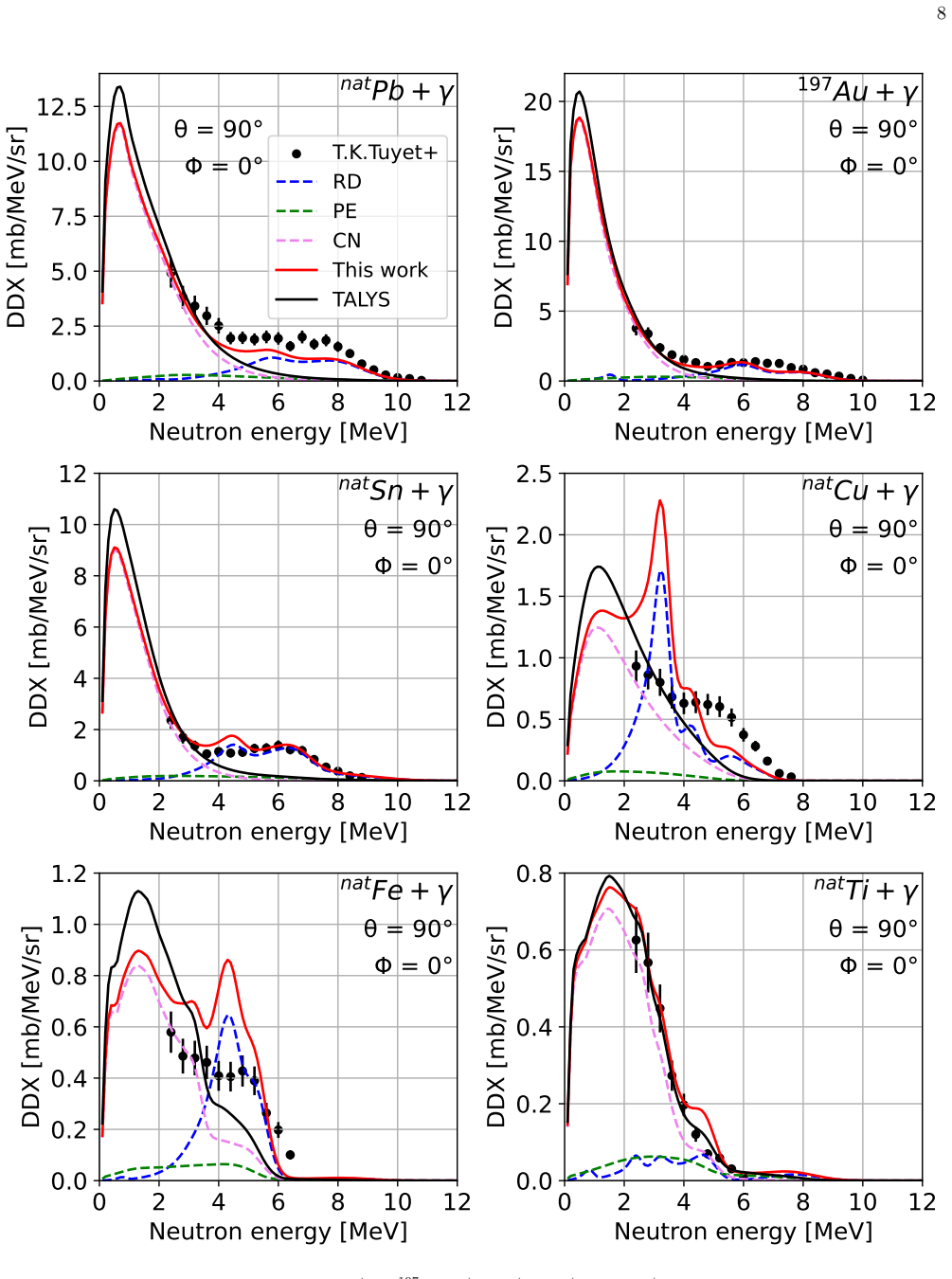
The paper claims that photoneutron double-differential cross sections in the GDR region are accurately reproduced for natPb, 197Au and natSn once the resonance direct process is included via Wilkinson's independent-particle-model theory, the pre-equilibrium component is treated with the two-component exciton model, and the compound component is treated with the Hauser-Feshbach formalism; the Agodi-Courant formalism supplies the angular distribution of the resonance-direct neutrons, and the combined model accounts for the measured energy and angular distributions while showing that the direct process supplies a large fraction of the anisotropy at high neutron energies.
What carries the argument
Wilkinson's resonance direct (RD) theory based on the independent particle model, extended by the Agodi-Courant formalism to generate the angular distribution of directly emitted neutrons.
If this is right
- The combined model reproduces the measured energy and angular distributions for natPb, 197Au and natSn.
- The resonance direct process supplies considerable contributions to angular anisotropies at high neutron energies.
- The framework supplies a consistent description of direct, pre-equilibrium and compound emission in the GDR region for these nuclei.
- The same approach can be used to interpret other photoneutron data taken with quasi-monochromatic polarized photons.
Where Pith is reading between the lines
- Explicit treatment of the direct channel may be needed for reliable predictions of neutron spectra in photonuclear applications involving heavy targets.
- The stronger agreement for heavier nuclei hints that nuclear size or shell structure modulates the strength of the direct emission component.
- Repeating the comparison at additional photon energies inside the GDR would test how far the resonance-direct description remains valid.
Load-bearing premise
The three reaction mechanisms—resonance direct, pre-equilibrium and compound—together with the chosen angular formalism capture essentially all of the observed photoneutron yield without large missing channels or parameter adjustments.
What would settle it
A clear mismatch between the measured and calculated double-differential cross sections or angular distributions at high neutron energies for Pb, Au or Sn would show that the resonance-direct component is not being modeled correctly or that additional mechanisms are required.
Figures



read the original abstract
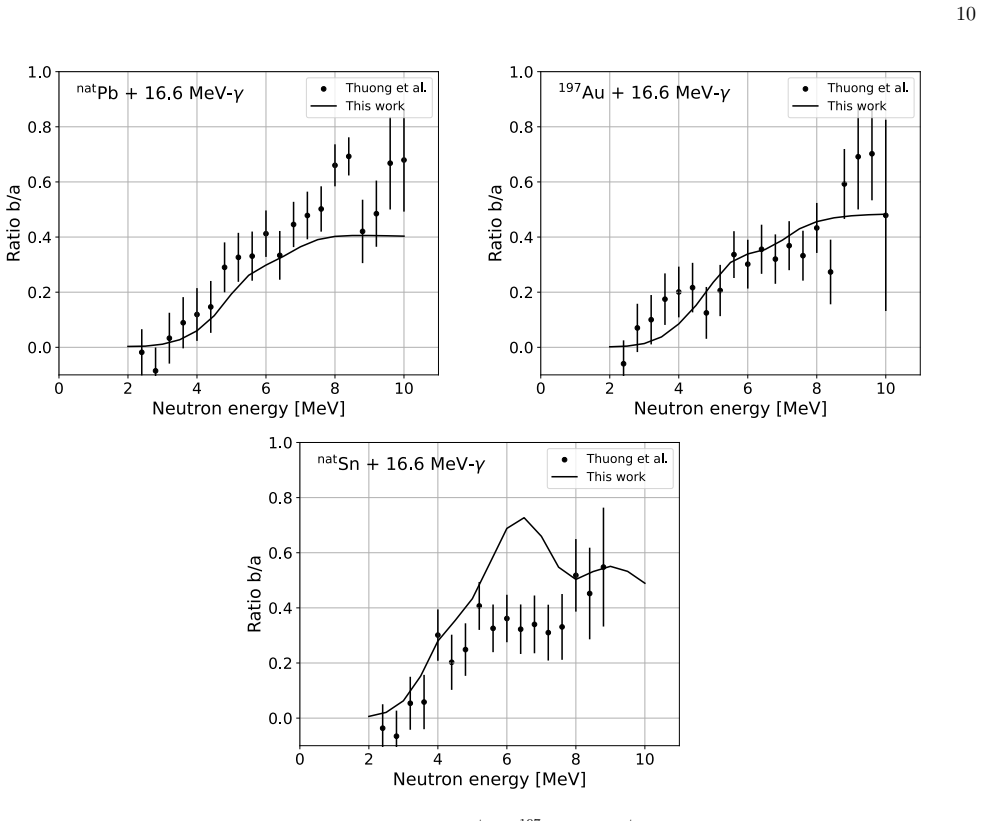
Photoneutron double-differential cross sections in the giant dipole resonance (GDR) region were calculated to investigate the underlying nuclear reaction mechanisms, with particular emphasis on the role of the direct process. Contributions from direct, pre-equilibrium, and compound processes were all taken into account. Wilkinson's resonance direct (RD) theory, based on the independent particle model, was applied to describe high-energy neutron emission from the direct process. The angular distribution of neutrons emitted via the RD mechanism was formulated using the Agodi and Courant formalism, which was incorporated into the RD framework. Neutron emission from the pre-equilibrium and compound processes was calculated using the two-component exciton model and the Hauser-Feshbach formalism, respectively. The calculated results were compared with experimental data obtained at NewSUBARU using 16.6-MeV quasi-monochromatic linearly-polarized photon beams. Good agreement between calculations and measurements was observed for Pb, Au, and Sn, confirming the validity of the proposed model. Furthermore, the angular anisotropies of photoneutrons emitted from these elements were investigated, revealing considerable contributions from the RD process at high neutron energies. This study provides a deeper understanding of photoneutron emission mechanisms in the GDR energy region.
Editorial analysis
A structured set of objections, weighed in public.
Referee Report
Summary. The manuscript calculates photoneutron double-differential cross sections in the GDR region for natPb, 197Au, natSn, natCu, natFe, and natTi by combining Wilkinson's resonance direct (RD) theory for the direct component, the two-component exciton model for pre-equilibrium emission, and the Hauser-Feshbach formalism for compound-nucleus decay. Angular distributions of the RD neutrons are treated with the Agodi-Courant formalism. The results are compared to experimental data taken at NewSUBARU with 16.6 MeV quasi-monochromatic linearly polarized photons; good agreement is reported for Pb, Au, and Sn, and the angular anisotropies are analyzed to show substantial RD contributions at high neutron energies.
Significance. If the reported agreement is quantitatively robust, the work supplies a useful consistency check of a standard multi-component model for photoneutron emission in heavy nuclei, where the independent-particle assumptions underlying RD theory are expected to hold better. The explicit treatment of angular distributions adds modest insight into the reaction mechanisms. The absence of quantitative fit metrics, parameter values, and error-bar comparisons, however, prevents a firm judgment of how strongly the data actually support the model.
major comments (2)
- [Results section / abstract] The central claim of 'good agreement' for Pb, Au, and Sn (abstract and results) is not accompanied by any quantitative measures of fit quality (e.g., chi-squared per degree of freedom), tabulated cross-section ratios, or error bars on either data or calculations. Without these, the strength of the validation cannot be assessed.
- [Theory / computational details] The RD component requires normalization or resonance-strength parameters (free_parameters list in the model description). The manuscript does not state the numerical values adopted, whether they were taken from literature or adjusted to the present data, or how many parameters were varied. This information is load-bearing for the claim that the model is validated rather than fitted.
minor comments (2)
- [Abstract] The abstract states that 'considerable contributions' from the RD process appear at high neutron energies but supplies no numerical fractions or energy thresholds to make the statement quantitative.
- [Discussion] A short discussion of why the same framework does not reproduce the lighter targets (Cu, Fe, Ti) would help delineate the model's domain of applicability.
Simulated Author's Rebuttal
We thank the referee for the careful reading of our manuscript and the constructive comments. We address each major point below and have revised the manuscript to strengthen the presentation of our results.
read point-by-point responses
-
Referee: [Results section / abstract] The central claim of 'good agreement' for Pb, Au, and Sn (abstract and results) is not accompanied by any quantitative measures of fit quality (e.g., chi-squared per degree of freedom), tabulated cross-section ratios, or error bars on either data or calculations. Without these, the strength of the validation cannot be assessed.
Authors: We agree that the absence of quantitative fit metrics limits the ability to assess the agreement rigorously. In the revised manuscript we have added chi-squared per degree of freedom values for the comparisons of calculated and measured double-differential cross sections for natPb, 197Au, and natSn. We have also inserted a table of calculated-to-experimental ratios at selected neutron energies and angles, together with a brief discussion of the experimental uncertainties reported in the NewSUBARU data set. These additions provide a clearer, quantitative basis for the claim of good agreement. revision: yes
-
Referee: [Theory / computational details] The RD component requires normalization or resonance-strength parameters (free_parameters list in the model description). The manuscript does not state the numerical values adopted, whether they were taken from literature or adjusted to the present data, or how many parameters were varied. This information is load-bearing for the claim that the model is validated rather than fitted.
Authors: The resonance energies, widths, and strengths entering the RD calculation were taken directly from the standard GDR parameter compilation of Berman and Fultz (1975) and the photoabsorption data of Dietrich and Berman (1988); no parameters were varied to fit the NewSUBARU measurements. The overall normalization is fixed by the integrated GDR cross section. We have added an explicit table in the Theory section listing every adopted numerical value together with its literature source and estimated uncertainty. This makes clear that the calculations are predictive rather than fitted to the present data set. revision: yes
Circularity Check
No significant circularity; standard models applied to external data
full rationale
The paper combines established external formalisms (Wilkinson's resonance direct theory, two-component exciton model, Hauser-Feshbach statistical model, and Agodi-Courant angular formalism) to compute photoneutron double-differential cross sections in the GDR region. These are compared directly to independent experimental measurements obtained at NewSUBARU with 16.6-MeV polarized photons. No derivation step defines a quantity in terms of itself, renames a fitted result as a prediction, or relies on a load-bearing self-citation whose content reduces to the present work. The reported agreement for Pb, Au, and Sn is presented as external validation within the model's stated domain of applicability, leaving the central chain self-contained against outside benchmarks.
Axiom & Free-Parameter Ledger
free parameters (2)
- RD normalization or resonance strength parameters
- exciton-model transition rates
axioms (2)
- domain assumption Independent-particle model underlying Wilkinson's RD theory
- standard math Statistical equilibrium assumption of Hauser-Feshbach formalism
Reference graph
Works this paper leans on
-
[1]
Hayward,Photonuclear Reactions, NBS monograph (U.S
E. Hayward,Photonuclear Reactions, NBS monograph (U.S. National Bureau of Standards, 1970)
work page 1970
- [2]
-
[3]
E. D. Courant, Phys. Rev.82, 703 (1951)
work page 1951
-
[4]
G. N. Zatsepina, V. V. Igonin, and L. E. Lazareva, SO- VIET PHYSICS JETP17(1963)
work page 1963
-
[5]
A. I. Lepestkin, V. A. Seliverstov, and V. I. Sidorov, Sov. J. Nucl. Phys.(Engl. Transl.);(United States)42(1985)
work page 1985
-
[6]
B. S. Ishkhanov, I. M. Kapitonov, V. G. Shevchenko, 11 V. I. Shvedunov, and V. V. Varlamov, Nuclear Physics A283, 307 (1977)
work page 1977
-
[7]
V. Emma, C. Milone, A. Rubbino, S. Jannelli, and P. Mezzawares, Il Nuovo Cimento22, 135 (1961)
work page 1961
-
[8]
G. S. Mutchler,The Angular Distributions and Energy Spectra of Photoncutrons from Heavy Elements, Ph.D. thesis, Massachusetts institute of technology (1966)
work page 1966
-
[9]
M. E. Toms and W. E. Stephens, Phys. Rev.92, 362 (1953)
work page 1953
-
[10]
M. E. Toms and W. E. Stephens, Physical Review98, 626 (1955)
work page 1955
-
[11]
D. H. Wilkinson, Physica22, 1039 (1956)
work page 1956
-
[12]
A. M. Lane and C. F. Wandel, Phys. Rev.98, 1524 (1955)
work page 1955
-
[13]
Y. Kirihara, H. Nakashima, T. Sanami, Y. Namito, T. Itoga, S. Miyamoto, A. Takemoto, M. Yamaguchi, and Y. Asano, Journal of Nuclear Science and Technology57, 444 (2020)
work page 2020
-
[14]
T. Kim Tuyet, T. Sanami, H. Yamazaki, T. Itoga, A. Takeuchi, Y. Namito, S. Miyamoto, and Y. Asano, Nuclear Instruments and Methods in Physics Research Section A: Accelerators, Spectrometers, Detectors and Associated Equipment989, 164965 (2021)
work page 2021
-
[15]
N. T. Hong Thuong, T. Sanami, H. Yamazaki, T. Itoga, Y. Kirihara, K. Sugihara, T. K. Tuyet, M. F. B. Mohd Zin, S. Miyamoto, S. Hashimoto, and Y. Asano, Journal of Nuclear Science and Technology61, 261 (2024)
work page 2024
-
[16]
N. T. H. Thuong, T. Sanami, H. Yamazaki, N. Iwamoto, T. Itoga, Y. Kirihara, E. Lee, K. Sugihara, S. Miyamoto, S. Hashimoto, and Y. Asano, Physics Letters B870, 139900 (2025)
work page 2025
- [17]
- [18]
-
[19]
G. Gurevich, L. Lazareva, V. Mazur, S.YU. Merkulov, G. Solodukhov, and V. Tyutin, Nuclear Physics A351, 257 (1981)
work page 1981
-
[20]
A. Veyssiere, H. Beil, R. Bergere, P. Carlos, and A. Lep- retre, Nuclear Physics A159, 561 (1970)
work page 1970
-
[21]
J. M. Blatt and V. F. Weisskopf,Theoretical Nuclear Physics(Springer New York, NY, 1979)
work page 1979
-
[22]
A. A. Ross, H. Mark, and R. D. Lawson, Phys. Rev.102, 1613 (1956)
work page 1956
-
[23]
Livechart - Table of Nuclides - Nuclear structure and decay data
-
[24]
T. Hayakawa, T. Shizuma, S. Miyamoto, S. Amano, A. Takemoto, M. Yamaguchi, K. Horikawa, H. Akimune, S. Chiba, K. Ogata, and M. Fujiwara, Phys. Rev. C93, 044313 (2016)
work page 2016
-
[25]
K. Horikawa, S. Miyamoto, T. Mochizuki, S. Amano, D. Li, K. Imasaki, Y. Izawa, K. Ogata, S. Chiba, and T. Hayakawa, Physics Letters B737, 109 (2014)
work page 2014
- [26]
- [27]
- [28]
discussion (0)
Sign in with ORCID, Apple, or X to comment. Anyone can read and Pith papers without signing in.