Recognition: no theorem link
Full-gap kinetic limitation of thermionic-electron transport for electron transpiration cooling
Pith reviewed 2026-05-11 01:17 UTC · model grok-4.3
The pith
Thermionic electron transport for electron transpiration cooling encounters a sharp kinetic limit from backflow at high emission rates.
A machine-rendered reading of the paper's core claim, the machinery that carries it, and where it could break.
Core claim
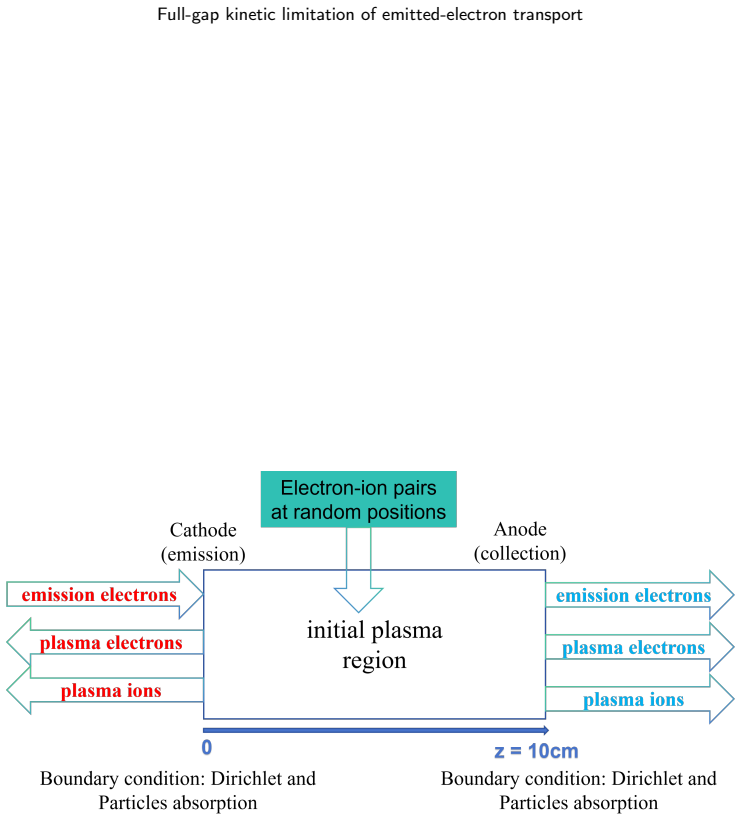
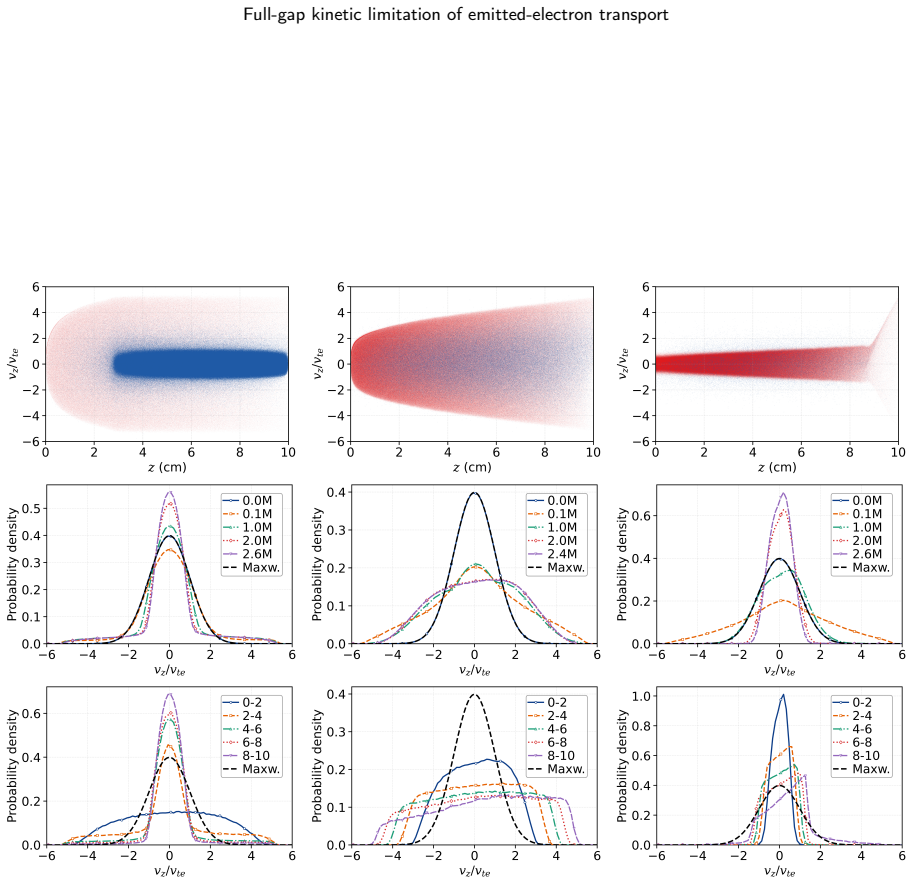
A one-dimensional-in-space three-dimensional-in-velocity electrostatic particle-in-cell/Monte Carlo collision model is developed for a full cathode-anode plasma diode, resolving thermionic emission, collisional plasma transport, emitted-electron backflow, and downstream collection. With increasing imposed emission the diode first remains in a weak-backflow regime where net emitted-electron transport and downstream collection both increase. Further emission produces a sharp transition to backflow-limited transport between 7.0 and 7.5 times 10 to the 19th m to the minus 2 s to the minus 1. At 7.25 times 10 to the 19th the backflow ratio reaches 54.03 percent while net transport and downstream
What carries the argument
one-dimensional-in-space three-dimensional-in-velocity electrostatic PIC-MCC model of a full cathode-anode plasma diode that resolves thermionic emission, collisional transport, backflow, and collection
Load-bearing premise
The one-dimensional-in-space, three-dimensional-in-velocity electrostatic PIC-MCC model with chosen boundary conditions and helium benchmark accurately captures the kinetic backflow and transport processes without significant numerical artifacts or missing physics.
What would settle it
Direct laboratory measurement of backflow ratio and net transport efficiency in a plasma diode at an imposed emission rate of 7.25 times 10 to the 19th m to the minus 2 s to the minus 1, checking whether backflow reaches approximately 54 percent and net efficiencies fall to 46 percent.
Figures


read the original abstract
Electron transpiration cooling (ETC) can reduce aerothermal loads on sharp hypersonic leading edges, but its performance is governed by whether thermionically emitted electrons escape the hot surface or return as cathode-directed backflow. Here, a one-dimensional-in-space, three-dimensional-in-velocity electrostatic particle-in-cell/Monte Carlo collision model is developed for a full cathode--anode plasma diode, resolving thermionic emission, collisional plasma transport, emitted-electron backflow, and downstream collection. A helium benchmark is used to examine emitted-electron transport and backflow-limited current flow. With increasing imposed emission, the diode first remains in a weak-backflow regime, where net emitted-electron transport and downstream collection both increase with emission. Further increasing the emission produces a sharp transition to backflow-limited transport between $7.0\times10^{19}$ and $7.5\times10^{19},\mathrm{m^{-2},s^{-1}}$. At $7.25\times10^{19},\mathrm{m^{-2},s^{-1}}$, the backflow ratio reaches $54.03%$, while the net transport and downstream collection efficiencies fall to about $46%$. Above this transition, added backflow overcompensates the imposed emission increase, reducing useful emitted-electron transport rather than causing saturation. Boundary energy diagnostics show that stronger emission may still increase the nominal cathode-side cooling metric, but after transition this metric no longer indicates improved emitted-electron escape or full-gap transport. These results show that the present PIC-MCC framework captures the key kinetic processes governing ETC-relevant emitted-electron escape and backflow limitation.
Editorial analysis
A structured set of objections, weighed in public.
Referee Report
Summary. The manuscript develops a 1D3V electrostatic PIC-MCC model for a cathode-anode plasma diode to study thermionic electron transport and backflow limitation in electron transpiration cooling (ETC). Using a helium benchmark, it reports that net transport increases with imposed emission in a weak-backflow regime, followed by a sharp transition to backflow-limited transport between 7.0×10^{19} and 7.5×10^{19} m^{-2}s^{-1}. At 7.25×10^{19} m^{-2}s^{-1}, backflow reaches 54.03% and net transport/downstream collection efficiencies fall to ~46%; above the transition, added backflow overcompensates further emission increases. Boundary energy diagnostics are shown to decouple from actual escape efficiency post-transition.
Significance. If the numerical results hold, the work is significant for ETC design in hypersonic applications because it identifies a concrete kinetic threshold beyond which increasing thermionic emission reduces rather than enhances net cooling transport. The direct-simulation approach yields emergent, quantitative predictions (transition location, 54.03% backflow ratio, 46% efficiencies) without fitted parameters or algebraic closure, supplying falsifiable benchmarks for future models or experiments.
major comments (2)
- [Results section (transition paragraph)] Results section (paragraph reporting the transition between 7.0×10^{19} and 7.5×10^{19} m^{-2}s^{-1} and the 54.03% backflow value at 7.25×10^{19} m^{-2}s^{-1}): no resolution or convergence study is presented that varies macroparticle count per Debye length, grid spacing relative to λ_D, time step relative to ω_p, or the precise implementation of thermionic emission/absorbing boundaries while holding the imposed emission fixed in the critical interval. Because the backflow ratio is known to be sensitive to these parameters in electrostatic PIC-MCC, the reported sharpness of the transition and the precise 54.03% figure cannot yet be confirmed as physical rather than numerical.
- [Model description] Model description (1D3V electrostatic PIC-MCC with helium benchmark and chosen boundary conditions): the central claim that the framework 'captures the key kinetic processes' rests on the assumption that the chosen spatial dimensionality, collision treatment, and sheath resolution are sufficient to exclude artifacts in the backflow-limited regime. Without documented tests (e.g., comparison to 2D or higher-resolution runs, or variation of the helium cross-section implementation), it remains possible that missing transverse effects or under-resolved sheaths contribute to the observed overcompensation behavior.
minor comments (2)
- [Abstract] Abstract: the net efficiencies are stated as 'about 46%' while the backflow ratio is given to two decimal places (54.03%); a consistent level of precision or explicit statement of the exact net value would improve clarity.
- [Results section] The manuscript would benefit from an explicit statement of the total simulation time or number of plasma periods used to compute the time-averaged backflow ratio and efficiencies, to allow readers to assess statistical convergence of the reported percentages.
Simulated Author's Rebuttal
We thank the referee for their careful and constructive review of our manuscript. The comments correctly identify areas where additional numerical validation would strengthen the presentation. We respond to each major comment below and outline the revisions we will incorporate.
read point-by-point responses
-
Referee: [Results section (transition paragraph)] Results section (paragraph reporting the transition between 7.0×10^{19} and 7.5×10^{19} m^{-2}s^{-1} and the 54.03% backflow value at 7.25×10^{19} m^{-2}s^{-1}): no resolution or convergence study is presented that varies macroparticle count per Debye length, grid spacing relative to λ_D, time step relative to ω_p, or the precise implementation of thermionic emission/absorbing boundaries while holding the imposed emission fixed in the critical interval. Because the backflow ratio is known to be sensitive to these parameters in electrostatic PIC-MCC, the reported sharpness of the transition and the precise 54.03% figure cannot yet be confirmed as physical rather than numerical.
Authors: We agree that a dedicated convergence study is necessary to confirm the physical nature of the transition. In the revised manuscript we will add a new subsection in the results presenting simulations at the critical emission rate of 7.25×10^{19} m^{-2}s^{-1} while independently varying macroparticle number per Debye length, grid spacing relative to λ_D, and time step relative to ω_p. The backflow ratio and net transport efficiency will be reported for each case to demonstrate that the transition location and the 54% backflow value remain robust within the resolution used. revision: yes
-
Referee: [Model description] Model description (1D3V electrostatic PIC-MCC with helium benchmark and chosen boundary conditions): the central claim that the framework 'captures the key kinetic processes' rests on the assumption that the chosen spatial dimensionality, collision treatment, and sheath resolution are sufficient to exclude artifacts in the backflow-limited regime. Without documented tests (e.g., comparison to 2D or higher-resolution runs, or variation of the helium cross-section implementation), it remains possible that missing transverse effects or under-resolved sheaths contribute to the observed overcompensation behavior.
Authors: The 1D-3V geometry is the standard and appropriate choice for a planar cathode-anode diode in which transverse uniformity is assumed; transverse instabilities are not expected to alter the axial backflow dynamics under the conditions studied. Standard helium cross sections from the LXCat database are employed, and the sheath is resolved with multiple cells per Debye length following established PIC practice. Nevertheless, we will expand the model-description section to provide explicit justification for the dimensionality choice, state the sheath-resolution criterion used, and add a short limitations paragraph acknowledging that full 2D or 3D runs could further test for transverse effects. A brief note on internal higher-resolution checks will also be included. revision: partial
Circularity Check
No circularity: results are direct simulation outputs
full rationale
The paper reports emergent numerical results from a 1D3V electrostatic PIC-MCC simulation of a cathode-anode diode with thermionic emission and helium collisions. The claimed sharp transition between 7.0×10^{19} and 7.5×10^{19} m^{-2}s^{-1}, the 54.03% backflow ratio at 7.25×10^{19} m^{-2}s^{-1}, and the ~46% net efficiencies are computed outputs from particle tracking and boundary diagnostics, not algebraic reductions, fitted parameters renamed as predictions, or self-referential definitions. The model setup and boundary conditions are stated as inputs; no load-bearing self-citations, uniqueness theorems, or ansatzes imported from prior author work appear in the derivation chain. The simulation is self-contained against the helium benchmark and produces falsifiable kinetic quantities independent of the target claims.
Axiom & Free-Parameter Ledger
free parameters (1)
- imposed thermionic emission rate
axioms (2)
- domain assumption Electrostatic particle-in-cell with Monte Carlo collisions accurately models electron and ion transport in the diode
- domain assumption Helium benchmark gas and chosen cathode-anode boundary conditions represent relevant ETC physics
Reference graph
Works this paper leans on
-
[1]
QingdianZhang,ChengwenZhong,CongshanZhuo,andShaLiu. Investigationofheatanddragreductioninhypersonicrarefiedenvironments using spike-aerodisk-opposing jet configurations.Aerospace Science and Technology, 168:111136, 2026
work page 2026
-
[2]
LesterLeesandToshiKubota. Inviscidhypersonicflowoverblunt-nosedslenderbodies.Journal of the Aeronautical Sciences,24(3):195–202, 1957
work page 1957
-
[3]
J.A.FayandF.R.Riddell. Theoryofstagnationpointheattransferindissociatedair.Journal of the Aerospace Sciences,25(2):73–85,1958
work page 1958
-
[4]
Yinhai Zhu, Wei Peng, Ruina Xu, and Peixue Jiang. Review on active thermal protection and its heat transfer for airbreathing hypersonic vehicles.Chinese Journal of Aeronautics, 31(10):1929–1953, 2018
work page 1929
-
[5]
Silong Zhang, Xin Li, Jingying Zuo, Jiang Qin, Kunlin Cheng, Yu Feng, and Wen Bao. Research progress on active thermal protection for hypersonic vehicles.Progress in Aerospace Sciences, 119:100646, 2020
work page 2020
-
[6]
Xiaobing Zhang and Zekang Wang. Thermal protection and drag reduction induced by flow control devices in supersonic/hypersonic flows: A review.Progress in Aerospace Sciences, 155:101093, 2025
work page 2025
-
[7]
Shibin Luo, Daiwei Li, Junfeng Wang, Yicong Dai, and Yanbin Feng. Drag reduction and thermal protection efficiencies of combinational spike and opposing jet with different forebody geometries in hypersonic flows.Applied Thermal Engineering, 278:127298, 2025
work page 2025
-
[8]
Qifan Zhang, Yiping Han, Qinlu Dong, and Chang Dong. Analysis of the influence of sheath positions, flight parameters and incident wave parameters on the wave propagation in plasma sheath.Plasma Science and Technology, 24(3):035003, 2022
work page 2022
-
[9]
Shiping Guo, Haicheng Cen, Wenchong Ouyang, Donglin Liu, and Zhengwei Wu. Rapid prediction model of terahertz transmission in hypersonicplasmasheathunderdifferentflightspeedsfordifferentvehicletypes.Journal of Physics D: Applied Physics,58(8):085208,2025
work page 2025
-
[10]
Haoran Zhang, Jingfeng Tang, Yujie Cui, Desheng Zhou, Ji Li, and Daren Yu. Study on the characterization of wide-range working characteristics of plasma jet igniter based on similarity theory in aerospace engineering.Aerospace Science and Technology, 177:112331, 2026
work page 2026
-
[11]
Conceptualanalysisofelectrontranspirationcoolingfortheleadingedgesofhypersonic vehicles
HichamAlkandry,KyleHanquist,andIainD.Boyd. Conceptualanalysisofelectrontranspirationcoolingfortheleadingedgesofhypersonic vehicles. In11th AIAA/ASME Joint Thermophysics and Heat Transfer Conference, 2014
work page 2014
-
[12]
Luke Uribarri and Edward H. Allen. Electron transpiration cooling for hot aerospace surfaces. In20th AIAA International Space Planes and Hypersonic Systems and Technologies Conference, 2015
work page 2015
-
[13]
Hanquist, Kentaro Hara, and Iain D
Kyle M. Hanquist, Kentaro Hara, and Iain D. Boyd. Modeling of electron transpiration cooling for hypersonic vehicles. In46th AIAA Thermophysics Conference, 2016
work page 2016
-
[14]
Hanquist, Kentaro Hara, and Iain D
Kyle M. Hanquist, Kentaro Hara, and Iain D. Boyd. Detailed modeling of electron emission for transpiration cooling of hypersonic vehicles. Journal of Applied Physics, 121(5):053302, 2017
work page 2017
-
[15]
Kyle M. Hanquist and Iain D. Boyd. Effectiveness of thermionic emission for cooling hypersonic vehicle surfaces. In2018 AIAA Aerospace Sciences Meeting, 2018. Zhang et al.:Preprint submitted to ElsevierPage 16 of 17 Full-gap kinetic limitation of emitted-electron transport
work page 2018
-
[16]
Liang Li, Zhen Qian, Bo Niu, Xiubing Liang, Xiaojing Wang, and Donghui Long. Impacting factors and operation thresholds of electron transpiration cooling-based thermal protection system.Thermal Science and Engineering Progress, 55:103002, 2024
work page 2024
-
[17]
Flightenvelopeanalysisofhypersonicleading-edgeusingelectrontranspirationcooling
NicholasGibbons,KyleDamm,andRowanGollan. Flightenvelopeanalysisofhypersonicleading-edgeusingelectrontranspirationcooling. Journal of Thermophysics and Heat Transfer, pages 1–12, 2025
work page 2025
-
[18]
Kalvin Y. Monroe, Jens A. Rataczak, and Iain D. Boyd. The influence of hypersonic flight regimes on electron transpiration cooling systems. InAIAA AVIATION FORUM AND ASCEND 2025, 2025
work page 2025
-
[19]
Kalvin Y. Monroe, Marcel P. Georgin, and Iain D. Boyd. Electron transpiration circuits for hypersonic leading edges.Journal of Applied Physics, 138(16):163304, 2025
work page 2025
-
[20]
PhD thesis, University of California, Los Angeles, USA, 2025
Bryce Justin Boyer.Mechanisms and Limitations of Passive Electron Transpiration Cooling for Hypersonic Leading Edges. PhD thesis, University of California, Los Angeles, USA, 2025
work page 2025
-
[21]
Heatflowthroughalangmuirsheathinthepresenceofelectronemission.Plasma Physics,9(1):85–87,1967
G.D.HobbsandJ.A.Wesson. Heatflowthroughalangmuirsheathinthepresenceofelectronemission.Plasma Physics,9(1):85–87,1967
work page 1967
-
[22]
S. Takamura, N. Ohno, M. Y. Ye, and T. Kuwabara. Space-charge limited current from plasma-facing material surface.Contributions to Plasma Physics, 44(1-3):126–137, 2004
work page 2004
-
[23]
J. P. Sheehan, N. Hershkowitz, I. D. Kaganovich, H. Wang, Y. Raitses, E. V. Barnat, B. R. Weatherford, and D. Sydorenko. Kinetic theory of plasma sheaths surrounding electron-emitting surfaces.Physical Review Letters, 111(7):075002, 2013
work page 2013
-
[24]
Plasmasheathmodelsforelectrontranspirationcoolinginhypersonic vehicles
RupaliSahu,AlbinaTropina,DaniilAndrienko,andRichardB.Miles. Plasmasheathmodelsforelectrontranspirationcoolinginhypersonic vehicles. InAIAA SCITECH 2022 Forum, 2021
work page 2022
-
[25]
Davut Vatansever, Nakul Nuwal, and Deborah A. Levin. A parametric study for kinetic modeling of emissive sheaths using electrostatic particle-in-cell method. InAIAA AVIATION 2022 Forum, 2022
work page 2022
-
[26]
M. D. Campanell. Negative plasma potential relative to electron-emitting surfaces.Physical Review E, 88(3):033103, 2013
work page 2013
-
[27]
M. D. Campanell and M. V. Umansky. Strongly emitting surfaces unable to float below plasma potential.Physical Review Letters, 116(8):085003, 2016
work page 2016
-
[28]
M. D. Campanell. Alternative model of space-charge-limited thermionic current flow through a plasma.Physical Review E, 97(4):043207, 2018
work page 2018
-
[29]
M.D.CampanellandG.R.Johnson.Thermioniccoolingofthetargetplasmatoasub-evtemperature.Physical Review Letters,122(1):015003, 2019
work page 2019
-
[30]
M.D.Campanell,C.Y.Wang,andK.L.Nguyen. Twomechanismslimitingtheemittedelectroncurrentfromacathodetoananode.Physical Review Letters, 134(14):145301, 2025
work page 2025
-
[31]
C. K. Birdsall and A. B. Langdon.Plasma Physics via Computer Simulation. Adam Hilger, Bristol, 1991
work page 1991
-
[32]
R. W. Hockney and J. W. Eastwood.Computer Simulation Using Particles. CRC Press, Boca Raton, 1988
work page 1988
-
[33]
V. Vahedi and M. Surendra. A monte carlo collision model for the particle-in-cell method: Applications to argon and oxygen discharges. Computer Physics Communications, 87(1-2):179–198, 1995
work page 1995
-
[34]
Luca Fedeli, Axel Huebl, France Boillod-Cerneux, Thomas Clark, Kevin Gott, Conrad Hillairet, Stephan Jaure, Adrien Leblanc, Rémi Lehe, AndrewMyers,ChristellePiechurski,MitsuhisaSato,NeïlZaim,WeiqunZhang,Jean-LucVay,andHenriVincenti. Pushingthefrontierinthe design of laser-based electron accelerators with groundbreaking mesh-refined particle-in-cell simula...
work page 2022
-
[35]
Owen Willans Richardson. The electrical conductivity imparted to a vacuum by hot conductors.Philosophical Transactions of the Royal Society of London. Series A, 201(331–345):497–549, 1903
work page 1903
-
[36]
Electron emission from metals as a function of temperature.Physical Review, 21(6):623–636, 1923
Saul Dushman. Electron emission from metals as a function of temperature.Physical Review, 21(6):623–636, 1923
work page 1923
-
[37]
Hua Jin, Zhitong Mi, Zhuoran Li, Xiao Wu, Zhuochen Sui, and Pan Dong. Investigation of the influence mechanism of hypersonic flow field environment on thermionic emission efficiency.International Journal of Heat and Mass Transfer, 226:125502, 2024. Zhang et al.:Preprint submitted to ElsevierPage 17 of 17 Full-gap kinetic limitation of emitted-electron tra...
work page 2024
discussion (0)
Sign in with ORCID, Apple, or X to comment. Anyone can read and Pith papers without signing in.