Recognition: 2 theorem links
· Lean TheoremBaryon Bethe-Salpeter Equation in Minkowski-Space QCD₂
Pith reviewed 2026-05-11 01:01 UTC · model grok-4.3
The pith
The three-quark Bethe-Salpeter equation in two-dimensional QCD reduces to the Bars-Durgut equation at leading order in the valence truncation.
A machine-rendered reading of the paper's core claim, the machinery that carries it, and where it could break.
Core claim
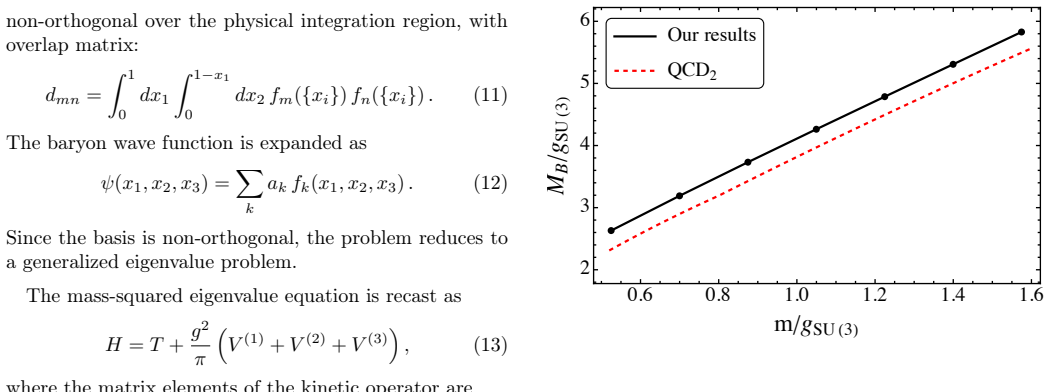
Using the quasi-potential expansion of the ladder Bethe-Salpeter equation in light-cone gauge, the mass-squared eigenvalue problem for the three-quark system in QCD2 is shown to be equivalent to the Bars-Durgut equation when truncated to the leading valence sector. Numerical solution for Nc=3 gives a ground-state mass in reasonable agreement with light-cone quantization results, and the excited states follow a Regge trajectory that tracks the experimental nucleon spectrum trend.
What carries the argument
The quasi-potential expansion of the three-quark ladder Bethe-Salpeter equation, truncated at leading order in the valence sector after light-front projection, which converts the Minkowski-space bound-state equation into a mass-squared eigenvalue problem.
If this is right
- The ground-state baryon mass agrees with previous light-cone quantization results, indicating the valence sector dominates the ground state.
- The excited-state spectrum produces a Regge trajectory that follows the overall trend of the nucleon spectrum.
- The valence wave function obeys an endpoint power-law behavior fixed by the quark mass and the coupling, paralleling the 't Hooft meson analysis.
- Structure observables including parton distribution functions, double distribution amplitudes, and coordinate-space densities follow directly from the numerical solutions.
Where Pith is reading between the lines
- The demonstrated equivalence offers a controlled setting to test whether higher-order terms in the quasi-potential expansion remain small for ground states in related confining models.
- The same reduction procedure could be applied to other lower-dimensional gauge theories to isolate the contribution of valence versus higher Fock components.
- Numerical techniques developed here for solving the reduced eigenvalue problem may transfer to Minkowski-space formulations of baryons once systematic truncations are available in 3+1 dimensions.
Load-bearing premise
The quasi-potential expansion truncated at leading order in the valence sector captures the dominant physics of the ground-state baryon.
What would settle it
A direct numerical solution of the full three-quark Bethe-Salpeter equation in QCD2 without the valence truncation that produces a ground-state mass differing substantially from the truncated result.
Figures




read the original abstract
We study the three-quark ladder Bethe--Salpeter equation in Minkowski-space QCD$_2$ in the light-cone gauge. Using the quasi-potential expansion, we project the baryon equation onto the light front and show that, at leading order in the valence truncation, the resulting mass-squared eigenvalue equation is equivalent to the Bars--Durgut equation. We also derive the endpoint power-law behavior of the valence wave function in terms of the quark mass and coupling, closely paralleling the original 't Hooft analysis for mesons. The resulting three-quark equation is solved numerically for $N_c=3$, and the ground-state baryon mass is found to be in reasonable agreement with previous light-cone quantization results in QCD$_2$, suggesting that the valence sector provides the dominant contribution to the ground state. The excited-state spectrum further yields a Regge trajectory that captures the overall trend of the experimental nucleon spectrum, and we compute selected structure observables, including parton distribution functions, double distribution amplitudes, and coordinate-space densities. This framework provides a useful confining test bed for Minkowski-space bound-state methods and for future developments toward confining formulations in 3+1 dimensions beyond the valence truncation.
Editorial analysis
A structured set of objections, weighed in public.
Referee Report
Summary. The paper studies the three-quark ladder Bethe-Salpeter equation in Minkowski-space QCD_2 in the light-cone gauge. Using the quasi-potential expansion, it projects the baryon equation onto the light front and demonstrates that at leading order in the valence truncation, the resulting mass-squared eigenvalue equation is equivalent to the Bars-Durgut equation. It derives the endpoint power-law behavior of the valence wave function, solves the equation numerically for N_c=3 obtaining ground-state mass in reasonable agreement with prior light-cone quantization results, and computes the excited-state spectrum showing a Regge trajectory, along with structure observables such as parton distribution functions, double distribution amplitudes, and coordinate-space densities.
Significance. If the results hold, this provides a useful confining test bed for Minkowski-space bound-state methods. The explicit equivalence to the Bars-Durgut equation and the parallel derivation of the endpoint power-law behavior with the meson case are strengths. The numerical agreement with independent prior results supports the approach, and the computation of structure observables adds value for applications in bound-state physics.
minor comments (3)
- [Abstract] The phrase 'reasonable agreement' for the ground-state mass should be quantified with the actual numerical values and the difference from previous results to allow readers to assess the level of agreement.
- [Numerical results] The Regge trajectory is said to capture the 'overall trend' of the experimental nucleon spectrum; this comparison should be qualified as qualitative due to the model being in 1+1 dimensions versus real-world 3+1 dimensions.
- Check for consistency in notation between the quasi-potential expansion and the valence truncation throughout the text.
Simulated Author's Rebuttal
We thank the referee for the positive evaluation of our manuscript on the baryon Bethe-Salpeter equation in Minkowski-space QCD_2. We are pleased that the equivalence to the Bars-Durgut equation under valence truncation, the derivation of the endpoint power-law behavior, the numerical agreement with prior light-cone quantization results, and the computation of structure observables are recognized as strengths. The recommendation for minor revision is noted, and we will incorporate improvements to clarity and presentation in the revised version.
Circularity Check
No significant circularity; equivalence derived by explicit projection and truncation
full rationale
The paper's central derivation projects the three-quark ladder BSE onto the light front via quasi-potential expansion and shows equivalence to the Bars-Durgut equation at leading valence order through explicit truncation steps. The resulting eigenvalue equation is solved numerically for masses and wave functions, with results compared to independent prior light-cone quantization calculations rather than fitted to them. Endpoint power-law behavior is derived in parallel with 't Hooft's meson analysis using the same coupling and mass parameters. No load-bearing step reduces to a self-citation chain, a fitted parameter renamed as prediction, or an ansatz smuggled via prior work by the same authors. The framework is self-contained against external benchmarks.
Axiom & Free-Parameter Ledger
axioms (2)
- domain assumption Light-cone gauge for the gluon propagator in QCD2
- ad hoc to paper Leading-order valence truncation in the quasi-potential expansion
Lean theorems connected to this paper
-
IndisputableMonolith/Foundation/AlexanderDuality.leanalexander_duality_circle_linking unclear?
unclearRelation between the paper passage and the cited Recognition theorem.
at leading order in the valence truncation, the resulting mass-squared eigenvalue equation is equivalent to the Bars--Durgut equation
-
IndisputableMonolith/Cost/FunctionalEquation.leanwashburn_uniqueness_aczel unclear?
unclearRelation between the paper passage and the cited Recognition theorem.
derive the endpoint power-law behavior of the valence wave function... closely paralleling the original 't Hooft analysis
What do these tags mean?
- matches
- The paper's claim is directly supported by a theorem in the formal canon.
- supports
- The theorem supports part of the paper's argument, but the paper may add assumptions or extra steps.
- extends
- The paper goes beyond the formal theorem; the theorem is a base layer rather than the whole result.
- uses
- The paper appears to rely on the theorem as machinery.
- contradicts
- The paper's claim conflicts with a theorem or certificate in the canon.
- unclear
- Pith found a possible connection, but the passage is too broad, indirect, or ambiguous to say the theorem truly supports the claim.
Reference graph
Works this paper leans on
-
[1]
’t Hooft, A Two-Dimensional Model for Mesons, Nucl
G. ’t Hooft, A Two-Dimensional Model for Mesons, Nucl. Phys. B 75 (1974) 461–470.doi:10.1016/ 0550-3213(74)90088-1
1974
-
[2]
K. Hornbostel, S. J. Brodsky, H. C. Pauli, Light Cone Quantized QCD in (1+1)-Dimensions, Phys. Rev. D 41 (1990) 3814.doi:10.1103/PhysRevD.41.3814
- [3]
-
[4]
J. P. Vary, C. Mondal, S. Xu, X. Zhao, Y. Li, Nu- cleon Structure from Basis Light-Front Quantization : Status and Prospects (12 2025).arXiv:2512.08283, doi:10.1140/epjs/s11734-025-02084-y
- [5]
-
[6]
S. Xu, C. Mondal, J. Lan, X. Zhao, Y. Li, J. P. Vary, Nucleon structure from basis light-front quantization, Phys. Rev. D 104 (9) (2021) 094036.arXiv:2108. 03909,doi:10.1103/PhysRevD.104.094036
-
[7]
S. Xu, C. Mondal, X. Zhao, Y. Li, J. P. Vary, Quark and gluon spin and orbital angular momentum in the proton, Phys. Rev. D 108 (9) (2023) 094002.arXiv: 2209.08584,doi:10.1103/PhysRevD.108.094002
-
[9]
J. Lan, C. Mondal, S. Jia, X. Zhao, J. P. Vary, Par- ton Distribution Functions from a Light Front Hamil- tonian and QCD Evolution for Light Mesons, Phys. Rev. Lett. 122 (17) (2019) 172001.arXiv:1901. 11430,doi:10.1103/PhysRevLett.122.172001
-
[10]
J. Lan, K. Fu, C. Mondal, X. Zhao, j. P. Vary, Light mesons with one dynamical gluon on the light front, Phys. Lett. B 825 (2022) 136890.arXiv:2106.04954, doi:10.1016/j.physletb.2022.136890
-
[11]
Nakanishi, A General survey of the theory of the Bethe-Salpeter equation, Prog
N. Nakanishi, A General survey of the theory of the Bethe-Salpeter equation, Prog. Theor. Phys. Suppl. 43 (1969) 1–81.doi:10.1143/PTPS.43.1
-
[12]
K. Kusaka, A. G. Williams, Solving the Bethe- Salpeter equation for scalar theories in Minkowski space, Phys. Rev. D 51 (1995) 7026–7039.arXiv: hep-ph/9501262,doi:10.1103/PhysRevD.51.7026
-
[13]
V. A. Karmanov, J. Carbonell, Solving Bethe- Salpeter equation in Minkowski space, Eur. Phys. J. A 27 (2006) 1–9.arXiv:hep-th/0505261,doi: 10.1140/epja/i2005-10193-0
-
[14]
T. Frederico, G. Salme, M. Viviani, Two-body scat- tering states in Minkowski space and the Nakanishi integral representation onto the null plane, Phys. Rev. D 85 (2012) 036009.arXiv:1112.5568,doi: 10.1103/PhysRevD.85.036009
-
[15]
J. Carbonell, V. A. Karmanov, Solving Bethe- Salpeter scattering state equation in Minkowski space, Phys. Rev. D 90 (5) (2014) 056002.arXiv: 1408.3761,doi:10.1103/PhysRevD.90.056002
-
[16]
G. Eichmann, E. Ferreira, A. Stadler, Going to the light front with contour deformations, Phys. Rev. D 105 (3) (2022) 034009.arXiv:2112.04858,doi:10. 1103/PhysRevD.105.034009
-
[17]
W. de Paula, T. Frederico, Minkowski Space Dy- namics and Light-Front Projection (1 2026).arXiv: 2601.11760
- [19]
- [20]
- [21]
-
[22]
C. M. Weller, G. A. Miller, Confinement in two- dimensional QCD and the infinitely long pion, Phys. Rev. D 105 (3) (2022) 036009.arXiv:2111.03194, doi:10.1103/PhysRevD.105.036009
-
[24]
DOI 10.1140/epjc/ s10052-022-10942-5
M. Rinaldi, F. A. Ceccopieri, V. Vento, The pion in the graviton soft-wall model: phenomeno- logical applications, Eur. Phys. J. C 82 (7) (2022) 626.arXiv:2204.09974,doi:10.1140/epjc/ s10052-022-10538-z
- [25]
-
[26]
S. Kaur, C. Mondal, X. Zhao, C.-R. Ji, Structure of the lightest nucleus in the visible Universe, Phys. Rev. D 113 (5) (2026) 054008.arXiv:2507.09886,doi: 10.1103/xkdk-ymn6
-
[27]
S. Kaur, C. Mondal, Gluon distributions in the pion, Phys. Rev. D 112 (11) (2025) 114015.arXiv:2507. 01506,doi:10.1103/j5x3-ljwd
-
[28]
B. Gurjar, C. Mondal, S. Kaur,ρ-meson spectroscopy anddiffractiveproductionusingtheholographiclight- front Schrödinger equation and the ’t Hooft equation, Phys. Rev. D 109 (9) (2024) 094017.arXiv:2401. 13514,doi:10.1103/PhysRevD.109.094017
-
[29]
M. Ahmady, S. Kaur, C. Mondal, R. San- dapen, Pion spectroscopy and dynamics using the holographic light-front Schrödinger equation and the ’t Hooft equation, Phys. Lett. B 836 (2023) 137628.arXiv:2208.08405,doi:10.1016/j. physletb.2022.137628
work page doi:10.1016/j 2023
- [30]
-
[31]
Bars, Exact Equivalence of Chromodynamics to a String Theory, Phys
I. Bars, Exact Equivalence of Chromodynamics to a String Theory, Phys. Rev. Lett. 36 (1976) 1521.doi: 10.1103/PhysRevLett.36.1521
-
[32]
I. Bars, A Quantum String Theory of Hadrons and Its Relation to Quantum Chromodynamics in Two- Dimensions, Nucl. Phys. B 111 (1976) 413–440.doi: 10.1016/0550-3213(76)90327-8
-
[33]
Durgut, Baryon Bound State in Two-Dimensional SU(N) Gauge Theory, Nucl
M. Durgut, Baryon Bound State in Two-Dimensional SU(N) Gauge Theory, Nucl. Phys. B 116 (1976) 233– 252.doi:10.1016/0550-3213(76)90324-2
-
[34]
B. R. Webber, Solution of a Two-dimensional QCD Model for Baryons, Nucl. Phys. B 153 (1979) 455– 466.doi:10.1016/0550-3213(79)90609-6
-
[35]
J. H. O. Sales, T. Frederico, B. V. Carlson, P. U. Sauer, Light front Bethe-Salpeter equation, Phys. Rev. C 61 (2000) 044003.arXiv:nucl-th/ 9909029,doi:10.1103/PhysRevC.61.044003
-
[36]
J. H. O. Sales, T. Frederico, B. V. Carlson, P. U. Sauer, Renormalization of the ladder light front Bethe-Salpeter equation in the Yukawa model, Phys. Rev. C 63 (2001) 064003.doi:10.1103/ PhysRevC.63.064003
2001
-
[37]
J. A. O. Marinho, T. Frederico, Next-to-leading order light-front three-body dynamics, PoS LC2008 (2008) 036.doi:10.22323/1.061.0036
-
[38]
J. A. O. Marinho, T. Frederico, Three-boson systems in light-front dynamics, J. Phys. Conf. Ser. 110 (2008) 122009.doi:10.1088/1742-6596/110/12/122009
-
[39]
K. S. F. F. Guimarães, O. Lourenço, W. de Paula, T. Frederico, A. C. dos Reis, Final state interac- tion inD + →K −π+π+ withKπI = 1/2 and 3/2 channels, JHEP 08 (2014) 135.arXiv:1404.3797, doi:10.1007/JHEP08(2014)135
-
[40]
E. Ydrefors, T. Frederico, Proton image and momen- tum distributions from light-front dynamics, Phys. Rev. D 104 (11) (2021) 114012.arXiv:2108.02146, doi:10.1103/PhysRevD.104.114012
-
[41]
S. J. Brodsky, H.-C. Pauli, S. S. Pinsky, Quan- tum chromodynamics and other field theories on the light cone, Phys. Rept. 301 (1998) 299–486.arXiv:hep-ph/9705477,doi:10.1016/ S0370-1573(97)00089-6
work page Pith review arXiv 1998
-
[42]
Y.-z. Mo, R. J. Perry, Basis function calculations for the massive Schwinger model in the light front Tamm- Dancoff approximation, J. Comput. Phys. 108 (1993) 159–174.doi:10.1006/jcph.1993.1171
-
[43]
S. Navas, et al., Review of particle physics, Phys. Rev. D 110 (3) (2024) 030001.doi:10.1103/PhysRevD. 110.030001
-
[44]
Y. L. Dokshitzer, Calculation of the Structure Func- tions for Deep Inelastic Scattering and e+ e- Annihi- lation by Perturbation Theory in Quantum Chromo- dynamics., Sov. Phys. JETP 46 (1977) 641–653
1977
-
[45]
V. N. Gribov, L. N. Lipatov, Deep inelastic e p scat- tering in perturbation theory, Sov. J. Nucl. Phys. 15 (1972) 438–450
1972
-
[46]
G. Altarelli, G. Parisi, Asymptotic Freedom in Parton Language, Nucl. Phys. B 126 (1977) 298–318.doi: 10.1016/0550-3213(77)90384-4
-
[47]
G. P. Salam, J. Rojo, A Higher Order Perturbative Parton Evolution Toolkit (HOPPET), Comput. Phys. Commun. 180 (2009) 120–156.arXiv:0804.3755, doi:10.1016/j.cpc.2008.08.010
-
[48]
G. F. de Teramond, T. Liu, R. S. Sufian, H. G. Dosch, S. J. Brodsky, A. Deur, Universal- ity of Generalized Parton Distributions in Light- Front Holographic QCD, Phys. Rev. Lett. 120 (18) 10 (2018) 182001.arXiv:1801.09154,doi:10.1103/ PhysRevLett.120.182001
work page Pith review arXiv 2018
-
[49]
A. Buckley, J. Ferrando, S. Lloyd, K. Nordström, B. Page, M. Rüfenacht, M. Schönherr, G. Watt, LHAPDF6: parton density access in the LHC preci- sion era, Eur. Phys. J. C 75 (2015) 132.arXiv:1412. 7420,doi:10.1140/epjc/s10052-015-3318-8
-
[50]
W. de Paula, E. Ydrefors, J. H. Nogueira Alvarenga, T. Frederico, G. Salmè, Parton distribution function in a pion with Minkowskian dynamics, Phys. Rev. D 105 (7) (2022) L071505.arXiv:2203.07106,doi: 10.1103/PhysRevD.105.L071505
-
[51]
G. A. Miller, S. J. Brodsky, Frame-independent spa- tial coordinate˜z: Implications for light-front wave functions, deep inelastic scattering, light-front holog- raphy, and lattice QCD calculations, Phys. Rev. C 102 (2) (2020) 022201.arXiv:1912.08911,doi: 10.1103/PhysRevC.102.022201
- [52]
-
[53]
E. Ydrefors, J. H. Alvarenga Nogueira, V. Gi- gante, T. Frederico, V. A. Karmanov, Three- body bound states with zero-range interaction in the Bethe–Salpeter approach, Phys. Lett. B 770 (2017) 131–137.arXiv:1703.07981,doi:10.1016/ j.physletb.2017.04.035
-
[54]
E. Ydrefors, J. H. Alvarenga Nogueira, V. A. Kar- manov, T. Frederico, Three-boson bound states in Minkowski space with contact interactions, Phys. Rev. D 101 (9) (2020) 096018.arXiv:2005.07943, doi:10.1103/PhysRevD.101.096018
-
[55]
E. Ydrefors, T. Frederico, Proton quark distributions from a light-front Faddeev-Bethe-Salpeter approach, Phys. Lett. B 838 (2023) 137732.arXiv:2211.10959, doi:10.1016/j.physletb.2023.137732. 11
discussion (0)
Sign in with ORCID, Apple, or X to comment. Anyone can read and Pith papers without signing in.