Recognition: 2 theorem links
· Lean TheoremA fast Physics-Informed Neural Networks based approach to the 2D design of turbine blades
Pith reviewed 2026-05-11 02:22 UTC · model grok-4.3
The pith
A progressive PINN framework screens turbine blade families at CFD-comparable accuracy across many conditions with one workflow.
A machine-rendered reading of the paper's core claim, the machinery that carries it, and where it could break.
Core claim
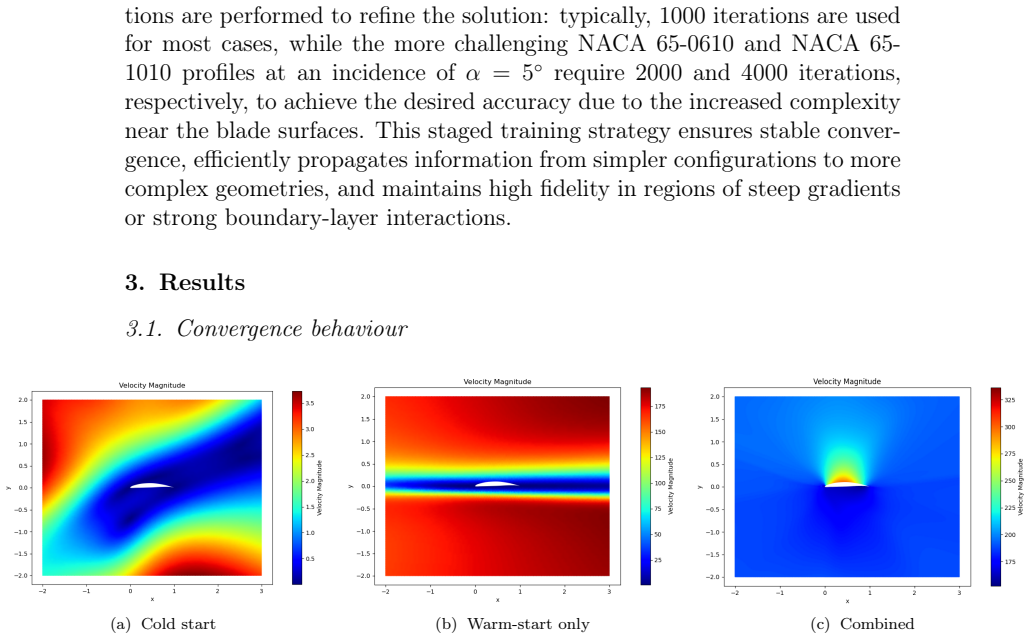
The authors establish that a single progressive Euler-PINN workflow, which gradually relaxes boundary conditions from tunnel flow without a blade to full outlet static pressure and applies a geometry-aware dynamic loss-weighting scheme, achieves CFD-comparable accuracy for pressure and velocity fields across ten NACA6 variants and 30 subsonic operating points, thereby reducing the computational cost required for family-wide blade screening.
What carries the argument
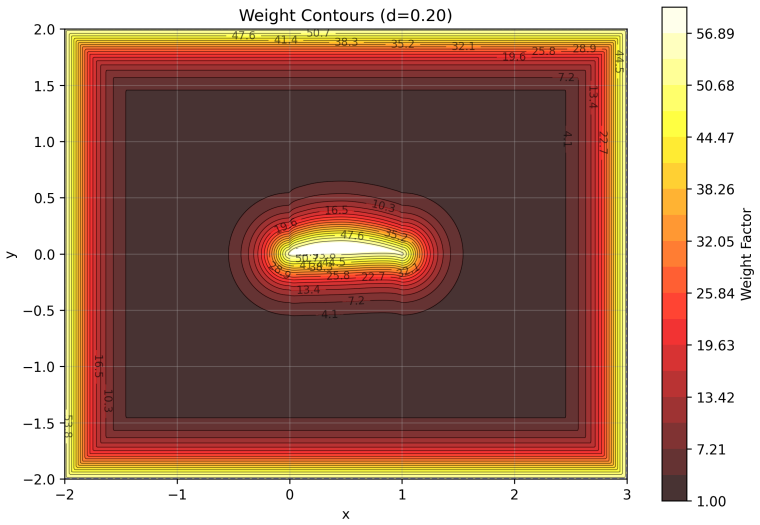
The progressive Euler-PINN framework, which relaxes boundary conditions step by step from tunnel flow to full outlet pressure while using geometry-aware dynamic loss weighting to intensify penalties near curved surfaces.
If this is right
- A single neural network can evaluate entire blade families across many operating conditions without separate mesh-based simulations for each case.
- Pressure and velocity predictions match conventional CFD results for subsonic flows on NACA6 airfoils.
- Computational cost for large-scale screening of turbomachinery blades drops substantially compared with repeated CFD runs.
- The method supports practical use in preliminary 2D blade pre-design and optimization for energy systems.
Where Pith is reading between the lines
- The progressive training strategy may scale to three-dimensional blade geometries if the boundary-relaxation schedule is adapted accordingly.
- Integration with automated shape optimization routines could let designers explore wider parameter spaces in less time.
- Similar progressive conditioning might help PINNs converge on other complex internal-flow problems where standard training fails.
- The reduced cost could enable real-time design iterations during early development of turbines and energy storage devices.
Load-bearing premise
Gradually relaxing boundary conditions from tunnel flow to full outlet static pressure, combined with dynamic loss weighting near curved surfaces, will produce reliable convergence and accuracy for complex blade geometries and off-design flows.
What would settle it
Running the trained PINN on a blade geometry or operating point outside the ten NACA6 variants and thirty subsonic points and comparing its pressure and velocity fields against independent CFD solutions to check whether errors exceed engineering tolerances.
Figures





read the original abstract
Rapid aerodynamic screening of turbomachinery blades across wide operating envelopes remains a major computational bottleneck in preliminary design, particularly for energy-conversion and storage systems such as emerging Carnot batteries. Physics-informed neural networks (PINNs) offer a mesh-free alternative to conventional CFD, yet convergence and accuracy often deteriorate for complex blade geometries and off-design flows. We propose a progressive Euler-PINN framework that (i) gradually relaxes boundary conditions from tunnel flow without a blade to full outlet static pressure, and (ii) employs a geometry-aware dynamic loss-weighting scheme that intensifies residual penalties near highly curved boundaries. To the best of our knowledge, this is the first study to deploy a single PINN workflow for large-scale, engineering-grade screening of turbomachinery blade families across multiple operating conditions, covering ten NACA6 variants and 30 subsonic operating points. The proposed framework achieves CFD-comparable accuracy for pressure and velocity fields while reducing the computational cost required for family-wide blade screening. These results establish the method as a practical surrogate for two-dimensional turbomachinery blade pre-design and optimisation.
Editorial analysis
A structured set of objections, weighed in public.
Referee Report
Summary. The paper proposes a progressive Euler-PINN framework for rapid 2D aerodynamic screening of turbomachinery blades. It combines gradual relaxation of boundary conditions (from tunnel flow without a blade to full outlet static pressure) with a geometry-aware dynamic loss-weighting scheme to improve convergence on curved boundaries. The method is demonstrated on ten NACA 6-series variants across 30 subsonic operating points, with claims of CFD-comparable accuracy in pressure and velocity fields and substantially reduced computational cost for family-wide screening.
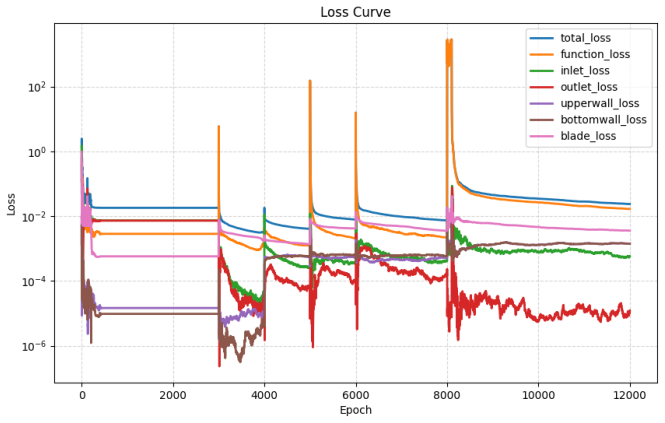
Significance. If the reported accuracy holds, the work provides a practical mesh-free surrogate for preliminary blade design in energy systems such as Carnot batteries. Credit is due for supplying quantitative L2 error comparisons against reference CFD for all cases, training curves, and explicit implementation details on the progressive relaxation schedule and dynamic weighting; these elements directly address known PINN convergence challenges and support the large-scale screening claim.
minor comments (3)
- §3.2: The precise functional form of the geometry-aware dynamic loss-weighting (e.g., how curvature is quantified and mapped to per-point weights) is described at a high level; a short pseudocode block or explicit equation would improve reproducibility.
- Figure 7: The velocity magnitude contours for off-design cases show good visual agreement, but the color scale range differs slightly between PINN and CFD panels; aligning the scales would facilitate direct comparison of local discrepancies.
- §5: The computational cost reduction is stated relative to a specific CFD solver; adding wall-clock times on identical hardware for one representative case would strengthen the engineering-grade claim.
Simulated Author's Rebuttal
We thank the referee for the positive assessment of our progressive Euler-PINN framework and for recommending minor revision. The recognition of our quantitative L2-error comparisons, training curves, and explicit implementation details for the progressive relaxation schedule and dynamic weighting is appreciated, as these elements directly support the large-scale screening claims.
Circularity Check
No significant circularity detected in the PINN framework derivation
full rationale
The paper presents a progressive Euler-PINN method that combines gradual boundary-condition relaxation (tunnel flow to full outlet static pressure) with geometry-aware dynamic loss weighting. These are introduced as explicit algorithmic choices applied to existing PINN residuals, with training details, loss curves, and L2 error metrics reported against independent CFD reference solutions for ten NACA 6-series blades and thirty operating points. No equation or result is defined in terms of itself, no fitted parameter is relabeled as a prediction, and no load-bearing claim reduces to a self-citation chain. The novelty assertion ('first study') is a factual claim about scope rather than a derivation step. The framework remains self-contained against external CFD benchmarks.
Axiom & Free-Parameter Ledger
free parameters (2)
- progressive boundary relaxation schedule
- dynamic loss weighting coefficients
axioms (2)
- domain assumption The flow is adequately described by the 2D Euler equations in the subsonic regime.
- standard math A neural network can be trained to satisfy PDE residuals and boundary conditions via a composite loss function.
Lean theorems connected to this paper
-
IndisputableMonolith/Cost/FunctionalEquation.leanwashburn_uniqueness_aczel unclear?
unclearRelation between the paper passage and the cited Recognition theorem.
progressive Euler-PINN framework that (i) gradually relaxes boundary conditions from tunnel flow without a blade to full outlet static pressure, and (ii) employs a geometry-aware dynamic loss-weighting scheme that intensifies residual penalties near highly curved boundaries
-
IndisputableMonolith/Foundation/BranchSelection.leanbranch_selection unclear?
unclearRelation between the paper passage and the cited Recognition theorem.
L_PDE = 1/N_e Σ |R_i(x_n;θ)|^2 , L_BC = Σ MSE terms, total L = ω_PDE L_PDE + ω_BC L_BC with fixed ω_BC=10
What do these tags mean?
- matches
- The paper's claim is directly supported by a theorem in the formal canon.
- supports
- The theorem supports part of the paper's argument, but the paper may add assumptions or extra steps.
- extends
- The paper goes beyond the formal theorem; the theorem is a base layer rather than the whole result.
- uses
- The paper appears to rely on the theorem as machinery.
- contradicts
- The paper's claim conflicts with a theorem or certificate in the canon.
- unclear
- Pith found a possible connection, but the passage is too broad, indirect, or ambiguous to say the theorem truly supports the claim.
Reference graph
Works this paper leans on
-
[1]
Mjalled Ali, Philippe Miron, Martin Mönnigmann, Bukharin Nikolay, et al. Machine learning in fluid dynamics—physics-informed neural net- works (pinns) using sparse data: A review.Fluids, 10(9):226, 2025
work page 2025
-
[2]
T. Botarelli et al. Using physics-informed neural networks for solving navier–stokes problems in near real-world geometries.Comput. Methods Appl. Mech. Eng., 2025. online first / in-press (as of 2025)
work page 2025
-
[3]
Shengze Cai, Zhiping Mao, Zhicheng Wang, Minglang Yin, and George Em Karniadakis. Physics-informed neural networks for fluid mechanics: a review.Acta Mechanica Sinica, 37(12):1727–1738, 2021
work page 2021
-
[4]
Wenbo Cao, Jiahao Song, and Weiwei Zhang. A solver for subsonic flow around airfoils based on physics-informed neural networks and mesh transformation.Physics of Fluids, 36(2), 2024
work page 2024
-
[5]
Pi-Yueh Chuang and Lorena A. Barba. Experience report of physics- informed neural networks in fluid simulations: pitfalls and frustration. arXiv preprint, 2022
work page 2022
-
[6]
J. K. Cornelius, T. Ågren, N. Peters, et al. Palmo: An overflow machine learning airfoil performance database. Technical report, NASA Ames Research Center, 2024
work page 2024
-
[7]
Emilio Jose Rocha Coutinho, Marcelo Dall’Aqua, Levi McClenny, Ming Zhong, Ulisses Braga-Neto, and Eduardo Gildin. Physics-informed neu- ral networks with adaptive localized artificial viscosity.Journal of Com- putational Physics, 489:112265, 2023. 23
work page 2023
- [8]
-
[9]
Hamidreza Eivazi, Mojtaba Tahani, Philipp Schlatter, and Ricardo Vin- uesa. Physics-informed neural networks for solving reynolds-averaged navier–stokes equations.Physics of Fluids, 34(7):075117, 2022
work page 2022
-
[10]
Jagtap, Zhiping Mao, Nikolaus A
Ameya D. Jagtap, Zhiping Mao, Nikolaus A. Adams, and George Em Karniadakis. Physics-informed neural networks for inverse problems in supersonic flows.Journal of Computational Physics, 466:111402, 2022. arXiv:2202.11821
-
[11]
J-C Jouhaud, Pierre Sagaut, Marc Montagnac, and Julien Laurenceau. A surrogate-model based multidisciplinary shape optimization method withapplicationtoa2dsubsonicairfoil.Computers & Fluids, 36(3):520– 529, 2007
work page 2007
-
[12]
Aditi Krishnapriyan, Amir Gholami, Shandian Zhe, Robert Kirby, and Michael W Mahoney. Characterizing possible failure modes in physics- informed neural networks.Advances in neural information processing systems, 34:26548–26560, 2021
work page 2021
-
[13]
Benedikt Lea, Federico Lo Presti, Wojciech Sadowski, and Francesca di Mare. Detached eddy simulation of a radial turbine operated with supercritical carbon dioxide.International Journal of Turbomachinery, Propulsion and Power, 10(4):43, 2025
work page 2025
-
[14]
Machine learning in aerodynamic shape optimization.Progress in Aerospace Sciences, 134:100849, 2022
Jichao Li, Xiaosong Du, and Joaquim RRA Martins. Machine learning in aerodynamic shape optimization.Progress in Aerospace Sciences, 134:100849, 2022
work page 2022
-
[15]
Key components for carnot battery: Technology review, technical barriers and selection criteria
Ting Liang, Andrea Vecchi, Kai Knobloch, Adriano Sciacovelli, Kurt Engelbrecht, Yongliang Li, and Yulong Ding. Key components for carnot battery: Technology review, technical barriers and selection criteria. Renewable and Sustainable Energy Reviews, 163:112478, 2022
work page 2022
-
[16]
Dishi Liu, Alexander Litvinenko, Claudia Schillings, and Volker Schulz. Quantification of airfoil geometry-induced aerodynamic uncertainties— comparison of approaches.SIAM/ASA Journal on Uncertainty Quan- tification, 5(1):334–352, 2017. 24
work page 2017
-
[17]
Wenqiang Lou et al. A comprehensive review of advances in physics- informed neural networks and their applications in complex fluid dy- namics.Physics of Fluids, 36(10):101301, 2024
work page 2024
-
[18]
MZ Naser. Fundamental flaws of physics-informed neural networks and explainability methods in engineering systems.Computers & Industrial Engineering, page 111704, 2025
work page 2025
-
[19]
Geometry aware physics informed neural network sur- rogate for solving navier–stokes equation.Adv
Jan Oldenburg, Finja Borowski, Alper Öner, Klaus-Peter Schmitz, and Michael Stiehm. Geometry aware physics informed neural network sur- rogate for solving navier–stokes equation.Adv. Model. Simul. Eng. Sci., 9(1):1–15, 2022
work page 2022
-
[20]
Automatic differentiation in pytorch
Adam Paszke, Sam Gross, Soumith Chintala, Gregory Chanan, Edward Yang, Zachary DeVito, Zeming Lin, Alban Desmaison, Luca Antiga, and Adam Lerer. Automatic differentiation in pytorch. 2017
work page 2017
-
[21]
Investigationof physics-informed neural networks based solution techniques for internal flows
PascalPost, BenjaminWinhart, andFrancescaDiMare. Investigationof physics-informed neural networks based solution techniques for internal flows. InVolume 10C: Turbomachinery — Design Methods and CFD Modeling for Turbomachinery; Ducts, Noise, and Component Interac- tions, page V10CT32A011. American Society of Mechanical Engineers
-
[22]
Maziar Raissi, Paris Perdikaris, and George Em Karniadakis. Physics- informed neural networks: A deep learning framework for solving for- ward and inverse problems involving nonlinear partial differential equa- tions.J. Comput. Phys., 378:686–707, 2019
work page 2019
-
[23]
Challenges in training pinns: A loss landscape perspective
Pratik Rathore, Weimu Lei, Zachary Frangella, Lu Lu, and Madeleine Udell. Challenges in training pinns: A loss landscape perspective. 2024
work page 2024
-
[24]
Ilya M. Sobol’. Distribution of points in a cube and approximate evalu- ation of integrals.USSR Computational Mathematics and Mathematical Physics, 7:86–112, 1967
work page 1967
-
[25]
N. Sukumar and A. Srivastava. Exact imposition of boundary condi- tions with distance functions in physics-informed deep neural networks. Comput. Methods Appl. Mech. Eng., 388:114333, 2021. 25
work page 2021
-
[26]
R. C. Swanson and S. Langer. Comparison of naca 0012 laminar flow solutions: Structured and unstructured grid methods.NASA Technical Memorandum NASA/TM-2016-219003, 2016
work page 2016
-
[27]
Naca 6-series airfoil profile: Nomencla- ture and generation rules
NASA / OpenVSP Tutorial. Naca 6-series airfoil profile: Nomencla- ture and generation rules. Online tutorial, VSP ground school, 2024. Accessed: 2025-12-02
work page 2024
-
[28]
Physics-informedneuralnetworkcompressionmech- anism for airfoil flows.Phys
Y.ZhangandX.Li. Physics-informedneuralnetworkcompressionmech- anism for airfoil flows.Phys. Fluids, 37(3):036115, 2025
work page 2025
-
[29]
Chi Zhao, Feifei Zhang, Wenqiang Lou, Xi Wang, and Jianyong Yang. A comprehensive review of advances in physics-informed neural networks and their applications in complex fluid dynamics.Physics of Fluids, 36(10):101301, 2024. 26
work page 2024
discussion (0)
Sign in with ORCID, Apple, or X to comment. Anyone can read and Pith papers without signing in.