Recognition: 3 theorem links
· Lean TheoremProbing Gravitational Wave Signatures from Periodic Orbits of Regular Black Holes in Asymptotically Safe Gravity
Pith reviewed 2026-05-11 02:34 UTC · model grok-4.3
The pith
Quantum corrections via a scaling parameter in asymptotically safe gravity modify periodic orbits around regular black holes, producing gravitational wave signals with measurable amplitude modulations and phase shifts.
A machine-rendered reading of the paper's core claim, the machinery that carries it, and where it could break.
Core claim
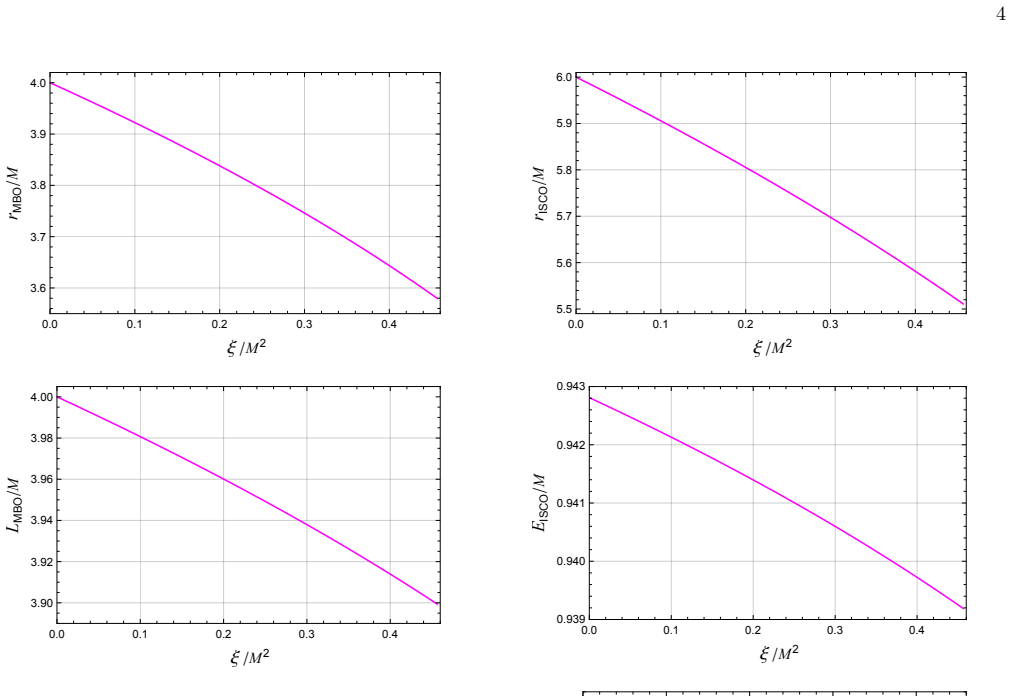
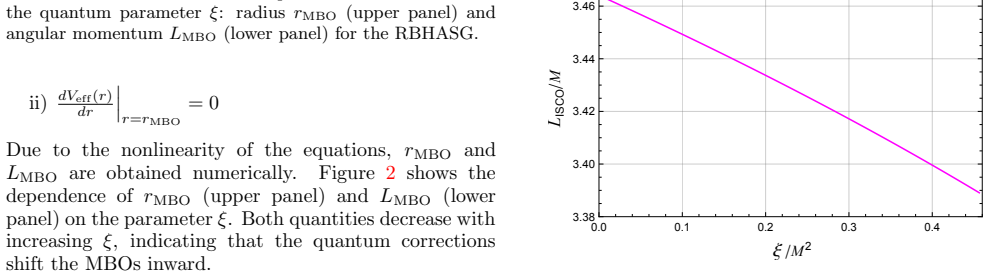
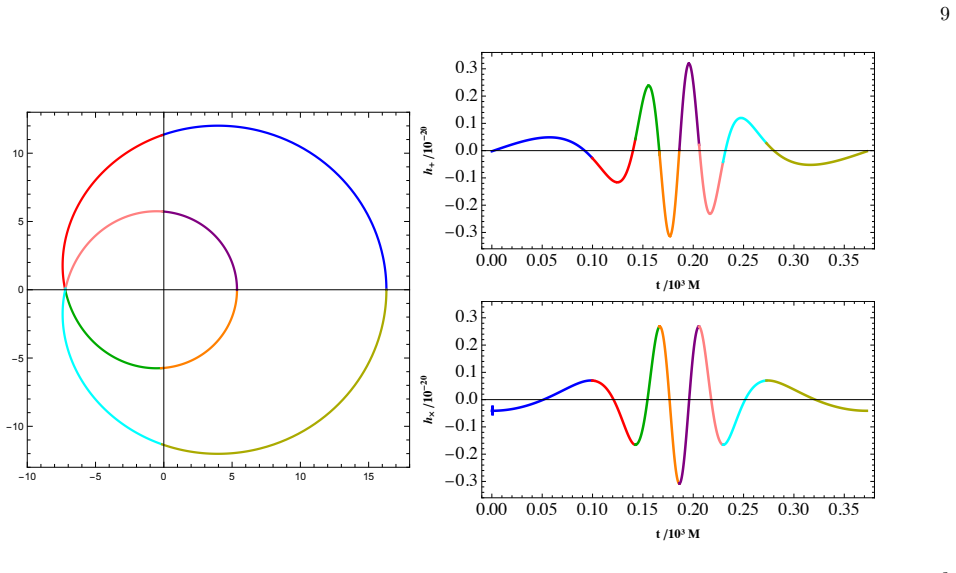
In the spacetime of a regular black hole arising in asymptotically safe gravity, the dimensional scaling parameter ξ modifies the effective potential for timelike geodesics, shifting the innermost stable circular orbit and enhancing the whirl component of periodic orbits classified by the topological integers (z, w, v) and the rational frequency ratio q = ω_φ/ω_r − 1. Within the quadrupole approximation, the gravitational waveforms for extreme-mass-ratio inspirals exhibit amplitude modulations and phase shifts that increase with ξ; the corresponding strain spectra peak in the millihertz range accessible to LISA, Taiji, and TianQin, and the peak strain grows monotonically with ξ.
What carries the argument
The zoom-whirl taxonomy of periodic orbits, defined by the integers (z, w, v) for zooms, whirls, and vertices per radial cycle together with the rational frequency ratio q, which organizes the bound geodesics and determines the structure of the emitted gravitational waves.
Load-bearing premise
The metric is taken as the correct singularity-free solution of asymptotically safe gravity whose only adjustable parameter is ξ, and the quadrupole approximation is assumed to capture the dominant gravitational-wave emission from extreme-mass-ratio inspirals.
What would settle it
A set of observed extreme-mass-ratio inspiral waveforms around a supermassive black hole that show no systematic increase in amplitude modulations or peak strain with any measurable parameter analogous to ξ, while remaining within the millihertz sensitivity window, would falsify the predicted monotonic growth and detectability of the quantum corrections.
Figures





read the original abstract
We investigate bound and periodic timelike geodesics and their associated gravitational-wave (GW) signatures in the spacetime of a regular black hole arising in asymptotically safe gravity (ASG). The geometry incorporates quantum corrections via a running gravitational coupling, encoded in a dimensional scaling parameter $\xi$, that modifies the near-horizon structure while preserving asymptotic flatness. We derive the effective potential for massive test particles and determine the conditions for stable circular and bound motion as functions of $\xi$, including the shift in the innermost stable circular orbit (ISCO). The three topological integers $(z,w,v)$, which represent the number of zooms, whirls, and vertices per radial cycle, are used to categorize the test particles' periodic orbits using Levin's zoom -- whirl taxonomy. Moreover, we employ the rational frequency ratio $q = \frac{\omega_\phi}{\omega_r} - 1$ to find closed orbits, where $\omega_\phi$ and $\omega_r$ stand for the azimuthal and radial frequencies, respectively. We examine how the orbital frequency spectrum is altered, whirl behaviour is enhanced, and deviations from the Schwarzschild limit are produced by the quantum parameter $\xi$. The GW forms for extreme mass-ratio inspirals (EMRIs) are calculated within the quadrupole approximation. We find that as $\xi$ increases, the signals that are released exhibit detectable amplitude modulations and phase shifts. The corresponding typical strain spectra fall within the anticipated sensitivity limits of space-based detectors such as LISA, Taiji, and TianQin, as they peak in the millihertz frequency band. Peak strain increases monotonically with $\xi$, indicating that observational restrictions on quantum-gravity-induced deviations from classical general relativity in the strong-field domain can be obtained from precise measurements of zoom -- whirl dynamics in EMRIs.
Editorial analysis
A structured set of objections, weighed in public.
Referee Report
Summary. The manuscript studies bound and periodic timelike geodesics in the regular black-hole spacetime of asymptotically safe gravity, which incorporates a running gravitational coupling via the dimensional parameter ξ. It derives the effective potential, identifies conditions for stable circular and bound orbits (including the ISCO shift), classifies periodic orbits via the zoom-whirl integers (z, w, v) and the rational frequency ratio q = ω_φ/ω_r − 1, and computes the associated gravitational waveforms in the quadrupole approximation for extreme-mass-ratio inspirals. The central claim is that increasing ξ produces detectable amplitude modulations and phase shifts whose peak strains lie in the millihertz band accessible to LISA, Taiji, and TianQin, with peak strain rising monotonically with ξ.
Significance. If the results on orbit classification and the monotonic strain dependence hold after addressing the modeling limitations, the work would supply a concrete, falsifiable signature of quantum-gravity corrections in the strong-field regime that could be tested with future space-based detectors. The structured use of Levin’s zoom-whirl taxonomy and the explicit mapping to frequency ratio q provide a useful framework for exploring deviations from the Schwarzschild case.
major comments (2)
- [GW waveforms section] The gravitational-wave forms for EMRIs are obtained by applying the quadrupole formula directly to fixed periodic geodesics classified by (z, w, v) and q (see the section on GW forms and the associated figures). This fixed-orbit treatment omits the radiation-reaction force and the adiabatic inspiral that cause the orbit to traverse a sequence of zoom-whirl configurations while accumulating phase over ∼10^4–10^5 cycles. Consequently, the reported amplitude modulations, phase shifts, and monotonic rise in peak strain do not correspond to the observable EMRI signal; the cumulative phase evolution and frequency drift that determine detectability and distinguishability from GR are absent.
- [results on strain spectra] The abstract and results assert that peak strain increases monotonically with ξ and that the spectra fall within LISA/Taiji/TianQin sensitivity, yet no explicit derivation, numerical tabulation, or error estimate supporting the monotonicity is referenced. Because this monotonic dependence is presented as the key observable signature for constraining ξ, its evidential basis must be shown explicitly (e.g., via an equation relating strain amplitude to ξ or a table of computed values).
minor comments (2)
- [effective potential derivation] The abstract states that the effective potential, orbit conditions, and frequency ratio q are derived, but the manuscript should ensure every intermediate step (including the explicit form of the effective potential as a function of ξ) appears with numbered equations for reproducibility.
- [periodic orbits section] Notation for the three integers (z, w, v) and the frequency ratio q should be introduced with a brief reminder of Levin’s taxonomy in the main text, even if a reference is given, to aid readers unfamiliar with the zoom-whirl classification.
Simulated Author's Rebuttal
We thank the referee for the careful and constructive review. The comments highlight important limitations in our modeling of EMRI waveforms and the presentation of numerical results. We address each point below and will revise the manuscript accordingly to improve clarity and rigor while preserving the core findings on periodic orbits and their quadrupole signatures.
read point-by-point responses
-
Referee: The gravitational-wave forms for EMRIs are obtained by applying the quadrupole formula directly to fixed periodic geodesics classified by (z, w, v) and q (see the section on GW forms and the associated figures). This fixed-orbit treatment omits the radiation-reaction force and the adiabatic inspiral that cause the orbit to traverse a sequence of zoom-whirl configurations while accumulating phase over ∼10^4–10^5 cycles. Consequently, the reported amplitude modulations, phase shifts, and monotonic rise in peak strain do not correspond to the observable EMRI signal; the cumulative phase evolution and frequency drift that determine detectability and distinguishability from GR are absent.
Authors: We agree that the present calculation applies the quadrupole formula to fixed periodic geodesics and therefore does not incorporate radiation-reaction forces or the adiabatic inspiral through a sequence of orbits. This fixed-orbit approach is adopted to isolate the direct imprint of the quantum parameter ξ on individual zoom-whirl waveforms, including the enhanced whirl behavior and resulting amplitude modulations. While these features would appear as building blocks within a full radiation-reaction-driven inspiral, the cumulative phase accumulation and frequency drift are indeed absent from our current results. We will revise the GW waveforms section and the abstract to explicitly state this approximation and its implications, noting that the reported modulations indicate potential strong-field deviations that merit further study with radiation-reaction included. A complete adiabatic inspiral calculation lies beyond the scope of this work. revision: partial
-
Referee: The abstract and results assert that peak strain increases monotonically with ξ and that the spectra fall within LISA/Taiji/TianQin sensitivity, yet no explicit derivation, numerical tabulation, or error estimate supporting the monotonicity is referenced. Because this monotonic dependence is presented as the key observable signature for constraining ξ, its evidential basis must be shown explicitly (e.g., via an equation relating strain amplitude to ξ or a table of computed values).
Authors: The monotonic rise in peak strain with increasing ξ was obtained from direct numerical evaluation of the quadrupole waveforms across a range of ξ values while holding orbital parameters fixed. We will add a new table to the results section that tabulates the computed peak strain amplitudes for representative values of ξ (including the Schwarzschild limit ξ = 0), together with a short explanatory paragraph describing how the modified effective potential and orbital frequencies lead to this dependence. This addition will supply the explicit numerical evidence requested. revision: yes
Circularity Check
No significant circularity in the derivation chain
full rationale
The paper takes the ASG metric (with free parameter ξ) as an external input, derives the effective potential and timelike geodesic equations in the standard way, computes orbital frequencies ω_φ and ω_r to obtain the rational ratio q and the (z,w,v) classification, and then applies the quadrupole formula to produce strains. None of these steps reduces by the paper's own algebra to a self-definition, a fitted quantity relabeled as a prediction, or a load-bearing self-citation whose content is itself unverified. The reported trends (amplitude modulations, phase shifts, monotonic rise in peak strain with ξ) are direct numerical consequences of the modified metric inside the geodesic and quadrupole expressions; they are not forced by construction. The derivation is therefore self-contained against external benchmarks.
Axiom & Free-Parameter Ledger
free parameters (1)
- ξ
axioms (3)
- domain assumption The given line element is a regular, asymptotically flat solution of asymptotically safe gravity
- standard math Test particles follow timelike geodesics derived from the metric
- domain assumption Gravitational-wave emission is adequately described by the quadrupole formula
invented entities (1)
-
Regular black hole with running gravitational coupling
no independent evidence
Lean theorems connected to this paper
-
IndisputableMonolith/Foundation/RealityFromDistinction.leanreality_from_one_distinction contradicts?
contradictsCONTRADICTS: the theorem conflicts with this paper passage, or marks a claim that would need revision before publication.
the exterior metric is static and spherically symmetric, with the lapse function modified by a logarithmic term involving the scale parameter ξ... 0 < ξ < 0.4565 M²
-
IndisputableMonolith/Cost/FunctionalEquation.leanwashburn_uniqueness_aczel contradicts?
contradictsCONTRADICTS: the theorem conflicts with this paper passage, or marks a claim that would need revision before publication.
We employ the rational frequency ratio q = ωϕ/ωr − 1 to find closed orbits... GW forms for extreme mass-ratio inspirals (EMRIs) are calculated within the quadrupole approximation
-
IndisputableMonolith/Foundation/Constants.leanphi_golden_ratio contradicts?
contradictsCONTRADICTS: the theorem conflicts with this paper passage, or marks a claim that would need revision before publication.
Peak strain increases monotonically with ξ, indicating that observational restrictions on quantum-gravity-induced deviations... can be obtained
What do these tags mean?
- matches
- The paper's claim is directly supported by a theorem in the formal canon.
- supports
- The theorem supports part of the paper's argument, but the paper may add assumptions or extra steps.
- extends
- The paper goes beyond the formal theorem; the theorem is a base layer rather than the whole result.
- uses
- The paper appears to rely on the theorem as machinery.
- contradicts
- The paper's claim conflicts with a theorem or certificate in the canon.
- unclear
- Pith found a possible connection, but the passage is too broad, indirect, or ambiguous to say the theorem truly supports the claim.
Reference graph
Works this paper leans on
-
[1]
B. P. Abbottet al.(LIGO Scientific, Virgo), Phys. Rev. Lett.116, 061102 (2016), arXiv:1602.03837 [gr-qc]
work page internal anchor Pith review Pith/arXiv arXiv 2016
-
[2]
B. P. Abbottet al.(LIGO Scientific, Virgo), Phys. Rev. D93, 122003 (2016), arXiv:1602.03839 [gr-qc]
work page Pith review arXiv 2016
- [3]
- [4]
-
[5]
First M87 Event Horizon Telescope Results. I. The Shadow of the Supermassive Black Hole
K. Akiyamaet al.(Event Horizon Telescope), Astro- phys. J. Lett.875, L1 (2019), arXiv:1906.11238 [astro- ph.GA]
work page internal anchor Pith review arXiv 2019
-
[6]
K. Akiyamaet al.(Event Horizon Telescope), Astro- phys. J. Lett.930, L12 (2022), arXiv:2311.08680 [astro- ph.HE]
work page internal anchor Pith review arXiv 2022
-
[7]
Testing General Relativity with Present and Future Astrophysical Observations
E. Bertiet al., Class. Quant. Grav.32, 243001 (2015), arXiv:1501.07274 [gr-qc]
work page internal anchor Pith review arXiv 2015
-
[8]
Gravitational Wave Tests of General Relativity with Ground-Based Detectors and Pulsar Timing Arrays
N. Yunes and X. Siemens, Living Rev. Rel.16, 9 (2013), arXiv:1304.3473 [gr-qc]
work page Pith review arXiv 2013
- [9]
- [10]
- [11]
-
[12]
Laser Interferometer Space Antenna
P. Amaro-Seoaneet al.(LISA), (2017), arXiv:1702.00786 [astro-ph.IM]
work page internal anchor Pith review Pith/arXiv arXiv 2017
-
[13]
A. Maselli, N. Franchini, L. Gualtieri, T. P. Sotiriou, S. Barsanti, and P. Pani, Nature Astron.6, 464 (2022), arXiv:2106.11325 [gr-qc]
- [14]
-
[15]
TianQin: a space-borne gravitational wave detector
J. Luoet al.(TianQin), Class. Quant. Grav.33, 035010 (2016), arXiv:1512.02076 [astro-ph.IM]
work page Pith review arXiv 2016
- [16]
-
[17]
J. Levin and B. Grossman, Phys. Rev. D79, 043016 (2009), arXiv:0809.3838 [gr-qc]
-
[18]
A Periodic Table for Black Hole Orbits
J. Levin and G. Perez-Giz, Phys. Rev. D77, 103005 (2008), arXiv:0802.0459 [gr-qc]. 13
work page Pith review arXiv 2008
-
[19]
J. Levin, Class. Quant. Grav.26, 235010 (2009), arXiv:0907.5195 [gr-qc]
-
[20]
P. Bambhaniya, D. N. Solanki, D. Dey, A. B. Joshi, P. S. Joshi, and V. Patel, Eur. Phys. J. C81, 205 (2021), arXiv:2007.12086 [gr-qc]
-
[21]
P. Rana and A. Mangalam, Class. Quant. Grav.36, 045009 (2019), arXiv:1901.02730 [gr-qc]
-
[22]
V. Misra and J. Levin, Phys. Rev. D82, 083001 (2010), arXiv:1007.2699 [gr-qc]
- [23]
- [24]
- [25]
- [26]
- [27]
- [28]
-
[29]
R. Wang, F. Gao, and H. Chen, Annals Phys.447, 169167 (2022)
work page 2022
- [30]
-
[31]
S. Haroon and T. Zhu, Phys. Rev. D112, 044046 (2025), arXiv:2502.09171 [gr-qc]
- [32]
- [33]
- [34]
- [35]
- [36]
- [37]
- [38]
- [39]
- [40]
- [41]
-
[42]
M. Azreg-A¨ ınou, Z. Chen, B. Deng, M. Jamil, T. Zhu, Q. Wu, and Y.-K. Lim, Phys. Rev. D102, 044028 (2020), arXiv:2004.02602 [gr-qc]
- [43]
-
[44]
D. Pugliese, H. Quevedo, and R. Ruffini, Eur. Phys. J. C77, 206 (2017), arXiv:1304.2940 [gr-qc]
- [45]
- [46]
-
[47]
C.-H. Wang, Y.-P. Zhang, T. Zhu, and S.-W. Wei, (2025), arXiv:2508.20558 [gr-qc]
-
[48]
M. Alloqulov, S. Shaymatov, B. Ahmedov, and T. Zhu, (2025), arXiv:2508.05245 [gr-qc]
-
[49]
Z.-L. Wei, J. Zhang, Y. Xie, and P.-L. Yin, Eur. Phys. J. C85, 698 (2025)
work page 2025
-
[50]
S. Yang, Y.-P. Zhang, T. Zhu, L. Zhao, and Y.-X. Liu, JCAP01, 091 (2025), arXiv:2407.00283 [gr-qc]
-
[51]
O. Shabbir, M. Jamil, and M. Azreg-A¨ ınou, Phys. Dark Univ.47, 101816 (2025), arXiv:2501.04367 [gr-qc]
- [52]
- [53]
- [54]
-
[55]
S. Yang, Y.-P. Zhang, T. Zhu, L. Zhao, and Y.-X. Liu, Chin. Phys.49, 115107 (2025), arXiv:2412.04302 [gr- qc]
- [56]
- [57]
- [58]
-
[59]
M. Alloqulov, T. Xamidov, S. Shaymatov, and B. Ahmedov, Eur. Phys. J. C85, 798 (2025), arXiv:2504.05236 [gr-qc]
-
[60]
C.-H. Wang, X.-C. Meng, Y.-P. Zhang, T. Zhu, and S.-W. Wei, (2025), 10.1088/1475-7516/2025/07/021, arXiv:2502.08994 [gr-qc]
- [61]
- [62]
-
[63]
H. Gong, S. Long, X.-J. Wang, Z. Xia, J.-P. Wu, and Q. Pan, (2025), arXiv:2509.23318 [gr-qc]
work page internal anchor Pith review Pith/arXiv arXiv 2025
- [64]
-
[65]
S. Choudhury, M. K. Hossain, G. Bauyrzhan, and K. Yerzhanov, (2025), arXiv:2507.00904 [gr-qc]
-
[66]
J. Chen and J. Yang, Eur. Phys. J. C85, 726 (2025), arXiv:2505.02660 [gr-qc]
- [67]
- [68]
- [69]
-
[70]
J. Bardeen, in Proceedings of the 5th International Con- ference on Gravitation and the Theory of Relativity (1968)
work page 1968
-
[71]
S. A. Hayward, Phys. Rev. Lett.96, 031103 (2006), arXiv:gr-qc/0506126
work page Pith review arXiv 2006
- [72]
-
[73]
A. Burinskii, E. Elizalde, S. R. Hildebrandt, and G. Magli, Phys. Rev. D65, 064039 (2002), arXiv:gr- qc/0109085
-
[74]
Construction of Regular Black Holes in General Relativity
Z.-Y. Fan and X. Wang, Phys. Rev. D94, 124027 (2016), arXiv:1610.02636 [gr-qc]
work page Pith review arXiv 2016
- [75]
-
[76]
J. Mazza and S. Liberati, JHEP03, 199 (2023), arXiv:2301.04697 [gr-qc]
-
[77]
L. Modesto and P. Nicolini, Phys. Rev. D82, 104035 (2010), arXiv:1005.5605 [gr-qc]
-
[78]
R. Casadio, A. Giusti, and J. Ovalle, JHEP05, 118 (2023), arXiv:2303.02713 [gr-qc]
-
[79]
J. Lewandowski, Y. Ma, J. Yang, and C. Zhang, Phys. Rev. Lett.130, 101501 (2023), arXiv:2210.02253 [gr-qc]
-
[80]
Geodesically complete black holes,
R. Carballo-Rubio, F. Di Filippo, S. Liberati, and M. Visser, Phys. Rev. D101, 084047 (2020), 14 arXiv:1911.11200 [gr-qc]
discussion (0)
Sign in with ORCID, Apple, or X to comment. Anyone can read and Pith papers without signing in.