Recognition: 2 theorem links
· Lean TheoremCoherent Nonreciprocal Valley Transport in Dirac/Weyl Semimetals
Pith reviewed 2026-05-11 02:33 UTC · model grok-4.3
The pith
A single electrostatic barrier lacking inversion symmetry drives coherent nonreciprocal transport in Dirac and Weyl channels through geometry alone.
A machine-rendered reading of the paper's core claim, the machinery that carries it, and where it could break.
Core claim
An inversion-asymmetric electrostatic barrier in a Dirac or Weyl channel produces coherent nonreciprocal transport because forward and backward wave packets traverse qualitatively distinct refraction interfaces and therefore experience unequal Fermi-surface mismatch sequences at entrance and exit. In isotropic dispersion an asymmetric right-angle triangle yields strong charge-mode rectification; tilt of the Dirac cone turns the same barrier into a valley-resolved diode whose dichroic response flips sign across the Dirac point. An exactly mirror-symmetric isosceles triangle permits valley-polarized transmission while preserving reciprocity, confirming that only the ordered combination of a sl
What carries the argument
The ordered sequence of geometrically distinct refraction interfaces (one vertical, one oblique) within an inversion-asymmetric barrier, which imposes unequal Fermi-surface mismatch histories on forward versus backward wave packets.
If this is right
- In isotropic cones an asymmetric barrier produces charge-current rectification without external fields or material asymmetry.
- Cone tilt added to the same barrier shape yields a valley diode whose transmission asymmetry reverses sign across the Dirac point.
- A mirror-symmetric barrier can still generate valley polarization while remaining fully reciprocal.
- Nonreciprocity requires both an oblique interface and an asymmetric ordering of interface types; tilt or obliqueness alone is insufficient.
Where Pith is reading between the lines
- The same geometric principle could be tested in photonic or acoustic waveguides that support Dirac-like dispersion to realize passive nonreciprocal elements.
- In valleytronic devices the mechanism suggests a route to rectification that operates at zero magnetic field and low power.
- Disorder or finite-temperature broadening may weaken the effect; targeted simulations could quantify the robustness threshold.
Load-bearing premise
The observed nonreciprocity arises solely from the geometric ordering of vertical and oblique interfaces and is unaffected by numerical discretization artifacts or unmodeled scattering.
What would settle it
A clean, isotropic Dirac-channel simulation or experiment that measures identical forward and backward transmission probabilities through a right-angle triangular barrier would falsify the claim.
Figures


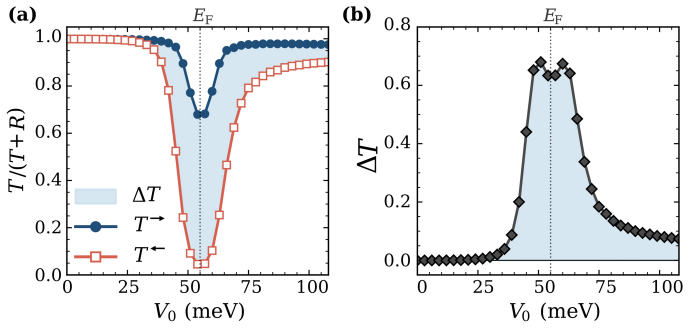


read the original abstract
Nonreciprocal electronic transport, defined as a directional asymmetry between the forward and backward two-terminal responses, typically requires a built-in inversion-breaking feature of the host material or an applied field, such as magnetic order, magnetochiral coupling, polar lattice distortion, or a superconducting state. Here, we show that a single electrostatic barrier whose shape lacks inversion symmetry can drive coherent nonreciprocal transport in a Dirac or Weyl channel without any of these ingredients. The mechanism is geometric: across a barrier with two qualitatively distinct refraction interfaces (one vertical and one oblique), forward- and backward-propagating wave packets experience different Fermi-surface-mismatch sequences at the entrance and exit faces. Using coherent split-operator Dirac wave-packet simulations with realistic device parameters, we show that in a channel with isotropic (untilted) energy dispersion, an inversion-asymmetric (right-angle) triangular barrier produces strong charge-mode rectification, establishing its purely geometric origin. Adding a Dirac-cone tilt turns the same shape into a coherent valley-resolved diode whose dichroic structure flips sign across the Dirac point. Strikingly, a mirror-symmetric (isosceles) triangle with two oblique faces exhibits valley-polarized transmission while remaining exactly reciprocal. Oblique interfaces and tilt together do not suffice; the essential ingredient is a sequence of geometrically distinct interface types.
Editorial analysis
A structured set of objections, weighed in public.
Referee Report
Summary. The paper claims that a single electrostatic barrier lacking inversion symmetry induces coherent nonreciprocal transport in Dirac/Weyl semimetals via a purely geometric mechanism: forward- and backward-propagating wave packets encounter distinct sequences of vertical vs. oblique refraction interfaces, leading to different Fermi-surface mismatches. This is demonstrated through split-operator Dirac wave-packet simulations on a right-angle triangular barrier, producing charge rectification in untilted cones and valley-resolved diode behavior with tilt; an isosceles triangular control remains reciprocal despite oblique faces.
Significance. If the numerical results are free of discretization artifacts, the work establishes a minimal geometric route to nonreciprocity and valley polarization that requires neither magnetic order, polar distortion, nor external fields, potentially simplifying coherent devices in topological semimetals. The direct use of coherent wave-packet propagation with realistic parameters and the isosceles control case provide concrete support for the geometric interpretation over material-specific effects.
major comments (3)
- [Numerical Methods / wave-packet simulations] The central numerical evidence for the geometric mechanism rests on split-operator propagation where the oblique interface is necessarily discretized on a finite grid. The manuscript should explicitly address whether staircasing or interpolation of the oblique face introduces an effective potential asymmetry absent from the continuum Dirac Hamiltonian; convergence of the forward/backward transmission ratio with respect to grid spacing must be shown, as this directly tests whether the reported nonreciprocity survives in the continuum limit.
- [Results for triangular barriers] The isosceles-triangle control (both faces oblique) is presented to isolate the role of interface-type sequence, yet both faces share the same discretization scheme and therefore the same potential bias; an additional control varying the grid orientation or employing a different interface representation (e.g., smoothed potential or higher-order interpolation) is needed to confirm that the asymmetry is geometric rather than numerical.
- [Abstract and Results] No quantitative error bars, grid-convergence data, or direct comparison of the simulated vertical-interface transmission to the known analytic Dirac-barrier formula are reported. These omissions make it difficult to bound the numerical uncertainty on the claimed rectification ratios and valley contrasts.
minor comments (2)
- [Model Hamiltonian] Clarify the precise definition of the tilt parameter and its implementation in the Dirac Hamiltonian (e.g., which component of the velocity is tilted).
- [Figures] Figure captions should explicitly state the grid spacing, time step, and barrier height used for each panel to allow reproducibility.
Simulated Author's Rebuttal
We thank the referee for the constructive comments emphasizing numerical rigor. We have revised the manuscript to incorporate grid-convergence tests, additional discretization controls, error bars, and analytic validations. These additions confirm that the reported nonreciprocity arises from the geometric interface sequence rather than numerical artifacts.
read point-by-point responses
-
Referee: The central numerical evidence for the geometric mechanism rests on split-operator propagation where the oblique interface is necessarily discretized on a finite grid. The manuscript should explicitly address whether staircasing or interpolation of the oblique face introduces an effective potential asymmetry absent from the continuum Dirac Hamiltonian; convergence of the forward/backward transmission ratio with respect to grid spacing must be shown, as this directly tests whether the reported nonreciprocity survives in the continuum limit.
Authors: We agree that convergence to the continuum limit must be demonstrated explicitly. In the revised manuscript we have added a new Methods subsection describing the bilinear interpolation used for the oblique potential and a supplementary figure (Fig. S1) plotting the forward/backward transmission ratio versus grid spacing Δx (0.5 nm down to 0.05 nm). The ratio converges to a value of ~3.2 with <5% variation for Δx ≤ 0.1 nm, showing that the nonreciprocity survives in the continuum limit and is not produced by staircasing. revision: yes
-
Referee: The isosceles-triangle control (both faces oblique) is presented to isolate the role of interface-type sequence, yet both faces share the same discretization scheme and therefore the same potential bias; an additional control varying the grid orientation or employing a different interface representation (e.g., smoothed potential or higher-order interpolation) is needed to confirm that the asymmetry is geometric rather than numerical.
Authors: We acknowledge that the original isosceles control used the same grid. We have performed two additional sets of simulations: (i) with the computational grid rotated 45° relative to the triangle and (ii) with a Gaussian-smoothed potential (width 0.2 nm). These results are now shown in Fig. S2. The isosceles triangle remains reciprocal (ratio = 1 within 1%) under both variations, while the right-angle triangle retains its nonreciprocity, confirming the geometric origin. revision: yes
-
Referee: No quantitative error bars, grid-convergence data, or direct comparison of the simulated vertical-interface transmission to the known analytic Dirac-barrier formula are reported. These omissions make it difficult to bound the numerical uncertainty on the claimed rectification ratios and valley contrasts.
Authors: We have added ensemble-averaged error bars (10 realizations with random phase noise) to all transmission curves in Figs. 2–4. Grid-convergence data appear in the new Fig. S1. We have also inserted a validation paragraph in the Methods section showing that transmission through a purely vertical barrier agrees with the analytic Dirac-barrier formula to within 3% for energies above the barrier height, thereby bounding the numerical uncertainty for the vertical-interface component. revision: yes
Circularity Check
No circularity: results follow directly from numerical propagation under standard Dirac Hamiltonian
full rationale
The paper demonstrates nonreciprocal transport via coherent split-operator wave-packet simulations on the standard Dirac Hamiltonian with a geometrically asymmetric electrostatic barrier. The claimed mechanism (distinct refraction interfaces producing different Fermi-surface mismatch sequences for forward vs. backward packets) is exhibited numerically rather than derived from any fitted parameter, self-referential definition, or load-bearing self-citation. No step reduces by construction to its own inputs; the isosceles-triangle control further isolates the geometric sequence as the variable. The derivation chain is therefore self-contained against external benchmarks.
Axiom & Free-Parameter Ledger
axioms (1)
- domain assumption The low-energy physics of the semimetals is captured by the Dirac or Weyl Hamiltonian with possible tilt term.
Lean theorems connected to this paper
-
IndisputableMonolith/Foundation/RealityFromDistinction.leanreality_from_one_distinction unclear?
unclearRelation between the paper passage and the cited Recognition theorem.
a single electrostatic barrier whose shape lacks inversion symmetry can drive coherent nonreciprocal transport... The mechanism is geometric: across a barrier with two qualitatively distinct refraction interfaces (one vertical and one oblique), forward- and backward-propagating wave packets experience different Fermi-surface-mismatch sequences
-
IndisputableMonolith/Cost/FunctionalEquation.leanwashburn_uniqueness_aczel unclear?
unclearRelation between the paper passage and the cited Recognition theorem.
Oblique interfaces and tilt together do not suffice; the essential ingredient is a sequence of geometrically distinct interface types
What do these tags mean?
- matches
- The paper's claim is directly supported by a theorem in the formal canon.
- supports
- The theorem supports part of the paper's argument, but the paper may add assumptions or extra steps.
- extends
- The paper goes beyond the formal theorem; the theorem is a base layer rather than the whole result.
- uses
- The paper appears to rely on the theorem as machinery.
- contradicts
- The paper's claim conflicts with a theorem or certificate in the canon.
- unclear
- Pith found a possible connection, but the passage is too broad, indirect, or ambiguous to say the theorem truly supports the claim.
Reference graph
Works this paper leans on
-
[1]
Ideue, T.et al.Bulk rectification effect in a polar semiconductor.Nat. Phys.13, 578–583 (2017)
work page 2017
-
[2]
Ando, F.et al.Observation of superconducting diode effect.Nature584, 373–376 (2020)
work page 2020
-
[3]
Wakatsuki, R.et al.Nonreciprocal charge transport in noncentrosymmetric superconductors. Sci. Adv.3, e1602390 (2017)
work page 2017
-
[4]
Rikken, G. L. J. A., Fölling, J. & Wyder, P. Electrical magnetochiral anisotropy.Phys. Rev. Lett.87, 236602 (2001)
work page 2001
-
[5]
Tokura, Y. & Nagaosa, N. Nonreciprocal responses from non-centrosymmetric quantum materials.Nat. Commun.9, 3740 (2018)
work page 2018
-
[6]
Nagaosa, N. & Yanase, Y. Nonreciprocal transport and optical phenomena in quantum materials.Annu. Rev. Condens. Matter Phys.15, 63–84 (2024)
work page 2024
-
[7]
Castro Neto, A. H., Guinea, F., Peres, N. M. R., Novoselov, K. S. & Geim, A. K. The electronic properties of graphene.Rev. Mod. Phys.81, 109–162 (2009)
work page 2009
-
[10]
Yesilyurt, C., Tan, S. G., Liang, G. & Jalil, M. B. A. Klein tunneling in Weyl semimetals under the influence of magnetic field.Sci. Rep.6, 38862 (2016)
work page 2016
-
[11]
Yesilyurt, C., Tan, S. G., Liang, G. & Jalil, M. B. A. Efficient dual spin-valley filter in strained silicene.Appl. Phys. Express8, 105201 (2015)
work page 2015
- [12]
-
[13]
Mak, K. F., McGill, K. L., Park, J. & McEuen, P. L. The valley Hall effect in MoS2 transistors.Science344, 1489–1492 (2014)
work page 2014
-
[14]
Rycerz, A., Tworzydło, J. & Beenakker, C. W. J. Valley filter and valley valve in graphene. Nat. Phys.3, 172–175 (2007)
work page 2007
-
[15]
Sui, M.et al.Gate-tunable topological valley transport in bilayer graphene.Nat. Phys.11, 1027–1031 (2015)
work page 2015
-
[16]
Shimazaki, Y.et al.Generation and detection of pure valley current by electrically induced Berry curvature in bilayer graphene.Nat. Phys.11, 1032–1036 (2015)
work page 2015
-
[18]
Nguyen, V. H. & Charlier, J.-C. Klein tunneling and electron optics in Dirac–Weyl fermion systems with tilted energy dispersion.Phys. Rev. B97, 235113 (2018)
work page 2018
- [19]
-
[20]
Yesilyurt, C.et al.Anomalous tunneling characteristic of Weyl semimetals with tilted energy dispersion.Appl. Phys. Lett.111, 063101 (2017)
work page 2017
-
[21]
Yesilyurt, C.et al.Electrically tunable valley polarization in Weyl semimetals with tilted energy dispersion.Sci. Rep.9, 4480 (2019)
work page 2019
-
[22]
Yesilyurt, C., Siu, Z. B., Tan, S. G., Liang, G. & Jalil, M. B. A. Conductance modulation in Weyl semimetals with tilted energy dispersion without a band gap.J. Appl. Phys.121, 244303 (2017)
work page 2017
-
[23]
Yesilyurt, C., Tan, S. G., Liang, G. & Jalil, M. B. A. Perfect valley filter in strained graphene with single barrier region.AIP Adv.6, 056303 (2016)
work page 2016
-
[30]
Feng, B.et al.Experimental realization of two-dimensional boron sheets.Nat. Chem.8, 563–568 (2016)
work page 2016
-
[38]
Wild, A., Hartmann, R. R., Mariani, E. & Portnoi, M. E. Designer gapped and tilted Dirac cones in lateral graphene superlattices.APL Quantum2, 026107 (2025). 12 Supplementary Information Coherent Nonreciprocal Valley Transport in Dirac/Weyl Semimetals Can Yesilyurt Nanoelectronics Research Center, Istanbul, Turkey This Supplementary Information contains f...
work page 2025
-
[39]
O., Fuchs, J.-N., Montambaux, G
Goerbig, M. O., Fuchs, J.-N., Montambaux, G. & Piéchon, F. Tilted anisotropic Dirac cones in quinoid-type graphene andα-(BEDT-TTF)2I3.Phys. Rev. B78, 045415 (2008)
work page 2008
-
[40]
Armitage, N. P., Mele, E. J. & Vishwanath, A. Weyl and Dirac semimetals in three- dimensional solids.Rev. Mod. Phys.90, 015001 (2018)
work page 2018
-
[41]
Katsnelson, M. I., Novoselov, K. S. & Geim, A. K. Chiral tunnelling and the Klein paradox in graphene.Nat. Phys.2, 620–625 (2006)
work page 2006
-
[42]
Cheianov, V. V., Fal’ko, V. & Altshuler, B. L. The focusing of electron flow and a Veselago lens in graphenep-njunctions.Science315, 1252–1255 (2007)
work page 2007
-
[43]
On the construction and comparison of difference schemes.SIAM J
Strang, G. On the construction and comparison of difference schemes.SIAM J. Numer. Anal.5, 506–517 (1968)
work page 1968
-
[44]
Feit, M. D., Fleck, J. A. & Steiger, A. Solution of the Schrödinger equation by a spectral method.J. Comput. Phys.47, 412–433 (1982)
work page 1982
-
[45]
Mocken, G. R. & Keitel, C. H. FFT-split-operator code for solving the Dirac equation in 2+1 dimensions.Comput. Phys. Commun.178, 868–882 (2008)
work page 2008
-
[46]
Berry, M. V. & Mondragon, R. J. Neutrino billiards: time-reversal symmetry-breaking without magnetic fields.Proc. R. Soc. A412, 53–74 (1987)
work page 1987
-
[47]
Akhmerov, A. R. & Beenakker, C. W. J. Boundary conditions for Dirac fermions on a terminated honeycomb lattice.Phys. Rev. B77, 085423 (2008)
work page 2008
-
[48]
J.et al.Synthesis of borophenes: anisotropic, two-dimensional boron polymorphs
Mannix, A. J.et al.Synthesis of borophenes: anisotropic, two-dimensional boron polymorphs. Science350, 1513–1516 (2015)
work page 2015
-
[49]
Feng, B.et al.Experimental realization of two-dimensional boron sheets.Nat. Chem.8, 563–568 (2016). S7
work page 2016
-
[50]
Lopez-Bezanilla, A. & Littlewood, P. B. Electronic properties of 8-P mmn borophene.Phys. Rev. B93, 241405(R) (2016)
work page 2016
-
[51]
Yekta, Y., Hadipour, H. & Jafari, S. A. Tunning the tilt of the Dirac cone by atomic manipulations in 8-pmmnborophene.Commun. Phys.6, 46 (2023)
work page 2023
-
[52]
Katayama, S., Kobayashi, A. & Suzumura, Y. Pressure-induced zero-gap semiconducting state in organic conductorα-(BEDT-TTF)2I3 salt.J. Phys. Soc. Jpn.75, 054705 (2006)
work page 2006
-
[53]
Kobayashi, A., Katayama, S., Suzumura, Y. & Fukuyama, H. Massless fermions in organic conductor.J. Phys. Soc. Jpn.76, 034711 (2007)
work page 2007
-
[54]
Grassano, D., Pulci, O., Cannuccia, E. & Bechstedt, F. Influence of anisotropy, tilt and pairing of Weyl nodes: the Weyl semimetals TaAs, TaP, NbAs, and NbP.Eur. Phys. J. B 93, 157 (2020)
work page 2020
-
[55]
Le Mardelé, F.et al.Optical conductivity of the type-II Weyl semimetal TaIrTe4.Phys. Rev. B102, 045201 (2020)
work page 2020
-
[56]
A.et al.Type-II Weyl semimetals.Nature527, 495–498 (2015)
Soluyanov, A. A.et al.Type-II Weyl semimetals.Nature527, 495–498 (2015)
work page 2015
-
[57]
Somroob, P., Sutthibutpong, T., Tangwancharoen, S. & Liewrian, W. Tunable tilted anisotropy of massless Dirac fermion in magnetic Kronig–Penney-type graphene.Physica E 127, 114501 (2021)
work page 2021
-
[58]
Wild, A., Hartmann, R. R., Mariani, E. & Portnoi, M. E. Designer gapped and tilted Dirac cones in lateral graphene superlattices.APL Quantum2, 026107 (2025). S8
work page 2025
discussion (0)
Sign in with ORCID, Apple, or X to comment. Anyone can read and Pith papers without signing in.