Recognition: 2 theorem links
· Lean TheoremTraversable wormholes in boldsymbol{f(Q)} gravity: Energy conditions, stability and quasinormal modes
Pith reviewed 2026-05-11 01:19 UTC · model grok-4.3
The pith
f(Q) gravity permits analytic traversable wormhole solutions that remain dynamically stable under scalar perturbations.
A machine-rendered reading of the paper's core claim, the machinery that carries it, and where it could break.
Core claim
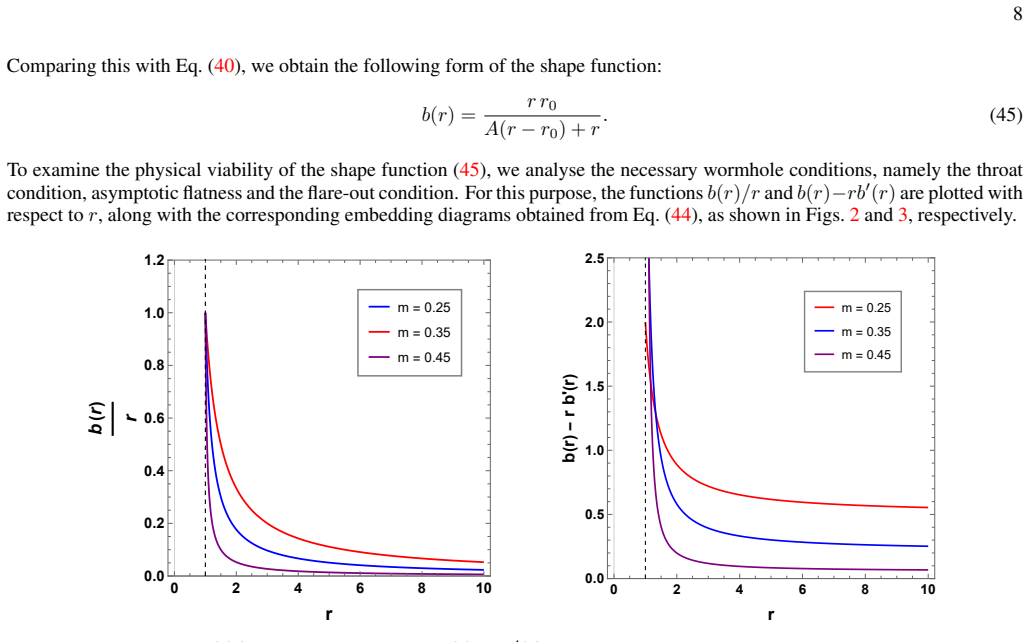
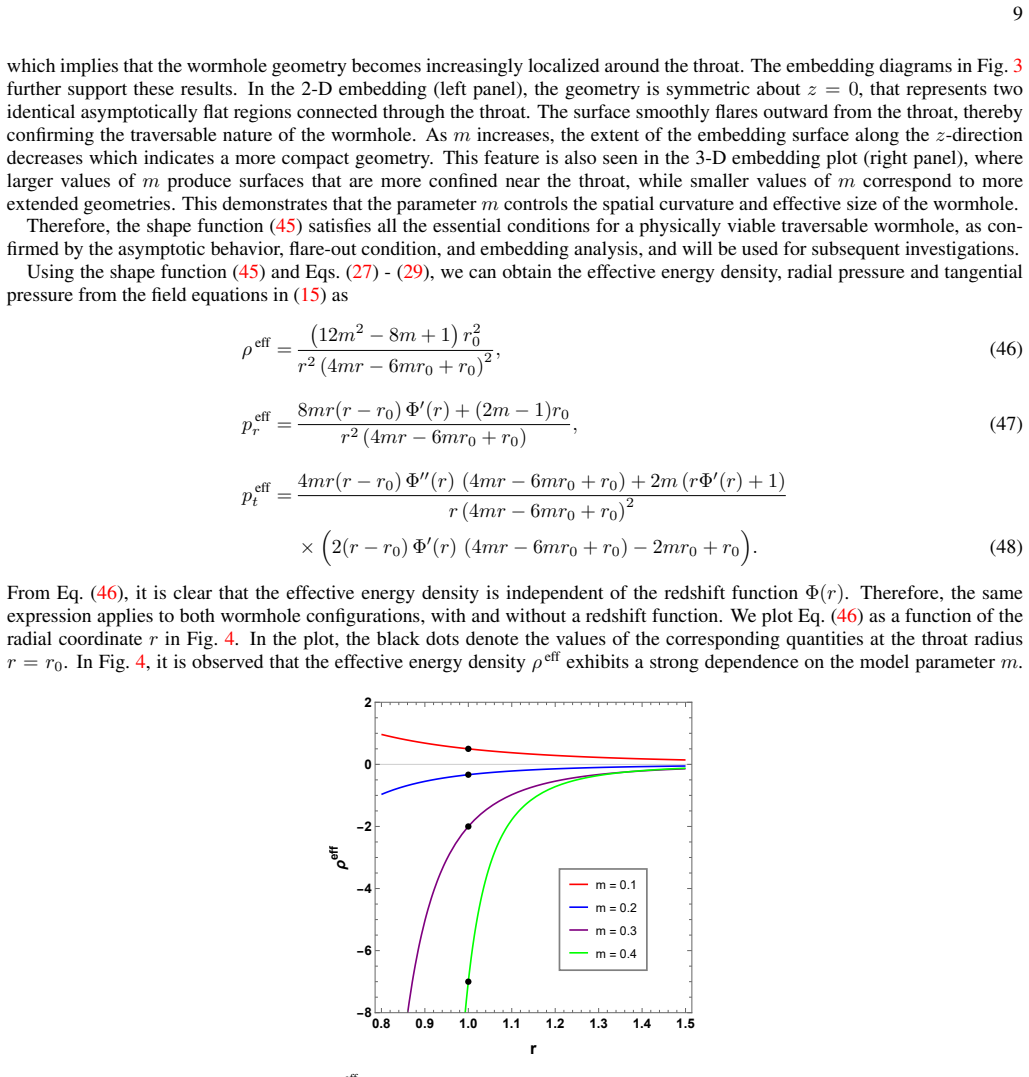
By adopting the power-law model f(Q) = gamma (-Q)^m with 0 < m < 1/2 and an equation of state p_r = omega rho, an analytic shape function is obtained that satisfies the geometric requirements for a traversable wormhole. The energy conditions are violated near the throat but the violations remain localized. The anisotropy parameter stays positive, the generalized TOV equation shows force balance with anisotropic effects providing the dominant outward support, and scalar perturbations produce a single-peak effective potential whose sixth-order WKB quasinormal modes have negative imaginary parts, indicating stable damping confirmed by time-domain simulations.
What carries the argument
The analytic shape function derived from the power-law f(Q) = gamma (-Q)^m together with the linear equation of state p_r = omega rho, which adjusts the effective energy-momentum tensor so that the geometric flaring-out condition holds while energy-condition violations stay localized.
If this is right
- Wormhole solutions exist geometrically for the parameter range 0 < m < 1/2 corresponding to quintessence-like behavior.
- Null and weak energy conditions are violated only near the throat while the strong energy condition holds outside a small region.
- Positive anisotropy throughout the spacetime supplies the repulsive stress that sustains the wormhole throat.
- Both constant and logarithmic redshift functions yield equilibrium configurations via the generalized TOV equation.
- Quasinormal modes computed by sixth-order WKB with Padé approximants have negative imaginary parts and agree with time-domain stability simulations.
Where Pith is reading between the lines
- The localization of energy-condition violations suggests that f(Q) modifications can confine exotic-matter requirements to small regions, a feature that might appear in other modified-gravity wormhole constructions.
- The link between the allowed m interval and quintessence-like equations of state offers a concrete bridge between wormhole solutions and dark-energy models without invoking new fields.
- Agreement between WKB frequencies and time-domain results indicates that the stability conclusion is insensitive to the precise numerical method used for the perturbation analysis.
Load-bearing premise
The solution depends on choosing both a power-law form for f(Q) and a specific linear relation between radial pressure and energy density that together allow an exact analytic shape function within a narrow window of m.
What would settle it
A calculation or simulation in which the effective potential for scalar perturbations produces quasinormal modes with positive imaginary parts, or in which time-domain evolution shows exponential growth of perturbations instead of damping.
Figures




read the original abstract
We investigate static and spherically symmetric traversable wormhole solutions in the framework of $f(Q)$ gravity by considering a power-law model of the form $f(Q)=\gamma(-Q)^m$. By adopting an anisotropic matter distribution and imposing an equation of state relating the radial pressure and energy density, we obtain an analytic shape function that satisfies the geometric requirements for a traversable wormhole. The model parameter is constrained to $0<m<1/2$, corresponding to a quintessence-like regime with $-1<\omega<-1/3$. The energy conditions are analyzed in detail, showing that violations of the null and weak energy conditions are unavoidable but remain localized near the wormhole throat. The anisotropy parameter is positive throughout the spacetime, indicating that repulsive anisotropic stresses play a key role in sustaining the wormhole. The equilibrium configuration is examined using the generalized Tolman-Oppenheimer-Volkoff (TOV) equation for both zero and logarithmic redshift functions, where a consistent force balance is achieved with anisotropic effects providing the dominant outward support. Dynamical stability is studied through scalar perturbations, leading to a Schr\"odinger-like wave equation with a single-peak effective potential. The quasinormal modes are computed using the sixth-order WKB method with Pad\'e approximation. The resulting frequencies possess negative imaginary parts, indicating stable damping of perturbations. Time-domain simulations further confirm the stability of the solutions and show good agreement with the WKB results, with small deviations in the damping rates. Thus, these results establish that $f(Q)$ gravity admits traversable wormhole solutions that are geometrically consistent and dynamically stable, with $f(Q)$ gravity effects effectively regulating the required matter content.
Editorial analysis
A structured set of objections, weighed in public.
Referee Report
Summary. The manuscript constructs static spherically symmetric traversable wormhole solutions in f(Q) gravity for the power-law model f(Q)=γ(-Q)^m. An anisotropic fluid with a linear equation of state p_r=ωρ is assumed, yielding an analytic shape function b(r) that satisfies the flaring-out condition at the throat for the parameter range 0<m<1/2 (corresponding to quintessence-like ω). Energy conditions are analyzed, showing localized violations of the null and weak energy conditions near the throat. Equilibrium is checked via the generalized Tolman-Oppenheimer-Volkoff equation for both constant and logarithmic redshift functions. Dynamical stability is examined through scalar perturbations, producing a Schrödinger-like equation whose quasinormal frequencies (computed via sixth-order WKB with Padé approximants) have negative imaginary parts; this is corroborated by time-domain evolution.
Significance. If the results hold, the work provides explicit analytic examples of traversable wormholes in f(Q) gravity that are geometrically consistent and linearly stable, with energy-condition violations confined to a finite region around the throat. The agreement between WKB and time-domain methods, together with the closed-form shape function and direct TOV balance, strengthens the evidence that modified gravity can regulate the required matter content without global exotic-matter distributions. This adds a concrete, falsifiable case to the literature on wormholes beyond general relativity.
major comments (2)
- [§3] §3 (shape-function derivation): the analytic b(r) is obtained by direct substitution of the chosen EOS p_r=ωρ into the f(Q) field equations; while this produces a closed-form solution satisfying b(r0)=r0 and b'(r0)<1, the restriction 0<m<1/2 is an output of matching the quintessence range -1<ω<-1/3 rather than an independent prediction, so the existence result is tied to this specific EOS choice.
- [§5.2] §5.2 (WKB quasinormal modes): the sixth-order WKB frequencies with Padé approximants are reported to have negative imaginary parts for the single-peak effective potential, but the manuscript does not tabulate the explicit frequency values or perform a convergence check against fifth- or seventh-order WKB, which is needed to confirm that the damping rates are robust rather than sensitive to the approximation order.
minor comments (3)
- [Abstract and §4] The abstract and §4 claim that 'f(Q) gravity effects effectively regulating the required matter content,' but this phrasing should be qualified to note that the regulation occurs through the interplay of the specific power-law f(Q) and the imposed EOS.
- [Figures 2-4] Figure captions for the energy-condition and potential plots should include the specific numerical values of m, γ, and r0 used, to allow direct reproduction of the localized-violation profiles.
- [Throughout] Notation: the redshift function is denoted Φ(r) in some sections and Φ in others; consistent use throughout would improve readability.
Simulated Author's Rebuttal
We thank the referee for the positive evaluation of our work and for the constructive comments. We address each major comment point by point below, indicating the revisions we plan to implement in the revised manuscript.
read point-by-point responses
-
Referee: [§3] §3 (shape-function derivation): the analytic b(r) is obtained by direct substitution of the chosen EOS p_r=ωρ into the f(Q) field equations; while this produces a closed-form solution satisfying b(r0)=r0 and b'(r0)<1, the restriction 0<m<1/2 is an output of matching the quintessence range -1<ω<-1/3 rather than an independent prediction, so the existence result is tied to this specific EOS choice.
Authors: We acknowledge that the parameter range 0<m<1/2 is indeed determined by consistency with the chosen linear equation of state and the flaring-out condition. The linear EOS p_r=ωρ was deliberately selected to permit an exact analytic solution for the shape function b(r), a standard strategy in the wormhole literature when seeking closed-form expressions. This choice is physically motivated by the requirement of negative radial pressure to support the throat, corresponding to the quintessence regime. We will add a brief clarifying paragraph in Section 3 to explicitly state the rationale for the EOS and note that the resulting constraints are tied to this assumption rather than being a model-independent prediction of f(Q) gravity. revision: partial
-
Referee: [§5.2] §5.2 (WKB quasinormal modes): the sixth-order WKB frequencies with Padé approximants are reported to have negative imaginary parts for the single-peak effective potential, but the manuscript does not tabulate the explicit frequency values or perform a convergence check against fifth- or seventh-order WKB, which is needed to confirm that the damping rates are robust rather than sensitive to the approximation order.
Authors: We agree that tabulating the explicit quasinormal frequencies and performing a convergence test across WKB orders would strengthen the stability analysis. In the revised manuscript we will add a table listing the real and imaginary parts of the fundamental and first overtone frequencies obtained with the sixth-order WKB plus Padé approximants. We will also include a short subsection or appendix comparing these results with fifth- and seventh-order WKB calculations to demonstrate that the negative imaginary parts (damping rates) converge and are not sensitive to the truncation order. revision: yes
Circularity Check
No significant circularity: solutions constructed explicitly from stated assumptions
full rationale
The derivation begins with an explicit power-law ansatz f(Q)=γ(-Q)^m and an imposed equation of state p_r=ωρ on the anisotropic fluid. These inputs are used to integrate the field equations for a closed-form shape function b(r) that satisfies the flaring-out and asymptotic-flatness conditions by direct substitution. Subsequent checks (energy-condition violations localized at the throat, positive anisotropy, TOV force balance, and stability via the Schrödinger-like potential with negative Im(ω) from WKB and time-domain evolution) are all downstream verifications performed on the constructed metric. No step renames a fitted quantity as a prediction, invokes a self-citation as a uniqueness theorem, or reduces the central existence claim to a tautology; the allowed interval 0<m<1/2 emerges as the consistency requirement for quintessence-like ω rather than an independent forecast. The paper therefore remains self-contained against its own inputs.
Axiom & Free-Parameter Ledger
free parameters (2)
- m =
0 < m < 1/2
- gamma
axioms (2)
- domain assumption Static and spherically symmetric metric ansatz with traversable wormhole geometry
- domain assumption Anisotropic matter distribution obeying p_r = omega rho with omega in (-1, -1/3)
Lean theorems connected to this paper
-
IndisputableMonolith/Cost/FunctionalEquation.leanwashburn_uniqueness_aczel unclear?
unclearRelation between the paper passage and the cited Recognition theorem.
By adopting an anisotropic matter distribution and imposing an equation of state relating the radial pressure and energy density, we obtain an analytic shape function... 0<m<1/2... ω=-1/(4m+1)
-
IndisputableMonolith/Foundation/AlexanderDuality.leanalexander_duality_circle_linking unclear?
unclearRelation between the paper passage and the cited Recognition theorem.
The effective potential... single-peak... sixth-order WKB... negative imaginary parts
What do these tags mean?
- matches
- The paper's claim is directly supported by a theorem in the formal canon.
- supports
- The theorem supports part of the paper's argument, but the paper may add assumptions or extra steps.
- extends
- The paper goes beyond the formal theorem; the theorem is a base layer rather than the whole result.
- uses
- The paper appears to rely on the theorem as machinery.
- contradicts
- The paper's claim conflicts with a theorem or certificate in the canon.
- unclear
- Pith found a possible connection, but the passage is too broad, indirect, or ambiguous to say the theorem truly supports the claim.
Reference graph
Works this paper leans on
-
[1]
(45), the effective potential in Eq
QNMs forΦ(r) =0case For the tideless condition, i.e., for the redshift functionΦ(r) = 0and the shape function given in Eq. (45), the effective potential in Eq. (79) simplifies to Vs(r) = l(l+ 1) r2 + 2(1−2m)mrr 0 r2 (4mr−6mr 0 +r 0)2 .(82) 17 l=1 l=2 l=3 0 2 4 6 8 100 1 2 3 4 5 r Vs(r) l=1 l=2 l=3 -10 -5 0 5 100 2 4 6 8 10 12 r* Vs(r*) FIG. 12. Variation ...
-
[2]
(45), the effective potential in Eq
QMNS forΦ(r) = log 1+ r0 r For this redshift function and the shape function given in Eq. (45), the effective potential in Eq. (79) simplifies to Vs(r) = 1 + r0 r 2 l(l+ 1) r2 + r0 2m(6m+ 1)r 2 + (1−4m(7m+ 1))rr 0 + (1−6m) 2r2 0 r2(r+r 0) (4mr−6mr 0 +r 0)2 .(83) We plot the effective potential in terms of both the radial coordinaterand the tortoise coordi...
-
[3]
ForΦ(r) =0case For this case of zero redshift function, i.e., for the tideless state of the wormhole, the time evolution of scalar perturbations for multipole numbersl= 1,2,3is shown in Fig. 18 form= 0.1andr 0 = 1. The waveforms exhibit the characteristic behavior of perturbations, consisting of an initial transient phase followed by a quasinormal ringing...
-
[4]
ForΦ(r) = log 1+ r0 r case For this redshift function, the time-domain evolution of scalar perturbations for multipole numbersl= 1,2,3is shown in Fig. 20 form= 0.1andr 0 = 1. The profiles clearly exhibit the standard three-stage behavior consisting of an initial transient phase, followed by a quasinormal ringing phase and late-time noises. With increasing...
-
[5]
J. A. Wheeler,On the nature of quantum geometrodynamics, Ann. Phys. (N. Y .)2, 604 (1957)
work page 1957
-
[6]
A. Einstein and N. Rosen,The particle problem in the general theory of relativity, Phys. Rev.48, 73 (1935)
work page 1935
-
[7]
M. S. Morris and K. S. Thorne,Wormholes in space-time and their use for interstellar travel: A tool for teaching general relativity, Am. J. Phys.56, 395 (1988)
work page 1988
-
[8]
F. S. N. Lobo,Wormhole geometries in modified gravity, AIP Conf. Proc. 1458(1), 447 (2012)
work page 2012
-
[9]
Harko et al.,Modified-gravity wormholes without exotic matter, Phys
T. Harko et al.,Modified-gravity wormholes without exotic matter, Phys. Rev. D87, 067504 (2013)
work page 2013
-
[10]
P. H. R. S. Moraes, et al.,An exponential shape function for wormholes in modified gravity, Chin. Phys. Lett.36, 120401 (2019)
work page 2019
- [11]
-
[12]
R. Radhakrishnan, et al.,A Review of Stable, Traversable Wormholes in f(R) Gravity Theories, Symmetry16(8), 1007 (2024)
work page 2024
-
[13]
S. D. Sadatian and S. M. R. Hosseini,Modified Gravity Modelf(Q, T)and Wormhole Solution, Adv. High Energy Phys.2024(1), 3717418 (2024)
work page 2024
-
[14]
H. A. Kumara, C. C. Chalavadi and V . Venkatesha,Investigating wormhole structures inf(R,Lm)gravity: Implications for dark matter, Nucl. Phys. B, 117258 (2025)
work page 2025
-
[15]
D. Hochberg, M. Visser,Geometric structure of the generic static traversable wormhole throat, Phys. Rev. D56, 4745 (1997)
work page 1997
-
[16]
S. W. Kim,Flare-out condition of a Morris-Thorne wormhole and finiteness of pressure, J. Korean Phys. Soc.63, 1887 (2013)
work page 2013
-
[17]
K. Suhasini, et al.,Traversable Wormhole Solutions inf(Q,L m)Gravity, arXiv preprint arXiv:2601.08888 (2026)
-
[18]
M. S. Morris, K. S. Thorne, and U. Yurtsever,Wormholes, Time Machines, and the Weak Energy Condition, Phy. Rev. Lett.61, 1446 (1988)
work page 1988
-
[19]
R. A. Konoplya and A. Zhidenko,Traversable wormholes in general relativity, Phys. Rev. Lett.128, 091104 (2022)
work page 2022
-
[20]
P. Ca ˜nate and F. Maldonado-Villamizar,Novel traversable wormhole in general relativity and Einstein-Scalar-Gauss-Bonnet theory supported by non-linear electrodynamics, Phys. Rev. D106, 044063 (2022)
work page 2022
-
[21]
J. Goswami, H. Rahman, R. Sikdar, R. Parvin and F. Ahmed,Morris–Thorne-type wormholes with global monopole charge and the energy conditions, EPJC84, 1037 (2024)
work page 2024
- [22]
-
[23]
H. Moradpour, N. Sadeghnezhad and S. Hendi,Traversable asymptotically flat wormholes in Rastall gravity, Can. J. Phys.95, 1257 (2017)
work page 2017
-
[24]
P. Pavlovic and M. Sossich,Wormholes in viablef(R)modified theories of gravity and weak energy condition, EPJC75, 117 (2015)
work page 2015
-
[25]
E. F. Eiroa and G. F. Aguirre,Thin-shell wormholes with charge inF(R)gravity, EPJC76, 132 (2016)
work page 2016
-
[26]
P. Moraes and P. Sahoo,Modeling wormholes inf(R, T)gravity, Phys. Rev. D96, 044038 (2017)
work page 2017
-
[27]
E. Elizalde and M. Khurshudyan,Wormholes withρ(R, R ′)matter inf(R, T)gravity, Phys. Rev. D99, 024051 (2019)
work page 2019
-
[28]
N. Godani and G. C. Samanta,Traversable wormholes inR+αR n gravity, EPJC80, 30 (2020)
work page 2020
-
[29]
F. Parsaei and S. Rastgoo,Wormhole inf(R)gravity revisited, arXiv preprint arXiv:2110.07278 (2021)
-
[30]
D. J. Gogoi and U. D. Goswami,Tideless traversable wormholes surrounded by cloud of strings inf(R)gravity, JCAP2023, 027 (2023)
work page 2023
-
[31]
M. Chakraborty and S. Chakraborty,Traversable wormholes and their shadows in 4D Einstein–Gauss–Bonnet Gravity: An analytic description, Phys. Dark Univ.47, 101793 (2025)
work page 2025
-
[32]
C. G. Boehmer, T. Harko, and F. S. Lobo,Wormhole geometries in modified teleparallel gravity and the energy conditions, Phys. Rev. D 85, 044033 (2012)
work page 2012
-
[33]
S. Paul, S. K. Maurya, J. Kumar and A. Ali,Wormhole solutions in extended symmetric teleparallel gravity inspired by holographic dark energy, Phys. Dark Univ.49, 102043 (2025). 27
work page 2025
-
[34]
J. B. Jim ´enez, L. Heisenberg, and T. Koivisto,Coincident general relativity, Phys. Rev. D98, 044048 (2018)
work page 2018
-
[35]
D. N. Spergel, et al.,First-Year Wilkinson Microwave Anisotropy Probe (WMAP) Observations: Determination of Cosmological Param- eters, Astrophys. J. Suppl. Ser.148, 175 (2003)
work page 2003
-
[36]
A. G. Riess, et al.,Observational Evidence from Supernovae for an Accelerating Universe and a Cosmological Constant, The Astro. J. 116, 1009 (1998)
work page 1998
-
[37]
Perlmutter, et al.,Measurements ofΩandΛfrom 42 High-Redshift Supernovae, The Astro
S. Perlmutter, et al.,Measurements ofΩandΛfrom 42 High-Redshift Supernovae, The Astro. J.517, 565 (1999)
work page 1999
-
[38]
W. Khyllep, J. Dutta, E. N. Saridakis and K. Yesmakhanova,Cosmology inf(Q)gravity: A unified dynamical systems analysis of the background and perturbations, Phys. Rev. D107, 044022 (2023)
work page 2023
-
[39]
R. H. Lin and X. H. Zhai,Spherically symmetric configuration inf(Q)gravity, Phys. Rev. D103, 124001 (2021)
work page 2021
-
[40]
W. Wang, H. Chen and T. Katsuragawa,Static and spherically symmetric solutions inf(Q)gravity, Phys. Rev. D105, 024060 (2022)
work page 2022
-
[41]
U. K. Sharma, Shweta and A. K. Mishra,Traversable wormhole solutions with non-exotic fluid in framework off(Q)gravity, Int. J. Geom. Methods Mod. Phys.19(02), 2250019 (2022)
work page 2022
- [42]
- [43]
-
[44]
A. Banerjee, A. Pradhan, T. Tangphati and F. Rahaman,Wormhole geometries inf(Q)gravity and the energy conditions, EPJC81(11), 1031 (2021)
work page 2021
-
[45]
E. Elizalde and M. Khurshudyan,Wormhole formation inf(R, T)gravity: Varying Chaplygin gas and barotropic fluid, Phys. Rev. D98, 123525 (2018)
work page 2018
-
[46]
S. Bolokhov and M. Skvortsova,Correspondence between quasinormal modes and grey-body factors of spherically symmetric traversable wormholes, JCAP04, 025 (2025)
work page 2025
-
[47]
K. D. Kokkotas and B. G. Schmidt, emphQuasi-Normal Modes of Stars and Black Holes, Living Rev. Relativ.2, 2 (1999)
work page 1999
- [48]
-
[49]
G. Murtaza, S. Chakraborty and A. De,A generic dynamical system formulation for Bianchi-I cosmology with isotropic fluid inf(Q) gravity, JCAP08, 093 (2025)
work page 2025
-
[50]
Raychaudhuri,Relativistic Cosmology
A. Raychaudhuri,Relativistic Cosmology. I, Phys. Rev.98, 1123 (1955)
work page 1955
-
[51]
F. S. N. Lobo and M. A. Oliveira,Wormhole geometries inf(R)modified theories of gravity, Phys. Rev. D80, 104012 (2009)
work page 2009
-
[52]
F. Parsaei, S. Rastgoo, P. K. Sahoo,Wormhole inf(Q)gravity, EPJ Plus137, 1 (2022)
work page 2022
-
[53]
J. R. Oppenheimer and G. M. V olkoff,On Massive Neutron Cores, Phys. Rev.55, 374 (1939)
work page 1939
-
[54]
R. A. Konoplya,How to tell the shape of a wormhole by its quasinormal modes, Phys. Lett. B784, 43 (2018)
work page 2018
- [55]
-
[56]
Godani,”Wormhole solutions inf(R, T)gravity, New Astronomy94, 101774 (2022)
N. Godani,”Wormhole solutions inf(R, T)gravity, New Astronomy94, 101774 (2022)
work page 2022
-
[57]
S. K. Maurya, J. Kumar, S. Chaudhary, A. Errehymy, G. Mustafa, K. Myrzakulov,Embedded class one analysis of wormhole configura- tions in 4DEinstein–Gauss–Bonnet gravity with logarithmic redshift functions, Phys. Dark Univ.48, 101857 (2025)
work page 2025
-
[58]
S. Chaudhary, S. K. Maurya, J. Kumar, S. Ray,Stability analysis of wormhole solutions inf(Q)gravity utilizing Karmarkar condition with radial dependent redshift function, Astropart. Phys.162, 103002 (2024)
work page 2024
-
[59]
K. D. Kokkotas and B. G. Schmidt,Quasi-Normal Modes of Stars and Black Holes, Living Rev. Relativ.2(1), 2 (1999)
work page 1999
-
[60]
C. V . Vishveshwara,Stability of the Schwarzschild Metric, Phys. Rev. D1, 2870 (1970)
work page 1970
-
[61]
W. H. Press,Long Wave Trains of Gravitational Waves from a Vibrating Black Hole, The Astrophys. J.170, L105 (1971)
work page 1971
-
[62]
S. Chandrasekhar and S. Detweiler,The Quasi-Normal Modes of the Schwarzschild Black Hole, Proc. R. Soc. Lond. A. Math Phys. Sci., 344(1639), 441 (1975)
work page 1975
-
[63]
Berti et al.,Testing general relativity with present and future astrophysical observations, Class
E. Berti et al.,Testing general relativity with present and future astrophysical observations, Class. Quantum Grav.32, 243001 (2015)
work page 2015
-
[64]
O. Dreyer et al.,Black-hole spectroscopy: testing general relativity through gravitational-wave observations, Class. Quantum Grav.21, 787 (2004)
work page 2004
-
[65]
S. Chen, J. Jing,Quasinormal modes of a black hole surrounded by quintessence, Class. Quantum Grav.22, 4651 (2005)
work page 2005
- [66]
- [67]
-
[68]
C. Ma, Y . Gui, W. Wang, F. Wang,Massive scalar field quasinormal modes of a Schwarzschild black hole surrounded by quintessence, Cent. Eur. J. Phys.6, 194 (2008)
work page 2008
- [69]
-
[70]
J. P. M. Grac ¸a and I. P. Lobo,Scalar QNMs for higher dimensional black holes surrounded by quintessence in Rastall gravity, EPJC78, 101 (2018)
work page 2018
-
[71]
V . P. Frolov, P. Krtouˇs, D. Kubiz ˇn´ak and J. E. Santos,Massive Vector Fields in Rotating Black-Hole Spacetimes: Separability and Quasinormal Modes, Phys. Rev. Lett.120, 231103 (2018)
work page 2018
-
[72]
Jing,Dirac quasinormal modes of Schwarzschild black hole, Phys
J. Jing,Dirac quasinormal modes of Schwarzschild black hole, Phys. Rev. D71, 124006 (2005)
work page 2005
-
[73]
A. Chowdhury and N. Banerjee,Quasinormal modes of a charged spherical black hole with scalar hair for scalar and Dirac perturba- tions, EPJC78, 594 (2018)
work page 2018
-
[74]
R. A. Konoplya and A. Zhidenko,Can the abyss swallow gravitational waves or why do we not observe echoes?, Europhys. Lett.138, 49001 (2022). 28
work page 2022
-
[75]
R. A. Konoplya and A. Zhidenko,Quasinormal modes of black holes: From astrophysics to string theory, Rev. Mod. Phys.83, 793 (2011)
work page 2011
-
[76]
R. Karmakar, D. J. Gogoi, U. D. Goswami,Quasinormal modes and thermodynamic properties of GUP-corrected Schwarzschild black hole surrounded by quintessence, Int. J. Mod. Phys. A37(28n29), 2250180 (2022)
work page 2022
-
[77]
B. F. Schutz and C. M. Will,Black Hole Normal Modes- A Semianalytic Approach, Astrophys. J.291, L33 (1985)
work page 1985
-
[78]
S. Iyer and C. M. Will,Black-hole normal modes: A WKB approach. I. Foundations and application of a higher-order WKB analysis of potential-barrier scattering, Phys. Rev. D35, 3621 (1987)
work page 1987
-
[79]
R. A. Konoplya,Quasinormal behavior of the D-dimensional Schwarzschild black hole and the higher order WKB approach, Phys. Rev. D68, 024018 (2003)
work page 2003
-
[80]
J. Matyjasek and M. Telecka,Quasinormal modes of black holes. II. Pad ´e summation of the higher-order WKB terms, Phys. Rev. D100, 124006 (2019)
work page 2019
discussion (0)
Sign in with ORCID, Apple, or X to comment. Anyone can read and Pith papers without signing in.