Recognition: no theorem link
Topological Characterization of Discrete-Time Classical Stochastic Processes: Dual Role of Point-Gap Topology
Pith reviewed 2026-05-11 01:06 UTC · model grok-4.3
The pith
Point-gap topology around the origin of a stochastic matrix spectrum enforces non-Markovianity via feedback control.
A machine-rendered reading of the paper's core claim, the machinery that carries it, and where it could break.
Core claim
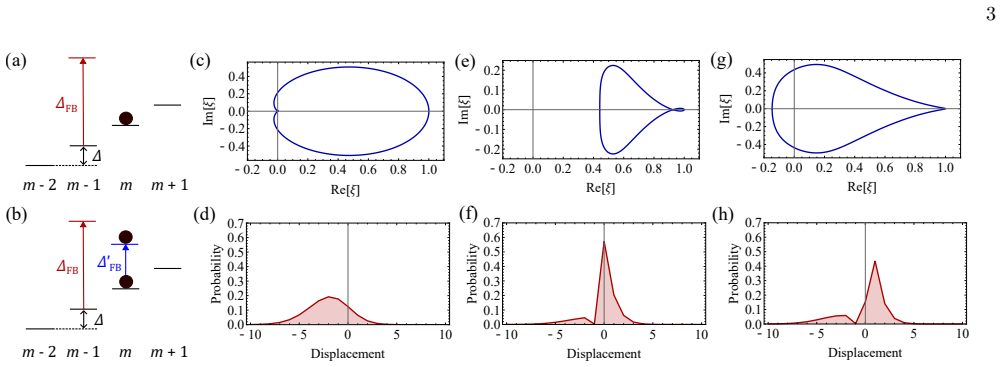
We show that the point-gap topology of stochastic matrices characterizes discrete-time classical stochastic processes. The point-gap topology around a generic reference point is related to the direction of transport, and nontrivial topology around the origin of the complex spectrum implies non-Markovianity caused by feedback control. We identify the topological origin of directed transport in the Maxwell's demon experiment and demonstrate that a topologically enforced non-Markovian classical stochastic process can be simulated by a Markovian quantum master equation.
What carries the argument
Point-gap topology of the complex spectrum of a stochastic matrix, whose nontrivial winding around the origin requires non-Markovian dynamics while winding around other points fixes transport direction.
If this is right
- Directed transport in classical lattice processes acquires a topological origin independent of thermodynamic arguments.
- Feedback control in stochastic systems such as Maxwell's demon is topologically protected by the point-gap invariant around zero.
- Topologically enforced non-Markovian classical processes admit exact simulation by Markovian quantum master equations.
- The dual role of point-gap topology supplies a classification scheme for stochastic processes that goes beyond purely thermodynamic descriptions.
Where Pith is reading between the lines
- Quantum dynamics can serve as a topological simulator for classically non-Markovian processes that would otherwise require explicit memory or feedback.
- The same spectral topology might be used to design or protect memory effects in engineered classical or hybrid systems.
- The framework invites extension to continuous-time processes or to open quantum systems where similar point-gap structures appear.
Load-bearing premise
Point-gap topology defined on the spectrum of a stochastic matrix directly produces physical consequences such as transport direction or non-Markovianity without extra system-specific assumptions on the lattice or dynamics.
What would settle it
A discrete-time Markovian stochastic process whose transition matrix nevertheless shows nontrivial point-gap winding around the origin would falsify the claimed implication of non-Markovianity.
Figures

read the original abstract
We present topological characterization of classical stochastic processes described by discrete-time Markov chains on lattices. We point out that point-gap topology of stochastic matrices entails two distinct physical consequences that hinge on the choice of the reference point. The point-gap topology around a generic reference point is related to the direction of transport, and nontrivial topology around the origin of the complex spectrum of a stochastic matrix implies non-Markovianity caused by, e.g., feedback control. On the basis of this characterization, we identify the topological origin of directed transport in a classic experiment of Maxwell's demon [S. Toyabe et al., Nat. Phys. 6, 988 (2010)] and find the topological nature of feedback control beyond thermodynamic interpretation. We demonstrate that a topologically enforced non-Markovian classical stochastic process can be simulated by a Markovian quantum master equation, indicating a topological form of quantum advantage.
Editorial analysis
A structured set of objections, weighed in public.
Referee Report
Summary. The manuscript presents a topological characterization of discrete-time classical stochastic processes using point-gap topology applied to stochastic matrices. It identifies two roles depending on the reference point: topology around a generic point relates to transport direction, while around the origin indicates non-Markovianity arising from mechanisms such as feedback control. The authors apply this framework to explain the topological origin of directed transport in the Maxwell's demon experiment and demonstrate that such topologically protected non-Markovian processes can be simulated using a Markovian quantum master equation, suggesting a form of topological quantum advantage.
Significance. If the central claims hold, this work provides a valuable bridge between non-Hermitian topological physics and classical stochastic processes, offering new tools to analyze directed transport and non-Markovian effects. The connection to the Maxwell's demon experiment and the quantum simulation aspect highlight potential interdisciplinary impact, particularly if the topological enforcement is rigorously established.
major comments (3)
- [Abstract and §3 (dual role characterization)] Abstract and the section defining the dual role of point-gap topology: The assertion that nontrivial point-gap topology around the origin implies non-Markovianity (e.g., from feedback) is load-bearing but under-supported. A stochastic matrix defines a Markov chain by construction; the manuscript must provide a no-go theorem or explicit counter-example showing that spectra with winding around zero cannot be realized by any memoryless Markovian dynamics on the lattice without hidden states or feedback, rather than treating it as an interpretation.
- [§4 (Maxwell's demon)] Section on the Maxwell's demon application: The identification of topological origin in the Toyabe et al. experiment requires the explicit stochastic matrix extracted from the data, the computed spectrum, and the winding number around the origin to be shown; without this, the claim that topology 'implies' the observed directed transport remains qualitative.
- [§5 (quantum master equation simulation)] Section on quantum simulation: The mapping from the topologically enforced non-Markovian classical process to a Markovian quantum master equation must specify how the point-gap topology is preserved under the embedding and demonstrate that the quantum dynamics is strictly Markovian (Lindblad form) while the classical effective process is not; resource comparison to direct classical simulation of the same process should be included.
minor comments (2)
- [§2 (theoretical framework)] Clarify the precise mathematical definition of the point-gap winding number for a stochastic matrix (including how the reference point is chosen and why the origin is special) with a simple 2x2 or 3x3 example matrix in the main text.
- [Figures 2 and 3] Ensure all figures showing complex spectra explicitly mark the reference point and indicate the contour used for the winding number calculation.
Simulated Author's Rebuttal
We thank the referee for their thorough review and valuable suggestions, which will help improve the clarity and rigor of our manuscript. We address each major comment point by point below, indicating the revisions we will undertake.
read point-by-point responses
-
Referee: [Abstract and §3 (dual role characterization)] Abstract and the section defining the dual role of point-gap topology: The assertion that nontrivial point-gap topology around the origin implies non-Markovianity (e.g., from feedback) is load-bearing but under-supported. A stochastic matrix defines a Markov chain by construction; the manuscript must provide a no-go theorem or explicit counter-example showing that spectra with winding around zero cannot be realized by any memoryless Markovian dynamics on the lattice without hidden states or feedback, rather than treating it as an interpretation.
Authors: We agree that a more rigorous foundation is required for this central claim. In the revised manuscript, we will add an explicit no-go argument (or a concrete counterexample) demonstrating that a stochastic matrix with nontrivial point-gap winding around the origin cannot be realized by any memoryless Markovian dynamics on the lattice without hidden states or feedback mechanisms. This will replace the current interpretive discussion and directly support the implication of non-Markovianity. revision: yes
-
Referee: [§4 (Maxwell's demon)] Section on the Maxwell's demon application: The identification of topological origin in the Toyabe et al. experiment requires the explicit stochastic matrix extracted from the data, the computed spectrum, and the winding number around the origin to be shown; without this, the claim that topology 'implies' the observed directed transport remains qualitative.
Authors: We acknowledge that the current treatment is qualitative. In the revision, we will extract the effective stochastic matrix from the Toyabe et al. experimental data, display its complex spectrum, and explicitly compute the winding number around the origin. This will quantitatively establish the nontrivial point-gap topology and its direct connection to the observed directed transport. revision: yes
-
Referee: [§5 (quantum master equation simulation)] Section on quantum simulation: The mapping from the topologically enforced non-Markovian classical process to a Markovian quantum master equation must specify how the point-gap topology is preserved under the embedding and demonstrate that the quantum dynamics is strictly Markovian (Lindblad form) while the classical effective process is not; resource comparison to direct classical simulation of the same process should be included.
Authors: We will substantially expand §5 to include a detailed derivation of the embedding map, explicitly showing preservation of the point-gap topology in the effective classical dynamics. We will verify that the underlying quantum evolution is strictly Markovian (satisfying the Lindblad form) while the projected classical process is non-Markovian due to the topological enforcement. A resource comparison between the quantum simulation and direct classical simulation of the equivalent non-Markovian process will also be added to quantify the topological quantum advantage. revision: yes
Circularity Check
Point-gap topology on stochastic matrix spectrum asserted to imply non-Markovianity, yet matrix defines Markov chain by definition
specific steps
-
self definitional
[Abstract]
"nontrivial topology around the origin of the complex spectrum of a stochastic matrix implies non-Markovianity caused by, e.g., feedback control"
A stochastic matrix P satisfies P_ij ≥ 0 and column sums = 1, which defines a discrete-time Markov chain (memoryless by definition). Assigning the point-gap winding number around 0 as a marker that forces non-Markovianity (feedback) makes the claimed physical consequence tautological with the input matrix class; the topology is computed directly from the Markovian object yet declared to require non-Markovian dynamics.
full rationale
The paper's central claim equates a topological feature of a stochastic matrix (which generates a memoryless Markov process by construction) with non-Markovianity. This reduces the implication to a re-labeling rather than a derived necessity, as no independent no-go theorem separating Markovian realizations from the observed spectrum is exhibited in the provided derivation chain. The abstract and skeptic analysis confirm the reduction without external benchmarks or self-contained proof.
Axiom & Free-Parameter Ledger
axioms (1)
- domain assumption Stochastic matrices possess complex spectra to which point-gap topology can be applied in the same manner as non-Hermitian Hamiltonians.
Reference graph
Works this paper leans on
-
[1]
Moessner and J
R. Moessner and J. E. Moore,Topological Phases of Mat- ter(Cambridge University Press, Cambridge, 2021)
2021
-
[2]
G. Ma, M. Xiao, and C. T. Chan, Topological phases in acoustic and mechanical systems, Nat. Rev. Phys.1, 281 (2019)
2019
-
[3]
Ozawa, H
T. Ozawa, H. M. Price, A. Amo, N. Goldman, M. Hafezi, L. Lu, M. C. Rechtsman, D. Schuster, J. Simon, O. Zil- berberg, and I. Carusotto, Topological photonics, Rev. Mod. Phys.91, 015006 (2019)
2019
-
[4]
Shankar, A
S. Shankar, A. Souslov, M. J. Bowick, M. C. Marchetti, and V. Vitelli, Topological active matter, Nat. Rev. Phys. 4, 380 (2022)
2022
-
[5]
Murugan and S
A. Murugan and S. Vaikuntanathan, Topologically pro- tected modes in non-equilibrium stochastic systems, Nat. Commun.8, 13881 (2017)
2017
-
[6]
E. Tang, J. Agudo-Canalejo, and R. Golestanian, Topol- ogy Protects Chiral Edge Currents in Stochastic Systems, Phys. Rev. X11, 031015 (2021)
2021
-
[7]
Sawada, K
T. Sawada, K. Sone, R. Hamazaki, Y. Ashida, and T. Sagawa, Role of Topology in Relaxation of One- Dimensional Stochastic Processes, Phys. Rev. Lett.132, 046602 (2024)
2024
- [8]
-
[9]
Agudo-Canalejo and E
J. Agudo-Canalejo and E. Tang, Topological phases in discrete stochastic systems, Rep. Prog. Phys.88, 102601 (2025)
2025
-
[10]
Z. Gong, Y. Ashida, K. Kawabata, K. Takasan, S. Hi- gashikawa, and M. Ueda, Topological Phases of Non- Hermitian Systems, Phys. Rev. X8, 031079 (2018)
2018
-
[11]
Oka and H
T. Oka and H. Aoki, Photovoltaic Hall effect in graphene, Phys. Rev. B79, 081406 (2009)
2009
-
[12]
Kitagawa, E
T. Kitagawa, E. Berg, M. Rudner, and E. Demler, Topo- logical characterization of periodically driven quantum systems, Phys. Rev. B82, 235114 (2010)
2010
-
[13]
Kitagawa, M
T. Kitagawa, M. S. Rudner, E. Berg, and E. Demler, Exploring topological phases with quantum walks, Phys. Rev. A82, 033429 (2010)
2010
-
[14]
N. H. Lindner, G. Refael, and V. Galitski, Floquet topo- logical insulator in semiconductor quantum wells, Nat. Phys.7, 490 (2011)
2011
-
[15]
M. S. Rudner, N. H. Lindner, E. Berg, and M. Levin, Anomalous Edge States and the Bulk-Edge Correspon- dence for Periodically Driven Two-Dimensional Systems, Phys. Rev. X3, 031005 (2013)
2013
-
[16]
Roy and F
R. Roy and F. Harper, Periodic table for Floquet topo- logical insulators, Phys. Rev. B96, 155118 (2017)
2017
-
[17]
Harper, R
F. Harper, R. Roy, M. S. Rudner, and S. Sondhi, Topol- ogy and Broken Symmetry in Floquet Systems, Ann. Rev. Condens. Matter Phys.11, 345 (2020)
2020
-
[18]
M. S. Rudner and N. H. Lindner, Band structure engi- neering and non-equilibrium dynamics in Floquet topo- logical insulators, Nat. Rev. Phys.2, 229 (2020)
2020
-
[19]
Kawabata, K
K. Kawabata, K. Shiozaki, M. Ueda, and M. Sato, Sym- metry and Topology in Non-Hermitian Physics, Phys. Rev. X9, 041015 (2019)
2019
-
[20]
Ashida, Z
Y. Ashida, Z. Gong, and M. Ueda, Non-Hermitian physics, Adv. Phys.69, 249 (2020)
2020
-
[21]
E. J. Bergholtz, J. C. Budich, and F. K. Kunst, Ex- ceptional topology of non-Hermitian systems, Rev. Mod. Phys.93, 015005 (2021)
2021
-
[22]
Okuma and M
N. Okuma and M. Sato, Non-Hermitian Topological Phe- nomena: A Review, Annu. Rev. Condens. Matter Phys. 14, 83 (2023)
2023
-
[23]
Oshima, K
H. Oshima, K. Mochizuki, R. Hamazaki, and Y. Fuji, Topology and Spectrum in Measurement-Induced Phase 6 Transitions, Phys. Rev. Lett.134, 240401 (2025)
2025
-
[24]
Xiao and K
Z. Xiao and K. Kawabata, Symmetry and topology of monitored quantum dynamics, Phys. Rev. B113, 134307 (2026)
2026
-
[25]
Nakagawa and M
M. Nakagawa and M. Ueda, Topology of Discrete Quan- tum Feedback Control, Phys. Rev. X15, 021016 (2025)
2025
-
[26]
J. Wen, Z. Gong, and T. Sagawa, Symmetry and Topol- ogy of Successive Quantum Feedback Control, Phys. Rev. Lett.136, 090802 (2026)
2026
-
[27]
Gross, V
D. Gross, V. Nesme, H. Vogts, and R. F. Werner, Index Theory of One Dimensional Quantum Walks and Cellular Automata, Commun. Math. Phys.310, 419 (2012)
2012
-
[28]
H. C. Po, L. Fidkowski, T. Morimoto, A. C. Potter, and A. Vishwanath, Chiral Floquet Phases of Many-Body Lo- calized Bosons, Phys. Rev. X6, 041070 (2016)
2016
-
[29]
Higashikawa, M
S. Higashikawa, M. Nakagawa, and M. Ueda, Floquet Chiral Magnetic Effect, Phys. Rev. Lett.123, 066403 (2019)
2019
-
[30]
Z. Gong, C. S¨ underhauf, N. Schuch, and J. I. Cirac, Clas- sification of Matrix-Product Unitaries with Symmetries, Phys. Rev. Lett.124, 100402 (2020)
2020
-
[31]
X. Liu, A. B. Culver, F. Harper, and R. Roy, Classifi- cation of unitary operators by local generatability, Phys. Rev. B111, 085149 (2025)
2025
-
[32]
Toyabe, T
S. Toyabe, T. Sagawa, M. Ueda, E. Muneyuki, and M. Sano, Experimental demonstration of information- to-energy conversion and validation of the generalized Jarzynski equality, Nat. Phys.6, 988 (2010)
2010
-
[33]
However, the statement about non-Markovianity is unique to stochastic dynamics since unitary quantum dynamics is always memoryless
A similar observation has been made for unitary quan- tum dynamics [27, 31]. However, the statement about non-Markovianity is unique to stochastic dynamics since unitary quantum dynamics is always memoryless. In ad- dition, whereas the inverse statement, i.e., the existence of a generator that continuously connects two homotopic time-evolution operators, ...
-
[34]
Elfving, Zur Theorie der Markoffschen Ketten, Acta Soc
G. Elfving, Zur Theorie der Markoffschen Ketten, Acta Soc. Sci. Fennicae8, 1 (1937)
1937
-
[35]
Kingman, The imbedding problem for finite Markov chains, Z
J. Kingman, The imbedding problem for finite Markov chains, Z. Wahrscheinlichkeitstheorie verw Gebiete1, 14 (1962)
1962
-
[36]
Goodman, An Intrinsic Time for Non-Stationary Fi- nite Markov Chains, Z
G. Goodman, An Intrinsic Time for Non-Stationary Fi- nite Markov Chains, Z. Wahrscheinlichkeitstheorie verw Gebiete16, 165 (1970)
1970
-
[37]
Davies, Embeddable Markov Matrices, Electronic Journal of Probability15, 1474 (2010)
E. Davies, Embeddable Markov Matrices, Electronic Journal of Probability15, 1474 (2010)
2010
-
[38]
Baake and J
M. Baake and J. Sumner, Notes on Markov embedding, Linear Algebra and its Applications594, 262 (2020)
2020
-
[39]
Baake and J
M. Baake and J. Sumner, Embedding of Markov matrices ford≤4, J. Math. Biol.89, 23 (2024)
2024
-
[40]
See Supplemental Material for details
-
[41]
Okuma, K
N. Okuma, K. Kawabata, K. Shiozaki, and M. Sato, Topological Origin of Non-Hermitian Skin Effects, Phys. Rev. Lett.124, 086801 (2020)
2020
-
[42]
Zhang, Z
K. Zhang, Z. Yang, and C. Fang, Correspondence be- tween Winding Numbers and Skin Modes in Non- Hermitian Systems, Phys. Rev. Lett.125, 126402 (2020)
2020
-
[43]
D. S. Borgnia, A. J. Kruchkov, and R.-J. Slager, Non- Hermitian Boundary Modes and Topology, Phys. Rev. Lett.124, 056802 (2020)
2020
-
[44]
Korzekwa and M
K. Korzekwa and M. Lostaglio, Quantum Advantage in Simulating Stochastic Processes, Phys. Rev. X11, 021019 (2021)
2021
-
[45]
T. Haga, M. Nakagawa, R. Hamazaki, and M. Ueda, Li- ouvillian Skin Effect: Slowing Down of Relaxation Pro- cesses without Gap Closing, Phys. Rev. Lett.127, 070402 (2021)
2021
-
[46]
L. S´ a, P. Ribeiro, T. Prosen, and D. Bernard, Symmetry Classes of Classical Stochastic Processes, J. Stat. Phys. 192, 41 (2025)
2025
-
[47]
Seifert,Stochastic Thermodynamics(Cambridge Uni- versity Press, Cambridge, 2025)
U. Seifert,Stochastic Thermodynamics(Cambridge Uni- versity Press, Cambridge, 2025)
2025
-
[48]
H. C. Po, A. Vishwanath, and H. Watanabe, Symmetry- based indicators of band topology in the 230 space groups, Nat. Commun.8, 50 (2017)
2017
-
[49]
H. C. Po, Symmetry indicators of band topology, J. Phys. Condens. Mat.32, 263001 (2020)
2020
-
[50]
Gardner and N
R. Gardner and N. Govil, Enestr¨ om-Kakeya Theorem and Some of Its Generalizations, inCurrent Topics in Pure and Computational Complex Analysis(Birkh¨ auser, 2014)
2014
-
[51]
R. A. Horn and C. R. Johnson,Matrix Analysis, 2nd ed. (Cambridge University Press, Cambridge, 2013)
2013
-
[52]
Topological Characterization of Discrete-Time Classical Stochastic Processes: Dual Role of Point-Gap Topology
L. Ahlfors,Complex Analysis, 3rd ed. (McGraw-Hill Ed- ucation, 1979). 7 Supplemental Material for “Topological Characterization of Discrete-Time Classical Stochastic Processes: Dual Role of Point-Gap Topology” S1. PROPER TIES OF THE WINDING NUMBER OF STOCHASTIC MA TRICES In this section, we show general properties of the winding number of stochastic matri...
1979
discussion (0)
Sign in with ORCID, Apple, or X to comment. Anyone can read and Pith papers without signing in.