Recognition: no theorem link
Black holes at a finite distance: Quasi-local restricted phase space formalism
Pith reviewed 2026-05-11 00:51 UTC · model grok-4.3
The pith
Black hole first law holds at finite distance only after adding observer hypersurface pressure and area as thermodynamic variables
A machine-rendered reading of the paper's core claim, the machinery that carries it, and where it could break.
Core claim
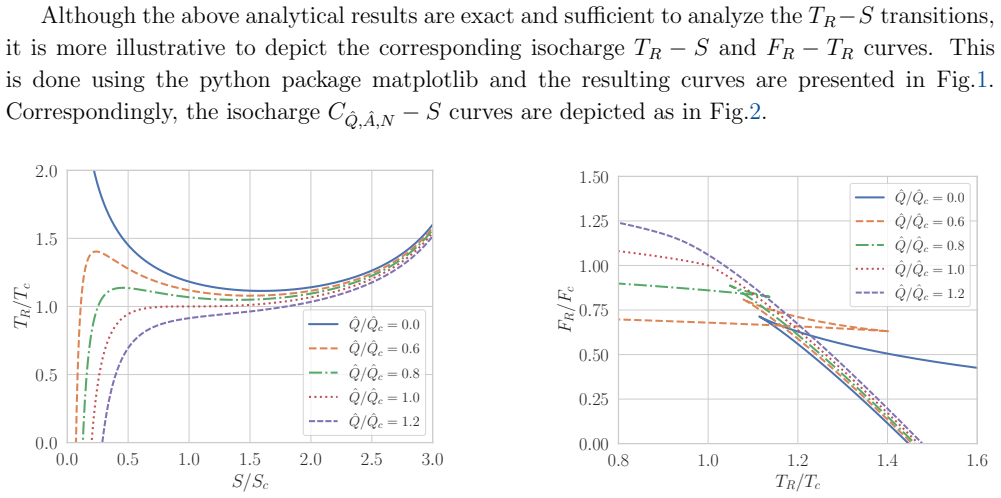
By placing static observers at finite radial distance inside the restricted phase space formalism for Einstein-Maxwell black holes, the first law and Euler relation for RN and RN-AdS solutions are shown to hold once the pressure and area of the observers' codimension-2 hypersurface are included as an additional thermodynamic conjugate pair. In this quasi-local setting RN black holes permit isocharge temperature-entropy phase transitions, forbid isovoltage ones, and display Hawking-Page-like transitions when uncharged, behaviors absent from the asymptotic description but identical to those of asymptotic RN-AdS black holes.
What carries the argument
Quasi-local restricted phase space formalism with the added pressure-area conjugate pair on the finite-distance observer hypersurface
If this is right
- RN black holes exhibit isocharge temperature-entropy phase transitions in the quasi-local regime.
- RN black holes lack isovoltage temperature-entropy phase transitions in the quasi-local regime.
- Hawking-Page-like phase transitions appear for neutral black holes when described quasi-locally.
- Quasi-local RN thermodynamics closely resembles the asymptotic RN-AdS case.
Where Pith is reading between the lines
- Thermodynamic quantities for black holes may depend on the radial location chosen for the reference surface, altering how entropy and temperature are interpreted in realistic settings.
- The appearance of AdS-like transitions at finite distance suggests that boundary effects can mimic the role of a cosmological constant in black hole thermodynamics.
- The same extra variables could be tested in rotating or dynamical black hole solutions to check whether the first law still requires them.
Load-bearing premise
The restricted phase space formalism can be extended to finite observer distances while keeping the new pressure and area variables consistent thermodynamic conjugates inside the Einstein-Maxwell equations.
What would settle it
A direct variation of the metric and electromagnetic potential at fixed new pressure that fails to reproduce the claimed first-law differential or violates the Einstein-Maxwell equations would falsify the extension.
Figures


read the original abstract
We extend the restricted phase space formalism for spherically symmetric black hole solutions of Einstein-Maxwell theory to the quasi-local regime, with the static observers located at a finite radial distance. The first law and Euler relation for the RN and RN-AdS black holes are proved to hold, but only with the inclusion of an extra pair of thermodynamic variables, i.e. the pressure and the area of the codimension-2 hypersurface on which the observers reside. For the RN black holes, the quasi-local behavior is analyzed in detail. It turns out that the RN black holes in the quasi-local description behaves significantly different from itself in the asymptotic description, but is extremely similar to the RN-AdS black holes in the asymptotic description, e.g. allowing for isocharge temperature-entropy phase transitions and lack of isovoltage temperature-entropy phase transitions. In the neutral limit, the Hawking-Page-like transitions appear in the quasi-local description which is absent in the asymptotic description.
Editorial analysis
A structured set of objections, weighed in public.
Referee Report
Summary. The paper extends the restricted phase space formalism for spherically symmetric black hole solutions of Einstein-Maxwell theory to the quasi-local regime, with static observers at finite radial distance. It claims to prove that the first law and Euler relation hold for RN and RN-AdS black holes only after including an extra conjugate pair consisting of the pressure and area of the codimension-2 hypersurface on which the observers reside. The quasi-local RN thermodynamics is analyzed in detail and shown to differ markedly from the asymptotic RN case while closely resembling the asymptotic RN-AdS case, including the presence of isocharge temperature-entropy phase transitions and Hawking-Page-like transitions in the neutral limit.
Significance. If the central derivations hold, the work supplies a thermodynamically consistent description of black holes at finite distance, which could be relevant for settings where asymptotic boundaries are unavailable or unphysical. The reported similarity between quasi-local RN and asymptotic RN-AdS, together with the emergence of new phase-transition structures, offers a concrete way to explore how boundary location affects thermodynamic phase space and may motivate further quasi-local studies in more general spacetimes.
major comments (2)
- [Abstract and derivation of first law] Abstract and the section deriving the first law: the claim that the first law and Euler relation are proved after adding the new variables rests on unshown algebra; no explicit expressions for the new conjugates, no step-by-step variation of the action or Hamiltonian at finite radius, and no explicit check that the Einstein-Maxwell constraints produce no residual boundary terms are supplied. This is load-bearing because the skeptic correctly notes that the restricted phase-space closure at finite r is not automatic once the codim-2 surface is introduced.
- [Introduction of new thermodynamic variables] The section introducing the new variables: it is not shown whether the pressure and area of the codim-2 hypersurface are derived from the Einstein-Maxwell equations evaluated at finite r or simply postulated to restore the first law; an explicit integrability condition or variation that absorbs all surface terms into P dA must be displayed.
minor comments (1)
- The discussion of phase transitions would be strengthened by quantitative comparison (e.g., critical exponents or transition temperatures) between the quasi-local RN and asymptotic RN-AdS cases.
Simulated Author's Rebuttal
We thank the referee for the careful reading and constructive comments on our manuscript. The points raised concern the explicitness of our derivations, which we address directly below. We have prepared a revised version incorporating additional details and calculations as requested.
read point-by-point responses
-
Referee: [Abstract and derivation of first law] Abstract and the section deriving the first law: the claim that the first law and Euler relation are proved after adding the new variables rests on unshown algebra; no explicit expressions for the new conjugates, no step-by-step variation of the action or Hamiltonian at finite radius, and no explicit check that the Einstein-Maxwell constraints produce no residual boundary terms are supplied. This is load-bearing because the skeptic correctly notes that the restricted phase-space closure at finite r is not automatic once the codim-2 surface is introduced.
Authors: We acknowledge that the original manuscript presented the first law and Euler relation without sufficient intermediate steps, making the algebra appear unshown. This is a valid observation. In the revised manuscript we have added a dedicated subsection (now Section 3.2) that supplies the explicit step-by-step variation of the Hamiltonian at finite radius, the expressions for the new conjugate pair (pressure P and area A of the codimension-2 surface), and a direct verification that the Einstein-Maxwell constraints leave no residual boundary terms once this pair is included. These additions confirm that the restricted phase space closes at finite r. The abstract has been updated to note the presence of these explicit derivations. revision: yes
-
Referee: [Introduction of new thermodynamic variables] The section introducing the new variables: it is not shown whether the pressure and area of the codim-2 hypersurface are derived from the Einstein-Maxwell equations evaluated at finite r or simply postulated to restore the first law; an explicit integrability condition or variation that absorbs all surface terms into P dA must be displayed.
Authors: The pressure and area are not introduced by postulate. They emerge directly from the boundary terms generated by varying the Einstein-Maxwell action (or Hamiltonian) when the observers are placed at finite radius. The revised manuscript now contains an explicit calculation of the integrability condition together with the variation that absorbs all surface contributions into the P dA term. This shows that the new pair is required by the field equations at finite r to ensure thermodynamic consistency and closure of the first law. revision: yes
Circularity Check
No circularity: quasi-local first law derived from Einstein-Maxwell variations with added conjugates
full rationale
The paper extends the restricted phase-space formalism by placing static observers at finite radius and introduces the codimension-2 pressure and area as additional thermodynamic variables. The first law and Euler relation are then verified to hold for RN and RN-AdS solutions. This construction follows directly from the field equations evaluated at the finite surface without reducing the claimed relations to a fit, self-definition, or prior self-citation chain. The reported differences in phase-transition behavior between quasi-local and asymptotic regimes supply independent content. No load-bearing uniqueness theorems or ansatzes imported from the authors' earlier work are required for the central proof.
Axiom & Free-Parameter Ledger
axioms (2)
- standard math Einstein-Maxwell field equations hold for spherically symmetric RN and RN-AdS solutions
- domain assumption Restricted phase-space formalism can be consistently restricted to a finite-radius hypersurface
Reference graph
Works this paper leans on
-
[1]
Black holes and the second law,
J. D. Bekenstein, “Black holes and the second law,”Lett. Nuovo Cim.4(1972) 737–740
1972
-
[2]
Black holes and entropy,
J. D. Bekenstein, “Black holes and entropy,”Phys. Rev. D7(1973) 2333–2346
1973
-
[3]
The Four laws of black hole mechanics,
J. M. Bardeen, B. Carter, and S. W. Hawking, “The Four laws of black hole mechanics,” Commun. Math. Phys.31(1973) 161–170
1973
-
[4]
Action Integrals and Partition Functions in Quantum Gravity,
G. W. Gibbons and S. W. Hawking, “Action Integrals and Partition Functions in Quantum Gravity,”Phys. Rev. D15(1977) 2752–2756
1977
-
[5]
Thermodynamics of Black Holes in anti-De Sitter Space,
S. W. Hawking and D. N. Page, “Thermodynamics of Black Holes in anti-De Sitter Space,” Commun. Math. Phys.87(1983) 577
1983
-
[6]
Charged AdS Black Holes and Catastrophic Holography
A. Chamblin, R. Emparan, C. V. Johnson, and R. C. Myers, “Charged AdS black holes and catastrophic holography,”Phys. Rev. D60(1999) 064018,arXiv:hep-th/9902170
work page Pith review arXiv 1999
-
[7]
Holography, Thermodynamics and Fluctuations of Charged AdS Black Holes
A. Chamblin, R. Emparan, C. V. Johnson, and R. C. Myers, “Holography, thermodynamics and fluctuations of charged AdS black holes,”Phys. Rev. D60(1999) 104026, arXiv:hep-th/9904197
work page Pith review arXiv 1999
-
[8]
Holographic Entropy Production,
Y. Tian, X.-N. Wu, H. Zhang, “Holographic Entropy Production,”,JHEP1410:170 (2014), [arXiv:1407.8273]
-
[9]
A topological charge of black holes,
Y. Tian, “A topological charge of black holes,”Class. Quantum Grav.36 (2019) 245001, [arXiv:1804.00249]
-
[10]
Restricted phase space thermodynamics for AdS black holes via holography,
G. Zeyuan and L. Zhao, “Restricted phase space thermodynamics for AdS black holes via holography,”Class. Quant. Grav.39no. 7, (2022) 075019,arXiv:2112.02386 [gr-qc]
-
[11]
Topological black holes in Einstein-Maxwell and 4D conformal gravities revisited,
T. Wang, Z. Zhang, X. Kong, and L. Zhao, “Topological black holes in Einstein-Maxwell and 4D conformal gravities revisited,”Nucl. Phys. B995(2023) 116352, arXiv:2211.16904 [hep-th]
-
[12]
Thermodynamics of Kerr-AdS black holes in the restricted phase space,
Z. Gao, X. Kong, and L. Zhao, “Thermodynamics of Kerr-AdS black holes in the restricted phase space,”Eur. Phys. J. C82no. 2, (2022) 112,arXiv:2112.08672 [hep-th]
-
[13]
Black hole thermodynamics is extensive with variable Newton constant,
T. Wang and L. Zhao, “Black hole thermodynamics is extensive with variable Newton constant,”Phys. Lett. B827(2022) 136935,arXiv:2112.11236 [hep-th]
-
[14]
Revisiting the thermodynamics of the BTZ black hole with a variable gravitational constant,
Y.-Y. Bai, X.-R. Chen, Z.-M. Xu, and B. Wu, “Revisiting the thermodynamics of the BTZ black hole with a variable gravitational constant,”Chin. Phys. C47no. 11, (2023) 115105. 17
2023
-
[15]
Thermodynamics of Kerr-Sen-AdS black holes in the restricted phase space,
M. S. Ali, S. G. Ghosh, and A. Wang, “Thermodynamics of Kerr-Sen-AdS black holes in the restricted phase space,”Phys. Rev. D108no. 4, (2023) 044045,arXiv:2308.00489 [gr-qc]
-
[16]
4D-EGB black holes in RPS thermodynamics,
Y. Ladghami, B. Asfour, A. Bouali, A. Errahmani, and T. Ouali, “4D-EGB black holes in RPS thermodynamics,”Phys. Dark Univ.41(2023) 101261,arXiv:2303.00604 [hep-th]
-
[17]
J. Sadeghi, M. Shokri, S. Gashti Noori, and M. R. Alipour, “RPS thermodynamics of Taub–NUT AdS black holes in the presence of central charge and the weak gravity conjecture,”Gen. Rel. Grav.54no. 10, (2022) 129,arXiv:2205.03648 [hep-th]
-
[18]
P. Tripathy, “Exploring critical behavior of thermodynamic variables of the Kerr-Newman-AdS black hole in the restricted phase space,”Phys. Rev. D110no. 4, (2024) 044027,arXiv:2403.19229 [hep-th]
-
[19]
C. Wang, S. P. Yin, Z. M. Xu, B. Wu, and W. L. Yang, “Ruppeiner geometry and the fluctuation of the RN-AdS black hole in framework of the extensive thermodynamics,” Nucl. Phys. B998(2024) 116426,arXiv:2210.08822 [gr-qc]
-
[20]
Thermodynamics of charged AdS black hole surrounded by quintessence in restricted phase space,
S. Jian, S. Long, J. Chen, and Y. Wang, “Thermodynamics of charged AdS black hole surrounded by quintessence in restricted phase space,”Chin. Phys. B33no. 10, (2024) 100504
2024
-
[21]
The Large N Limit of Superconformal Field Theories and Supergravity
J. M. Maldacena, “The LargeNlimit of superconformal field theories and supergravity,” Adv. Theor. Math. Phys.2(1998) 231–252,arXiv:hep-th/9711200
work page internal anchor Pith review Pith/arXiv arXiv 1998
-
[22]
Quasilocal Energy and Conserved Charges Derived from the Gravitational Action
J. D. Brown and J. W. York, Jr., “Quasilocal energy and conserved charges derived from the gravitational action,”Phys. Rev. D47(1993) 1407–1419,arXiv:gr-qc/9209012
work page Pith review arXiv 1993
-
[23]
Black hole thermodynamics and the Euclidean Einstein action,
J. W. York, Jr., “Black hole thermodynamics and the Euclidean Einstein action,”Phys. Rev. D33(1986) 2092–2099
1986
-
[24]
Quasi-Local Energy-Momentum and Angular Momentum in General Relativity,
L. B. Szabados, “Quasi-Local Energy-Momentum and Angular Momentum in General Relativity,”Living Rev. Rel.12(2009) 4
2009
-
[25]
Temperature, energy and heat capacity of asymptotically anti-de Sitter black holes,
J. D. Brown, J. Creighton, and R. B. Mann, “Temperature, energy and heat capacity of asymptotically anti-de Sitter black holes,”Phys. Rev. D50(1994) 6394–6403, arXiv:gr-qc/9405007
-
[26]
Charged black hole in a grand canonical ensemble,
H. W. Braden, J. D. Brown, B. F. Whiting, and J. W. York, Jr., “Charged black hole in a grand canonical ensemble,”Phys. Rev. D42(1990) 3376–3385
1990
-
[27]
Phase transitions and critical behavior for charged black holes,
S. Carlip and S. Vaidya, “Phase transitions and critical behavior for charged black holes,” Class. Quant. Grav.20(2003) 3827–3838,arXiv:gr-qc/0306054
-
[28]
M. M. Akbar, “Schwarzschild - anti-de sitter within an isothermal cavity: Thermodynamics, phase transitions and the Dirichlet problem,”Phys. Rev. D82(2010) 064001,arXiv:hep-th/0401228. 18
-
[29]
Charged black hole in a canonical ensemble,
A. P. Lundgren, “Charged black hole in a canonical ensemble,”Phys. Rev. D77(2008) 044014,arXiv:gr-qc/0612119
-
[30]
Quasilocal Smarr relation for an asymptotically flat spacetime,
Y. Lee, M. Richards, S. Stotyn, and M. Park, “Quasilocal Smarr relation for an asymptotically flat spacetime,”Eur. Phys. J. C81no. 4, (2021) 319,arXiv:1809.07259 [hep-th]
-
[31]
Quasilocal Smarr relations for static black holes,
F. D. Villalba and P. Bargue˜ no, “Quasilocal Smarr relations for static black holes,”Phys. Rev. D99no. 4, (2019) 044021,arXiv:1902.00825 [gr-qc]
-
[32]
Canonical ensemble of a d-dimensional Reissner-Nordstr¨ om black hole in a cavity,
T. V. Fernandes and J. P. S. Lemos, “Canonical ensemble of a d-dimensional Reissner-Nordstr¨ om black hole in a cavity,”Phys. Rev. D111no. 10, (2025) 104027, arXiv:2504.15339 [hep-th]
-
[33]
Moving observers, nonorthogonal boundaries, and quasilocal energy,
I. S. Booth and R. B. Mann, “Moving observers, nonorthogonal boundaries, and quasilocal energy,”Phys. Rev. D59(1999) 064021,arXiv:gr-qc/9810009
-
[34]
Action and energy of the gravitational field,
J. D. Brown, S. R. Lau, and J. W. York, Jr., “Action and energy of the gravitational field,” arXiv:gr-qc/0010024
work page internal anchor Pith review arXiv
-
[35]
Critical Phenomena of Charged de Sitter Black Holes in Cavities,
F. Simovic and R. B. Mann, “Critical Phenomena of Charged de Sitter Black Holes in Cavities,”Class. Quant. Grav.36no. 1, (2019) 014002,arXiv:1807.11875 [gr-qc]
-
[36]
Extended quasilocal Thermodynamics of Schwarzchild–anti de Sitter black holes,
W. B. Fontana, M. C. Baldiotti, R. Fresneda, and C. Molina, “Extended quasilocal Thermodynamics of Schwarzchild–anti de Sitter black holes,”Annals Phys.411(2019) 167954,arXiv:1806.05699 [hep-th]
-
[37]
Extended Phase Space Thermodynamics for Black Holes in a Cavity,
P. Wang, H. Wu, H. Yang, and F. Yao, “Extended Phase Space Thermodynamics for Black Holes in a Cavity,”JHEP09(2020) 154,arXiv:2006.14349 [gr-qc]
-
[38]
Thermodynamic geometry of black holes enclosed by a cavity in extended phase space,
P. Wang and F. Yao, “Thermodynamic geometry of black holes enclosed by a cavity in extended phase space,”Nucl. Phys. B976(2022) 115715,arXiv:2107.14640 [gr-qc]
-
[39]
Hawking–Page phase transitions of the black holes in a cavity,
W.-B. Zhao, G.-R. Liu, and N. Li, “Hawking–Page phase transitions of the black holes in a cavity,”Eur. Phys. J. Plus136no. 9, (2021) 981,arXiv:2012.13921 [gr-qc]
-
[40]
A Stress tensor for Anti-de Sitter gravity,
V. Balasubramanian and P. Kraus, “A Stress tensor for Anti-de Sitter gravity,”Commun. Math. Phys.208(1999) 413–428,arXiv:hep-th/9902121
-
[41]
Thermodynamics and an introduction to thermostatistics,
H. B. Callen, “Thermodynamics and an introduction to thermostatistics,”American Journal of Physics55no. 9, (1987)
1987
-
[42]
Far´ ıas V
C. Far´ ıas V. A. Pinto and P. S. MoyaWhat is the temperature of a moving body?,Sci. Rep. 717657 (2017)
2017
- [43]
discussion (0)
Sign in with ORCID, Apple, or X to comment. Anyone can read and Pith papers without signing in.